
Let’s get straight to the point: no, your standard homeowners or commercial property insurance policy will almost certainly not cover damage from a flood. This is probably the single most costly misunderstanding in the world of property insurance, especially for homeowners in the Los Angeles area facing unpredictable weather. In the first 100 words, it's crucial to understand that if you're asking "does insurance cover flood damage," the answer for a standard policy is a firm no.
Think of your standard policy as protection for what happens inside your property’s four walls—like a burst pipe in your Sherman Oaks home or an overflowing toilet in a West Hollywood apartment. It’s designed for those kinds of sudden, internal accidents. It offers zero protection when the water comes from the outside-in, rising from the ground up.
When disaster strikes, you need immediate, professional help. Onsite Pro Restoration offers 24/7 emergency services and helps you navigate the complex claims process.
Get a Free Damage Assessment Now
Why Your Standard Policy Excludes Flooding
It’s a painful truth that far too many property owners in Los Angeles discover only after a disaster: their trusted insurance policy won’t pay a dime for flood damage. This isn’t some buried fine print; it's a standard exclusion across the entire industry.
It all comes down to risk. Floods are widespread, catastrophic events that can damage entire neighborhoods at once. If standard policies had to cover that level of devastation, the financial exposure would be too massive for any single insurance company to handle. To protect your home or business from overflowing rivers, storm surges, or even heavy rains that saturate the ground, you need a completely separate, dedicated flood insurance policy.
Distinguishing Flood Damage from Water Damage
When it comes to filing a claim, the source of the water is everything. Insurers draw a very bright line between these two events:
Water Damage (Usually Covered): This is water that comes from a source inside your property. The event is sudden and accidental. Think of a burst washing machine hose, a leaking water heater, or an overflowing bathtub.
Flood Damage (Never Covered by Standard Policies): This is defined as surface water from a natural source that covers at least two acres of normally dry land or affects two or more properties. It’s water coming from the outside.
For example, if a plumbing line fails in your Glendale apartment and soaks the flooring, that’s a classic water damage claim. But if an atmospheric river causes the L.A. River to crest its banks and sends water rushing into your Burbank business, that is undeniably a flood. You can learn more about what typical policies do cover in our guide on homeowners insurance and water damage.
Key Takeaway: The single most important factor for an insurance claim is where the water came from. If it originated outside and rose from the ground level, it's a flood. Your standard insurance policy will deny the claim.
When you're dealing with a covered water loss, a fast response is absolutely critical to stop secondary damage like mold from taking hold. This is where a professional restoration team becomes your most important partner. While you navigate the separate, often complex, process of a flood insurance claim, a company like Onsite Pro Restoration can handle the emergency services for a covered water damage event, making sure the situation is contained and documented perfectly for your standard insurer.
The Hidden Dangers: The Massive Flood Insurance Protection Gap
Here’s one of the hardest lessons a property owner can learn: the flood itself isn't the biggest financial threat. The real danger is the mistaken belief that your standard insurance policy has you covered. This common misunderstanding creates what the industry calls the "protection gap"—a massive, multi-billion-dollar hole between the total cost of flood damage and the tiny fraction that insurance actually pays out.
For a homeowner in Los Angeles, this isn't just a dry statistic. It represents the very real risk of financial devastation.
This problem is getting worse, not better. Shifting weather patterns, like the atmospheric rivers that now frequently batter Southern California, are turning areas once considered "safe" into high-risk zones. Unfortunately, the insurance world hasn't caught up, leaving most property owners dangerously exposed without even realizing it.
The Scale of the Uninsured Risk
When you look at the numbers, the reality is sobering. Floods are the single most common natural disaster in the United States, but they remain the most underinsured threat.
This isn't a small rounding error; it's billions of dollars in recovery costs that fall directly on families and business owners every single year.
This table illustrates the massive gap between total flood damage costs and the portion covered by insurance, highlighting the financial risk for uninsured property owners.
Flood Damage vs. Insured Losses: A Stark Reality
| Metric | U.S. Data (2010-2023) | Implication for Homeowners |
|---|---|---|
| Total Flood Damage | $144 billion | The total economic impact of floods nationwide. |
| Insured Flood Losses | $50 billion (35%) | The portion paid out by NFIP and private flood policies. |
| Uninsured Flood Losses | $94 billion (65%) | The staggering amount paid out-of-pocket by property owners. |
| Active NFIP Policies | 4.7 million | Covering a tiny 2% of properties in flood-prone areas. |
What this data shows is a jaw-dropping $94 billion in uninsured losses over roughly a decade. That money came straight from homeowners, businesses, and taxpayer-funded disaster relief. To make matters worse, as of 2023, only about 4.7 million active policies through the National Flood Insurance Program (NFIP) were in force. You can explore more data on flood insurance trends to see just how wide this gap has become.
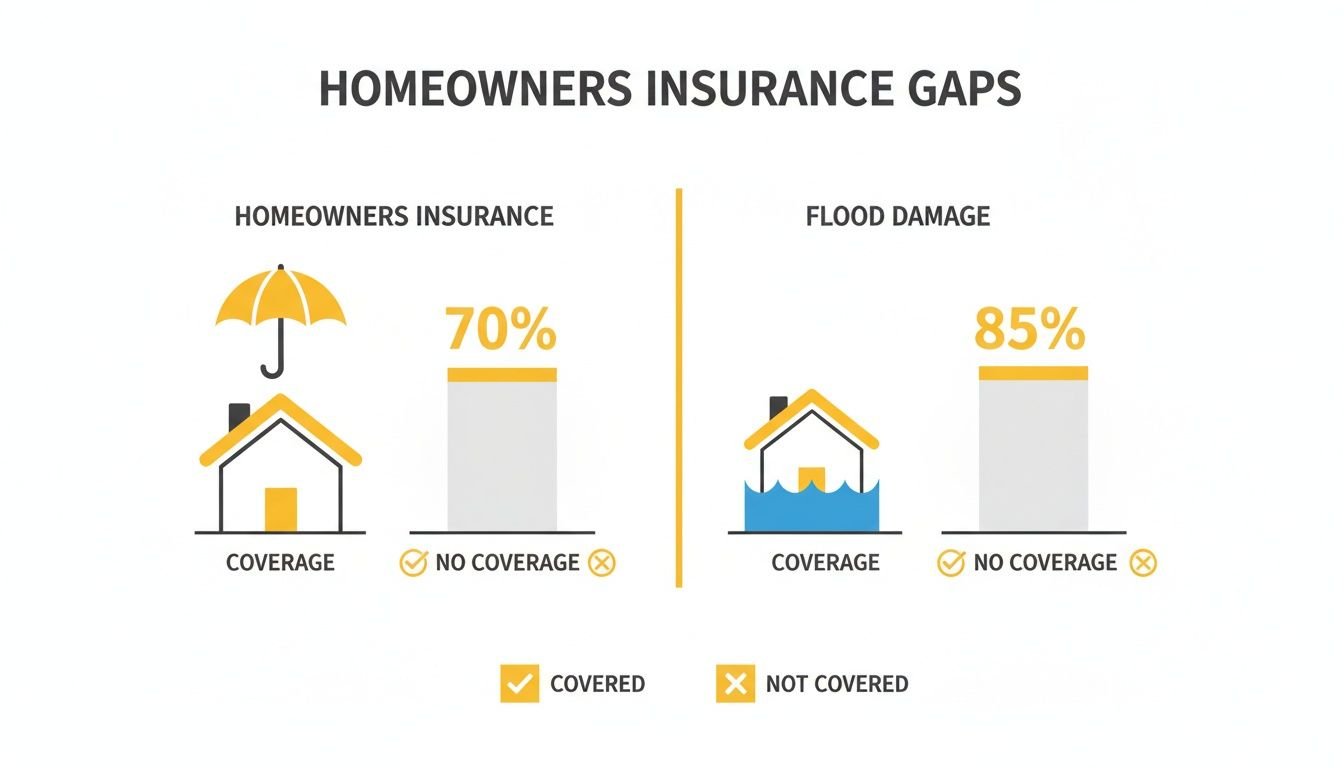
The gap is clear: while most people have homeowners insurance, very few have the specific flood policy needed to cover damage from rising waters.
Why This Gap Matters to Los Angeles Homeowners
So what does this all mean for you as a Los Angeles property owner? It means that if your Sherman Oaks home or Glendale storefront gets hit by rising water, the odds are stacked against you. You'll most likely be paying for the entire recovery out of your own pocket.
Just think about these realities:
- The True Cost of Recovery: Just an inch or two of water can lead to tens of thousands of dollars in damage. We're talking about complete replacement of drywall, flooring, electrical systems, and furniture.
- Don't Count on Federal Aid: FEMA assistance is not a substitute for insurance. If you qualify, it’s typically a loan you have to repay or a small grant designed only to make a home habitable—not to restore it to its previous condition.
- The Emotional Weight: Dealing with a catastrophic financial loss on top of the trauma of a disaster is simply overwhelming for most families.
The Hard Truth: Without a dedicated flood insurance policy, the question isn't if you will face a financial shortfall after a flood, but how large that shortfall will be.
Understanding this gap is the first, most critical step toward protecting yourself. When you do have to file a claim—whether for a covered internal leak or an uncovered flood—a clear, professional assessment of the damage is your most powerful tool. Onsite Pro Restoration provides exactly that: transparent, detailed damage reports that give you the hard numbers you need to understand the full cost of recovery and manage your claim effectively.
Flood Damage vs. Water Damage: A Crucial Distinction For Your Claim
In the eyes of an insurance company, not all water is the same. The single most common—and expensive—misunderstanding a property owner can have is confusing water damage with flood damage. Getting this wrong is the top reason for a denied claim, which can leave you holding a devastating repair bill.
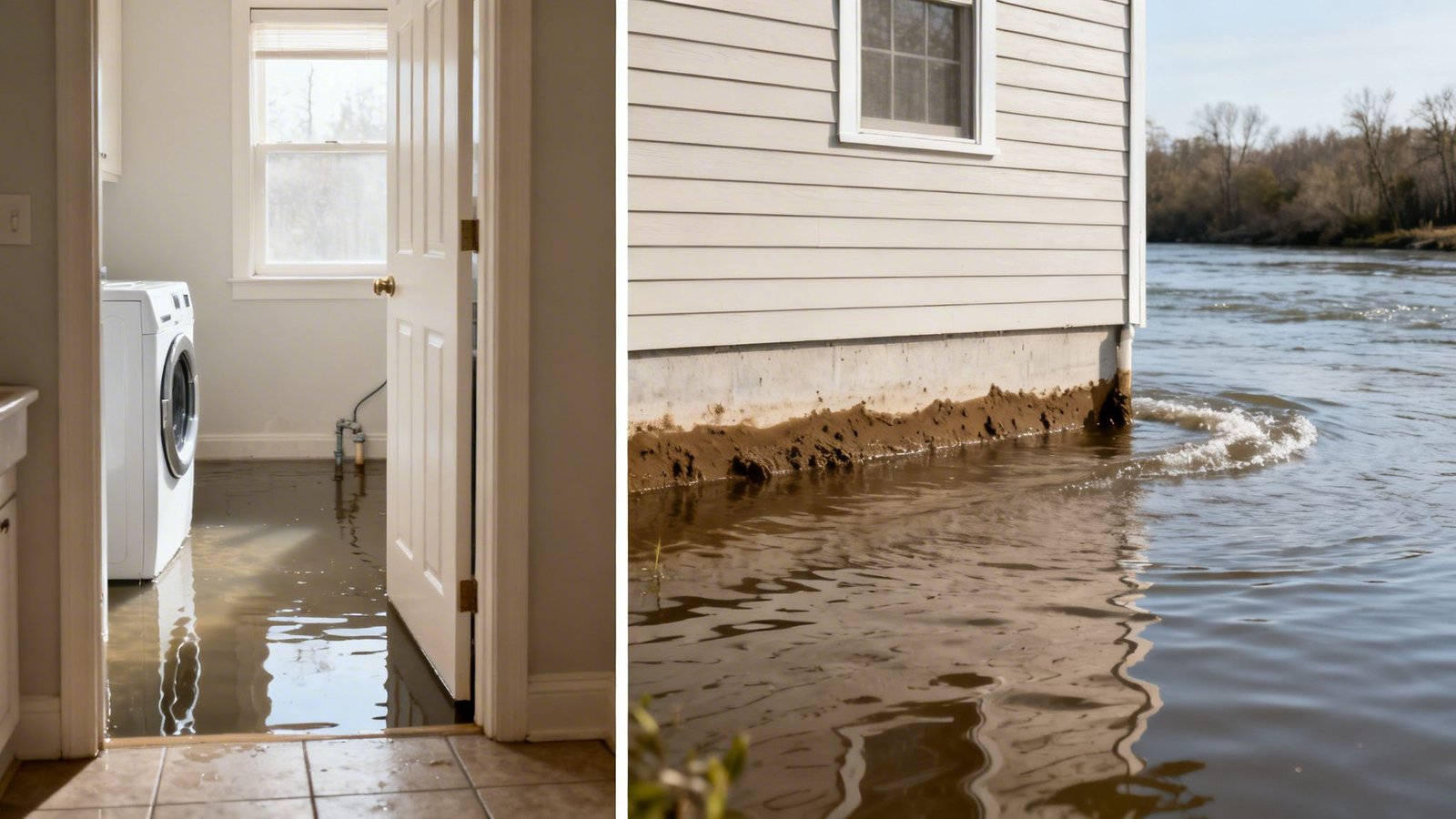
The key isn't how much water you have; it's where the water came from. A simple way to think about it is that water damage typically comes from the top-down or inside-out. Flood damage, however, comes from the ground-up. Your standard homeowners policy is designed for the first scenario and almost always excludes the second.
What Is Considered Water Damage
Water damage involves water escaping from a source inside your property line. It’s almost always a sudden and accidental event, which is precisely what a standard homeowners or commercial policy is built to cover.
Classic examples include:
- A washing machine hose ruptures and soaks your Glendale laundry room.
- The water heater in your West Hollywood apartment gives out, flooding the floor and nearby walls.
- A pipe inside a wall freezes and bursts in your Sherman Oaks home.
- An upstairs toilet overflows, sending water through the ceiling into the room below.
In every case, the damage started from your home's own plumbing or an appliance. For an adjuster, this is the critical detail that points toward a covered claim.
What Is Considered Flood Damage
On the other hand, flood damage is caused by water that originates from an outside source and enters from the ground level. Officially, the National Flood Insurance Program (NFIP) defines a flood as an event that covers at least two acres of normally dry land or affects at least two properties.
Clear examples of flood damage include:
- Heavy rains overwhelm the storm drains in Burbank, and surface water pushes in under your doors.
- An atmospheric river causes the Los Angeles River to breach its banks, inundating your entire block.
- A mudslide carries water and debris down a hill and directly into your Beverly Hills home.
Crucial Takeaway: If the water touched the ground outside before it entered your home, it's a flood. No matter how much damage there is, your standard policy won’t cover it. You need a separate flood insurance policy.
This isn't just a paperwork issue; this distinction determines your entire financial recovery. While you're dealing with the immediate crisis, it's also smart to think about prevention. For instance, knowing the basics of detecting water leaks can help you head off major non-flood-related problems that might have their own unique coverage rules.
Why Accurate Documentation Is Essential
When you call your insurance agent, one of the first things they'll ask is, "Where did the water come from?" If you mislabel a flood as a simple water leak, you could face an automatic denial and lose precious time. This is exactly where professional help becomes so important.
The certified technicians at Onsite Pro Restoration are trained to immediately identify the water's source and category. We provide the precise, detailed documentation that adjusters require to process a claim correctly from the start.
- For Covered Water Damage: We create detailed reports with moisture readings, photos, and equipment logs that prove the damage originated from an internal source, helping streamline your claim approval.
- For Flood Damage: We still provide a comprehensive damage assessment. This report is vital for your separate flood insurance claim or for applying for federal disaster assistance.
This professional assessment prevents expensive mistakes. For example, all floodwater is immediately classified as Category 3 water (also known as black water) because it's grossly contaminated with sewage, chemicals, and bacteria. This classification dictates the entire cleanup and restoration protocol. You can learn more about the health risks and procedures in our guide to what is Category 3 water damage. Getting the classification right from day one is non-negotiable for a safe and successful restoration.
Your Two Main Options: The NFIP and Private Flood Insurance
Since your standard policy won't cover flood damage, you’ll need a completely separate, dedicated policy. This isn't just a simple add-on; it's a standalone contract built specifically to handle damage from surface water. For decades, there was really only one choice, but today, Los Angeles homeowners have two main paths to get this vital protection.
Your options are the government-backed National Flood Insurance Program (NFIP) and the fast-growing private flood insurance market. Knowing the key differences between them is the only way to choose the right coverage for your home’s value and your personal risk tolerance.
The National Flood Insurance Program (NFIP)
For over 50 years, the NFIP, which is managed by FEMA, has been the go-to source for flood insurance in America. It was created to step in where private insurers wouldn't, filling a massive gap for homeowners who couldn’t get coverage for catastrophic flood risk. You usually buy an NFIP policy through your regular insurance agent, but the federal government is the one actually underwriting and backing the policy.
The problem? NFIP policies come with strict coverage limits—and they’re often not nearly enough. These caps simply haven't kept up with modern property values, especially in a high-cost market like Los Angeles.
- Building Coverage: An NFIP policy maxes out at $250,000 for your home’s structure. This includes the foundation, electrical and plumbing systems, and built-in appliances like your central AC.
- Contents Coverage: It offers a separate, and much lower, maximum of $100,000 for your personal belongings, like furniture, clothes, and electronics.
Important Limitation: One of the biggest shocks for homeowners with NFIP policies is the lack of coverage for basements and other below-ground areas. It won’t pay to replace finished basement walls, flooring, or any furniture down there. It also completely excludes "Additional Living Expenses" (ALE), meaning if a flood forces you out, you’re on the hook for your own hotel or rental costs.
The Rise of Private Flood Insurance
The private flood insurance market is a total game-changer. For years, private companies wanted nothing to do with flood risk, but that has changed dramatically. As you can explore in our complete guide to homeowners insurance policy, understanding all your options is key to being fully protected. Thanks to better risk-modeling technology and major shifts in the insurance landscape, private companies are now offering powerful, competitive alternatives to the NFIP.
This isn't a small trend. Driven by increasing climate-related risks, the global flood insurance market is booming. Valued at $17.46 billion in 2026, it's projected to more than double to $37.06 billion by 2030. In the U.S. alone, the number of private insurers offering flood policies jumped 51% between 2016 and 2022 as the NFIP faced financial struggles. For anyone in Los Angeles County, where atmospheric rivers can cause billion-dollar disasters, this growing market offers desperately needed choices. You can read the full research about the flood insurance market growth to see just how big this shift is.
Private policies often deliver several huge advantages over the NFIP:
- Higher Coverage Limits: Private insurers can offer building coverage well over $1 million and personal property coverage up to $500,000 or more—numbers that are far more realistic for many homes in California.
- Additional Living Expenses (ALE): This is a big one. Most private policies include ALE, which pays for your temporary housing if a flood makes your home unlivable. The NFIP doesn’t offer this at all.
- Faster Claims Process: Private companies are often built for speed. They tend to have more efficient claims processes and can get payments out the door faster than the government-backed program.
- Replacement Cost Value: Many private policies will pay the full cost to replace your belongings with new ones (Replacement Cost), not just their depreciated, garage-sale value (Actual Cash Value) that the NFIP typically offers.
NFIP vs. Private Flood Insurance: Which Is Right For You?
Deciding between a government-backed plan and a private policy can feel complicated, but it really boils down to your property’s value and what you need the policy to do. For many in Los Angeles, the NFIP’s low limits just aren’t enough.
This table breaks down the key differences to help you compare.
| Feature | National Flood Insurance Program (NFIP) | Private Flood Insurance |
|---|---|---|
| Max Building Coverage | $250,000 | Often $1 million+ (varies by carrier) |
| Max Contents Coverage | $100,000 | Typically up to $500,000 or more |
| Additional Living Expenses (ALE) | Not covered. You pay for your own hotel or rental. | Included in most policies. Covers temporary housing if displaced. |
| Basement Coverage | Very limited. Covers structural elements but not finished walls, floors, or furniture. | Varies by policy, but many offer broader coverage for finished basements. |
| Contents Payout | Actual Cash Value (depreciated value) | Often Replacement Cost Value (pays for new items) |
| Waiting Period | 30-day waiting period is standard. | Can be much shorter, often 10-14 days, sometimes less. |
| Availability | Available in participating communities. Required for federally backed mortgages in high-risk flood zones. | Availability depends on the insurer and property risk. Not all properties will qualify. |
For a homeowner in Beverly Hills or a property manager in Santa Monica, a private policy might be the only way to adequately insure a high-value property. While the NFIP provides a foundational safety net, its one-size-fits-all approach is often a poor fit for the diverse and valuable real estate in the Los Angeles area. The smartest move is always to compare quotes from both the NFIP and private carriers to build a financial plan that can truly stand up to flood risk.
What to Do Immediately After a Flood to Protect Your Property and Claim
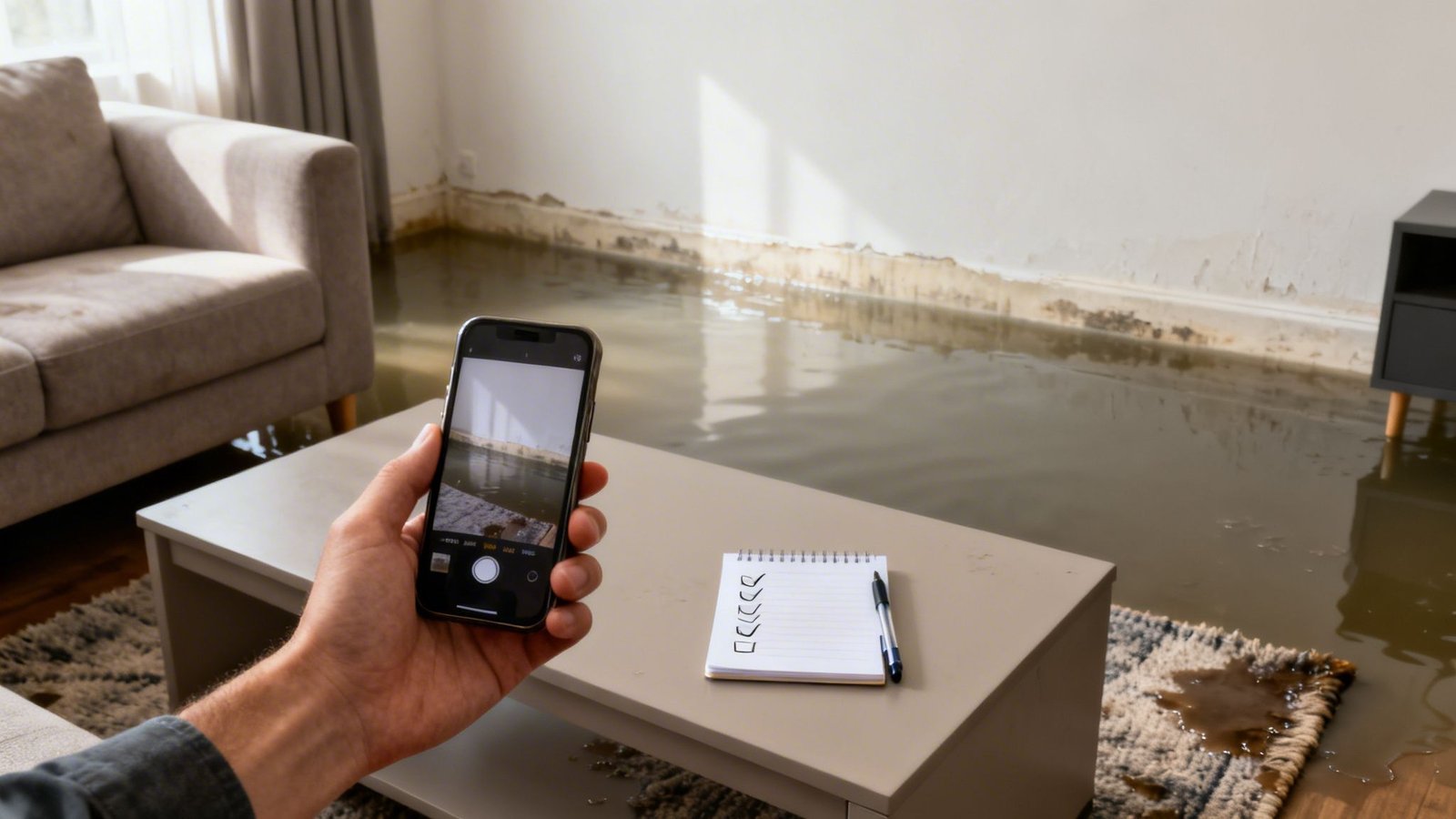
The moments right after a flood are chaotic, but what you do next is what really counts. Your immediate actions will protect your family’s health and set the stage for a successful insurance claim. Acting fast—and smart—can be the difference between a smooth recovery and a long, expensive nightmare.
Your first thought must be safety. Floodwater is never clean; it's considered Category 3 "black water" because it’s contaminated with everything from raw sewage and chemicals to bacteria and industrial runoff. Never step into standing water without proper protective gear. If you can do it without walking through water, shut off the main power and gas to prevent the risk of electrocution or gas leaks.
Your Immediate Action Checklist
Once you've made sure the area is safe, your focus has to shift to two things: documentation and communication. The evidence you gather now is the most powerful tool you'll have for your claim.
Follow these steps, in this exact order:
Document Everything Before You Touch Anything: This is the golden rule. Pull out your smartphone and take an overwhelming number of photos and videos. Get wide shots of every room, then zoom in on the water lines on the walls, your ruined furniture, and any submerged appliances. This visual proof is invaluable to your insurance adjuster.
Make Two Crucial Phone Calls: Next, it's time to get professionals moving.
- Call Your Insurance Agent First: Report the loss right away. This gets the clock started on your claim. Be ready to explain where the water came from.
- Call a 24/7 Restoration Company: Your second call should be to a certified firm like Onsite Pro Restoration. We can be on-site in about an hour in the Los Angeles area to start emergency water mitigation, which is critical for stopping the damage from getting worse.
Begin Initial Loss Mitigation (If Safe): While you wait for help to arrive, you can take a few small steps to minimize the loss. Move any dry, undamaged valuables to a higher floor or a safe, dry spot. If the water came from a clean source (like rain through a roof hole, not rising groundwater), you can start removing some of it. But for a situation like a flooded basement, cleanup is a job for trained technicians. You can see just how complex that process is in our guide to professional flooded basement cleanup.
Expert Tip: Do not throw away a single damaged item until your insurance adjuster has either seen it in person or given you clear written permission. Tossing things out too early is a surefire way to get those items denied on your claim.
Why Professional Mitigation Is Not Optional
It’s tempting to think about handling the cleanup yourself to save a few bucks, but this is a huge mistake. The number one cause of secondary damage is improper drying, which almost always leads to structural mold growth. Within just 24-48 hours, mold can start colonizing damp drywall, insulation, and the wood framing of your home.
Once mold gets a foothold, you’re dealing with a whole new problem—one that can threaten your family’s health and likely isn't covered by your flood policy. Professional restoration companies use a scientific approach with industrial-grade air movers, dehumidifiers, and moisture meters to make sure every single layer of your home is verifiably dry. It’s a level of thoroughness that shop vacs and household fans can never achieve.
After a flood, getting a handle on the official Flood Insurance Claims Process is key to a successful recovery. By calling in experts from the start, you not only protect your property from more damage but also give your insurer the professional documentation they need to validate your claim and get you back on your feet faster.
Choosing the Right Restoration Partner For Your Claim
When your property is suddenly underwater, trying to manage an insurance claim feels like a second disaster. The last thing you need is to argue with an adjuster while your home or business sits in ruins. Hiring a professional restoration company isn't just about the cleanup; it's about bringing in a powerful ally to manage the crisis and advocate for your recovery.
At Onsite Pro Restoration, we act as the critical bridge between the chaos of water damage and a successful, paid claim. We don’t just remove water—we build the case for your claim from the moment we arrive. Our entire process is designed to give your insurer exactly what they need, leaving no room for doubt, delays, or denials.
A Rapid Response With a Strategic Purpose
The clock starts ticking the second water hits your property. A delayed response doesn’t just mean more damage—it can give your insurance company a reason to deny parts of your claim due to “neglect” or “failure to mitigate.” We get this.
Our team is on-site anywhere in the Los Angeles area, from Glendale to West Hollywood, in about an hour. This immediate action proves to your insurer that you took every possible step to control the loss. We get right to work with water extraction and structural drying using our industrial-grade equipment.
Why This Matters: Fast, professional mitigation is proof of responsible action. It shows your insurance adjuster that secondary damage, like mold growth, was actively prevented—a key factor in getting your claim approved.
Building the Documentation Your Insurer Demands
An insurance claim is won or lost on the quality of its documentation. An adjuster needs clear, objective proof of the damage, its source, and the steps taken to fix it. This is exactly where a DIY cleanup falls short and our professional service excels.
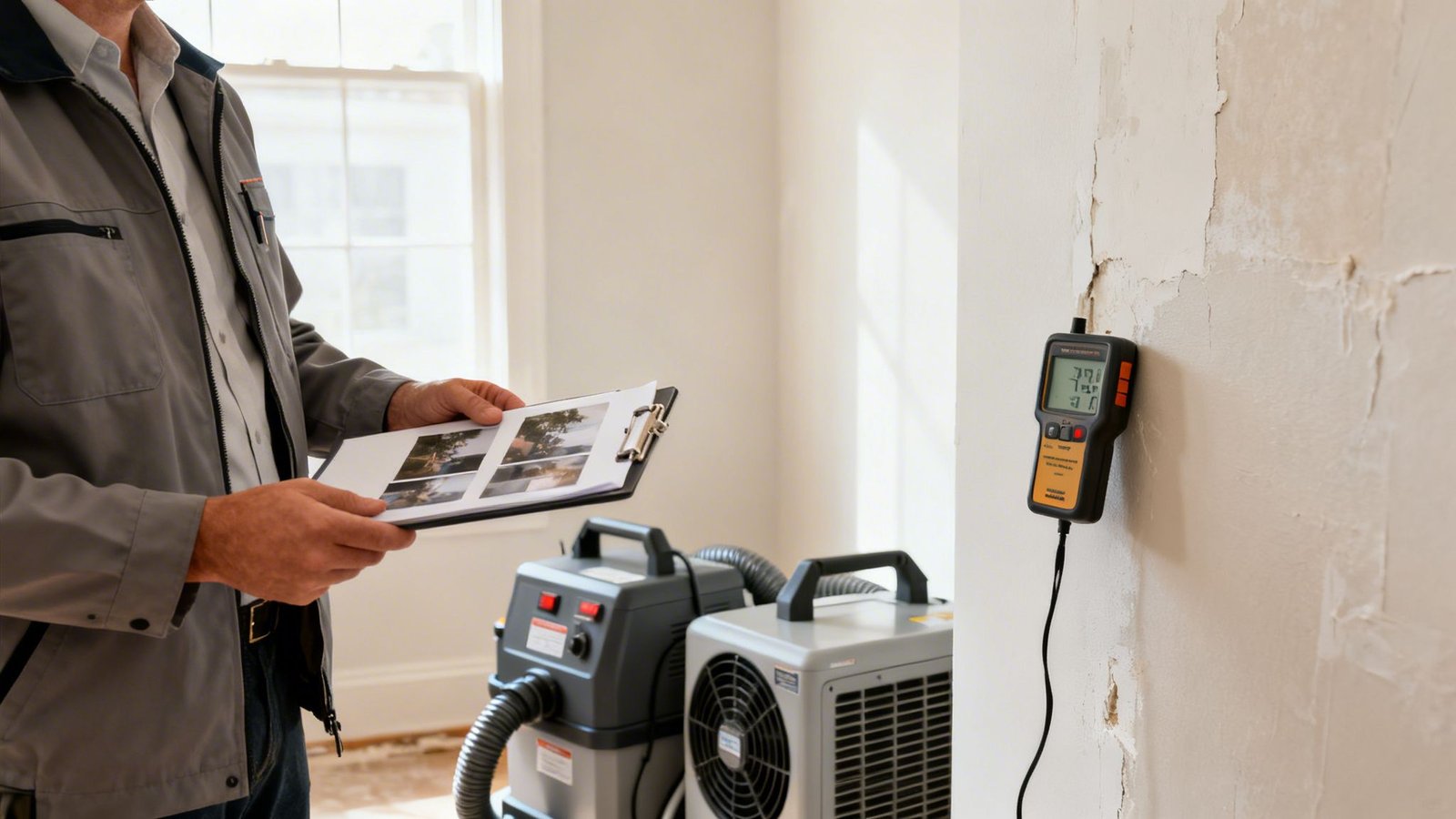
Our IICRC-certified technicians create a comprehensive evidence package that speaks the adjuster’s language. It includes:
- Detailed Photo and Video Logs: We visually document every affected area before, during, and after our work.
- Precise Moisture Readings: Using professional meters, we map moisture levels in walls, floors, and subfloors to prove the full extent of the water intrusion.
- Equipment and Drying Logs: We keep detailed records of every air mover and dehumidifier used, demonstrating a scientific and methodical approach to structural drying.
This isn't just paperwork; it’s the core of your claim. The financial stakes are enormous. U.S. floods caused $144 billion in damages between 2010 and 2023, while insurance only covered $50 billion. For property owners in Los Angeles, where uninsured claims spiked 40% after recent storms, having an expert team that delivers insurer-ready documentation is vital. You can discover more insights about the global flood insurance landscape to understand these growing financial risks.
By partnering with Onsite Pro Restoration, you’re not just hiring a cleanup crew. You’re deploying a dedicated team of claim specialists who handle the technical side of your recovery, so you can focus on getting your life back. Our established relationships with adjusters across Southern California help speed up approvals and turn a stressful, complex process into a managed, efficient recovery. You can also learn more about our professional restoration services in our article.
When water damage strikes, you need an expert on your side to navigate the chaos and the claims process. Onsite Pro Restoration provides 24/7 emergency services and the detailed documentation your insurer requires.
Get a Free Damage Assessment Now
Schedule a Free Inspection or Book Flood Cleanup
When you're dealing with the chaos of a flood, you have urgent questions and need straight answers. We've seen it all, and we're here to cut through the confusion so you can make the right moves when every minute counts.
Q: How long is the waiting period for a new flood policy?
A: This is the one detail that surprises everyone. You absolutely cannot buy flood insurance the day before a storm hits and expect to be covered. Both the NFIP and private insurers have mandatory waiting periods. NFIP policies have a standard 30-day waiting period, while private policies are often faster at 10 to 14 days. Proactive planning is non-negotiable.
Q: Does my car insurance cover flood damage?
A: Yes, it can—but only if you have comprehensive coverage. Your basic liability or collision insurance will not cover a vehicle swamped by floodwater. Comprehensive is an optional add-on that handles non-collision events like theft, fire, and natural disasters, including floods. Without it, you’ll pay for repairs out of pocket.
Q: What if I live in a low-risk flood zone in Los Angeles?
A: "Low-risk" does not mean "no-risk." FEMA's own data shows that over 25% of all NFIP flood claims are filed by property owners outside of high-risk flood zones. Urban sprawl in areas like the San Fernando Valley and shifting weather patterns cause floods in places that have never had them. A flood policy in a low-risk area is an affordable way to buy financial security.
Q: What is the first thing I should do if my house floods?
A: Your first step is to ensure safety—do not enter standing water. If safe, turn off power and gas. Your second step is to document everything with photos and videos before touching anything. Then, call your insurance agent to start the claim and immediately call a professional restoration company like Onsite Pro to begin mitigation and prevent further damage.