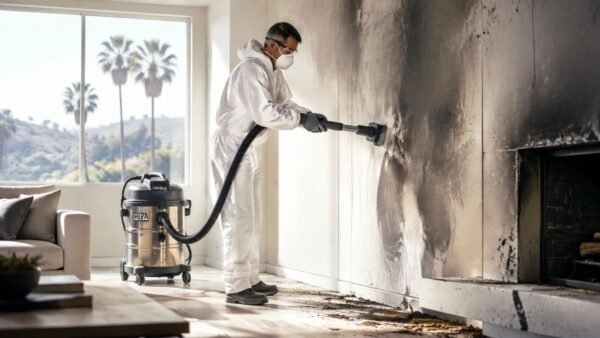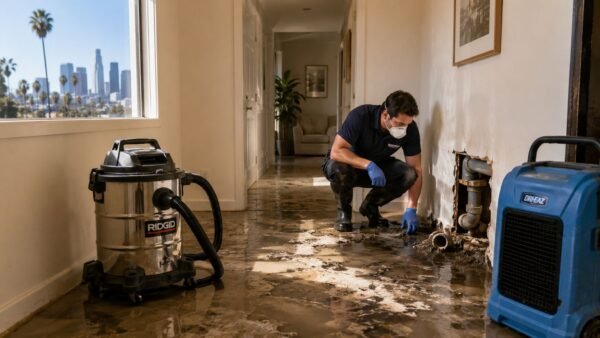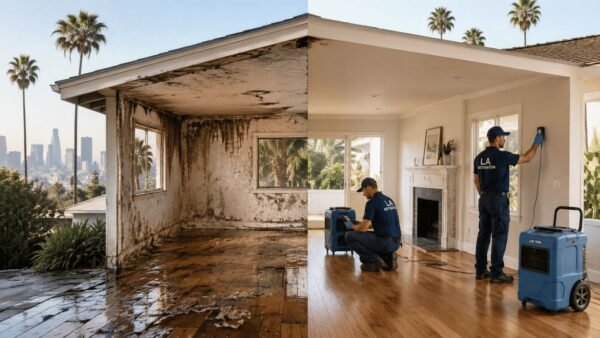

Water is coming through the ceiling in West Hollywood, or a supply line just burst behind a wall in Burbank, and your first instinct is usually the same. Grab towels. Move electronics. Call insurance. Panic a little.
That reaction is normal. What matters now is sequence.
The right flood cleanup companies don’t just remove water. They protect your safety, preserve evidence for your claim, and stop a small loss from turning into a drywall, flooring, and mold problem that drags on for weeks. In the U.S., home water damage emergencies affect approximately 14,000 people daily, and the country saw over 200 major flood events in 2023 according to Business Research Insights. In Los Angeles, that reality shows up as slab leaks, appliance failures, roof intrusions after storms, and sewer backups in older neighborhoods with stressed plumbing systems.
If you’re dealing with active water intrusion right now, don’t spend the next hour comparing ten websites. Focus on safety, documentation, and getting a certified team moving.
Need immediate help? Call for 24/7 emergency service now.
The First Hour After a Flood in Your LA Property
A flood loss rarely arrives at a convenient time. It hits at night, during work, or right before tenants are due back. In LA, I see this most often after a burst angle stop under a sink, a washing machine hose failure, a roof leak after heavy rain, or water traveling from an upstairs unit into a downstairs ceiling.
Protect people first
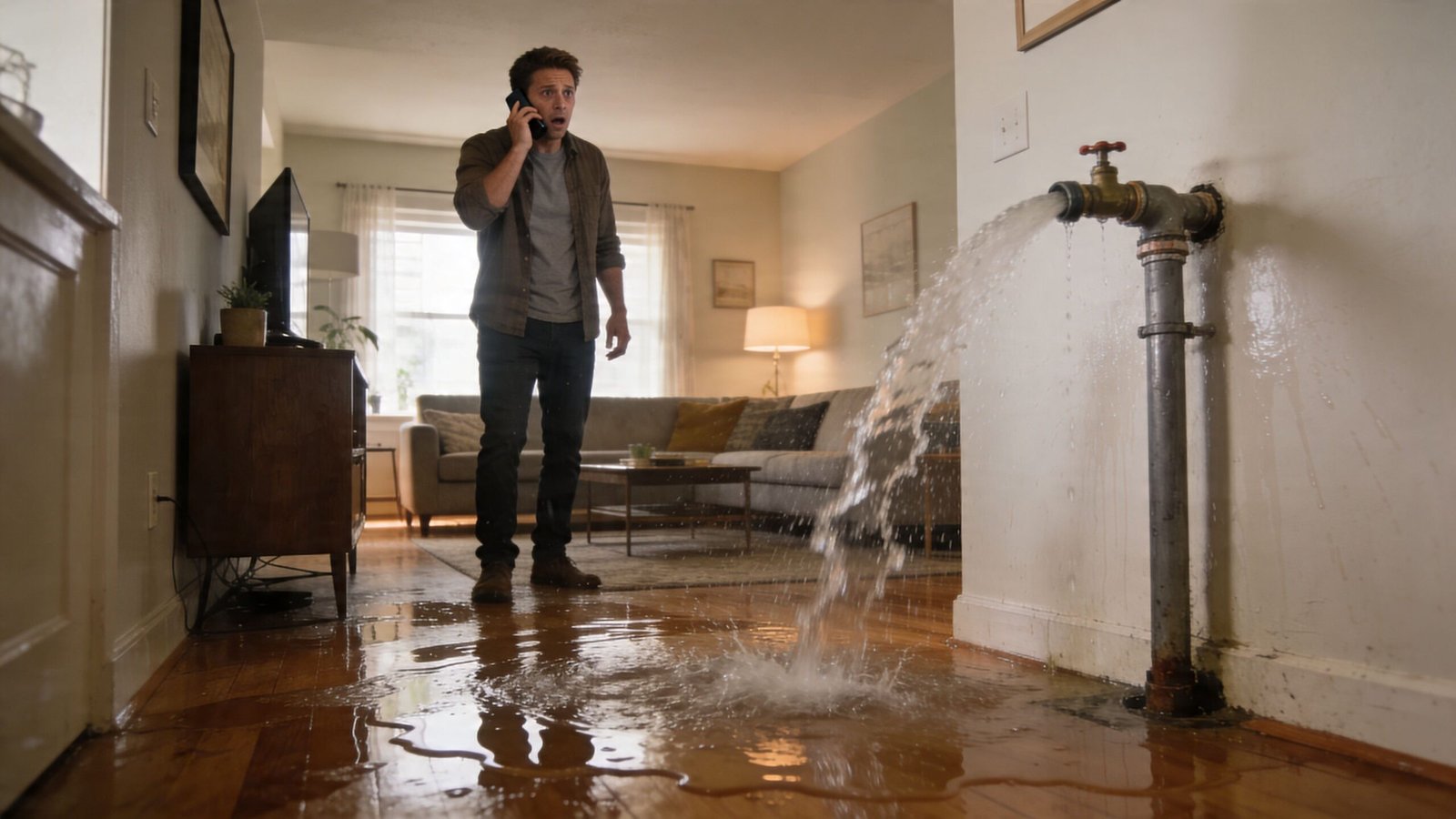
Before you think about flooring or furniture, deal with immediate hazards.
- Shut off power to affected areas if it’s safe to do so. Water and energized outlets, power strips, or appliances are a dangerous mix.
- Stop the water source if possible. If it’s a plumbing failure, find the property shutoff. If you’re not sure where that is, this guide on where to find the main water shut off can save valuable time.
- Keep people out of contaminated water. If the water may involve drainage, sewage, or toilet overflow, treat it as hazardous.
- Move only what you can safely move. Laptops, documents, medication, and sentimental items come first.
- Call a certified restoration company immediately. Time matters more than most owners realize.
Practical rule: If you have to choose between mopping visible water and documenting the loss, document first. You can’t recreate the original scene once cleanup starts.
Document before anything gets disturbed
Use your phone and take wide photos, then close-ups. Get the source of loss if visible, the standing water, wet baseboards, buckled flooring, stained ceilings, soaked contents, and any affected adjacent rooms.
Don’t curate the scene. Insurers and adjusters need to see what happened, not a partially cleaned version that hides severity.
Capture:
- The origin point if you can identify it
- The spread pattern across rooms and hallways
- Damaged contents including furniture, boxes, and electronics
- Building materials such as drywall, cabinets, hardwood, laminate, and carpet
- Time markers like your call log, thermostat screen, or appliance display if relevant
Be careful with sewer-related losses
If the problem isn’t a clean pipe leak, the risk changes fast. For homeowners trying to understand how a plumbing failure can escalate into contamination, this overview of a sewer line backing up into your basement gives useful context on how and why backups happen.
In LA rentals and older homes, sewer backups often affect lower bathrooms, garages, or converted living spaces first. Don’t let kids, pets, or tenants walk through that water.
Make the first call count
When you call flood cleanup companies, give them the essentials fast:
- Your address and neighborhood
- When the water started
- Whether the source is stopped
- Whether power is off
- What type of water it appears to be
- Whether the damage involves one room or multiple rooms
That lets the crew decide whether they need extraction equipment, containment materials, PPE, or additional technicians on arrival.
Assessing the Damage and Navigating Insurance Calls
The first insurance call can help your claim or weaken it. Most property owners don’t realize that until they’ve said too much, guessed at the cause, or started describing a sudden event in a way that sounds like a maintenance issue.
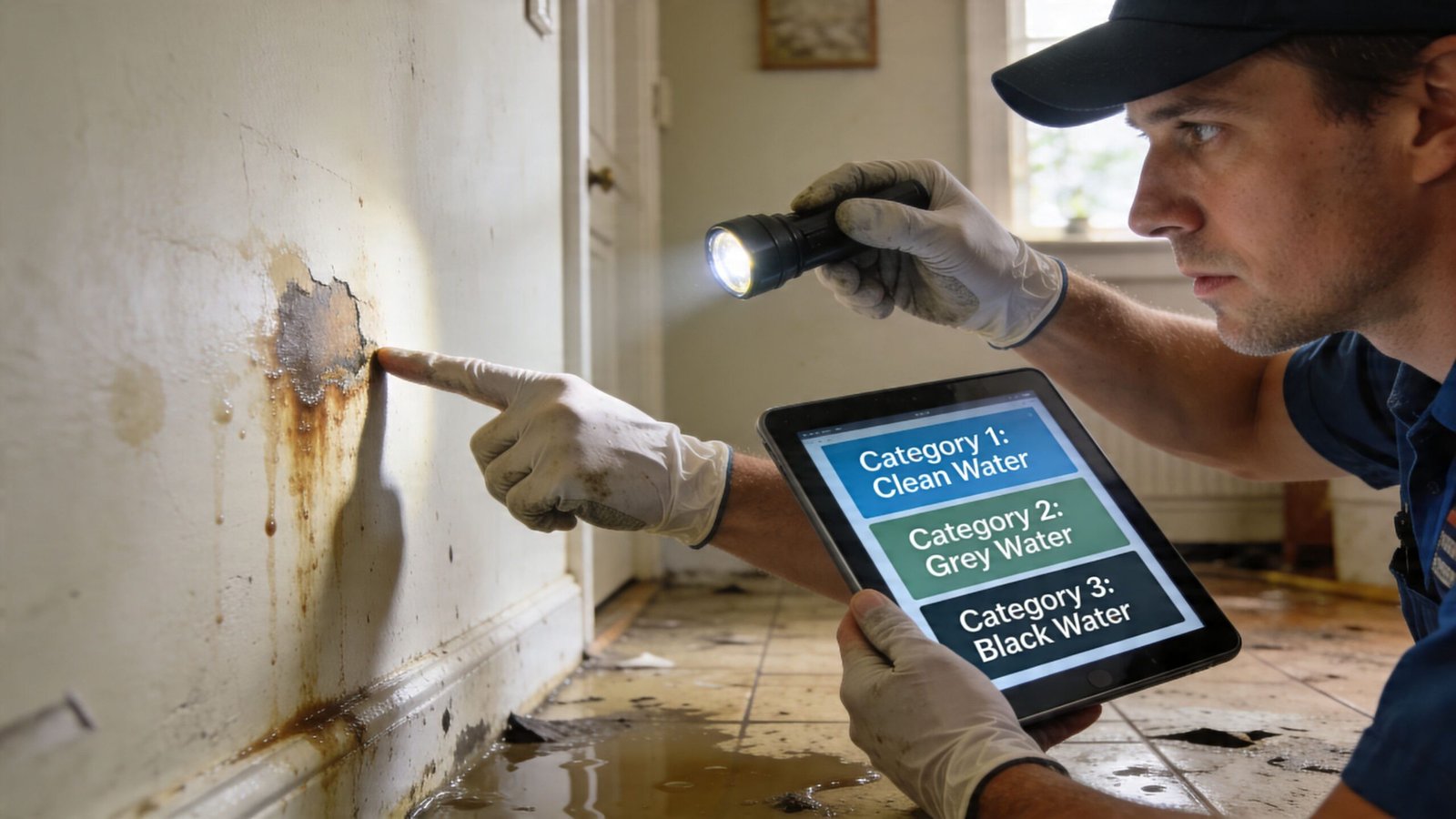
Know what kind of water entered the property
Not all water losses are treated the same. The contamination category affects safety protocols, demolition scope, drying strategy, and insurance documentation.
Category 1 water
This starts as a relatively clean source, such as a broken supply line, an overflowing sink from a clean line, or certain appliance feed leaks.
A refrigerator line failure in Sherman Oaks or a burst pipe in a Burbank condo usually starts here. If it sits too long, crosses dirty surfaces, or saturates materials, it may no longer be treated as clean.
Category 2 water
This carries more contamination risk. Common examples include dishwasher discharge, washing machine overflow, or water that has moved through building materials and collected debris.
Gray water losses are common in occupied homes because the water doesn’t stay isolated. It moves under cabinets, into underlayment, and behind baseboards.
Category 3 water
This is black water. Sewer backups, toilet backflows involving waste, and floodwater with heavy contamination fall into this category.
A sewer backup in Van Nuys, a low-lying unit in North Hollywood, or a commercial restroom overflow can move a job into a category where extraction alone is not enough. Cleaning, removal of affected porous material, disinfection, and strict drying verification become much more important.
What to say to your insurer
Keep your first report factual and tight. Don’t guess at hidden causes. Don’t speculate about long-term leaks unless you know that for a fact. Don’t describe damage as “probably old” or “maybe gradual” if you’re still waiting on a professional inspection.
Use language like this:
“We discovered water damage today. The damage appears to have resulted from a sudden event. We’ve taken photos and arranged for a professional inspection and moisture documentation.”
That wording is careful for a reason. Recent data tied to LA County shows a 28% rise in denied water damage claims due to ‘gradual damage’ classifications, and policyholders must prove the damage was ‘sudden and accidental’. Time-stamped documentation from a certified firm becomes important when a carrier challenges the claim, as noted in this discussion of insurance claim issues for water damage and the supporting claim-denial data cited from SERVPRO’s water damage page.
What not to say on that first call
Avoid these common mistakes:
- Don’t guess the duration. “It may have been leaking for months” can create problems if you don’t know that.
- Don’t minimize visible damage. Water often spreads beyond the obvious wet spot.
- Don’t authorize broad demolition without records. Insurers want a documented basis for what was removed.
- Don’t throw away damaged items yet. Photograph and inventory them first when possible.
Why professional assessment matters
A real assessment is more than a visual walk-through. Certified flood cleanup companies should document affected materials, moisture migration, probable category of water, visible deterioration, and areas that need further testing.
That usually includes:
- Moisture meter readings at walls, floors, and trim
- Thermal imaging or comparable methods to identify hidden spread
- A room-by-room photo log
- A written scope tied to what was found onsite
- Time-stamped notes showing when mitigation started
In these situations, weak contractors fail owners. They extract what’s visible, set a few fans, and leave you with an insurance file that doesn’t explain why cabinets were detached, why drywall was cut, or why drying took several days.
A practical LA insurance mindset
Los Angeles claims often get complicated because many buildings have layered issues. A storm may expose a roof defect. A slab leak may show prior patching. A tenant may report a bathroom overflow after trying to clean it first.
Your job isn’t to become your own adjuster in the first hour. Your job is to preserve facts.
A certified mitigation team gives the claim a cleaner record. That doesn’t guarantee coverage, but it gives the carrier a documented event, a documented response, and a technical basis for the work performed.
How to Choose a Certified Restoration Company in Los Angeles
Most owners don’t hire flood cleanup companies often enough to know who’s qualified and who only sounds qualified. In a loss, that gap matters.
The disaster restoration market is large and getting larger. It was valued at $41.2 billion in 2023 and is projected to reach $75.8 billion by 2034, while water damage claims over $1 million have tripled since 2015 according to Fact.MR. Those numbers tell you two things. There’s a lot of money in this industry, and there’s no room to hand your property to a company that can’t document, dry, and bill correctly.
Why certification matters in real jobs
IICRC certification isn’t a decoration. It tells you the company is working from an industry framework for water mitigation, contamination control, drying, and documentation.
For homeowners and managers comparing providers, this directory of water damage and restoration companies is a useful starting point, but the credential check has to go deeper than a website badge.
Look for technicians trained in water restoration and structural drying. In practical terms, that means they should understand when drywall can be saved, when insulation can’t, how to isolate a black water loss, and how to verify that a subfloor is completely dry instead of just dry-looking.
Questions to ask before you authorize work
Ask direct questions. A qualified company won’t dodge them.
- Who is coming onsite? Ask whether the working technicians are certified or whether only the estimator holds credentials.
- Are you licensed and insured for this work in California? You want proof, not a verbal yes.
- How do you document the loss for insurance? A serious company should mention photos, moisture readings, and written scope.
- What’s your response pattern in my area? Sherman Oaks, Glendale, West Hollywood, and Burbank all have different traffic realities.
- Do you separate mitigation from rebuild clearly? That protects you from scope confusion later.
- How do you handle contaminated water? If they answer vaguely, keep looking.
- What pricing platform do you use? Many insurers expect standardized estimating formats.
If a company sounds annoyed by normal vetting questions during the first call, that usually gets worse after you sign.
What a reliable answer sounds like
A solid contractor explains process without hiding behind jargon. They should be able to tell you what they’ll inspect first, what equipment they’re likely to bring, how often they’ll monitor drying, and what documentation you’ll receive.
They should also tell you what they don’t know yet. That’s a good sign. Honest restoration work starts with findings, not guesses.
Local presence matters in LA
Los Angeles is not one market in practice. A crew that can reach North Hollywood quickly may have a very different response pattern to Santa Monica or hillside properties above Studio City.
That matters because fast arrival is only useful if the company is built to work in your area. Parking limitations, elevator access, HOA rules, after-hours building access, and tenant communication all change the job.
One practical example is Onsite Pro Restoration, which serves Los Angeles and nearby communities from North Hollywood and handles emergency water extraction, structural drying, sewer cleanup, and insurance documentation. That local operating model is more relevant than a big generic service area page because flood losses are logistical problems as much as technical ones.
Here’s a short overview worth watching before you hire anyone.
Warning signs that should end the conversation
Some red flags are immediate disqualifiers.
They want a signature before inspection
You should understand what they believe is affected before authorizing broad work.
They promise claim approval
No contractor controls your policy. They can support the file, not guarantee coverage.
They don’t mention moisture verification
Drying isn’t done when the room feels less humid. It’s done when materials test dry enough to close.
They blur cleanup and reconstruction in one vague pitch
Mitigation, demolition, cleaning, drying, and rebuild should be understandable as separate scopes even if one company handles all phases.
What to Expect During Water Extraction and Structural Drying
The first day feels dramatic. The next several days feel slow. That’s normal.
Professional flood cleanup companies usually move through a loss in phases. Extraction happens first. Controlled demolition happens where necessary. Structural drying takes longer than most owners expect because the goal isn’t surface dryness. The goal is to bring affected materials back to an acceptable moisture condition.
The first phase is removal, not guesswork
Crews start by removing standing water with extraction equipment sized to the loss. Then they identify where water traveled.
Water rarely stays where you saw it first. It runs under floating floors, follows base plates, enters wall cavities, soaks insulation, and settles in low points. In a typical LA home, the visible wet area may be only part of the true footprint.
This is why a technician checks:
- Baseboards and drywall bottoms
- Cabinet toe-kicks and backs
- Subfloor and underlayment
- Adjacent rooms and shared walls
- Closets, vanity cavities, and hallway transitions
Some materials can dry. Others need removal.
Not every wet material should stay in place. Porous materials affected by contamination or prolonged saturation may need to be removed so the structure can dry.
You may see:
- Baseboard removal to release trapped moisture
- Drywall cuts where wall cavities are wet
- Padding removal under carpet
- Cabinet access openings in concealed wet zones
- Containment barriers to control dust and cross-contamination
A careful company explains each cut before making it, unless an active hazard requires immediate action.
Wet drywall behind a painted surface can look stable long after the cavity behind it is saturated.
Why the equipment stays so long
Once extraction is done, the property enters the drying phase. According to the restoration process described by Floorcare, professional drying commonly runs 3 to 5 days and aims to bring material moisture below 15%, while acting within a 2-hour golden window can reduce repair costs by up to 80% compared with delayed response. The same source notes that mold growth can begin within 24 to 48 hours if moisture remains untreated, as outlined in this discussion of emergency water extraction and the underlying process details from Floorcare’s restoration guide.
What the machines are doing
Owners often want to turn machines off at night because they’re loud. Don’t do that unless the technician tells you to.
Air movers
These push high-velocity airflow across wet surfaces. They help evaporate moisture from flooring, drywall, framing, and exposed cavities.
Dehumidifiers
These pull moisture from the air so evaporation can continue efficiently. Without dehumidification, moved air can redistribute moisture in the structure.
Air scrubbers
These are often added when demolition, contamination, or odor control is part of the job. They help clean airborne particulates during the work.
Daily monitoring is part of the job
Good drying is measured, not assumed. A technician should return to monitor progress, adjust equipment placement, and verify whether materials are trending dry.
That visit often includes:
- Moisture checks in the same locations used for baseline readings
- Temperature and humidity review
- Notes on materials that are responding slowly
- Decisions about whether more removal is necessary
- Documentation for your file
What disrupts drying in Los Angeles properties
LA buildings create their own complications. Plaster walls behave differently from standard drywall. Older hardwood can cup badly. Flat-roof leaks can travel far from the visible stain. Condo losses often involve neighboring units and shared walls.
That’s why no trustworthy company should promise the exact same timeline for every job. The process is standard. The building is not.
Decoding Pricing and Spotting Red Flags in Restoration Services
Many clients ask the wrong pricing question first. They ask, “What does flood cleanup cost per room?” That’s too simple for how restoration works.
The right question is, “What scope of work does my loss require?”
What drives the bill
Pricing usually follows the conditions found onsite, not a flat package.
A cleaner Category 1 leak in a small area may involve extraction, limited opening, and drying. A Category 3 sewer backup may require containment, removal of porous materials, disinfection steps, PPE, air filtration, and more extensive cleaning. Material type also changes the equation. Hardwood, custom cabinets, plaster, built-ins, and multi-layer flooring assemblies all affect labor and drying strategy.
A reputable company should be able to walk you through the logic of the estimate in plain English.
Why the cheapest estimate often costs more
Low bids look attractive when you’re stressed. They’re often expensive later.
A cut-rate contractor may skip containment, place too few machines, fail to monitor moisture correctly, or leave wet material in place because removal is harder to justify in writing. The short invoice becomes a longer problem when odor, microbial growth, or hidden deterioration shows up after closeout.
The risk is sharper with black water losses. In Category 3 floods, inadequate cleanup can create serious health issues. The CDC-related figure cited in ATI Restoration’s flood cleanup content states that 35% of flood survivors in urban areas like LA experience respiratory issues if moisture lingers over 72 hours, which is one reason property owners should understand the fundamental variables behind water damage cleanup cost before choosing the lowest bidder, with the source discussion available at ATI Restoration.
Red flags that deserve a hard no
| Red flag | Why it matters |
|---|---|
| Large cash demand upfront | It weakens your paper trail and shifts risk to you before work is defined. |
| No written scope of work | You can’t compare bids or challenge missing work later. |
| Pressure to sign immediately | High-pressure sales usually hide weak documentation. |
| No proof of license or insurance | You could inherit liability if something goes wrong onsite. |
| Vague answers about contaminated water | That often means unsafe cleanup practices. |
| No mention of monitoring | Drying without verification is guesswork. |
Bottom line: A restoration contract should tell you what they’re doing, why they’re doing it, and how they’ll know when the job is complete.
Ask for transparency, not promises
A trustworthy estimator won’t promise a painless claim or a perfect outcome. They’ll explain scope, assumptions, exclusions, and what may change if hidden moisture or contamination appears after work begins.
That’s the kind of clarity you want when your property is already under stress.
Your Los Angeles Flood Restoration Hiring Checklist
At this point, the goal is not to find the fastest talker on the phone. It is to hire a company that can document the loss cleanly, dry the structure correctly, and give your carrier what it needs to approve mitigation without avoidable disputes. In Los Angeles, that matters even more in condos, hillside homes, older plaster properties, and mixed-use buildings where moisture migration is easy to miss and ownership lines are not always simple.
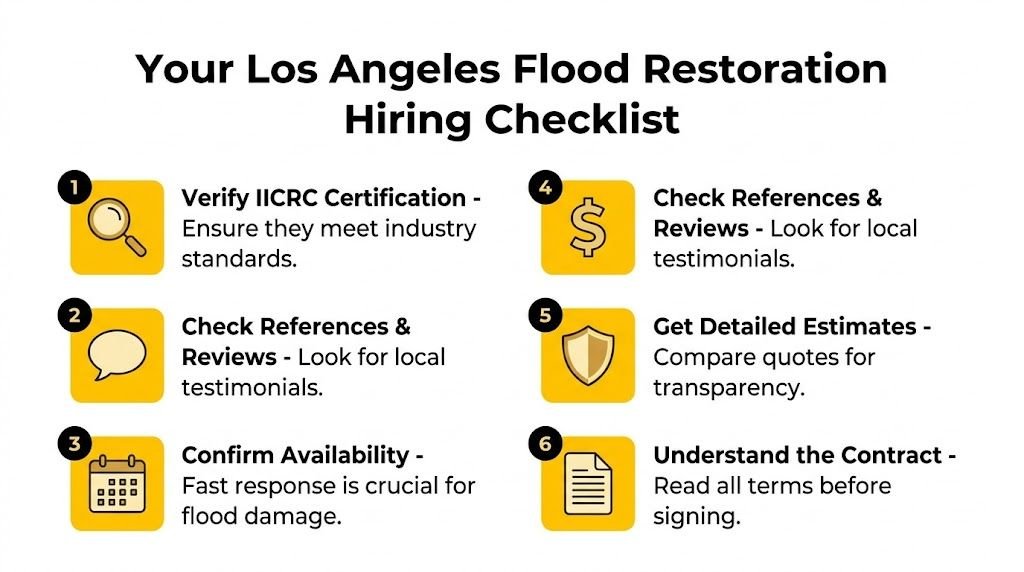
The six checks that matter most
Verify IICRC certification
Ask which technician or supervisor on your job holds current water damage restoration credentials, and who will be the one onsite making drying decisions.Confirm California license and insurance
Get the contractor license number, general liability proof, and workers' comp information before authorizing work. This protects you if there is a dispute, injury, or scope problem.Ask how they document for insurance
A qualified company should provide photos, moisture readings, equipment logs, daily notes, and a clear sketch or room-by-room record of affected areas. In California claims, weak documentation slows payment.Check local experience
Look for work history in Los Angeles neighborhoods and building types similar to yours. A crew that understands HOA access rules in Koreatown, older construction in Mid-City, or tight parking and loading conditions in Downtown LA will usually run a cleaner job.Request a written scope, not just a price
The estimate should spell out extraction, demolition limits, containment, antimicrobial treatment if justified, drying setup, monitoring, and what is excluded.Read the work authorization carefully
Confirm whether you are signing only for mitigation or also approving reconstruction. Those should be separated whenever possible.
The fastest way to compare two companies
Ask each one the same five questions and write down the answers.
What category of water loss do they believe this is? What materials are they trying to save, and what will they remove? How will they verify drying is complete? What records will you receive for your claim file? What could change once walls, cabinets, or flooring are opened?
The better company usually sounds more precise, not more reassuring. Clear limits, clear documentation, and clear change-order rules are what protect you later.
What owners and property managers in Los Angeles should add
For rentals, condos, and commercial units, add two practical checks.
Access and communication plan
Ask who coordinates with tenants, building management, security, and HOA staff, and how entry notices and daily updates are handled.Final drying file
Require closing moisture readings and drying records for your files. If there is a later mold allegation, resident complaint, or coverage question, that paperwork matters.
If you want a fast second opinion or a free assessment, contact Onsite Pro Restoration and ask for a documented mitigation inspection before authorizing broad demolition.
Frequently Asked Questions About Flood Cleanup
| Question | Answer |
|---|---|
| How quickly should I call flood cleanup companies after finding water? | Immediately. The sooner a team can inspect, extract, and start controlled drying, the better your odds of limiting damage and preserving a clean insurance record. Waiting to “see if it dries on its own” often makes the claim and the repair larger. |
| Can I stay in the property during cleanup? | Sometimes, yes. It depends on the source of water, the rooms affected, the amount of demolition required, and whether drying equipment can run safely without disrupting basic living conditions. Category 3 losses, strong odors, or heavy containment often make temporary relocation the safer choice. |
| Do I need a restoration company before I call insurance? | You can notify insurance first, but don’t delay mitigation while waiting for direction if water is actively damaging the property. In practice, many owners report the claim and arrange professional mitigation at the same time so the event is documented from both sides. |
| What if the water came from a neighbor’s unit or a building common area? | Document your unit thoroughly, notify building management right away, and ask the restoration company to note the suspected migration path. In condos and apartments, liability and coverage can involve more than one policy, so accurate origin documentation matters. |
| Will all wet drywall and flooring need to be removed? | No. Some materials can be dried and saved, while others can’t. The decision depends on contamination category, how long materials stayed wet, what the material is made of, and whether readings show hidden saturation. A competent company should explain the reason for each removal decision. |
| What should I keep for my records during the job? | Keep photos, claim numbers, emails, inspection notes, work authorizations, daily updates, and any inventory of damaged contents. If a dispute arises later, organized records are often as important as the cleanup itself. |
If you’re dealing with active water damage in Los Angeles and need clear documentation, certified mitigation, and a practical assessment of what can be saved, contact Onsite Pro Restoration. They handle emergency water intrusion, sewer backup cleanup, structural drying, and insurance-ready documentation for homes and commercial properties across the LA area.