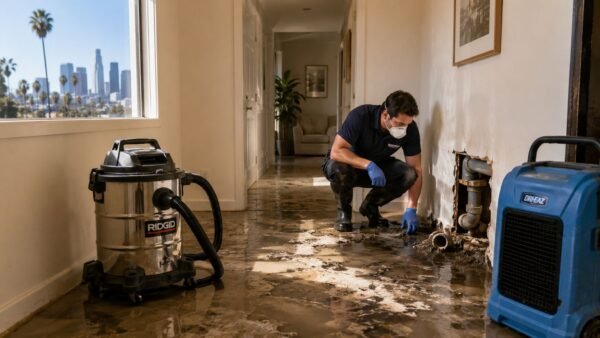

At 10:14 p.m., a tenant in a four-unit building calls about water coming through a bathroom light fixture. If no one knows the shutoff location, who has after-hours authority, or which restoration company can respond first, a small plumbing failure can turn into wet insulation, damaged electrical, tenant displacement, and a tougher insurance claim by morning.
That is what business continuity planning means for a Los Angeles property. It is not a corporate binder full of policy language. It is a short, usable plan that helps a small owner or property manager protect people, limit damage, keep units rentable, and make better decisions in the first hour of an emergency.
In Los Angeles, these disruptions are rarely abstract. Older supply lines fail without warning. Winter storms expose roof weaknesses. Wildfire smoke affects indoor air quality. Deferred maintenance in older buildings turns routine issues into expensive ones. If you are unsure whether a stain or soft spot needs immediate action, review these common signs of water damage before it spreads behind finishes.
Mainstream continuity advice is often written for larger companies with dedicated operations staff, formal IT systems, and layers of internal support. Travelers' business continuity guidance is useful, but small property owners still need a simpler version built around real building problems, after-hours decisions, and limited staff.
A workable plan for an LA rental property is straightforward. Identify the building risks most likely to interrupt occupancy or income. Write down the first actions for water, fire, and mold events. Keep contacts, records, and access instructions available even when the office is closed or the property itself is not safe to enter.
Why Your LA Property Needs a Continuity Plan
At 10 p.m., a second-floor tenant calls about water coming through a light fixture. The maintenance tech is off site. The owner is out of town. No one on duty can tell the resident which valve to shut off, who documents the loss, or whether the affected unit should be vacated that night. That is what business continuity planning looks like on a small LA property. It is a short plan that keeps a routine building failure from becoming a major income interruption.
For a property manager or small owner, continuity is simple. Keep people safe, control the source, protect records, document the loss, and get the right trades moving fast enough to limit downtime. On a duplex, fourplex, or small apartment building, those first decisions matter more than any formal policy language.

What continuity actually means on a property
A usable property continuity plan protects five areas that get hit first during an emergency:
- People: Tenants, staff, vendors, and visitors need clear instructions about access, hazards, and temporary relocation.
- Building operations: Water, power, HVAC, entry systems, and life-safety equipment need an order of priority.
- Records and access information: Insurance details, vendor contacts, leases, photos, and utility shutoff locations need to be available outside one office or one phone.
- Income: A closed unit, wet common area, or failed system can interrupt rent, trigger hotel costs, and delay turnover work.
- Claim support: Good photos, a written timeline, and notes on mitigation decisions make carrier conversations easier later.
Small properties do not need a corporate continuity manual. They need a decision tool that works at night, on weekends, and during the first hour when facts are incomplete.
If you are not sure whether a stain, soft baseboard, or warped flooring needs immediate action, review these visible signs of water damage before hidden moisture spreads into wall cavities.
Why small LA properties feel disruptions faster
On a larger commercial site, one person can be unavailable and someone else usually fills the gap. On a small rental property, one missing contact can stall the whole response. I see that problem often. The plumber has no gate code. The resident manager has the only copy of the vendor list. The owner knows where the shutoff is, but is on a flight.
That is why a lean written plan matters more on a 12-unit building than many owners expect.
In Los Angeles, the risks are specific to the building and the neighborhood. Older galvanized lines fail without much warning. Flat and low-slope roofs take on water after deferred maintenance and winter storms. Bathroom exhaust issues turn minor moisture into recurring mold complaints. Properties near foothill and wildfire-prone areas also need a plan for smoke intrusion, ash cleanup, and post-event habitability checks. If roof condition is a known weak point, schedule a storm damage roof inspection before the next heavy rain exposes the problem under occupied units.
A continuity plan converts those local risks into specific assigned actions — decisions made in advance so they don’t have to be made under pressure. Who takes the after-hours call. Who has authority to approve emergency drying. Where the shutoffs are. Which vendor gets called first. What gets photographed before demolition starts.
That is how small owners avoid the expensive mistake of treating continuity planning like a big-company exercise instead of basic property operations.
Your Foundational Property Risk Assessment
The fastest way to build business continuity planning into a small property is to stop thinking like a corporation and start thinking like a building operator. You're not ranking global departments. You're identifying what can physically interrupt occupancy, safety, and normal operations.
A defensible continuity plan starts with a business impact analysis, or BIA, to rank critical functions and assign recovery objectives such as RTO, the maximum tolerable downtime, and RPO, the maximum tolerable data loss (CL Digital Research). On a property, that translates well into a practical worksheet: what must stay functional, how long can it be down, and what happens if it isn't restored fast.
A useful first step is a formal property damage assessment checklist. It keeps your review grounded in actual building conditions instead of assumptions.
Start with the systems that stop occupancy
Focus on what would physically interrupt occupancy, income, and normal building operations.
| Property function | What interruption looks like | Why it matters |
|---|---|---|
| Water service | Burst line, leaking supply, failed shutoff | Unit damage, tenant displacement, mold risk |
| Electrical safety | Tripped panels, overheated wiring, smoke odor | Fire risk, unusable spaces, contractor delays |
| Roof and exterior envelope | Wind-driven rain, flashing failure, blocked drainage | Hidden intrusion, ceiling collapse, recurring moisture |
| Indoor air conditions | Mold growth, soot, odor, contaminated HVAC | Habitability complaints, health concerns, wider spread |
| Documentation access | Missing policies, no vendor list, no tenant roster | Slower response, weaker claim support |
Use a three-threat walkthrough
Most small LA properties can build a strong first version of a continuity plan by walking the site with three categories in mind.
- Water damage questions: Where is the main shutoff. Are supply hoses old or poorly secured. Do you know the plumbing material and rough age. Does the property have roof drainage trouble, patio ponding, or recurring wall staining.
- Fire risk questions: Are electrical panels labeled. Have tenants overloaded circuits. Are there space heaters, extension cord habits, or outdated receptacles. If the property sits near brush-prone areas, is exterior clearance being maintained.
- Mold risk questions: Which bathrooms lack proper exhaust. Are there units with recurring condensation, slow leaks, or prior remediation history. Has anyone documented musty odors or swelling baseboards but failed to open the wall.
If your concern includes recent weather exposure, a qualified storm damage roof inspection can help verify whether roof-related vulnerabilities are contributing to recurring moisture entry.
This short video gives a useful overview of how continuity planning starts with identifying what matters most and what can interrupt it.
Set realistic recovery priorities
Not every issue deserves the same response speed. A stained baseboard in a vacant storage room isn't the same as water reaching an occupied unit's electrical fixtures.
If your priorities aren't written down before the emergency, people will invent them during the emergency.
For a small property, recovery priorities often look like this:
Life safety first
Active electrical hazard, smoke, contaminated water, or unsafe access gets immediate action.Damage containment second
Stop the source, isolate the area, protect unaffected materials, and prevent spread.Operational continuity third
Keep tenants informed, maintain access where possible, and preserve the parts of the property that can still function.
That order keeps your response practical. It also prevents a common mistake. Owners often rush toward cosmetic repair while the underlying moisture, soot, or contamination problem is still active.
Building Your Emergency Response Playbook
When an incident starts, most bad outcomes come from delay, not from lack of effort. People hesitate, argue over responsibility, or take the wrong first step. A written playbook fixes that.
In our experience restoring LA properties, the biggest mistake we see is simple. Someone notices the problem early, but nobody treats the first hour like a containment window. A leaking angle stop gets a bucket instead of a shutoff. A small kitchen fire gets cleaned cosmetically before smoke residues are evaluated. A moldy wall gets painted instead of opened.
Water event in the first hour
If water is active, speed matters more than polish.
- Shut off the source: Know whether the issue needs the local fixture valve or the main line. If no one on site knows, that gap belongs in your plan.
- Cut electrical exposure: If water is near outlets, appliances, or panel areas, treat that as a safety issue first.
- Document before moving too much: Take wide shots of the room, mid-range photos of affected walls and flooring, and close-ups of the failure point if visible.
- Protect dry areas: Move contents, place barriers where possible, and stop foot traffic that spreads water into adjacent rooms.
- Start a written incident log: Record who found it, when it was reported, what was shut off, and which units or rooms were affected.
For a practical starting point, keep a copy of this emergency response plan template with your building records so staff aren't improvising under pressure.
Fire and smoke response without making it worse
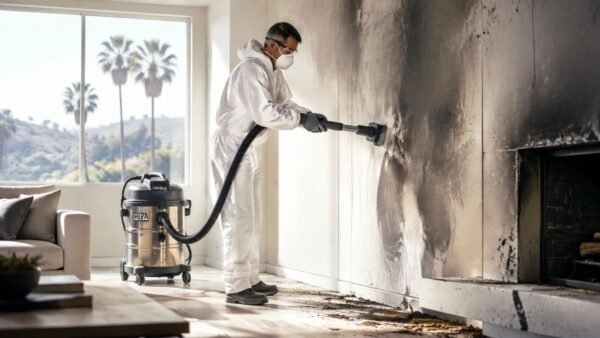
A fire event often leaves less visible damage than water, but it creates more cleanup mistakes. Soot residues smear easily. Odor travels. HVAC systems can distribute contamination beyond the room of origin.
If the fire department has cleared the property, focus on control and documentation. Restrict access. Photograph every affected area before cleanup begins. Don't let tenants or maintenance staff wipe walls, wash soft goods, or run the HVAC until the contamination pattern is understood.
A good household and small-operator emergency preparedness guide is worth keeping with your records, especially if your property depends on one manager or one family member to coordinate everything.
Mold response needs discipline
Mold is where small properties lose time by trying to "save money" the wrong way. The wrong move is surface cleaning without fixing the moisture source.
If you find suspect mold growth:
- Stop the moisture cause first: Leak, condensation, drainage failure, or humidity problem.
- Limit disturbance: Scrubbing, sanding, and tearing out material without controls can spread contamination.
- Separate occupied areas if needed: Keep tenants out of visibly affected spaces until the scope is understood.
- Photograph pattern and location: Corners, closets, behind furniture, under sinks, and HVAC-adjacent areas tell an important story.
A painted-over mold problem usually comes back. A dried-out and properly corrected moisture problem usually doesn't.
The strongest playbooks are boring on purpose. They tell people exactly what to do, in what order, and who has authority to make the call.
Essential Communication and Documentation
A lot of continuity plans fail at the desk, not at the pipe or the wall. The physical emergency gets attention. The communication trail doesn't. Then the owner can't prove timing, can't reconstruct events, and can't give tenants clear updates.
Keep three documents ready at all times
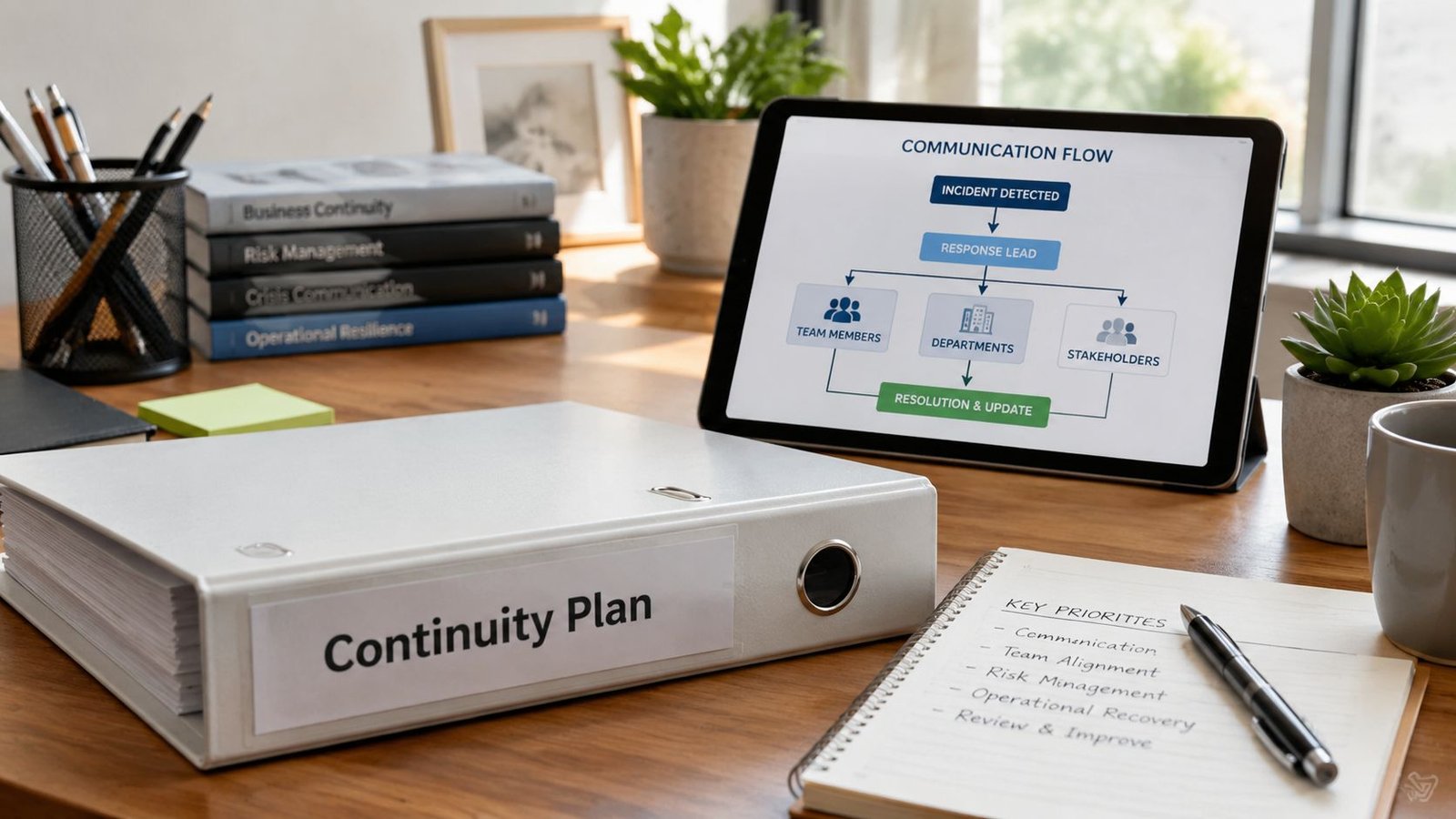
Your continuity file should be accessible off-site and on a phone, not just in a leasing office.
- Tenant emergency notification template: A short message with the issue, affected areas, immediate safety instruction, and next update time.
- Contractor and vendor contact list: Plumber, electrician, roofer, restoration firm, locksmith, board-up contact, and insurance carrier details.
- Damage documentation checklist: Date, time discovered, who reported it, source if known, affected rooms, photos taken, mitigation steps started, and current building status.
A simple tenant notice template
Use plain language:
Building notice: We identified water intrusion affecting Unit 3 and the hallway ceiling on the second floor. Water has been shut off to the affected area while we assess scope and complete emergency drying. Please avoid the marked area and report any new staining, odors, or moisture immediately. Next update will be sent by 6 p.m.
That format works because it answers the questions tenants ask first. What happened. Is it safe. What do I do. When will I hear more.
What to photograph and log
A good claim file doesn't rely on memory.
- Wide images first: Show the full room, ceiling lines, floor runs, and adjacent areas.
- Close details second: Capture burst fittings, char patterns, visible microbial growth, warped materials, and damaged contents.
- Sequence matters: Take photos before moving items, during mitigation, and after containment is in place.
- Written log entries: Note every vendor call, arrival time, shutoff action, tenant complaint, and access problem.
If you need help organizing records for a claim, this guide to insurance claim documentation is useful to keep with your emergency file.
Good documentation does two things. It supports the insurance process, and it protects you from confusion later when stories start to shift.
Coordinating Recovery with Professionals
After the property is stabilized, recovery becomes a coordination job. At this stage, many owners hire the wrong type of help first.
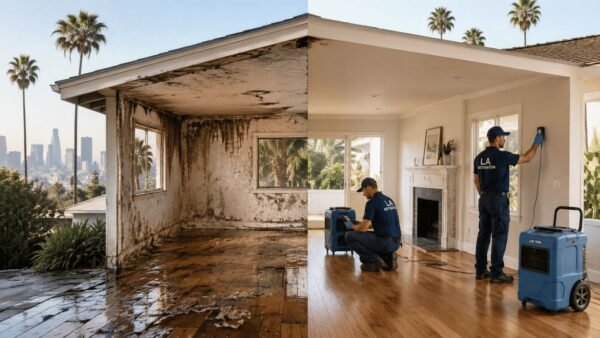
A general contractor rebuilds. A restoration company handles emergency mitigation, moisture control, contamination cleanup, and documentation tied to the loss. Those are different functions, and the order matters. If you skip proper mitigation and jump straight to repairs, you can trap moisture, miss hidden contamination, and create disputes over what was pre-existing versus newly damaged.
Who does what during recovery
A healthy recovery process usually involves these roles:
- Restoration team: Emergency extraction, structural drying, demolition of unsalvageable materials, smoke and soot cleanup, containment, odor control, and moisture verification.
- Adjuster: Reviews reported damage, policy scope, and claim documentation.
- Contractor or specialty trades: Rebuild, finish work, electrical repairs, plumbing correction, and code-related improvements.
For owners managing offices, retail, or mixed-use buildings, a partner experienced in commercial property restoration can help keep the mitigation side organized while tenant and business operations continue where possible.
Questions worth asking before you hire
Don't focus only on arrival time. Ask how the team documents the loss, verifies drying or cleanup progress, and communicates scope changes.
A few strong questions:
- How will you document affected materials and daily progress
- What containment or safety controls will you use
- Who communicates with the adjuster and how often
- What conditions would expand the scope after opening walls or ceilings
- What needs to happen before rebuild can begin
The best vendors reduce uncertainty. They don't just promise fast service. They show you how they make decisions and how they record them.
In Los Angeles, that transparency matters even more on occupied properties in places like West Hollywood, Glendale, or Beverly Hills, where access, parking, tenant scheduling, and neighboring units can complicate every phase of work.
Testing and Maintaining Your Continuity Plan
A continuity plan that isn't maintained becomes fiction. Phone numbers change. Tenants move. Staff forget shutoff locations. Vendors stop answering after hours. That's why business continuity planning fails so often in practice.
One industry source notes that plans often fail because they aren't maintained, aren't tested, or don't cover critical processes. The same guidance says 90% of businesses fail within a year if they can't resume operations in five days, which is why regular reviews, exercises, and backup communication paths matter (Riskonnect).
A low-effort maintenance routine that actually works
Most small operators don't need a committee. They need a calendar reminder and a short drill.
- Review the plan yearly: Confirm shutoff locations, vendor contacts, insurance details, and access instructions.
- Do one tabletop walkthrough: Ask, "If a pipe bursts above Unit 4 tonight, who does what first?"
- Update after every real incident: If your team got confused during a leak or smoke event, fix the document while the lesson is fresh.
- Keep multiple communication options: Phone, text, email, and a printed contact list still matter when one channel fails.
What testing should feel like
Testing doesn't need to be elaborate. It should be slightly inconvenient. That's how you find gaps.
Try a realistic scenario. The manager is off-site. The tenant reports water through a ceiling. The maintenance contact doesn't answer. Can someone else access the shutoff, notify affected occupants, start documentation, and escalate correctly without guessing?
If the answer is no, your plan isn't broken. It just isn't finished yet.
Frequently Asked Questions
What is business continuity planning for a small property owner
It's a written plan for keeping your property safe and operational during a disruption. For a small LA property, that usually means preparing for water, fire, smoke, mold, and vendor coordination rather than building a large corporate program.
Does a duplex or small apartment building really need a continuity plan
Yes. Smaller properties often have fewer backups, fewer staff, and older building systems. That makes a simple plan more valuable, not less. A one-page contact sheet, shutoff map, and first-hour action list can prevent expensive delays.
What's the difference between business continuity and disaster recovery
Business continuity is the broader plan for keeping operations going during a disruption. Disaster recovery is one part of it, usually focused on restoring systems, records, or specific functions after the event.
What do RTO and RPO mean for a property manager
RTO is the maximum tolerable downtime for a function. On a property, that could mean how long a unit, office, or critical system can be unavailable before the disruption becomes unacceptable. RPO is the maximum tolerable data loss, which matters for digital records, leases, inspection files, and insurance documentation.
How often should I update a continuity plan
At minimum, review it annually and after any real incident, staffing change, major renovation, or vendor change. If the people, systems, or contacts have changed, the plan needs to change too.
What if I don't have dedicated staff
That's common. Keep the plan lean. Define who makes decisions, who has backup authority, where records are stored off-site, and which vendors handle water, fire, and mold emergencies. The simpler the plan, the more likely people will use it.
If you need help turning business continuity planning into a practical property emergency plan, Onsite Pro Restoration can help. We serve Los Angeles, CA and nearby communities with emergency response for water, fire, smoke, and mold damage. Call 818-336-1800 for a free consultation and get a plan that works when your property needs it most.
SEO title tag: Los Angeles Business Continuity Planning Guide
Meta description: Business continuity planning for Los Angeles property owners. Learn how to prepare for water, fire, and mold emergencies before damage spreads.
Schema opportunities: FAQPage, HowTo, LocalBusiness