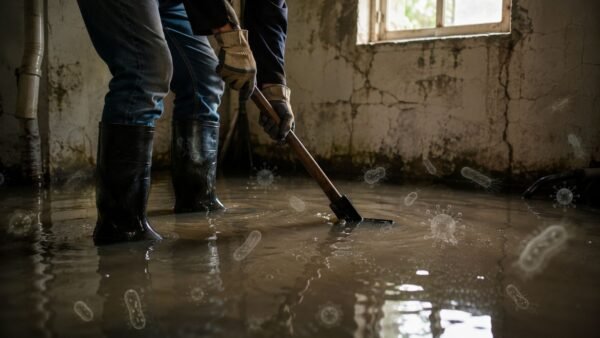

That sinking feeling when you open the basement door to see standing water is a nightmare for any homeowner. Whether it's from a burst pipe in your Sherman Oaks home or heavy rains overwhelming your foundation in the Hollywood Hills, what you do in the first hour is crucial. Your immediate actions will determine whether this is a manageable cleanup or a full-blown, wallet-draining catastrophe involving structural damage and mold.
This guide will walk you through the essential steps to take when your basement floods, from immediate safety measures to navigating insurance claims and preventing long-term damage.
Need Immediate Help? A flooded basement is an emergency. If you're in Los Angeles, call Onsite Pro for a 60-minute response.
Call (818) 336‑1800 Now for a Free Estimate
Step 1: Your First-Hour Safety and Damage Control Plan
It’s not a matter of if but when for many homeowners—water damage experts estimate that a shocking 98% of U.S. basements will experience water intrusion at some point. When it happens to you, forget everything else for a moment. Your first two moves are all about safety.
Prioritize Electrical and Water Safety First
Before you even think about stepping into the water, you must cut the power. Water and live electricity are a deadly combination.
Head straight for your main electrical panel (often in the garage, a utility closet, or a dry part of the basement). Find the breaker that powers the basement and flip it off. If you’re not sure which one it is, play it safe and shut off the main breaker for the entire house.
Safety Is Non-Negotiable: Never step into standing water unless you are 100% certain the electricity to that area is off. Electrocution is a real, immediate danger in any flood scenario.
With the electrical risk handled, your next job is to stop more water from coming in. If the source is internal—like a burst pipe from a plumbing failure or a failed water heater—you need to turn off your home's main water supply immediately. This single action can stop a disaster in its tracks.
This infographic breaks down those first critical actions into a simple, visual guide.

Identify the Water Source and Type
Once the area is safe, take a moment to identify the source. The type of water you're dealing with dictates the health risks and the cleanup strategy. It falls into one of three categories:
- Clean Water (Category 1): This comes from a sanitary source like a broken water supply line or a faucet left running. It’s not an immediate health threat but will become contaminated if left to sit and mix with building materials.
- Gray Water (Category 2): This is contaminated water from sources like a washing machine overflow or a dishwasher leak. It contains soaps, detergents, and microbes that can cause illness. Handle with caution.
- Black Water (Category 3): This is the worst-case scenario. It's grossly contaminated water from a sewer backup or overland flooding that has mixed with sewage, chemicals, and bacteria. It poses a serious health risk and requires professional handling with specialized equipment.
Step 2: Know When to Call a Professional Restoration Service
Your first instinct might be to grab a shop vac and old towels. For a tiny, contained puddle, that might work. But a real flood is a different beast entirely, and knowing when to call in the pros is the most important decision you'll make.
Clear Signs You Need a Professional Immediately
Some situations are non-negotiable. If you see any of these, don't hesitate—pick up the phone and call a restoration company. These are clear signs that the water poses a serious risk to your health and your home’s structure.
- Significant Water Volume: If you're looking at more than an inch of standing water, consumer-grade tools won't cut it. You need truck-mounted extractors that can remove hundreds of gallons per hour.
- Contaminated Water: If there's any chance the water is from a sewer backup ("black water") or has mixed with chemicals, do not touch it. This water is a biohazard teeming with dangerous bacteria and viruses. Professionals have the personal protective equipment (PPE) and antimicrobial treatments to handle it safely.
- The Water Is Still Coming In: Can't find the main shut-off? Or is the source external, like groundwater seeping through the foundation after heavy rains? You need help, fast. A pro crew can often locate and stop the source or set up containment barriers while extraction gets underway.
- Electrical Hazards Are Present: Once water reaches electrical outlets, your breaker box, or submerges appliances, the area is live. Restoration technicians are trained to assess and safely work in these hazardous environments.
A rapid professional response is a game-changer. For homeowners in Los Angeles communities like Burbank and Sherman Oaks, a one-hour response time—which is standard for 24/7 emergency services—can be the difference between a quick recovery and long-term structural damage.
The Advantage of Professional Equipment
The real value of hiring a professional team isn't just their experience; it's the gear they bring. What might take you days to dry with box fans, we can accomplish in a fraction of the time using a combination of industrial dehumidifiers and high-velocity air movers.
An IICRC-certified technician uses tools like moisture meters and thermal imaging cameras to "see" hidden water and guarantee the structure is brought back to a safe, dry standard. That’s something you simply can't verify on your own. Deciding to bring in an expert is a critical step, and if you're weighing your options, you can learn more about why hiring a restoration pro is often the smartest move.
Don't let a flooded basement lead to mold and structural rot. Get professional help now.
Schedule a Free Damage Assessment Online
Step 3: Document Everything for Your Insurance Claim

After you've handled immediate safety hazards and called for help, your next job is to prove what happened. A strong insurance claim is built on solid evidence. Before you touch anything, grab your phone.
Start with a slow, sweeping video of the entire basement. Speak clearly, stating the date and time, and narrate what you're seeing. This gives your adjuster a clear, unedited look at the full extent of the problem right from the start.
What to Capture with Photos and Videos
Once you have your overview video, get specific with photos. The more detailed your proof, the smoother the process will be.
Make sure you get detailed shots of these key areas:
- High-Water Marks: Get close-ups of the wet lines on the drywall, wood framing, and furniture. This is undeniable proof of how high the water rose.
- The Source of the Flood: If you can safely see where the water originated—a burst pipe, a leaking water heater, or a crack in the foundation—document it with multiple photos.
- Damaged Personal Property: Take pictures of every single item the water touched: furniture, stored boxes, electronics, tools, and sentimental items.
- Structural Damage: Capture photos of soaked carpet, warped floorboards, peeling paint, and any other damage to the structure itself.
Crucial Tip: Do not disturb the scene. Moving items or starting cleanup before everything is documented can seriously hurt your claim. You need to show the insurance company exactly what the flood did, as it happened.
Create a Detailed Inventory of Losses
A written list is just as powerful as photos. Open a spreadsheet and inventory every item that was damaged. For each item, list:
- Item description (e.g., "65-inch Sony TV," "leather sectional sofa")
- Make and model number, if available
- Approximate age and purchase price
- Estimated replacement cost today
A well-organized house inventory for insurance will become the backbone of your claim submission.
How a Professional Restoration Company Helps Your Claim
Navigating an insurance claim while dealing with a flooded basement is incredibly stressful. A professional restoration company like Onsite Pro Restoration becomes your strongest ally.
Our IICRC-certified technicians provide the official documentation your insurance company requires. We use moisture meters and thermal imaging cameras to find all affected areas—even moisture hiding behind your walls. These scientific readings give your adjuster objective, third-party proof of the damage. We then create detailed reports and submit them directly to your insurer, which helps get approvals faster and ensures you're compensated fairly. To see exactly how this works, take a look at our guide on filing an insurance claim for water damage.
Step 4: Understand the Professional Water Damage Restoration Process

When a professional restoration team arrives, you'll finally feel like you have a handle on the situation. Knowing how certified technicians operate will give you a clear roadmap for getting your home—and your life—back in order. The professional water damage restoration process follows a strict, science-based protocol.
Inspection and Moisture Mapping
The first thing the crew chief will do is perform a detailed inspection. They'll use high-tech gear to find out exactly where the water went.
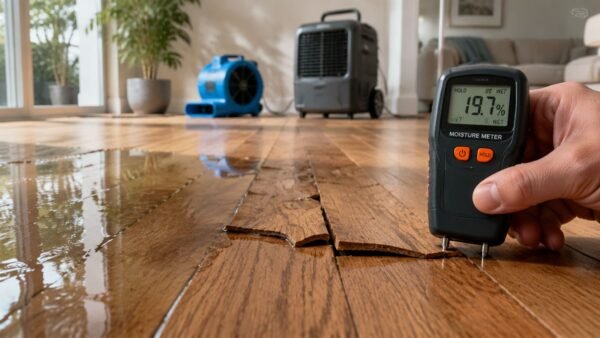
- Moisture Meters: These devices have probes that dig into drywall, baseboards, and wood framing to get an exact moisture content reading. It’s how they know what’s wet behind a dry-looking wall.
- Thermal Imaging Cameras: These cameras show temperature differences. Cool spots behind walls or under floors are a dead giveaway for hidden moisture, letting the team find water without destructive searching.
This scientific assessment creates the scope of work and gives your insurance adjuster the hard data they need to approve the claim.
Water Extraction and Structural Drying
With a clear plan, the physical work starts immediately with water extraction. Using powerful truck-mounted pumps, the team will remove all standing water far faster than any shop-vac.
Once the puddles are gone, the real work begins: drying out the structure itself. This involves a specific configuration of professional equipment:
- Industrial-Grade Dehumidifiers: These powerful machines pull massive amounts of water vapor out of the air, rapidly lowering the basement's humidity.
- High-Velocity Air Movers: These "snail fans" are aimed at walls, floors, and cavities. This focused airflow speeds up evaporation, lifting moisture out of wet materials and into the air for the dehumidifiers to capture.
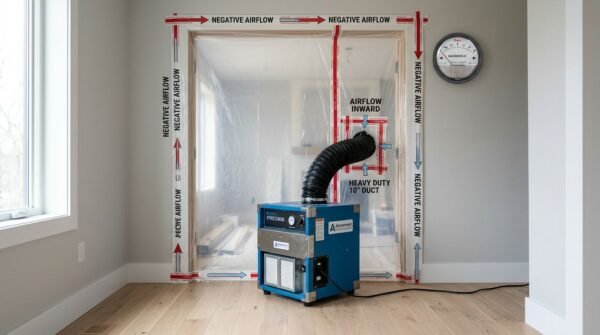
Why Not Just Open a Window? In a humid climate like Los Angeles, opening a window can actually make things worse. It lets more moisture-filled air inside, fighting against the dehumidifiers and increasing the risk of mold. Professionals create a closed, controlled drying environment for a reason.
The team will return daily to take moisture readings and reposition equipment, ensuring every material is dried to IICRC S500 standards. This means returning your home to its normal, pre-loss moisture content—a critical step to stop warping, rot, and mold.
Step 5: Prevent Mold Growth After Your Basement Floods

Once the standing water is gone, the real fight begins. The most dangerous threat after any flood is the moisture you can't see. Your flooded basement is now the perfect breeding ground for mold, which can grow in as little as 24 to 48 hours.
The CDC has clearly linked household mold to serious health problems, making aggressive prevention the most important part of your recovery. The goal is to get the relative humidity down below 50%—a level impossible to reach without serious intervention.
Immediately Remove Saturated Porous Materials
The first rule of mold prevention is simple: be ruthless. You must get rid of anything porous that got soaked. Trying to "save" these items is a losing battle and an invitation for a massive mold problem.
If any of these materials were saturated, they need to be hauled out and discarded immediately:
- Carpet and Padding: They are giant sponges for moisture and contaminants.
- Upholstered Furniture and Mattresses: The foam and stuffing become a hidden mold factory.
- Drywall and Insulation: Wet drywall falls apart, and soggy insulation is useless.
- Particleboard or MDF Furniture: This material swells, disintegrates, and turns to mush.
- Books, Cardboard Boxes, and Papers: Unless they're irreplaceable, they are now just mold food.
By getting these materials out fast, you're removing the primary fuel source mold needs to colonize. Every hour you wait gives spores more time to take hold and spread.
Control Humidity and Accelerate Drying
Tossing out soaked items is just step one. Now, you have to win the war against the moisture trapped in the air and building materials. This is where professional-grade equipment becomes essential.
- High-Capacity Dehumidifiers: Professional LGR (low-grain refrigerant) dehumidifiers can pull dozens of gallons of water out of the air daily.
- Strategic Air Movers: High-velocity air movers create a vortex of airflow across every wet surface, dramatically speeding up evaporation.
- Moisture Monitoring: Technicians use specialized moisture meters to get precise readings, ensuring materials are returned to their normal dry standard before any rebuilding starts.
This is a science-backed process. To see a full breakdown of the steps, check out our guide on how to prevent mold after water damage.
FAQs: What to Do When Your Basement Floods
Here are straight, no-nonsense answers to the most common questions we hear from Los Angeles homeowners dealing with a flooded basement.
Q: How long does it take for a basement to dry out completely?
A: With professional-grade equipment, a typical timeline for complete structural drying is three to five days. However, this depends on the severity of the flood and the materials involved. Surfaces may feel dry in a day, but porous materials like wood studs and concrete retain hidden moisture that fuels mold. We use calibrated moisture meters to ensure every material is returned to a safe dry standard (below 15% moisture content) before a job is considered complete.
Q: Is it safe to stay in my house during a basement flood?
A: It depends. If water has reached electrical outlets or your breaker panel, you need to get out immediately due to the severe risk of electrocution. If the source is a sewer backup ("black water"), you should also evacuate until the property is professionally sanitized. For a minor, contained leak from a clean water source where the power is safely off, you may be able to stay on upper floors, but always have an expert assess the situation first.
Q: What should I throw away after a basement flood?
A: Be ruthless. Any porous item that got saturated must be discarded if it can't be professionally sanitized. This includes carpet and padding, upholstered furniture, mattresses, particleboard (MDF) furniture, books, and cardboard boxes. These items are impossible to clean properly and become breeding grounds for mold. Hard, non-porous items like solid wood, metal, glass, and hard plastics can usually be salvaged.
Q: My basement flooded from rain. Is that covered by my homeowners insurance?
A: Unfortunately, in nearly every case, a standard homeowner's insurance policy does not cover damage from groundwater or surface water that floods your home during heavy rain. This type of disaster, common during California's "atmospheric river" events, requires a separate flood insurance policy, usually from the National Flood Insurance Program (NFIP). The only exception is if rain entered due to another covered event, like wind tearing a hole in your roof.
When disaster strikes, you need a team you can trust to respond quickly and restore your property correctly. For 24/7 emergency service in Los Angeles and the surrounding areas, contact Onsite Pro Restoration. We arrive in about an hour to handle everything from water extraction and structural drying to mold remediation and insurance claim documentation.
Call (818) 336‑1800 Now for Immediate Help or Schedule a Free Damage Assessment Online.