
Finding dark, ugly spots on your beautiful hardwood floors is a gut-punch for any homeowner. It’s not just an aesthetic issue; you're likely looking at black mold on your hardwood floor. This isn't some simple stain you can wipe away. It’s often Stachybotrys chartarum, a nasty fungus that absolutely loves the cellulose in wood, especially when things get damp. Tackling this requires a clear plan, especially in Southern California where humidity can be a constant battle.
Dealing with black mold on hardwood floors can be overwhelming. If you suspect you have a problem, don't wait for it to get worse.
The Hidden Dangers of Black Mold Under Your Hardwood Floors
That moment you spot black mold creeping across your floorboards confirms a major fear. Your floor isn't just a surface; it's a huge investment and a core part of your home's character. Unfortunately, the very thing that makes wood beautiful—its organic nature—also makes it the perfect meal for mold when conditions are right.
Mold spores are literally everywhere, all the time. They only turn into a problem when they find moisture and a food source. In Southern California, this can happen from a slow leak under a dishwasher in a Burbank kitchen, condensation building up beneath an area rug in a humid Santa Monica home, or leftover dampness from a long-forgotten plumbing issue.
Once the moisture content in the wood gets above 18-20%, mold can explode to life in as little as 24 to 48 hours.
The real trouble is that this growth often starts where you can't see it, deep inside the floorboards or beneath the finish. By the time you spot discoloration or smell that distinct musty odor, the colony is probably well-established, silently compromising your home and the air you breathe.
Understanding the Risks Involved
When you're dealing with black mold on hardwood, you're facing two distinct dangers: damage to your home and potential harm to your family.
- Structural Integrity: Mold doesn't just sit there; it eats. It releases enzymes that break down the cellulose in wood. Over time, this makes the wood soft, warped, and rotten, destroying not just the floorboards but potentially the subfloor underneath.
- Health Concerns: Stachybotrys chartarum, or black mold, can produce mycotoxins. These microscopic particles can become airborne and get inhaled, leading to allergic reactions, respiratory irritation, and chronic headaches. This is especially risky for kids, the elderly, and anyone with a compromised immune system.
Key Takeaway: Black mold is not a cosmetic problem. It is actively destroying your flooring and can pose serious health risks. You have to act, and you have to do it right.
Catching the early signs of water damage is your best defense. This guide will walk you through how to confidently identify the issue, what immediate steps to take safely, and—most importantly—when to put down the DIY cleaner and call in the certified pros.
How to Identify Black Mold on Your Flooring

Finding a suspicious dark stain on your beautiful hardwood floors can be alarming. Is it just a bit of dirt, an old water stain, or something much worse? Knowing how to properly identify black mold on a hardwood floor is the first, most critical step you can take. It’s time to put on your detective hat and use your senses to look for clues that are often hiding in plain sight.
This is a far more common problem than most people think. That slimy, dark patch you find creeping out from under a baseboard is likely Stachybotrys chartarum, and it loves the exact conditions found in many Los Angeles homes. In fact, an estimated 47% of buildings in the U.S. have some kind of mold issue, with black mold being the third most common toxic variety discovered inside. Hardwood is especially vulnerable because it's the perfect food source; mold thrives when the moisture content on the wood structure underneath climbs above 19% for just a week.
Visual Cues of a Mold Infestation
Your eyes are your best first line of defense. Black mold looks different depending on whether it’s wet or has had a chance to dry out.
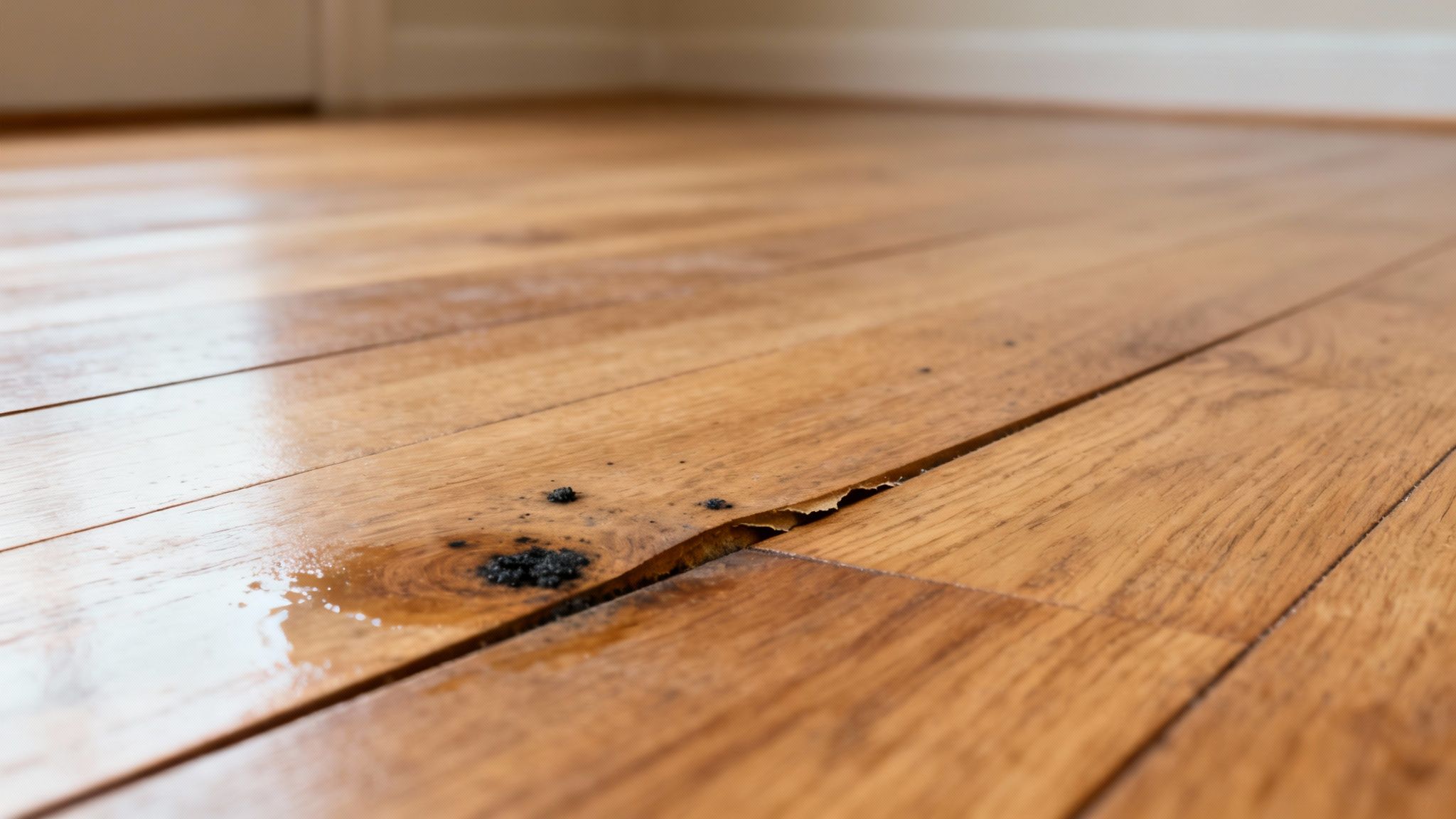
When it's actively growing with a moisture source, black mold typically has a slimy or even gelatinous texture. We see this all the time near a leaky sliding glass door in a Santa Monica condo after a rainy week, where constant condensation feeds the growth. The color is almost always a deep, inky black, sometimes with a dark greenish hue.
If the moisture source has dried up, the mold’s appearance changes completely. It can look sooty or powdery, making it easy to mistake for a little bit of dirt or ash. A homeowner in Sherman Oaks might find this powdery stuff behind a dishwasher that had a slow, intermittent leak they never even knew about.
Pro Tip: Don't just go by color. Lots of harmless molds can be black. The real giveaways are the texture, where you find it, and other signs of water damage nearby.
Black Mold Vs Mildew At a Glance
It's easy to confuse black mold with its less-threatening cousin, mildew. Both thrive in damp areas, but their appearance and potential for damage are vastly different. This table breaks down the key characteristics to help you quickly tell them apart.
| Characteristic | Black Mold (Stachybotrys) | Common Mildew |
|---|---|---|
| Color | Dark black or greenish-black | Typically white, gray, or yellowish |
| Texture | Slimy and wet, or powdery and sooty when dry | Powdery or downy |
| Growth Pattern | Grows in distinct spots or circular patches | Spreads out flat across the surface |
| Smell | Strong, musty, earthy odor (like rotting leaves) | Mild, musty scent |
| Penetration | Roots deeply into porous materials like wood | Stays on the surface of materials |
| Health Impact | Can produce mycotoxins, causing serious health issues | May cause minor respiratory irritation or allergies |
| Removal | Requires professional remediation and material removal | Can often be cleaned from surfaces with household products |
Recognizing these differences is crucial. While mildew is a nuisance, black mold is a serious threat that requires a more aggressive and careful approach.
Olfactory and Tactile Clues
Sometimes, you can smell or even feel a mold problem before you see a single spot. Mold has a very specific odor and can physically change your flooring.
The biggest giveaway is that unmistakable musty, earthy smell—often compared to damp soil or rotting leaves in a forest. If one particular room or corner of your house constantly has that smell, even after you’ve aired it out, that's a huge red flag. It almost always points to hidden mold growth, probably under the floorboards where you can't see it.
Beyond the smell, trust your sense of touch. If you feel a spot on the floor that’s always cool or damp, even when the room is warm, that’s a sign of trapped moisture underneath. You might even notice the floor feels a little spongy when you walk on it, which means the wood’s structure is already starting to weaken.
Subtle Signs of Structural Distress
Mold and moisture are a destructive team, and together they can cause physical changes to your hardwood floors. These subtle signs of damage can be your earliest warning.
- Localized Cupping or Buckling: This is when the edges of a floorboard rise higher than the center (cupping) or when the whole board lifts up from the subfloor (buckling). This warping is a direct result of the wood absorbing too much moisture.
- Peeling or Bubbling Finish: The finish on your floor is a protective barrier. When moisture gets trapped underneath, it can cause the polyurethane to bubble, crack, or peel right off, leaving the raw wood exposed and vulnerable.
- Gaps Between Planks: As wood swells up with moisture and then dries out, it can shrink unevenly. This creates new, noticeable gaps between the planks that weren't there before.
For a definitive check, nothing beats a moisture meter. It’s an essential tool for confirming your suspicions without tearing anything up. If you want to learn how to use one like the pros, check out our guide on how to read moisture meter readings to understand what the numbers are really telling you. By combining what you see, smell, and feel, you can get a clear picture of what’s going on and decide what to do next.
Your Immediate Action Plan After Finding Mold
That gut-punch feeling when you spot what looks like black mold on a hardwood floor is real. Before you reach for the bleach and start scrubbing, just stop. Take a breath. What you do in these first few minutes is more critical than anything that comes after, and it’s all about safety and containment, not removal.
The single most important rule: do not disturb the mold.
Scrubbing, sanding, or hitting a mold colony with your household vacuum is a catastrophic mistake. Imagine kicking an anthill—but instead of ants, you’re launching millions of microscopic spores into the air. This turns a contained problem in one corner into a house-wide contamination event. Those spores will happily travel through your HVAC system, settling down in new rooms to start new colonies wherever there’s a hint of moisture.
Think of these first steps as emergency first aid for your home. You’re just trying to stabilize the situation before the professionals arrive.
Isolate the Affected Area Immediately
Your number one goal is to quarantine the mold and stop those spores from going airborne. This is exactly what the pros do on a larger scale, but you can take these initial steps to dramatically cut down on cross-contamination.
- Stop All Foot Traffic: Cordon off the room. Don’t let anyone walk on or even near the affected floorboards. The simple vibration from footsteps is enough to dislodge spores and send them drifting.
- Close All Doors: Shut any doors that lead into the contaminated room. If you can see light coming through the gap at the bottom, stuff a towel under it to create a better seal.
- Cover HVAC Vents: This is a big one. Use plastic sheeting and painter's tape to completely cover any air supply or return vents in the room. You have to prevent your heating or AC from becoming a spore superhighway.
- Turn Off Your HVAC System: For extra security, shut off your central heating and air system right at the thermostat. This halts all air circulation, keeping the spores locked down until a professional can assess the scene.
Critical Safety Warning: Whatever you do, don't point a fan at the area to "dry it out." While tackling the moisture source is key, aiming a fan at an active mold colony is like putting it in front of a wind tunnel. It’s the fastest way to contaminate your entire property.
Document Everything for Your Records
Before a single thing is touched, cleaned, or removed, you need to become a crime scene investigator. Your photos and videos are the most powerful tools you have for filing a successful insurance claim. The insurance company needs to see clear proof of the damage exactly as you found it.
Pull out your smartphone and start documenting everything methodically:
- Wide Shots: Start with photos of the entire room. This gives the adjuster context for where the damage is located.
- Medium Shots: Move in closer to show the affected section of the floor and its relationship to walls, furniture, or potential sources like a leaky radiator.
- Close-Ups: Get detailed, crystal-clear photos of the mold itself. You want to capture its texture, color, and how it’s interacting with the wood grain and finish.
Make sure your shots are well-lit and in focus. It's also a great idea to photograph anything that looks like a potential moisture source—a leaky pipe under a nearby sink, water stains on a baseboard, or condensation dripping from a window frame. This evidence helps build a complete story for your claim, making the whole process smoother.
Once you’ve contained the area and have your documentation, your next call should be to a certified mold remediation specialist like Onsite Pro Restoration.
Deciding Between DIY Cleanup and Professional Remediation
After finding what looks like black mold on your hardwood floor, the first question is always the same: "Can I handle this myself?" The answer is maybe, but only in very specific, minor situations. Making the wrong call here is a classic homeowner mistake that can turn a small, contained spot into a costly, house-wide contamination nightmare.
The line between a DIY job and one that needs a professional isn't a gray area. It’s a hard boundary defined by safety and effectiveness. Knowing exactly where that line is protects your home, your health, and your wallet.
When a DIY Approach Is Feasible
You should only even consider a DIY cleanup for tiny, surface-level mold spots. I'm talking about an area no larger than a few square inches, usually caused by something simple and recent, like a small spill that wasn't wiped up right away.
If you’re sure it’s a minor spot, your safety gear is non-negotiable. Don't skip this part.
- N95 Respirator: This is not a simple dust mask. It’s essential for filtering out microscopic spores you can't see.
- Safety Goggles: Protects your eyes from airborne mold particles and any cleaning solutions.
- Rubber Gloves: Keep a barrier between your skin and the mold.
As for cleaning, stay away from harsh chemicals like bleach. It can easily damage your floor's finish and often fails to kill the mold's deeper roots. A simple 50/50 solution of white vinegar and water is usually more effective. Lightly spray the spot, let it sit for an hour, then gently scrub it and dry the area completely.
For more detailed techniques on these small-scale jobs, our guide on how to kill mold on wood has you covered.
Red Flags That Demand Professional Remediation
More often than not, the mold you see is just the tip of the iceberg. There are several red flags that immediately take the DIY option off the table and mean you need to call a certified specialist.
Expert Insight: Trying to clean a significant mold problem yourself is one of the costliest mistakes a homeowner can make. We frequently see cases where a small, localized issue was spread throughout an entire home's HVAC system by a well-intentioned but ill-equipped cleanup attempt.
You absolutely must call a professional if you see any of these signs:
- The Mold Covers More Than 10 Square Feet: This is the industry standard set by the EPA. An area this large signals a serious underlying moisture problem that surface cleaning will never fix.
- A Persistent Musty Odor: If that damp, earthy smell just won't go away, no matter how much you clean or air out the room, it's a dead giveaway. That smell means hidden mold is thriving, likely under the floorboards or in the subfloor.
- Mold Returns After Cleaning: You scrubbed a small spot, and a week later, it’s back. This is proof you only treated the symptom, not the source of the moisture that’s feeding the colony.
- Growth Linked to Major Water Damage: If the mold showed up after a burst pipe, appliance leak, or any kind of flood, the contamination is almost certainly deep inside the wood, subfloor, and possibly even the wall cavities.
Black mold under hardwood floors is a silent invader that escalates quickly. While Stachybotrys appears in less than 3% of general mold samples, studies show its presence skyrockets in damp wood environments like floor joists. In coastal LA, where humidity often tops 60-70%, black mold can colonize hardwood within 24-48 hours of a leak and spread aggressively along hidden moisture paths.
The Risks of Improper Removal
Trying to handle a large-scale cleanup without the right training and equipment is incredibly risky. The biggest danger is cross-contamination. If you scrape, sand, or use a regular vacuum on a mold colony, you’ll launch millions of spores into the air. Your HVAC system will then act like a superhighway, distributing them to every room in your home.
This doesn't just create new mold problems—it torpedoes your indoor air quality and can pose serious health risks to your family.
If you determine professional remediation is the right path, understanding the ins and outs of hiring a direct contractor can streamline the project. A true professional team will use negative air machines, HEPA filtration, and containment barriers to ensure the problem is completely isolated and eliminated for good.
The Professional Mold Remediation Process Explained
So, you've decided to call in the pros for the black mold on your hardwood floor. It can feel a little daunting if you're not sure what they're actually going to do.
But in reality, professional remediation is a highly systematic, scientific process. It's designed from the ground up to protect your home and your health. Certified technicians do a lot more than just scrub away the visible spots. They follow a strict protocol to find the source, eliminate the entire colony, and make sure it doesn't come back.
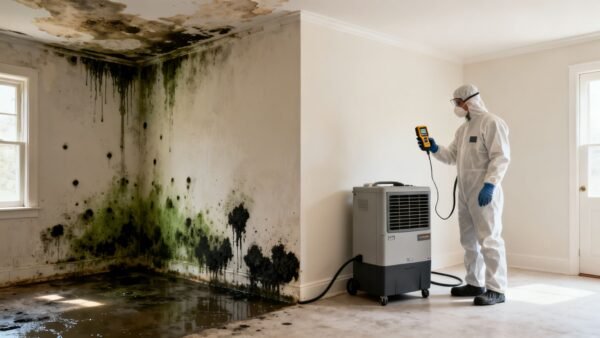
The whole thing kicks off with a detailed assessment. This isn't just a quick look-around; it's a full-blown investigation. Technicians use specialized gear like thermal imaging cameras to spot temperature differences in walls and floors, which is a classic sign of hidden moisture. They’ll also use moisture meters to get exact readings of the water content in your hardwood, subfloor, and nearby structural materials. This data-driven approach maps out the true extent of the problem, well beyond what you can see.
Establishing Safe Containment
Once the full scope of the contamination is clear, the most critical phase starts: containment. The number one goal here is to completely isolate the work area. This prevents microscopic mold spores from getting kicked up and spreading through the rest of your home during the removal work.
This is done by:
- Creating physical barriers: They use heavy-duty plastic sheeting to seal off doorways, vents, and any other openings.
- Establishing negative air pressure: A powerful air filtration machine, often called an air scrubber, is set up and vented to the outside. This creates a vacuum effect inside the contained area, ensuring that any disturbed spores get pulled out of the house instead of drifting into clean rooms.
Key Takeaway: Professional containment is the single biggest difference between a safe remediation and a DIY disaster. It’s what stops a localized problem from becoming a whole-house contamination event.
This flowchart shows you the difference between what's safe for DIY and when you absolutely need a professional team.
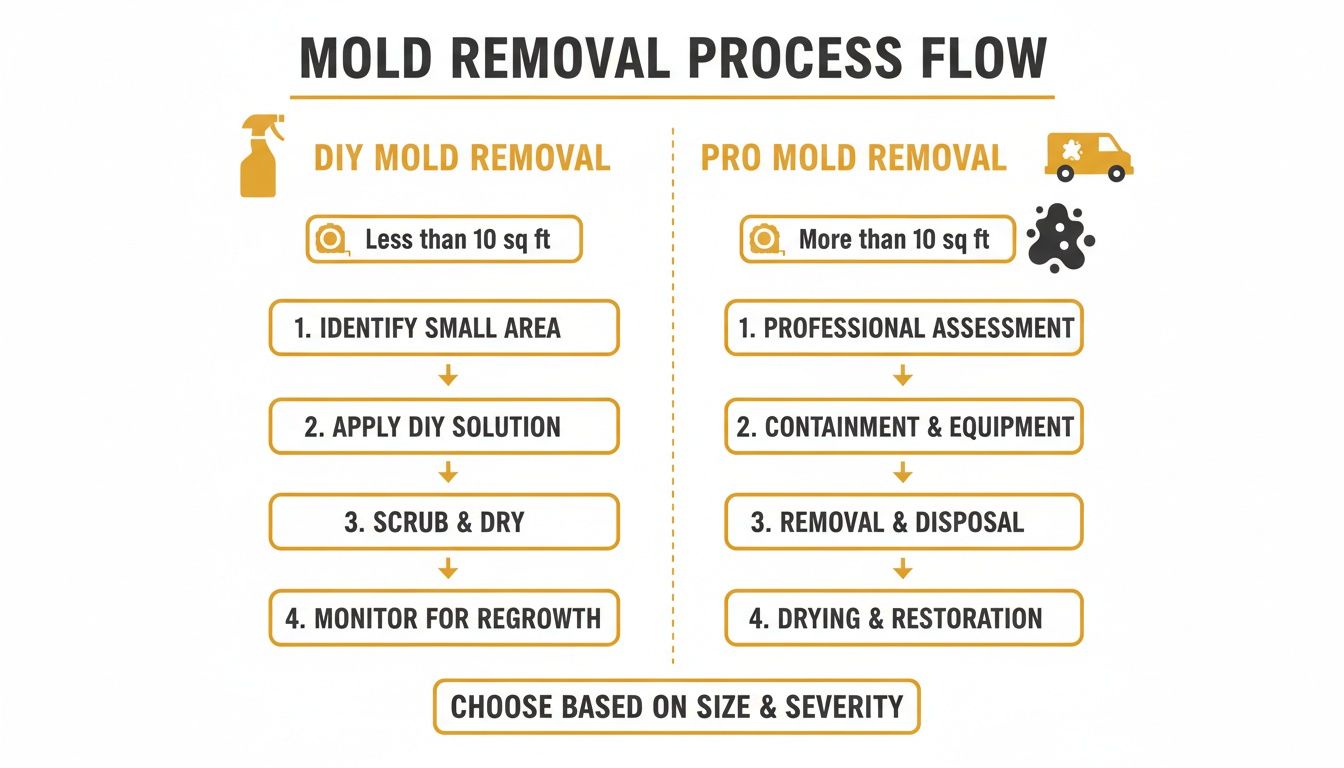
As you can see, DIY is really only for tiny, surface-level spots. Anything significant, especially on hardwood where it can get deep into the material and subfloor, requires a professional approach.
Removal, Cleaning, and Restoration
With the area totally sealed off, the technicians get to work on the careful removal of contaminated materials. For hardwood floors, this can sometimes mean pulling up affected planks if the mold has penetrated too deep and caused structural rot. Any non-salvageable materials are carefully double-bagged and disposed of according to strict industry regulations.
Next up, the entire contained area gets a meticulous cleaning using HEPA (High-Efficiency Particulate Air) vacuums. Unlike your vacuum at home, HEPA filters are designed to capture incredibly small particles like mold spores, ensuring they are gone for good. All the remaining surfaces—subflooring, wall cavities, you name it—are then treated with EPA-registered antimicrobial agents to kill any lingering mold roots and stop them from growing back.
The final steps are all about drying and restoration. Technicians bring in industrial-grade dehumidifiers and high-velocity air movers to get the structure completely dry, bringing moisture levels back down to a safe, normal range.
Once everything is verified as dry and clean, the rebuilding can begin. This might involve laying new floorboards, refinishing surfaces, and putting your space back to the way it was before the damage. To see what a full-scope project looks like, you can learn more about our comprehensive mold remediation service. This structured approach ensures every trace of the problem is gone, giving you peace of mind that your home is safe again.
Long-Term Strategies to Prevent Mold on Hardwood Floors
Once your floors have been professionally restored and that nightmare of black mold on your hardwood floor is finally behind you, the focus has to shift. It's all about prevention now. The best way to protect your investment and keep your home healthy is to be relentlessly proactive. This means taking control of the one thing mold absolutely cannot survive without: moisture.
For homes here in Southern California, that requires a specific game plan. You wouldn't think it, but the coastal fog in places like Santa Monica or even a few days of heavy rain can jack up indoor humidity levels surprisingly fast. Your target is to keep your indoor humidity between 30-50%. A good dehumidifier is your best friend in this fight, especially during the damp seasons or in areas of your home that are just naturally more humid, like a basement or a poorly ventilated bathroom.
Mastering Moisture Control Day to Day
Your daily habits are what really make the difference in stopping moisture from building up and giving mold another invitation. It’s about creating an environment where those microscopic spores just can't get the foothold they need to start growing.
It's the simple, consistent actions that count:
- Wipe Up Spills Instantly: Never, ever let water sit on your hardwood. Whether it's a spilled drink from a kid or a splash from the dog's water bowl, get it up immediately and make sure the area is completely dry.
- Use High-Quality Mats: Place absorbent, beefy floor mats at every single entryway. They’re your first line of defense for catching water off shoes, especially on rainy days.
- Ventilate, Ventilate, Ventilate: Run the exhaust fan in the kitchen when you're cooking. Run it in the bathroom during and after every shower. You want to pull all that moist air right out of your home before it has a chance to settle.
These small steps add up to a powerful defense against the very conditions that let black mold get started on hardwood floors. If you want to dig deeper into what to do after any kind of water event, our guide on how to prevent mold after water damage lays out even more detailed strategies.
Proactive Inspections and Maintenance
Beyond those daily routines, scheduling regular check-ups on your home’s plumbing and appliances can stop a disaster before it ever begins. I can’t tell you how many massive mold jobs I’ve seen that started as a slow, hidden leak that went unnoticed for months.
Expert Tip: Set a reminder on your phone for a semi-annual "leak check." Walk through your house and physically inspect under every single sink, behind each toilet, and around your dishwasher, refrigerator, and washing machine. You're looking for any sign of moisture—drips, water stains, discoloration, anything.
This kind of proactive maintenance is the cornerstone of keeping mold away for good. To truly build a robust defense, it's also smart to understand all your options and even look into what how much damp proofing costs for a more permanent solution. By staying vigilant and managing your home's moisture, you can ensure your beautiful hardwood floors stay healthy, safe, and free from the threat of black mold for years to come.
FAQs About Black Mold on Hardwood Floors
Even after reading a guide, you’ll probably have some specific questions pop into your head, especially when dealing with something as stressful as black mold on a hardwood floor. Here are some straight-up answers to the questions we hear most often from homeowners.
Q: Can I just sand the black mold off my hardwood floor?
A: This is a common first thought, but it's one of the most dangerous things you can do without proper containment. Sanding an active mold colony is like hitting a dandelion with a weed whacker—it sends millions of microscopic spores airborne. This simple mistake can turn a small, localized problem into a full-blown, house-wide contamination event. Professionals only sand wood after the mold has been killed, the area is sealed off with plastic sheeting and negative air pressure, and every last spore has been captured with HEPA vacuums. Sanding is a finishing touch for stain removal, not a cleaning method.
Q: Will my homeowner's insurance cover mold on hardwood floors?
A: This is the classic "it depends" scenario, and it almost always comes down to the source of the water. Most standard insurance policies will cover mold damage if, and only if, it was caused by a "covered peril." A perfect example is a pipe that suddenly bursts. That’s a covered peril, so the water damage and resulting mold are likely covered. On the other hand, if the mold grew because of a slow, dripping leak you never got around to fixing or high humidity from poor ventilation, the claim will almost certainly be denied. That falls under gradual damage or maintenance issues. Your best bet is to document the source with photos and call your agent immediately.
Q: Is it safe to stay in my house with black mold on the floor?
A: For a tiny, contained spot (less than 10 square feet), it's generally safe as long as you can completely isolate that room from the rest of the house and no one in your family has pre-existing respiratory issues or a compromised immune system. But when you're dealing with a larger infestation, or if anyone starts coughing, sneezing, or getting headaches, it's time to find somewhere else to stay. The health risks from airborne mycotoxins produced by Stachybotrys chartarum (black mold) are serious and not worth the gamble.
Q: What's the difference between mold and mildew on hardwood?
A: Mildew is a surface-level fungus, often appearing as a powdery white or gray patch. It's relatively easy to clean off with household products. Black mold, however, has deep roots that penetrate the wood, often appearing slimy and black or dark green. It causes structural damage and poses significant health risks, requiring professional remediation to remove safely and completely.
If you're looking at mold on your hardwood floors and feeling overwhelmed, don't wait for it to spread. Contact Onsite Pro Restoration for a free, no-obligation inspection. Get a professional assessment you can actually trust. Book Your Free Assessment Now.