
Let's get straight to it: most standard carpet cleaners are designed for dirt, not the complex organic compounds in pet accidents. Choosing the right carpet shampoo for pet odor is critical for Los Angeles homeowners. Typical cleaners just mask the smell, but specialized formulas—especially enzymatic cleaners—are engineered to break down and eliminate the source of the odor for good, a crucial first step in any pet-related remediation.
If you're battling stubborn pet smells, it may be time for professional help.
Schedule Your Free Odor Assessment Now
Why Standard Carpet Cleaners Can't Handle Pet Odors

If you've ever cleaned a pet stain only to have the smell return days later, you've experienced the fundamental failure of standard carpet cleaners. The issue isn’t a lack of cleaning power; it's that they are fighting the wrong battle.
Regular shampoos are great at removing surface dirt and food spills. However, they are chemically unequipped to deal with the true culprit behind persistent pet odors: uric acid. This is a crystalline compound in pet urine that doesn't dissolve in water or typical cleaning detergents.
The Science of a Lingering Smell
When a pet has an accident, the urine doesn't just sit on top of the carpet fibers. It seeps deep down, contaminating multiple layers:
- Carpet Fibers: The initial point of contact where stains appear.
- Carpet Backing: The dense material holding the fibers, which acts like a sponge.
- Carpet Padding: The thick foam cushion underneath that readily absorbs and traps liquids.
- Subfloor: The wood or concrete foundation, which can also become contaminated in severe cases.
A standard cleaner might remove the visible yellow stain from the fibers, but the uric acid crystals remain locked in the backing and padding. These crystals are dormant when dry. The moment they get wet—from humidity, another cleaning attempt, or even the coastal fog in a Santa Monica home—they reactivate and release that pungent ammonia smell. This is why odors reappear with a vengeance.
Key Takeaway: Standard carpet cleaners simply mask the smell with fragrances. They leave behind the odor-causing uric acid crystals, which guarantees the smell will return.
A Real-World Los Angeles Scenario
Consider a property manager in Sherman Oaks dealing with a tenant turnover. The previous tenant had a small dog, and a faint odor lingers in the living room. They hire a standard cleaning service; the carpet looks and smells fresh. A month later, the new tenant calls complaining that the "dog smell" is back after they spilled some water.
The initial cleaning was only a temporary fix. The uric acid crystals in the carpet padding were never eliminated. When the new tenant spilled water, it reactivated the old urine, bringing the smell right back to the surface.
Enzymatic Cleaners: The Superior Solution for Pet Odor
This is where a specialized carpet shampoo for pet odor becomes essential. Enzymatic cleaners work on a completely different principle. They don't just cover up smells; they release active enzymes and beneficial bacteria that act as biological catalysts.
These enzymes physically break down and "eat" the organic compounds in urine, feces, and vomit. They target and consume the uric acid, bacteria, and proteins, converting them into simple, odorless substances like carbon dioxide and water. Because they eliminate the source, the odor is gone for good.
Many standard cleaning approaches and common DIY solutions fall short. Learn more about why so many DIY carpet cleaning fails.
How to Choose the Right Carpet Shampoo for Pet Odor

Walking down the cleaning aisle can feel overwhelming. Dozens of bottles promise to eliminate pet odors, but many just cover up the problem. Choosing the right carpet shampoo for pet odor isn't about grabbing the brightest bottle—it’s about matching the cleaning science to the specific mess your pet made. The wrong choice won't just fail; it can actually lock in the smells, making them even harder to remove later.
Comparing Types of Carpet Shampoo for Pet Odor
To make this simple, here is a quick comparison table. This will help you see exactly how these cleaners work and which one you need for your situation.
| Shampoo Type | How It Works | Best For | Pros | Cons |
|---|---|---|---|---|
| Enzymatic | Uses beneficial bacteria to break down and "eat" organic matter like uric acid. | Pet urine, feces, and other deep organic stains. | Permanently neutralizes odors at the source. | Slower acting; requires dwell time to work. |
| Oxidizing | Releases oxygen to chemically break down stain and odor molecules. | Visible stains like vomit, blood, drool, and muddy paws. | Fast-acting on stains; excellent for color-safe brightening. | Can discolor some sensitive dyes; less effective on deep urine. |
| Scented | Uses fragrances to cover up or mask unpleasant smells. | Light surface dirt where no deep odor is present. | Leaves a pleasant, fresh smell. | Temporary fix; does not remove the underlying cause of odor. |
Enzymatic Cleaners: The Only Real Solution for Urine
When you're dealing with pet urine, an enzymatic cleaner is non-negotiable. These formulas aren't just soap; they contain active enzymes and beneficial bacteria specifically designed to be tiny, biological machines. Instead of just masking a smell, these microscopic agents physically break down and consume the organic waste causing the odor. They target the uric acid, proteins, and lipids in pet waste, converting them into harmless, odorless compounds like carbon dioxide and water.
Expert Insight: An enzymatic cleaner is the only shampoo that truly neutralizes the uric acid crystals in pet urine. Those crystals are the source of that recurring "pee smell" on humid days, and destroying them is the only way to permanently solve the problem.
This is exactly why these cleaners are so powerful on old, set-in accidents. Even if you can no longer see the spot, the enzymes will find and neutralize the odor-causing residue that has soaked deep into your carpet fibers and, more importantly, the padding underneath.
Oxidizing Cleaners: Your Best Bet for Stains and General Odors
Oxidizing cleaners, often branded with "Oxi" or listing hydrogen peroxide as an active ingredient, work through a powerful chemical reaction. The moment they touch organic material, they release a burst of oxygen that rapidly breaks apart the chemical bonds holding stains and odors together.
This makes them a fantastic choice for other biological messes, including:
- Vomit
- Muddy paw prints
- Drool spots
- Blood
Oxidizers are workhorses for visible stain removal and general deodorizing. While they can knock down urine odor, they don't fully break down the stubborn uric acid crystals the way enzymes do. Think of them as your go-to for non-urine messes or as a great carpet refresher between deep cleanings.
Scented Shampoos: A Temporary Mask
Let's be blunt: basic scented shampoos are a temporary fix. These formulas are made to do one thing—leave behind a pleasant fragrance while cleaning up surface-level dirt. Sure, your carpet might smell like "Spring Rain" for a day, but these products do nothing to address the source of the pet odor. Using one on a urine spot is like spraying air freshener on a full trash can. It's a waste of time and money.
When it comes time to replace your carpet, make life easier by planning ahead. Choosing the best pet friendly rugs from the start means using materials designed to resist stains and odors.
Concentrates vs. Ready-to-Use Formulas
Finally, you'll need to decide between a concentrate or a ready-to-use (RTU) formula.
- Concentrated Formulas: These are the powerhouse liquids you dilute with water for use in a carpet cleaning machine. They are the most cost-effective option for cleaning entire rooms. Always follow the machine's instructions for the shampoo-to-water ratio.
- Ready-to-Use (RTU) Sprays: These are your emergency response team. Perfect for spot-treating fresh accidents, they require no mixing and let you act fast.
Sometimes, lingering dampness after cleaning can lead to a different odor. If that happens, you might want to read our guide on how to get rid of mildew smell. The best strategy is a two-pronged attack: a high-quality enzymatic concentrate for your deep cleaner and an RTU enzymatic spray for emergencies.
A Practical Guide to Deep Cleaning Carpets for Odor Removal
Once you've chosen the right carpet shampoo for pet odor, it's time to get to work. Getting pet odors out for good isn't about just running a machine over the floor; it's a systematic process. This breakdown mirrors the phases we use in the field to ensure every trace of odor-causing bacteria is eliminated.
Phase One: Prepping the Area for Success
Before you even think about mixing shampoo, the prep work is what sets you up for success. Rushing this is the most common mistake we see.
First, clear the entire room. Get all the furniture out. You need total, unobstructed access to every square inch of the carpet. Next, give the room a thorough, deep vacuum with a rotating brush to agitate the fibers and lift out dry debris. If you skip this, you’re just going to turn all that dry soil into mud.
Finally, always do a spot test with your shampoo in a hidden area, like inside a closet, to ensure it won’t discolor your carpet.
Phase Two: Pre-Treating Stubborn Stains
This is arguably the most important phase for getting rid of odors permanently, especially urine. Pre-treating lets your specialized cleaner do the heavy lifting. If you're using an enzymatic cleaner, liberally spray the formula directly onto any known or suspected accident spots. Saturate the area so the cleaner penetrates as deeply as the original urine did.
Pro Tip: For old, dried urine stains, you must give the enzymes time to work. After applying the pre-treatment, cover the spot with a clean, damp towel for at least an hour. For really tough or old stains, you might let it dwell for several hours or even overnight. This keeps the area moist, allowing the enzymes to continuously break down the uric acid crystals.
This "dwell time" is an active battle. The beneficial bacteria in the cleaner are systematically destroying the source of the smell. Skipping this phase leaves the deep-down odor source intact.
Phase Three: Shampooing Like a Pro
Now it's time for the machine. Your technique is what separates a professional-level clean from a soggy mess.
- Mix Your Solution: Follow the dilution instructions for your carpet shampoo for pet odor precisely. Using too much shampoo leaves a sticky residue that will attract dirt.
- Work in Sections: Start in the corner of the room furthest from the door and work your way out. Mentally divide the room into small, manageable sections, like 4×4 feet.
- Slow and Steady Passes: Make a slow forward pass while depressing the trigger to release the solution. Then, release the trigger and make a slow backward pass over that same strip to extract the dirty water. Overlap your strokes by about 30% for even coverage.
After shampooing the whole room, do a rinse pass. Empty the dirty water, refill the tank with only clean, hot water, and go over the entire carpet again, focusing only on extraction. This removes leftover shampoo residue.
Phase Four: Drying and Post-Cleaning Care
Your job isn't over when you turn off the machine. A damp carpet is a perfect breeding ground for mildew, a big concern in humid areas like coastal Santa Monica.
- Create Airflow: Open windows, switch on ceiling fans, and set up box fans blowing across the carpet's surface.
- Use Your HVAC: Run your air conditioner or heat to help pull moisture from the air.
- Stay Off the Carpet: Keep all foot traffic off the carpet until it is 100% dry to the touch, which can take 8 to 24 hours.
Don't panic if a faint odor lingers. Sometimes, the enzymatic cleaner needs a few more days to finish its work. For more tips on this final step, check out our guide on how to dry wet carpet fast.
Advanced Tactics for Recurring Pet Odors in Los Angeles
You’ve followed all the steps—shampooed, scrubbed, and dried—but that phantom pet smell keeps coming back. This is a sure sign the problem runs deeper than your carpet shampooer can reach. When a high-quality carpet shampoo for pet odor doesn't finish the job, it’s because the urine has soaked through the carpet and into the padding and subfloor.
Uncovering Hidden Contamination with a Black Light
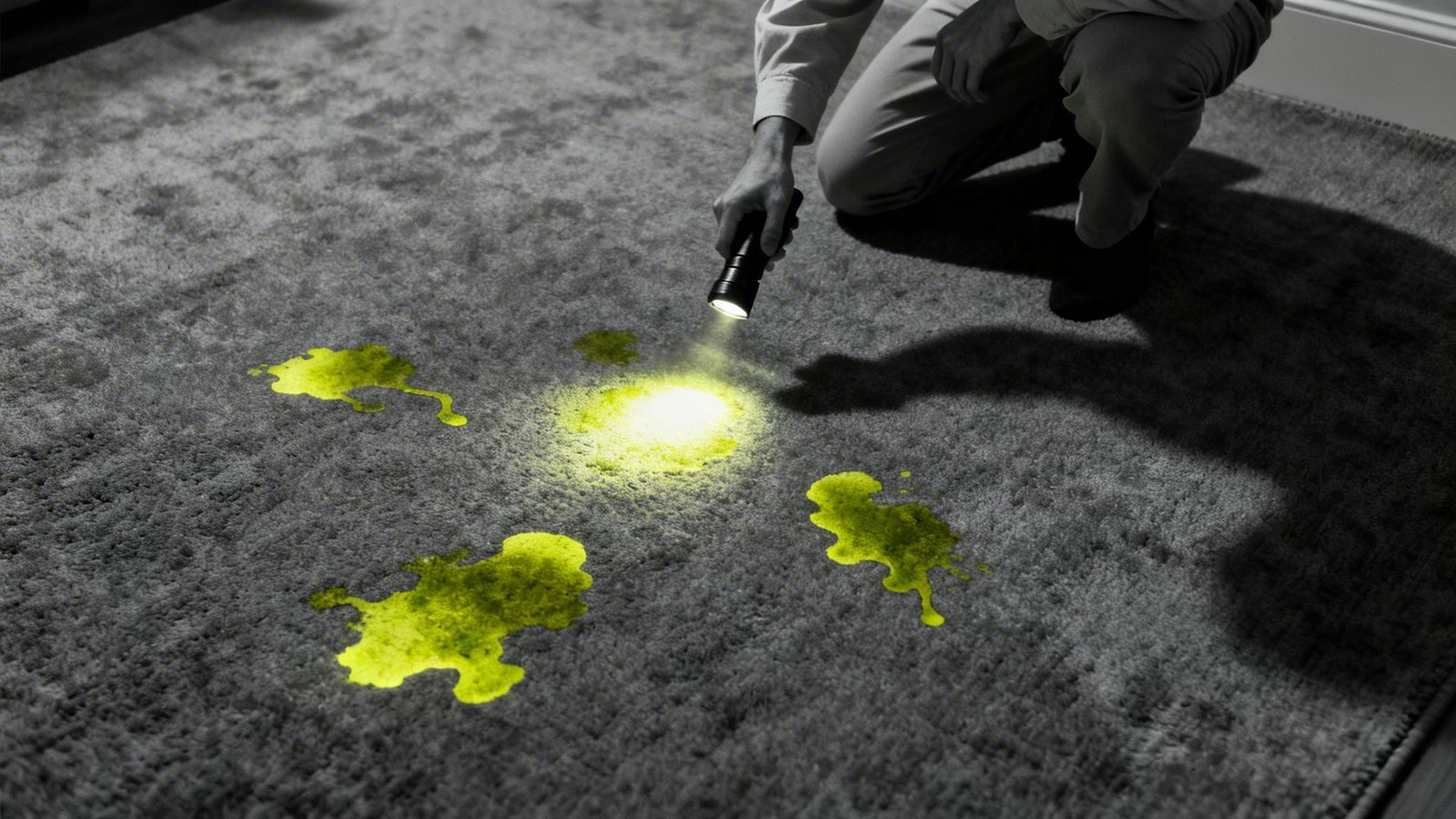
To treat these deep-set odors, you first have to find them. Old urine stains are often invisible to the naked eye, but the salts and proteins will glow a faint yellow-green under ultraviolet (UV) light.
- Wait until it’s completely dark.
- Turn off every light in the room.
- Slowly scan the black light over the carpet, holding it about one to two feet above the fibers.
Use small pieces of painter's tape to mark each glowing spot so you can find them again with the lights on.
Treating the Carpet Padding with the Syringe Method
Once you've mapped out the hidden damage, you can target the source directly. Since the odor is trapped in the padding, you need a way to deliver an enzymatic cleaner straight to that layer. A large-gauge syringe (without the needle) is the perfect tool for the job.
Fill the syringe with your undiluted enzymatic cleaning solution. Carefully push the tip of the syringe through the carpet backing at the center of a marked stain. Slowly inject the cleaner directly into the padding to saturate it. This technique allows the enzymes to break down the uric acid crystals hiding deep below the surface.
Key Insight: This is a simplified version of how restoration professionals treat sub-surface contamination. By injecting the cleaner, you’re bypassing the carpet fibers and delivering the solution directly to the odor source.
When to Stop DIY Efforts and Call for Help in Los Angeles
There comes a point where even advanced DIY methods aren't enough. Knowing when to call a professional restoration service is key to solving the problem for good.
You should seriously consider professional help if you see any of these signs:
- The odor returns immediately after drying: The clearest sign that the subfloor is contaminated.
- You find subfloor damage: Pull back a corner of the carpet. If you see dark stains, warping, or lingering dampness on the subfloor, the damage is severe.
- The contaminated area is massive: If an entire room was used as a pet bathroom, a DIY approach is outmatched.
- The odor is mixed with other issues: Problems like a burst pipe or a slab leak that also soaked the carpet can trap pet odors and demand professional water extraction.
For severe, lingering odors, we might use an air scrubber rental to purify the air during the remediation process. A certified team has the tools and expertise to properly assess the damage and restore your home correctly the first time.
If your DIY efforts have failed, it's time for a professional solution.
Schedule Your Free Odor Assessment Now
When to Call a Professional Restoration Service for Pet Odors
You’ve bought the best carpet shampoo for pet odor. You’ve followed every step, but that stubborn smell is still there. This is a sure sign the problem has gone beyond what any DIY product can handle. Knowing when to call for backup isn't giving up; it's a smart decision to protect your home.
Odors Soaked into the Subfloor
The number one reason pet odors keep coming back is because the source has soaked far below the carpet fibers. Once uric acid crystals get embedded in the porous wood or concrete subfloor, no amount of surface shampooing will ever reach them.
A Pro's First Step: When our team arrives at a home in Burbank or Glendale, one of the first things we do is pull back a corner of the carpet. If we see dark stains on the pad or feel dampness on the subfloor, we know this is no longer a cleaning job. It’s a restoration project.
The Problem Is Widespread
If pet accidents happened all over a room, a DIY approach is simply outmatched. The sheer volume of contamination is too much for consumer-grade equipment. Trying to treat an entire room often leads to over-wetting the carpet, which creates new problems like mildew or delamination.
When Pet Damage Meets Water Damage
A scenario we often encounter in the San Fernando Valley is a burst pipe or washing machine leak in a room with old pet stains. The clean water reactivates the dormant urine crystals, spreading the contamination. At that point, you're dealing with a Category 2 or Category 3 water damage situation that requires certified protocols.
The Professional Equipment Difference
A certified restoration technician shows up with gear that is exponentially more powerful than anything you can rent or buy.
- Truck-Mounted Hot Water Extraction: These machines generate much higher water temperatures and incredible suction, flushing deep into the carpet and pad and then powerfully extracting the dissolved urine and moisture.
- Specialized Odor Neutralization: For severe odors, we use tools like thermal foggers to atomize deodorizers. For the toughest jobs, hydroxyl generators use UV light to safely break down odor molecules at a chemical level.
For homeowners from West Hollywood to Orange County, bringing in a certified team like Onsite Pro Restoration means getting a permanent fix. We have the training to properly assess the damage and apply IICRC-approved methods. Learn more about what is involved in our pro restoration services.
FAQs on Using Carpet Shampoo for Pet Odor
You've shampooed the carpets, and now the questions pop up. Here are answers to the most common questions we get from Los Angeles homeowners battling pet odors.
Q: Can I just use vinegar and baking soda?
A: This DIY trick isn’t a real solution for pet urine. A vinegar and baking soda paste might temporarily mask surface-level smells, but it does nothing to break down the uric acid crystals in urine—the real source of the recurring odor. Only a proper enzymatic cleaner is designed to biochemically destroy those crystals.
Q: How long until the pet smell is really gone?
A: You’ll notice a huge difference as soon as the carpet is 100% dry (24-48 hours). However, the enzymes are still at work for a few days after cleaning. If you still smell a strong odor after a week, it’s a red flag that the urine has soaked into the padding or subfloor.
Q: Will shampooing make my pet go in the same spot again?
A: No, it's the opposite. A true enzymatic shampoo obliterates the urine molecules that create a scent marker, breaking the re-soiling cycle. Just be sure to avoid any cleaners containing ammonia, as the chemical smells very similar to urine and can attract your pet back to the spot.
Q: Are pet shampoos safe for my family and pets?
A: Most reputable carpet shampoos for pet odor are formulated to be safe once the carpet is totally dry. Keep kids and pets out of the room during cleaning and while the carpet is damp. Always check the product label for safety instructions and ensure good ventilation.
Q: Why does the smell seem worse after I cleaned?
A: This happens when the moisture from your cleaning solution reactivates dormant uric acid crystals that have soaked deep into the carpet pad and subfloor. You’ve essentially "woken up" a much bigger, deeper problem that requires professional intervention.
Q: I’ve tried everything and the odor still won’t go away. What now?
A: If you’ve used a strong enzymatic cleaner and the smell is still there—it’s time to stop. Repeatedly shampooing a deeply contaminated carpet will only lead to over-wetting, mildew, and potential subfloor damage. This is the point where you need a professional assessment.
Don't let stubborn pet odors compromise your home's comfort and air quality. If you've tried everything and the smell persists, it's a sign that the problem lies deep within the carpet padding or subfloor. The team at Onsite Pro Restoration has the IICRC-certified expertise and professional-grade equipment to permanently eliminate pet odors from your Los Angeles home.