
When you discover a burst pipe flooding your kitchen in Sherman Oaks, your first instinct isn't to start browsing new cabinet designs. It's to shut off the water, grab every towel you own, and try to stop the chaos. That frantic, damage-control mindset is the perfect way to understand what is water mitigation.
This guide explains the entire process, why immediate action is crucial for Los Angeles property owners, and how it differs from the full restoration that follows. Acting fast is the single most important step in protecting your property's value and your family's health.
Facing a sudden leak or flood? Don't wait. Our IICRC-certified team is available 24/7.
Call (818) 336‑1800 for an Immediate Emergency Response
The First Aid Analogy For Your Property
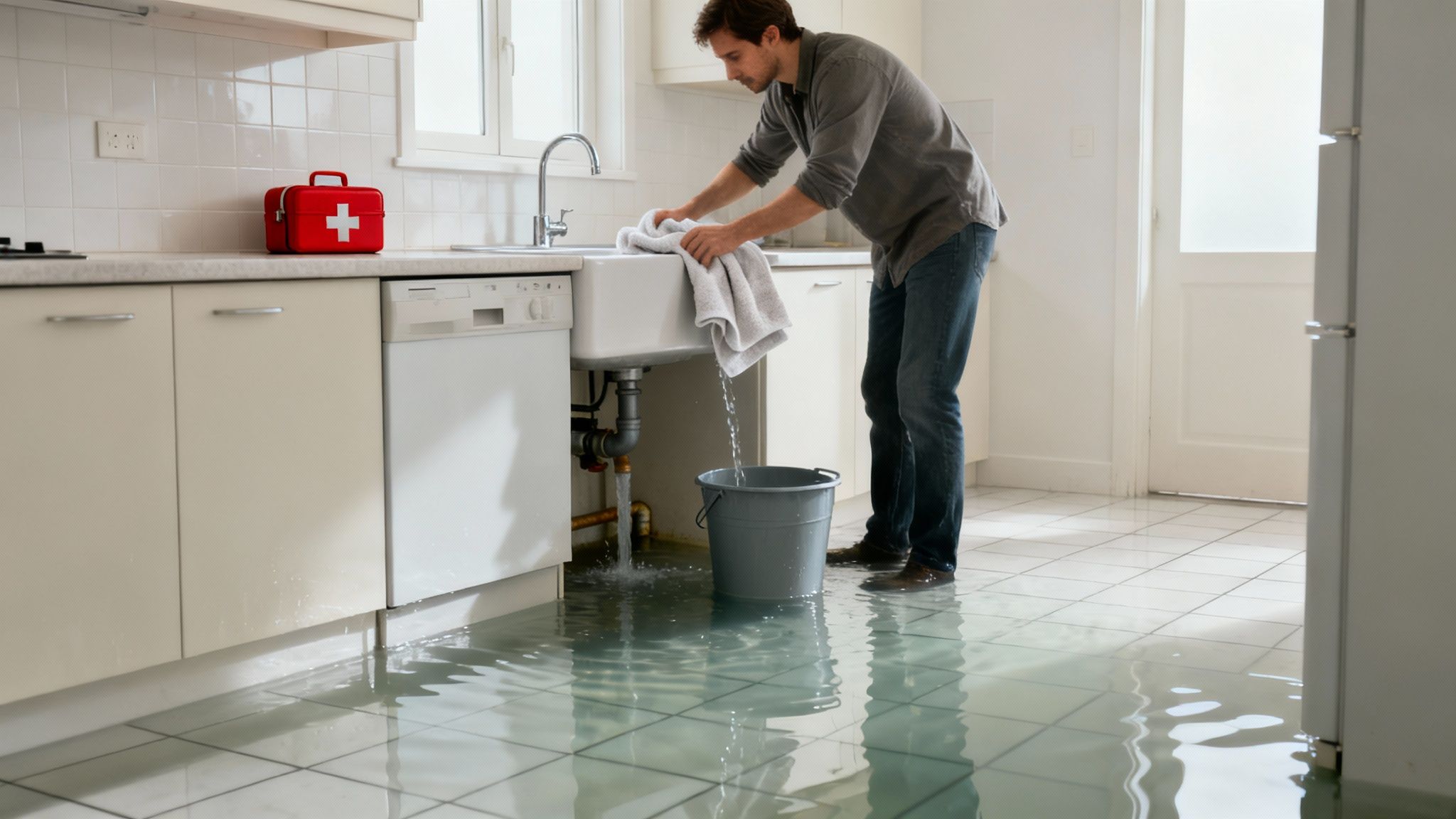
Think of mitigation as emergency first aid for your property. Its only job is to stop the bleeding—the active water damage—before it causes irreversible harm like structural rot or a dangerous mold outbreak. It's all about immediate action.
This crucial first step isn't about repairing what's already broken. It's about preventing a bad situation from getting much, much worse. Mitigation is the difference between a contained issue and a full-blown catastrophe that creeps into multiple rooms and costs tens of thousands more to fix.
What Mitigation Aims To Achieve
The whole process is a race against the clock. Why? Because materials can get saturated and create a perfect breeding ground for mold in as little as 24-48 hours. Professional technicians have to move fast, and they focus on a few key goals to protect your home.
Water mitigation is the critical first stage in managing flood damage. It consists of taking emergency measures to prevent further damage, thereby stabilizing the entire structure of your property.
Given the urgency, professional restoration companies have to be ready for calls at any hour, day or night. Many rely on specialized support like an emergency restoration answering service just to make sure no call for help gets missed. For homeowners here in Los Angeles, that means you can get a team on-site immediately when disaster strikes.
The core goals are straightforward and designed for maximum impact. Here’s a quick breakdown of what we’re trying to accomplish on every job.
The Four Core Goals Of Water Mitigation
This table breaks down the primary objectives of the water mitigation process, explaining what each step aims to achieve to protect your property.
| Goal | What It Means For Your Property |
|---|---|
| Damage Prevention | We find and stop the water source, then immediately start removing standing water to keep it from spreading to other areas of your home. |
| Loss Reduction | We carefully move furniture, electronics, documents, and other valuables out of the affected area to protect them and minimize your financial loss. |
| Stabilization | We bring in industrial-grade dehumidifiers and high-velocity air movers to aggressively dry out the structure and bring moisture levels down, stopping mold in its tracks. |
| Safety Assurance | We identify and deal with any immediate hazards, like contaminated water ("black water") or electrical risks, to make the area safe for the next steps. |
Ultimately, successful water mitigation sets the stage for a smooth restoration. By taking these aggressive, preventative steps right away, you dramatically reduce the scope, timeline, and cost of the final rebuilding phase.
Understanding Mitigation vs. Restoration
In Los Angeles, it’s common for property owners to use the terms “water mitigation” and “water restoration” interchangeably. While they are definitely two sides of the same coin, they are completely different phases of getting your property back to normal. Getting this right from the start is key to navigating the process and knowing what to expect.
Here’s an easy way to think about it: water mitigation is the immediate, adrenaline-pumping emergency response. It's the sprint to stop the damage. Restoration, on the other hand, is the methodical marathon of rebuilding and repairing what was lost.
Mitigation: The Emergency First Response
Mitigation is all about stopping the bleeding, fast. Imagine a dishwasher hose lets go in your Sherman Oaks condo. The mitigation team’s one and only goal is to prevent that water from causing a single ounce more of damage than it already has. Their entire focus is on damage control and stabilization.
This phase is all about urgency. Technicians show up, often within the hour, to extract standing water, tear out materials that can't be saved (like soaked carpet padding), and fire up powerful drying equipment. The mission is simple: get the property bone-dry and stable as quickly as humanly possible to stop secondary issues like mold growth or structural decay in their tracks.
Restoration: The Rebuilding Process
The restoration phase can only begin once every last bit of moisture is gone and the property is officially declared dry. This is where the focus flips from prevention to repair. The goal is no longer just to stop the damage—it’s to put your property back to its pre-loss condition, and sometimes even better.
This is the crew that hangs new drywall, lays down new flooring, repaints walls, and rebuilds ruined cabinetry. It’s a much more deliberate, construction-focused process that can take anywhere from a few days to several weeks, all depending on the extent of the damage that mitigation couldn't prevent.
Mitigation vs. Restoration At A Glance
To make the distinction crystal clear, let’s break down the key differences between these two critical services. Understanding their unique roles helps clarify the complete water damage restoration process from that first frantic call to the final walkthrough.
| Aspect | Water Mitigation (First Response) | Water Restoration (Rebuilding Phase) |
|---|---|---|
| Primary Goal | Prevent further damage from occurring | Repair existing damage and rebuild the property |
| Timing | Immediate emergency action (first 24-72 hours) | Begins after the structure is fully dried and stable |
| Core Tasks | Water extraction, removing wet materials, drying | Replacing drywall, painting, flooring installation |
| Speed | Fast-paced and urgent | Methodical and planned |
| Analogy | Emergency Room Doctor: Stabilizing the patient | Surgeon: Performing the reconstructive surgery |
The global restoration industry is valued at over $210 billion annually, and water mitigation is the critical first step. Water damage leads the market simply because of how often it happens and how much destruction it can cause. In fact, between 2017 and 2021, water damage and freezing pipes accounted for a staggering 23% of all property damage claims worldwide. This is exactly why companies like Onsite Pro Restoration prioritize a 24/7 emergency response. You can discover more insights about the restoration industry on 1800waterdamagefranchise.com.
In short: You mitigate the emergency, then you restore the property. One cannot happen without the other. Successful restoration is built on the foundation of a thorough and professional mitigation job.
Ultimately, you almost always need both. A solid mitigation job minimizes the total damage, which directly reduces the time and money needed for the final restoration. Skipping or delaying mitigation is a surefire way to turn a manageable problem into a catastrophic and incredibly expensive reconstruction project.
The Professional Water Mitigation Process Step by Step
When your property is suddenly underwater, the chaos can feel overwhelming. You know you need help, but what does a professional team actually do when they show up? It’s not a random, frantic effort. It’s a systematic, scientific process designed to stop the damage cold, prevent mold, and set the stage for a full recovery.
A certified team like Onsite Pro Restoration follows a precise, industry-approved workflow. Every step builds on the last, making sure no hidden moisture is left behind to cause bigger problems down the road—like the structural rot or stubborn mold that thrives in the coastal air of Santa Monica or Malibu. Let's walk through what you can expect.
Step 1: Inspection and Damage Assessment
The very first thing our technicians do is a thorough inspection. When they arrive—usually within the hour—they aren't just taking a quick look around. Their mission is to find the source of the water, figure out its contamination level (Category 1, 2, or 3), and map out the full extent of the damage.
They use specialized tools like thermal imaging cameras and moisture meters to "see" behind walls and under floors. This is how they find hidden pockets of water that would otherwise be missed. This initial assessment is crucial for building the right game plan and giving your insurance company the accurate documentation they need.
Step 2: Rapid Water Extraction
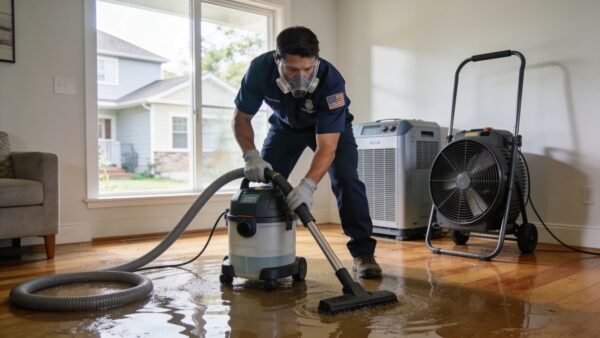
With a clear plan in hand, the next priority is getting all the standing water out. Fast. This isn’t a job for a shop vac from the garage. We bring in powerful, truck-mounted pumps and commercial-grade vacuums that can pull out hundreds, sometimes thousands, of gallons of water in a surprisingly short time.
This phase is a race against the clock. The faster that bulk water is gone, the less time it has to wick up into drywall, soak into wood framing, and create a perfect breeding ground for mold. You can see a breakdown of this critical stage in our guide to emergency water extraction services.
This infographic visualizes the two distinct phases: first, stopping the damage (mitigation), and second, rebuilding the property (restoration).
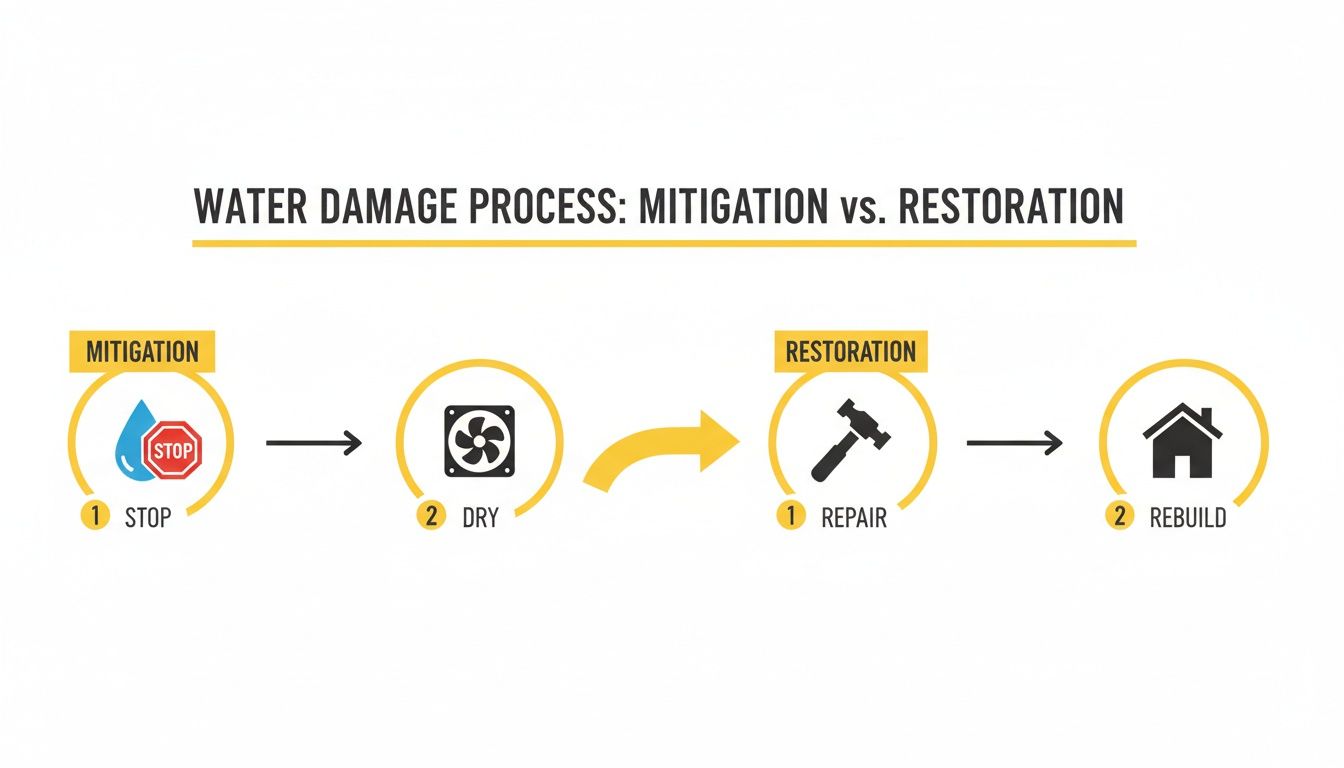
As the graphic shows, mitigation is the immediate "stop and dry" emergency response that must happen before any "repair and rebuild" restoration work can begin.
Step 3: Removal of Non-Salvageable Materials
Some materials just can't be saved once they're saturated. Think of things like carpet padding, insulation, and soggy drywall—they act like sponges, holding onto moisture and providing an ideal food source for mold. As part of the mitigation process, technicians will carefully remove and dispose of these items.
This might look destructive, but it’s a vital step for proper drying. Getting those ruined materials out of the way opens up the structure, allowing air to circulate freely around wall studs, subfloors, and other hidden cavities that need to dry out completely.
Step 4: Strategic Structural Drying
Once the standing water is gone and ruined materials are out, the real science of drying begins. This is where we place industrial-grade equipment in a strategic pattern to create a powerful drying vortex. This isn't just about blowing air around; it's a calculated system.
The key players here are:
- High-Velocity Air Movers: You might know them as "snail fans." These powerful blowers are aimed to create the best possible airflow across wet surfaces, which dramatically speeds up evaporation.
- Commercial Dehumidifiers: These aren't your typical home units. LGR (Low-Grain Refrigerant) dehumidifiers are beasts designed to pull massive amounts of moisture from the air and building materials, effectively wringing water out of wood, concrete, and drywall.
Step 5: Monitoring and Final Verification
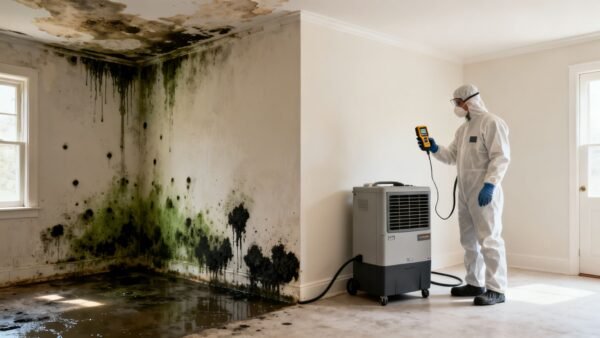
Setting up all that drying equipment isn't a "set it and forget it" job. Our technicians come back daily to monitor the entire process. They use moisture meters and thermal cameras to track progress, adjusting the equipment as needed to hit any stubborn damp spots.
This scientific monitoring continues until every single affected material has reached its predetermined "dry standard." This guarantees your property is safe, stable, and truly ready for the final restoration phase to begin.
The Key Equipment Used in Water Mitigation
When you’re dealing with serious water intrusion, a few towels and a shop vac from the garage just aren't going to cut it. True professional water mitigation relies on an arsenal of advanced, specialized equipment designed to locate, extract, and eliminate moisture with scientific precision.
Understanding this technology makes it crystal clear why DIY efforts often fall short, leading to much bigger problems like mold and structural decay down the road.
This gear isn't just about power; it's about a strategic, data-driven approach to drying. Each tool plays a specific role in ensuring every last drop of hidden moisture is found and removed, protecting your property from long-term harm.
Finding Hidden Moisture with Precision
Before any drying can begin, technicians need to know exactly where the water is. Guesswork is not an option when the health of your home is at stake.
-
Thermal Imaging Cameras: These devices allow technicians to "see" temperature differences behind walls, under floors, and in ceilings. Wet areas are almost always cooler than dry materials, showing up as distinct blue or purple spots on the camera's screen. This technology is invaluable for mapping the full extent of the damage, especially water that has wicked into hidden cavities.
-
Moisture Meters: While thermal cameras find potential problem areas, moisture meters confirm them. Technicians use both penetrating and non-penetrating meters to get hard data on the moisture content of materials like drywall, wood studs, and concrete. Knowing these precise moisture levels is a critical skill for determining when a structure is truly dry.
High-Volume Water Removal and Drying
Once the scope of the damage is clear, the heavy-duty equipment comes out to start the drying process. This is where industrial-grade power makes all the difference.
A professional's equipment isn't just stronger; it's part of an engineered system. The combination of high-velocity air movers and low-grain refrigerant dehumidifiers creates a powerful drying vortex that consumer-grade tools simply cannot replicate.
This synergy is what separates a professional mitigation job from a risky DIY attempt. Each piece of equipment is placed strategically to maximize its effectiveness.
The Power Players in Structural Drying
Commercial Air Movers (Snail Fans)
These are not ordinary fans. High-velocity air movers are designed to create a powerful, focused stream of air that blows across wet surfaces like floors and walls. This rapid airflow breaks the surface tension of the water and dramatically speeds up the rate of evaporation, lifting moisture from the materials into the air.
Low-Grain Refrigerant (LGR) Dehumidifiers
As air movers push moisture into the air, LGR dehumidifiers pull it right back out. These powerful machines work by cooling the incoming moist air to its dew point, causing the water vapor to condense and collect inside the unit. They are far more efficient than standard dehumidifiers, capable of removing dozens of gallons of water from the air each day and continuing to work effectively even in low humidity conditions.
Together, this equipment creates a cycle: air movers turn liquid water into vapor, and LGR dehumidifiers pull that vapor out of the environment for good. This systematic approach is the only way to ensure your property is dried completely, preventing the secondary damage that makes water mitigation so essential.
If you're facing a sudden leak or flood, understanding the importance of our emergency water cleanup services is the first step toward getting your property—and your life—back to normal.
Why Delaying Mitigation Is a Costly Mistake in Los Angeles
When water damage strikes, the clock starts ticking—loudly. Every hour you wait lets a manageable problem spiral into a potential catastrophe. Putting off a call for professional water mitigation isn't a small oversight; it’s a decision that can multiply repair costs, put your health at risk, and even get your insurance claim denied. The difference between acting in two hours versus two days is absolutely massive.
Think of it this way: a clean water leak from a supply line is considered Category 1 water, which is sanitary and relatively harmless at first. But that clean water doesn’t stay clean. Within just 24 to 48 hours, as it soaks into drywall, flooring, and insulation, it degrades into Category 2 (greywater), which is contaminated enough to cause illness.
Let it sit any longer, and it quickly becomes Category 3 (blackwater)—a hazardous soup of bacteria, pathogens, and mold spores. This level of contamination poses serious health risks and requires extensive, far more expensive decontamination.
The Domino Effect of Delay
Waiting allows a whole series of secondary problems to take hold, and each one is more destructive than the last. This is how a small leak balloons into a five-figure nightmare.
- Explosive Mold Growth: Mold spores are literally everywhere, just waiting for moisture to activate. In as little as 24 hours, they can start colonizing damp drywall, wood, and insulation. Check out our guide on how to prevent mold after water damage to see just how fast this happens.
- Structural Rot: Wood subfloors, wall studs, and ceiling joists act like giant sponges. When they stay saturated, their structural integrity is compromised, leading to sagging floors, warped walls, and, in the worst cases, catastrophic failure.
- Pest Infestations: Damp, dark, and decaying environments are an open invitation for pests. Cockroaches, termites, and rodents are all drawn to the moisture and rotting organic materials.
- Compromised Insurance Claims: Almost every insurance policy has a clause requiring you, the homeowner, to take reasonable steps to prevent further damage. Delaying that call to a mitigation company can easily be seen as negligence, giving your insurer grounds to deny the claim.
The Financial Stakes Are Higher Than Ever
The cost of doing nothing isn't just theoretical. Aging infrastructure is a huge problem, especially in a city like Los Angeles where deteriorated pipelines and old sewage lines are ticking time bombs. This isn't just a local issue; globally, aging infrastructure is a primary driver of water damage, with reports showing one in five pipes has already outlived its lifespan.
Between 2017 and 2021, water damage accounted for 23% of all property claims, with an average payout of $13,954. Even more alarming is that severe claims over $500,000 have doubled since 2015, a trend directly linked to these infrastructure failures. You can read the full report on global disaster restoration industry trends to see the hard data.
Immediate mitigation is not an expense; it is the single most important investment you can make to protect your property's value and your family's health.
Calling a professional team like Onsite Pro Restoration the moment you find water stops this destructive chain reaction cold. We contain the damage, prevent costly secondary issues from ever starting, and provide the critical documentation you need to make sure your insurance claim is approved without a fight.
Navigating Your Insurance Claim for Water Mitigation
When you’re dealing with water damage, the last thing you want is a mountain of confusing insurance paperwork. It’s stressful, I get it. But knowing a few key things can make the whole process feel much less intimidating, and this is where a professional mitigation company becomes your best friend.
Most standard homeowner policies will cover water damage that is sudden and accidental. Think of a washing machine hose that bursts out of nowhere or a supply line under the sink that just gives up. What they typically don't cover is damage from slow, gradual leaks that have been happening for months, or natural floods—that requires a separate flood policy.
The Role of Professional Documentation
This is where a certified team like Onsite Pro Restoration can make or break your claim. Insurance companies don’t pay based on what you think is wet; they pay based on what you can prove is wet. And we provide the proof.
From the second we step on site, we’re building a rock-solid, undeniable record of the entire event. This isn't just a few snapshots on a phone. We're talking about:
- Detailed Photo and Video Evidence: We document everything—the initial damage, the source of the water, and every single step we take to fix it.
- Scientific Moisture Readings: Using professional moisture meters and thermal cameras, we create a "moisture map." This shows the adjuster exactly which materials were hit and proves, without a doubt, when they are back to a safe, dry standard.
- Itemized Reports: You’ll get a clear, line-by-line report detailing every action we took, from the initial water extraction to hauling away materials that couldn't be saved.
This level of professional documentation cuts through the noise and gives the adjuster everything they need to approve your claim without a lot of back-and-forth.
Streamlining the Claims Process
Beyond just handing over evidence, a good restoration company works with your insurance provider. We speak the same language as adjusters. We know exactly what they need to see to sign off on a claim for what is water mitigation. This direct line of communication takes a huge weight off your shoulders.
A professional mitigation team essentially acts as your advocate. We make sure the scope of work is accurate and that your claim is handled fairly and quickly, preventing the delays and arguments that often come with sloppy, amateur documentation.
Putting off a professional response is a recipe for disaster. You end up with secondary damage, which is why it's so important to understand how to find, remove, and prevent mold behind baseboards—a perfect example of how cutting corners costs you more in the long run. When you partner with a team that knows the insurance game, you’re not just drying out your property; you’re setting your claim up for a smooth, successful resolution.
Frequently Asked Questions About Water Mitigation
Even with a good handle on the process, you probably still have a few practical questions. We get it. Here are some straightforward answers to the most common things Los Angeles homeowners ask us, designed to give you clarity and confidence when things go wrong.
How Long Does The Water Mitigation Process Usually Take?
The initial emergency response—the part where we get all the standing water out—is usually done within a day. But the most important part, the structural drying, typically takes 3 to 5 days to do correctly.
That timeline can change based on how bad the damage is, what got wet (plaster dries way slower than drywall), and even the humidity outside. Our technicians don't guess; they use professional moisture meters to get scientific proof that your home is completely dry, ensuring no hidden moisture is left to cause trouble later.
Can I Do Water Mitigation Myself?
We understand the temptation to save money, but DIY water mitigation is a huge gamble that almost always backfires. Professionals use gear like thermal cameras to find pockets of water hiding inside walls and under floors—stuff you’d never see with the naked eye. More importantly, our powerful dehumidifiers and air movers create a controlled drying environment that rental equipment can't even come close to matching.
Why does this matter? Because incomplete drying is the #1 cause of mold growth. Mold leads to much bigger repair bills, complicated insurance headaches, and potential health risks for your family. Working with a certified company like Onsite Pro Restoration also means your insurance claim gets the professional documentation it needs to be approved.
Does Homeowners Insurance Cover All Water Mitigation?
Most standard policies will cover mitigation for damage from a "sudden and accidental" event. Think a burst pipe, a washing machine hose that lets go, or an overflowing toilet.
What they almost always exclude is damage from gradual leaks, poor maintenance, or natural floods (that requires a separate flood policy from the NFIP). This is why calling a professional restoration company immediately is so important. We document the source and take immediate steps to stop more damage, which is a critical part of proving to your insurer that you did everything right to mitigate the loss.
What Is The First Thing I Should Do If I Find Water Damage?
Your first move is always about safety. If you can get to it without walking through water, shut off the main water valve to your house. Next, head to your breaker box and turn off the electricity to the affected rooms to eliminate any electrical hazards.
Once you've handled those immediate threats, your very next call should be to a 24/7 professional water mitigation company. The faster we get there, the more damage we can prevent. It really does save you significant time, money, and stress down the road.
When water damage strikes your Los Angeles home, every second counts. Don't wait for the problem to get worse. The IICRC-certified technicians at Onsite Pro Restoration are available 24/7 to stop the damage, prevent mold, and start the recovery process.