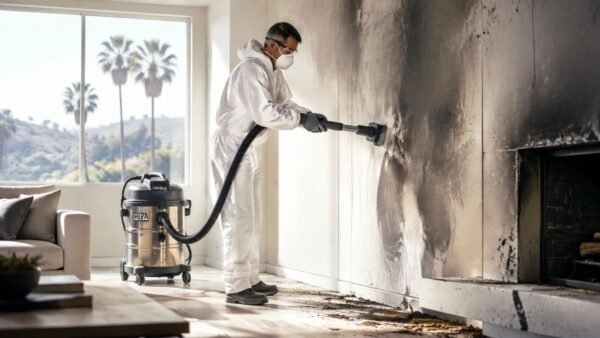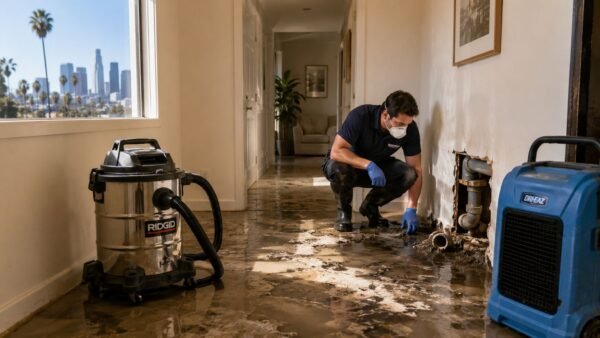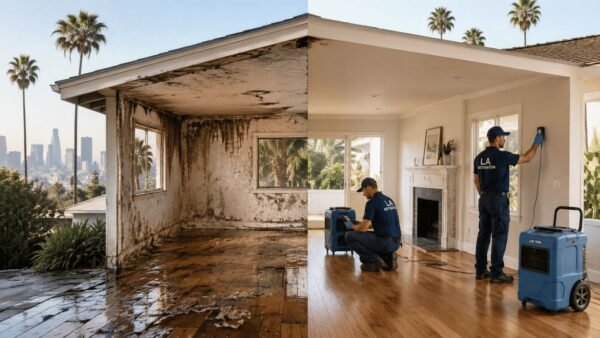

A negative air pressure system is a containment method used in restoration to prevent contaminated air from spreading by using a fan to pull air from a sealed area through a HEPA filter and exhaust it outside. For true containment work, the benchmark depends on the setting: healthcare isolation rooms are held at at least 0.01 inches water gauge with 12 air changes per hour in many cases, while hazardous material containment commonly requires -0.02 inches of water column and at least 4 air changes per hour, increasing to 6 air changes per hour if that pressure target can't be maintained.
You usually start looking this up when something already feels wrong. Maybe a pipe burst behind a wall in Burbank. Maybe you opened a closet in Glendale and found mold growth. Maybe wildfire smoke got into an older Los Angeles home and now every time the HVAC kicks on, the smell moves room to room.
That's when containment matters.
If contaminated air is allowed to drift through hallways, returns, attic gaps, and old plaster cracks, a localized problem can turn into a whole-house cleanup. A professional negative air pressure system stops that spread at the source. It doesn't “clean the whole house by magic.” It creates control. Air moves into the work zone, not out of it, so mold spores, soot, demolition dust, and other airborne particles stay where the crew can capture them safely.
What a Negative Air Pressure System Means for Your Home
A homeowner usually doesn't need a hospital lecture. You need to know whether this setup protects your family and your house. It does, when it's built correctly.
In residential restoration, a negative air pressure system means we isolate the damaged area, seal it, and use specialized equipment to pull air out of that contained zone so contaminants don't escape into clean rooms. If you've got mold in a bathroom wall, smoke residue in a bedroom after a small fire, or demolition dust during a repair, this is the standard way to keep the problem from spreading.
Why containment comes first
In Los Angeles homes, especially in Sherman Oaks, Glendale, and older pockets of Burbank, the building itself creates extra challenges. Older homes leak air through hidden gaps. Newer remodels can be so tight that airflow behaves differently than homeowners expect. Add attic access points, recessed lights, and duct runs, and airborne contamination can travel fast.
A proper setup addresses that before demolition starts.
Practical rule: If a restoration crew starts opening walls before building containment, they're already behind.
That's also why a box fan in a window isn't the same thing. A fan may move air, but it doesn't prove airflow direction, doesn't verify pressure, and doesn't guarantee particles are being captured before they leave the work area.
Indoor air concerns often overlap with HVAC performance, duct leakage, and ventilation balance, which is why homeowners can also benefit from Platinum Heating & Cooling's air quality expertise when they're trying to understand how contaminated air moves through a home.
What it protects
A good containment setup helps protect:
- Occupied rooms: Bedrooms, kitchens, and living areas stay separated from the work zone.
- HVAC pathways: The goal is to stop contaminants from getting pulled into returns and redistributed.
- Contents and finishes: Upholstery, clothes, and porous materials can absorb odor and fine particles if containment fails.
When homeowners ask whether this is overkill, the answer depends on the hazard. For visible mold, smoke damage, heavy dust, or demolition in an occupied home, containment isn't extra. It's the part that keeps a small restoration project from becoming a larger health and cleaning problem.
How Negative Air Pressure Works for Containment
On a Los Angeles loss, containment often starts before the first cut. In an older home with lath and plaster, leaky return ducts, or attic bypasses, fine particles do not stay put on their own. A professional negative air setup creates one controlled direction of travel so dust, soot, mold fragments, or smoke residue stay inside the work zone and out of the rest of the house.
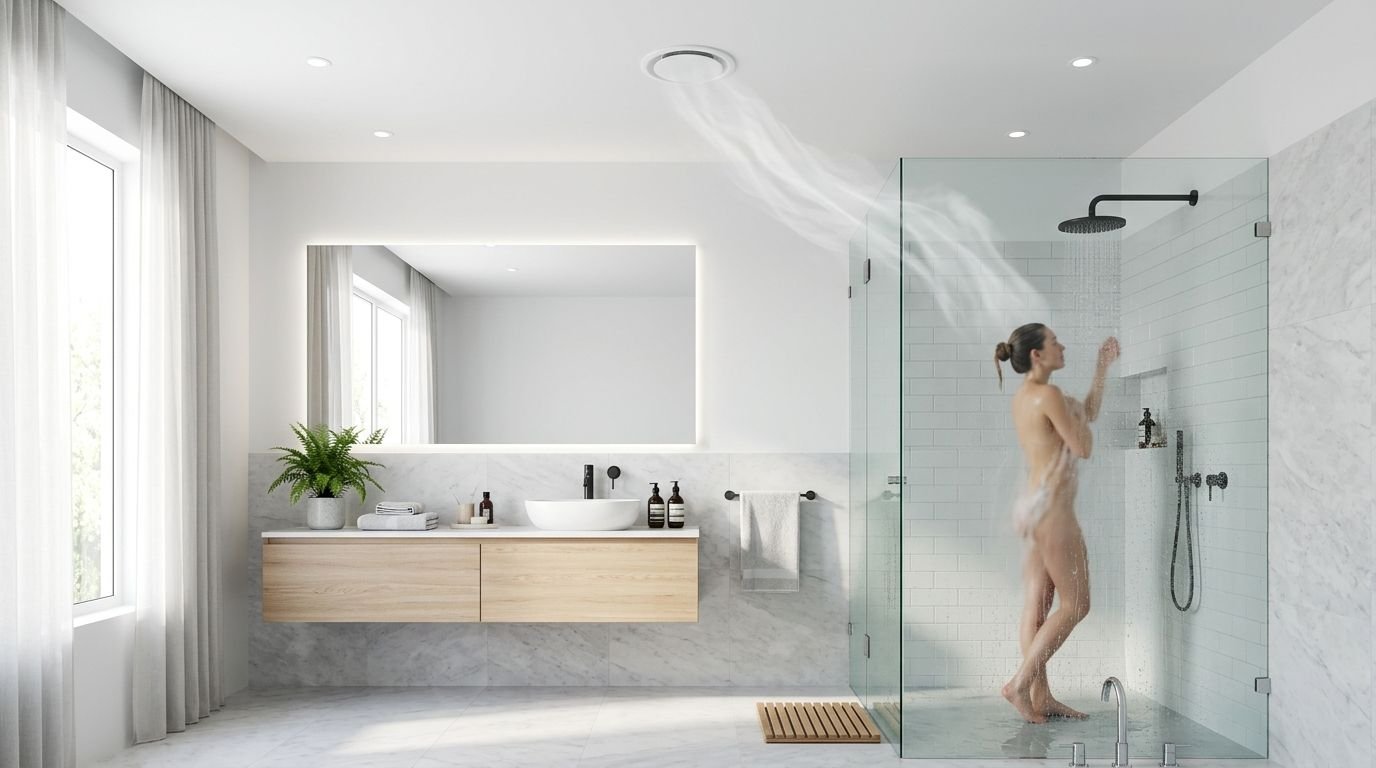
Isolate the work area
The process starts with a sealed containment chamber. Crews use heavy poly, tape rated for the surface, zipper access, and sealed seams at every edge, including the spots homeowners usually do not notice at first, such as supply vents, return grilles, recessed lights, and door undercuts.
Small leaks matter. If air can slip out through an easy opening, the machine will pull from there instead of drawing air in the direction the crew intended.
Depressurize the contained space
Once the barrier is built, the negative air machine removes air from that contained area faster than replacement air can drift back in. That makes the work zone slightly lower in pressure than the surrounding rooms. The result is simple. Air moves from the cleaner part of the house toward the contaminated area.
That pressure difference is what keeps contamination from spilling into occupied spaces during demolition, cleaning, or tear-out.
For homeowners comparing equipment, the machines used for this are the same general type shown in these air scrubber rental options for restoration jobs. The machine only works as intended when the containment is sealed and the pressure is checked on site.
Filter and exhaust the air
The air being removed has to go somewhere. On a proper setup, it is filtered through HEPA media and discharged in a controlled way, often to the exterior when the job conditions allow it. HEPA filtration is used because it captures very fine particles that ordinary household filters can miss, which is why it is standard on serious mold, smoke, and dust containment jobs.
This is also where DIY efforts go wrong in LA homes. A box fan in a window may move visible dust, but it does not confirm pressure, does not seal bypasses, and can pull contaminants through wall cavities or into the HVAC system if the house has hidden leaks.
On a real containment job, the goal is controlled airflow, not just strong airflow.
What CFM and ACH mean in plain English
Homeowners usually hear two terms during setup:
- CFM: Cubic feet per minute. This is how much air the machine can move.
- ACH: Air changes per hour. This is how often the air volume in the containment area is being replaced.
Those numbers only mean something when matched to the actual room. A machine that performs well in a small bathroom may be undersized for an open-plan bedroom suite, and an oversized unit can create practical problems too if the barrier is weak or the makeup air path is poorly planned.
Why simple DIY setups fail
In the field, the difference between a compliant setup and a risky one is verification. A trained crew checks whether the barrier holds, whether the exhaust path is appropriate, and whether the work area is staying under negative pressure while people enter and exit. That matters in Los Angeles homes, where wildfire smoke residue, older construction details, and occupied living spaces make cross-contamination a real concern.
A fan and plastic sheet can create air movement. Professional containment creates predictable air direction, filtration, and control. That is what keeps a localized restoration problem from turning into a whole-house cleanup.
Essential Equipment for a Professional System
On a proper residential containment job, the setup looks closer to a small controlled work zone than a fan in a doorway. In Los Angeles homes, that difference matters. Older plaster walls, attic gaps, and lingering wildfire smoke residue can turn a small cleanup area into a whole-house air problem if the equipment is incomplete or set up poorly.
The machine that creates the airflow plan
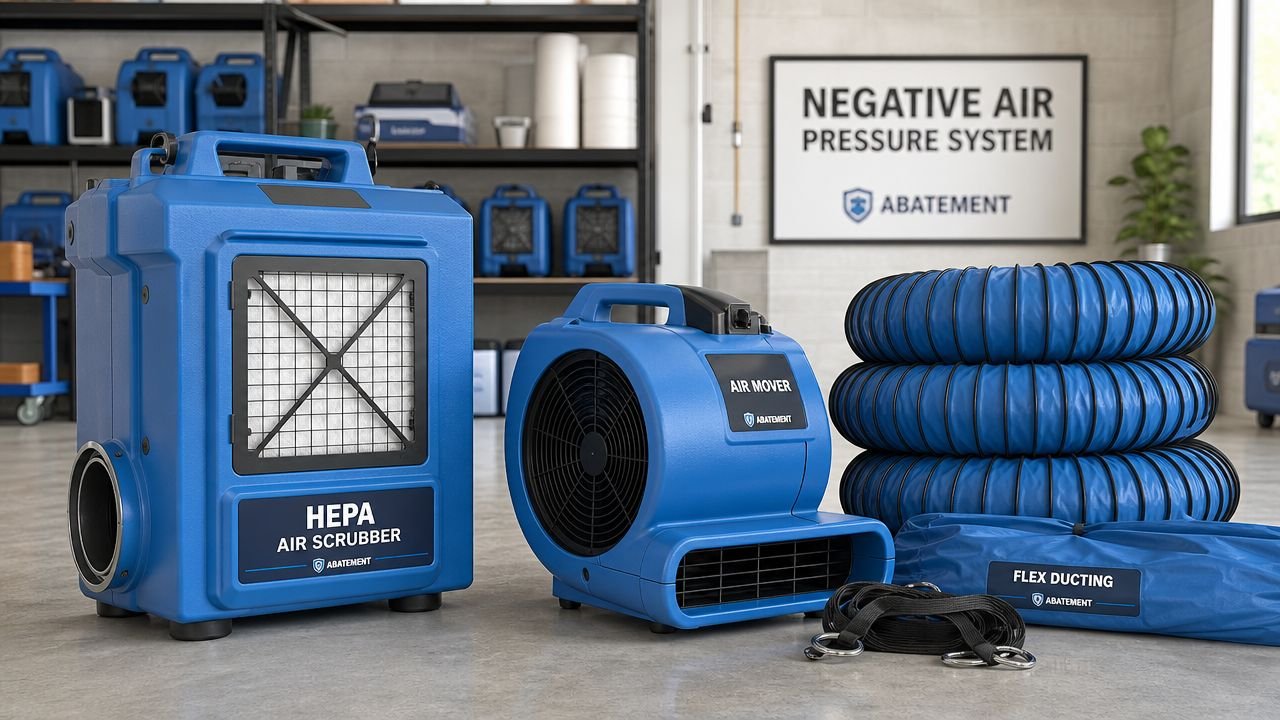
The negative air machine, often called an air scrubber on residential jobs, is the engine of the system. It pulls air from the contained area, runs that air through filtration, and helps maintain the pressure difference the crew is aiming for. On water, mold, and smoke jobs, it is often used alongside other drying and filtration tools like the equipment shown on this water damage restoration equipment page.
Capacity has to fit the space. A unit that works well in a bathroom containment can be undersized for a primary suite, and an oversized unit can stress a weak barrier or create door-control problems if the makeup air path is poorly planned.
The filter that keeps contaminants from cycling back
Homeowners usually focus on the machine housing. The filter inside is what determines whether the system is cleaning the airstream or just moving it.
In professional remediation, the negative air machine is fitted with a true HEPA stage rated to capture very fine airborne particles. That matters during demolition and cleanup, when disturbed mold, soot, insulation dust, and drywall debris can stay suspended in the air. A standard household filter is not built for that job.
A DIY setup often misses this point. Box fans, shop filters, and taped-together add-ons may move air, but they do not give the same level of filtration or performance control under job conditions.
The containment barrier that makes the machine work
Plastic sheeting, telescoping poles, zipper doors, and sealing tape do not look technical, but they do a lot of the heavy lifting. If the barrier leaks, air takes the path of least resistance and the machine starts pulling from places the crew did not intend.
That is a common issue in Los Angeles houses. I see it in lath-and-plaster walls, uneven casings, older recessed lights, attic access panels, and warped interior doors. The barrier has to be built around the house as it exists, not as it looks in a product diagram.
The parts that are easy to overlook
Flex ducting and exhaust routing matter because the air has to leave the work area safely. If discharge is handled poorly, contaminants can be pushed into the wrong part of the property or too close to an entry point.
The manometer is just as important. It verifies that the containment area is staying under negative pressure while the crew works, while people pass through the zipper door, and while conditions change during the day. Without that reading, pressure control is an assumption.
Here's a quick look at how the gear works together:
| Equipment | What it does | What goes wrong without it |
|---|---|---|
| Negative air machine | Pulls air out of containment | No stable pressure relationship |
| HEPA filtration | Captures fine contaminants | Particles can recirculate |
| Poly barrier and tape | Seals the work zone | Air escapes through gaps |
| Flex ducting | Routes exhaust safely | Dirty air can discharge in the wrong place |
| Manometer | Verifies pressure | Crew can't prove containment is holding |
A simple visual walkthrough helps homeowners see what a proper setup looks like in the field.
Why professional setups hold up better in occupied homes
In an occupied house, the system has to keep working while doors open, workers move debris, and the rest of the family still needs safe air outside the work zone. That is where a professional setup separates itself from a weekend DIY attempt. The trade-off with DIY is pricing materials without pricing the downside.
A homeowner can buy plastic and a fan. A compliant containment setup needs matched equipment, sealed barriers, filtered exhaust, and pressure verification that holds under real conditions.
Common Restoration Applications in Los Angeles
At an LA house, containment usually becomes real the moment demolition starts. A crew opens a plaster wall in a 1930s home, or pulls wet drywall after a supply-line leak, and whatever was trapped inside that cavity can move into hallways, bedrooms, and return vents fast if the work area is not under control.

Los Angeles homes make that harder than many generic guides suggest. Older houses often have hidden bypasses around framing, attic connections, and patched-over remodel work. Newer remodels can be tighter, which changes how air pulls through the structure. Add wildfire smoke, occupied homes, and mixed HVAC conditions, and a professional setup has to be designed for the building, not copied from a video.
Mold in older homes
A common Glendale or Sherman Oaks call starts with a leak that looked minor. Maybe it sat behind a vanity, under a window, or inside a kitchen wall for weeks before anyone saw it. Once demolition begins, disturbed mold growth and contaminated dust can spread beyond the visible damage.
A proper negative air setup keeps the work area pulling inward so that loosened particles move toward the machine, not into the rest of the home. In practice, that matters most in houses where family members are still sleeping ten feet away from the containment. Homeowners dealing with that kind of project usually need mold remediation in Los Angeles, not a wipe-down and a box fan.
If mold cleanup leaves a fine dust outside the work area or the house smells musty afterward, the containment likely did not hold.
Fire and wildfire smoke cleanup
In Los Angeles, smoke work often comes from two different events. One is a direct property fire. The other is wildfire smoke that finds its way into attics, insulation, closets, and wall cavities even when the house never burned.
During demolition, soot and odor-bearing particles can become airborne again. Negative air helps control that release inside the isolated work zone while crews remove damaged material and clean surfaces. That matters in occupied homes, especially after regional smoke events, because homeowners often need part of the house to stay usable while restoration is underway. For direct fire loss or smoke intrusion, the scope often expands into fire damage restoration in Los Angeles.
Water damage that turns into an air-quality problem
Water losses often start with extraction and drying, then shift into controlled removal. Wet drywall, insulation, underlayment, and cabinet backing can release contaminated dust once they are cut out. Bathrooms, laundry rooms, and kitchens are common trouble spots because they are enclosed and usually connected to active exhaust or HVAC pathways.
That is one reason DIY setups fail in real homes. A homeowner may add more fan power and assume more airflow means more safety. In the field, the trade-off is more complicated. Too much uncontrolled exhaust can pull air from the wrong places, spread debris, or interfere with appliance drafting in homes with combustion equipment. We set containment to control the work zone, then verify that the rest of the house is not being put at risk.
When whole-home negative pressure causes problems
Negative pressure belongs inside containment, not across the whole house.
If the entire structure is pulled negative, outside air can enter through attics, crawlspaces, wall gaps, fireplace assemblies, and other leakage paths. In Los Angeles, that can mean drawing in dusty attic air in an older home, or pulling residual smoke odors back into living spaces after a wildfire event. It can also create comfort and combustion-safety issues if the system is set up carelessly.
That is the practical difference between a professional plan and a DIY attempt. A trained crew isolates the affected area, filters the exhaust, checks how the house is responding, and adjusts the setup as conditions change. If you are comparing options for a larger cleanup, professional restoration services for containment and structural cleanup should treat negative air as one part of the job, not the whole strategy.
Safety Standards and Performance Metrics
In a Los Angeles home, containment has to do more than look tidy. It has to hold when the air conditioner kicks on, when an older door does not seal perfectly, and when fine soot or mold particles try to ride airflow into the rest of the house. That is why professional crews work to a measurable standard instead of relying on a fan and plastic alone.
The measurements that matter
For regulated containment work such as asbestos abatement, crews are expected to maintain a defined negative pressure and verify that the enclosure is exchanging enough air to keep contaminants under control. The commonly cited target is -0.02 inches of water column, with a minimum air exchange rate that can be increased if the enclosure is not holding pressure. Minnesota's asbestos rule lays out that requirement clearly, including continuous operation of a HEPA-filtered negative air system and increased air changes if needed under Minnesota Rule 4620.3570.
For a homeowner, the practical point is simple. If the contractor cannot show pressure readings and explain how they are checking them, the setup is not being managed at a professional level.
Why those standards exist in real homes
Pressure numbers are not paperwork filler. They tell us whether air is moving into the work area instead of letting contaminated air escape into hallways, bedrooms, or return vents.
That matters even more in older Los Angeles housing stock. Many homes here have hidden leakage paths around attic hatches, recessed lights, plaster cracks, wall cavities, and aging windows. After wildfire smoke events, those same pathways can carry odor and fine particulate in unpredictable ways. During demolition or cleanup, a weak enclosure can fail without looking dramatic from the outside.
A machine can be running the whole time and the containment can still be underperforming. We verify, then adjust.
Training and documentation separate a real setup from a risky one
A qualified contractor should be able to walk you through five things without hedging:
- How the containment is sealed at floors, walls, doors, and penetrations
- How air is being pulled through the work zone and filtered
- What instrument is being used to measure pressure differential
- What the crew does if readings drift or the enclosure is opened
- What records are kept for clearance, insurance, or project files
Training matters because the equipment only works when the setup is correct. Homeowners who want to vet that background can review this explanation of IICRC certification for restoration and remediation work.
What to ask before work starts
Ask direct questions.
- How will you confirm the containment stays negative during the job?
- Are you using HEPA-filtered negative air machines, not standard fans?
- Will the system run continuously while the hazard is active?
- Who checks the readings, and how are those checks documented?
- How do you protect the rest of the house if HVAC operation or door openings affect airflow?
Those answers usually tell you whether you are hearing a field-tested plan or a DIY-style setup dressed up with industry terms.
Hiring a Certified Pro vs DIY Risks
DIY containment usually looks convincing from the doorway. Plastic is up. A fan is humming. The smell seems reduced. That doesn't mean the system is holding under real conditions.
What we see on failed DIY jobs
In our experience restoring homes in Sherman Oaks and nearby Los Angeles neighborhoods, the most common DIY failure isn't effort. It's false confidence. Homeowners often work hard, but they use thin plastic, leave hidden leaks around trim and ceilings, and rely on a single fan without pressure monitoring.

Then the HVAC cycles on. Someone opens the barrier door. Outdoor temperature shifts. The airflow relationship changes.
According to the discussion summarized in this AskEngineers thread about pressure changes and monitoring, conditions like door openings or HVAC cycling can collapse containment integrity in minutes, and continuous electronic monitoring with alarms is the only reliable method for sustained negative pressure in changing conditions.
The real trade-off
DIY seems cheaper because you're only pricing materials. You're not pricing the downside.
If containment fails, you may end up with:
- Cross-contamination: Soot, spores, or dust move into clean rooms.
- Longer restoration: More surfaces need cleaning or removal.
- Insurance headaches: A poorly documented or expanded loss can complicate claim handling, especially if contamination spread could have been limited.
- Repeat work: The same area may need to be reopened and re-cleaned.
For homeowners trying to understand how contractor credentials affect cleanup quality, Restoration Pro is one example of a service page that reflects the type of professional restoration scope involved in monitored containment work.
Professional containment costs less than failed containment plus a second cleanup.
When a pro is the safer call
If the job involves mold, smoke residue, demolition in an occupied house, or any chance of contaminant spread through the HVAC system, this isn't the place to experiment. The right setup protects the parts of the home that were never damaged in the first place.
Frequently Asked Questions About Negative Air Systems
How long does a negative air pressure system need to run
It needs to run continuously for as long as the containment hazard exists. If the work area is still open, contaminated material is still present, or demolition is still underway, shutting the machine down can break containment. On professional jobs, the equipment stays on throughout the active phase of remediation.
Are negative air machines loud
Yes, most homeowners notice them. They sound more like jobsite equipment than a normal home appliance. The trade-off is that a properly sized machine is doing real air movement and filtration work. Crews can often reduce disruption with smart placement, duct routing, and limiting unnecessary traffic around the containment area.
Can you stay in your home while it's running
Sometimes, yes. It depends on the size of the affected area, what material is being removed, whether the HVAC system intersects the work zone, and whether the home still has safe, practical living space outside containment. A small isolated bathroom project is different from a smoke-damaged main floor.
Is a negative air machine the same as an air purifier
No. An air purifier usually recirculates air in an open room. A negative air setup is part of a containment system. It works with sealed barriers, controlled airflow, and exhaust planning to keep contamination from spreading during restoration.
What should I ask a contractor before they start
Ask how they'll seal the work zone, how they'll verify pressure, whether they're using HEPA filtration, and how they'll document the containment. If the answers are vague, keep asking.
If you're dealing with mold, smoke, or water damage in Los Angeles, CA, don't guess with containment. Onsite Pro Restoration handles residential and commercial restoration work throughout areas like Burbank, Glendale, and Sherman Oaks, with the equipment and documentation needed for controlled cleanup. Call 818-336-1800 for a free inspection.
Meta description: Negative air pressure system guide for Los Angeles homeowners. Learn how pros contain mold, smoke, and dust safely during restoration.
SEO title tag: Negative Air Pressure System for LA Homes
Schema opportunities: FAQ, LocalBusiness, HowTo