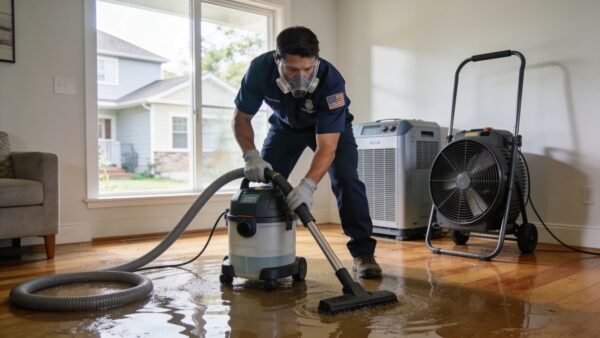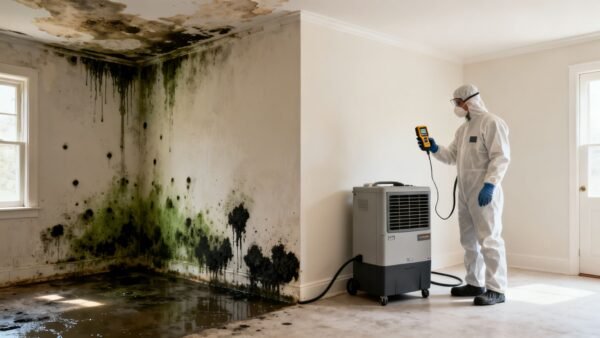

Finding mold in your Los Angeles home can be an unnerving experience. That's why hiring professional mold removal contractors is the only way to handle it safely and effectively. What you can see is often just the tip of the iceberg; the real problem usually hides behind walls, like in a Sherman Oaks home with a flat-roof leak, or under floors in a Santa Monica property dealing with coastal fog. This hidden growth puts both your property and your family's health at risk.
The Hidden Dangers of DIY Mold Removal
It’s tempting to grab a bottle of bleach and start scrubbing. Many homeowners do, thinking it's a quick fix. Unfortunately, this common DIY mistake often makes things much, much worse. Bleach might kill surface mold, but it can't penetrate porous materials like drywall or wood. This leaves the mold’s root system untouched, free to grow right back.
Even worse, scrubbing at mold without the right containment measures sends millions of microscopic spores airborne. Those spores can easily travel through your HVAC system, contaminating other parts of your home and turning a small problem in one corner into a full-blown infestation.
Why You Need a Professional Remediation Expert
Professional mold removal contractors are more than just cleaners—they’re environmental specialists for your home. They follow a systematic, IICRC-approved process designed to protect your property and ensure the air you breathe is clean.
A certified expert will:
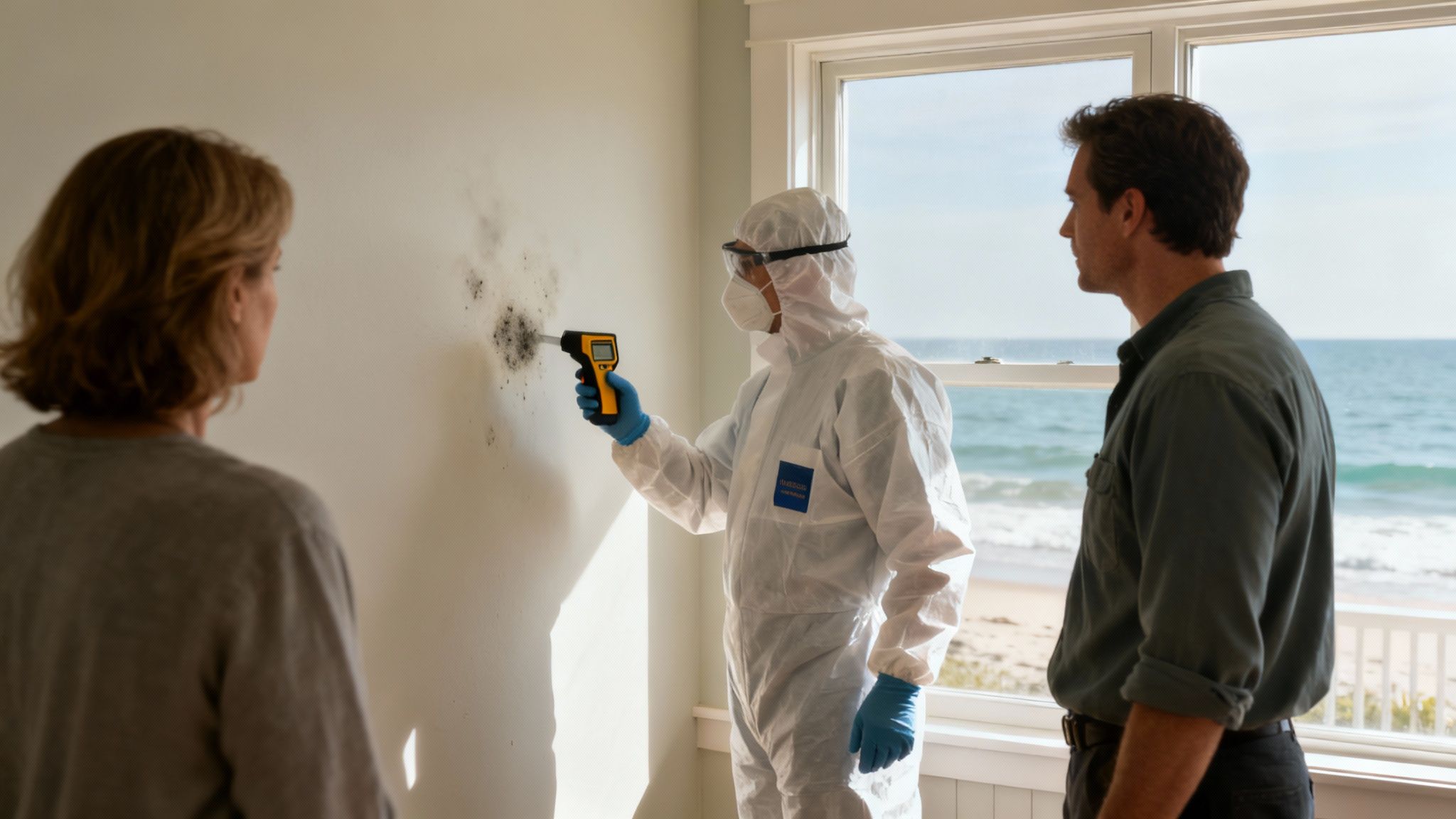
- Find the Source of the Moisture: They don't just clean the mold; they find out why it grew. Using tools like thermal imaging cameras and moisture meters, they pinpoint the hidden leak or humidity issue that’s feeding the problem.
- Set Up Proper Containment: Pros will seal off the affected area with plastic sheeting and use negative air pressure machines. This is a critical step that prevents cross-contamination, ensuring spores are captured, not spread.
- Remove Contamination Safely: Following strict industry standards, they remove compromised materials and use specialized HEPA vacuums to pull spores out of the air.
- Restore a Healthy Environment: The final step involves treating surfaces to discourage future growth and verifying that the area is clean, dry, and safe.
Think about a home in Santa Monica, where the constant coastal fog creates a damp environment. A professional assessment could uncover moisture hiding behind the walls that a homeowner would never find on their own, stopping long-term structural damage before it starts. As people become more aware of mold-related health issues, the demand for true experts is climbing. In fact, the global mold removal services market is expected to grow from USD 1.50 billion in 2024 to USD 2.02 billion by 2032.
You can read more about the growing demand for professional mold services on stellarmr.com. For a deeper dive into the local risks, check out our guide on why mold removal is so important for Los Angeles homes.
Decoding Certifications for Mold Removal Contractors
Navigating the world of mold removal contractors can feel a bit like the Wild West, especially since California doesn't issue a state-specific license for mold remediation. This lack of official state oversight makes third-party certifications the single most important sign of a contractor's expertise and commitment to doing the job right.
Think of these credentials as a professional's diploma in the science of getting rid of mold safely and for good. They prove a company has invested in real training, understands the complex biology of mold, and follows industry-wide safety protocols. It's your best assurance that they won't just paint over the problem.
The Gold Standard: IICRC Certification
When it comes to property restoration, one name stands above the rest: the Institute of Inspection, Cleaning and Restoration Certification, or IICRC. This isn't just another logo; the IICRC literally wrote the book on how to handle mold correctly.
If a company is IICRC-certified, it means their technicians have been trained and tested on the S520 Standard for Professional Mold Remediation. This document is the industry bible, outlining the proven, science-backed procedures for every step of the process.
An IICRC-certified pro knows how to:
- Set up proper containment zones to stop microscopic spores from spreading through your home.
- Use specialized equipment like HEPA air scrubbers and vacuums that actually capture mold, not just blow it around.
- Protect the health of your family and their own crew during the entire project.
Choosing an IICRC-certified firm is the closest thing you can get to a guarantee in this industry. It means the job will be done safely, correctly, and thoroughly the first time, protecting your property's value and preventing a dreaded callback.
Understanding Key Mold Remediation Certifications
While the IICRC is the big one, seeing other credentials shows a contractor has gone the extra mile. Here’s a quick rundown of the key certifications and why they should matter to you.
| Certification Body | What It Signifies | Why It Matters for Your Project |
|---|---|---|
| IICRC (Institute of Inspection, Cleaning and Restoration Certification) | The technician has passed exams based on the industry's highest standard (S520). It’s the foundational, most recognized certification. | This is non-negotiable. It ensures the team understands containment, safety, and proper removal techniques to prevent cross-contamination. |
| ACAC (American Council for Accredited Certification) | This is a board-awarded certification, not just a training course. Designations like CMR (Council-certified Microbial Remediator) are for experienced pros. | A step above basic training, ACAC credentials often signify years of field experience and a deeper understanding of building science and mold behavior. |
| AMRT (Applied Microbial Remediation Technician) | This is a specific IICRC course focused on the hands-on process of mold removal, from containment and pressure differentials to cleaning and disposal. | This proves the technician has specific, practical skills for the job site, not just theoretical knowledge. They know how to execute the plan. |
At the end of the day, any reputable mold removal contractor will be proud to show you their certifications. Don't be afraid to ask for them! Verifying these simple documents is a crucial step in ensuring the team you hire has the proven skills to bring your home back to a safe, healthy state.
The Professional Mold Remediation Process Step-by-Step
When you bring in professional mold removal contractors, you're not just paying someone to scrub a wall. You're investing in a scientific, step-by-step process designed to get your home's air quality and structure back to a healthy state. Knowing what to expect when they show up can take the mystery out of the whole thing and give you confidence in the results.
The entire procedure is built on one simple rule: get the mold out for good while making sure its spores don't get a free ride to clean areas of your home.
It all starts with a thorough assessment to pinpoint not just the visible mold, but the hidden water source that’s fueling the problem. Imagine you've got a musty smell in your Sherman Oaks kitchen. A true professional won't just glance at a discolored cabinet. They'll pull out moisture meters and thermal cameras to find the slow, silent leak inside the wall that's feeding the colony.
Step 1: Containment and Air Filtration
Once the source is identified, the crew’s first move is to set up a containment barrier. This is non-negotiable. They'll use thick plastic sheeting to seal off the entire contaminated area, then create negative air pressure with specialized fans that vent outside.
Think of it as building a "clean room" in reverse. It guarantees that any disturbed dust and airborne mold spores are pulled out of your house, not pushed into it.
Inside this sealed-off zone, the air is scrubbed clean around the clock.
- HEPA Air Scrubbers: These machines are the workhorses, running 24/7 to capture microscopic mold spores right out of the air.
- HEPA Vacuums: Unlike your standard vacuum that can actually spread spores, these are designed to safely lift contaminated dust from surfaces before any demolition begins.
Following this strict protocol is what separates a real, lasting fix from accidentally making the problem ten times worse. The growing understanding of these crucial steps is a big reason why the global mildew remover market, a closely related industry, was valued at USD 874.1 million in 2024 and is expected to keep climbing.
Before you hire anyone, it's vital to make sure they follow these kinds of high standards. This infographic breaks down the simple vetting process.
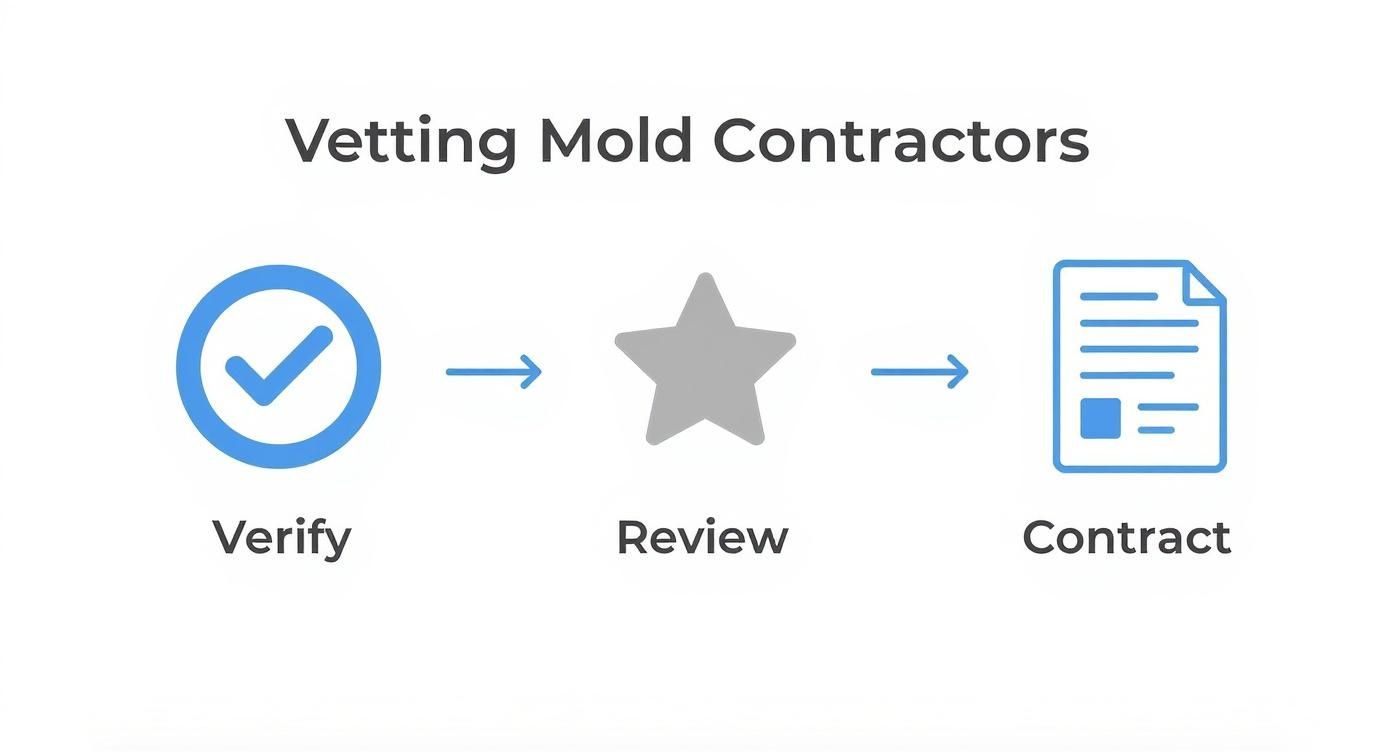
As the graphic shows, taking the time to verify credentials, check out past projects, and get a clear contract in writing is your best defense against a job done poorly.
Step 2: Removal and Final Verification
With the containment secure, the technicians get to work. They carefully remove any porous materials that can't be saved, like drywall and insulation, sealing them in heavy-duty bags for safe disposal. Any non-porous surfaces are then meticulously cleaned down with antimicrobial agents.
This isn't a rush job; it's a careful, methodical process that ensures nothing is missed. You can dive deeper into what a full professional mold remediation service involves and see exactly what to expect from our team.
How Mold Remediation Costs Are Calculated in Los Angeles
One of the first questions homeowners have is, "What's this going to cost?" Unlike a simple handyman service with a flat rate, mold remediation pricing is completely custom. There’s no such thing as a one-size-fits-all estimate because every mold situation is unique to the property.
The final price tag comes down to a handful of key factors that mold removal contractors look for during their initial inspection. If you understand these variables, you’ll be able to make sense of any quote you get and see the real value behind the numbers.
Key Cost Factors Driving Your Quote
The scope of the work is what really drives the total cost. Here’s a breakdown of what professionals are evaluating:
- Size of the Affected Area: This is the biggest piece of the puzzle. A small patch of mold tucked in a bathroom corner will cost a fraction of what an infestation spread across an entire basement or attic would.
- Location and Accessibility: Is the mold growing out in the open, like under a kitchen sink? That’s relatively easy to tackle. But if it’s hidden deep inside a wall, snaking through an HVAC system, or in a tight crawlspace, the labor required to get to it goes up.
- Extent of Demolition: Mold loves to eat into porous materials like drywall, insulation, and carpet. If it has penetrated these surfaces, they can't be salvaged—they have to be carefully cut out, bagged, and replaced. The more structural work involved, the higher the cost.
- Type of Mold: This isn't always a huge price driver, but certain types of mold might require more intensive containment and safety protocols, which can slightly increase labor costs.
A suspiciously low bid is almost always a red flag. It often means a contractor is planning to cut corners on critical steps like proper containment or post-remediation testing, which puts both your home and your family’s health on the line.
To get a clearer picture, you can start with a ballpark figure. Our mold removal cost calculator is a great tool for breaking down the potential expenses for your specific issue. This kind of transparency helps you budget properly and evaluate the professional estimates you receive with confidence.
How to Choose the Right Mold Removal Company in LA

Picking the right mold removal contractor is easily the most important decision you'll make to protect your Los Angeles property. It’s not just about checking for certifications; your vetting process needs a few practical steps to make sure you’re bringing a skilled and trustworthy pro into your home.
A legitimate contractor will always carry comprehensive insurance. This is non-negotiable.
- General Liability Insurance: This protects your property from any accidental damage while they’re working.
- Workers' Compensation: This protects you from being on the hook financially if a technician gets hurt on your property.
Always ask to see proof of both policies before you even think about signing a contract.
Spotting Common Industry Red Flags
As you start calling around, keep an eye out for some common red flags. High-pressure sales tactics or scare stories designed to make you sign a contract on the spot are huge signs of an unprofessional outfit.
Another major warning sign is a company that offers to do both the initial, independent mold testing and the remediation work that follows.
This creates a significant conflict of interest. An ethical process requires that the company testing for mold is a separate, unbiased third party from the one performing the cleanup.
The global mold remediation service market was valued at USD 1.23 billion in 2023, and North America makes up over 39% of that. That growth means there are a lot of companies out there, making it even more important to find the truly qualified ones.
Dig into online reviews and don't be afraid to ask for local references to get a real sense of a contractor's reputation. To find the best pros, it also helps to understand how reputable companies build their online presence, often using a complete local growth playbook for contractors.
Taking these extra steps will help you confidently choose from the top mold removal companies in Los Angeles and ensure the job is done right the first time.
FAQs About Hiring Mold Removal Contractors
When you're facing a potential mold problem, questions are bound to pop up. As a Los Angeles contractor, I hear the same concerns from homeowners all the time. Here are some straight answers to the most common ones.
Q: How long does professional mold removal take?
A: The timeline depends on the scale of the contamination. A small, contained patch in a bathroom can often be resolved in 1-3 days. However, a larger issue that has spread into the drywall of a basement or attic can easily take a week or more, especially if significant demolition and rebuilding are required. A reputable contractor will provide a clear timeline after a thorough inspection.
Q: Is it safe to stay in my house during remediation?
A: For minor jobs, you can often stay. A professional team will completely seal off the work area with plastic barriers and negative air pressure, keeping the rest of your home safe. However, for extensive projects or if mold is in your HVAC system, it is almost always recommended that you find alternative accommodation to avoid any risk of inhaling airborne spores or cleaning agents.
Q: Will my homeowners insurance cover mold removal costs?
A: This is complicated. Coverage depends on your specific policy and the cause of the moisture. Generally, if mold resulted from a "sudden and accidental" event covered by your policy (like a burst pipe), the costs are often included. If the mold is from a slow leak, high humidity, or lack of maintenance, it is almost always excluded. Learn more about whether mold remediation is covered by insurance and contact your insurance agent immediately.
Q: What is the difference between mold removal and mold remediation?
A: People often use these terms interchangeably, but they are very different. "Mold removal" is the simple act of physically getting rid of visible mold. "Mold remediation" is the comprehensive professional process. It includes finding and fixing the moisture source, containing the area to prevent spore spread, using air scrubbers to clean the air, and restoring your property to its pre-mold condition. A true professional performs full remediation, not just removal.
Q: Should I get a mold test before hiring a contractor?
A: Yes, it's a wise first step. An independent mold inspection and testing company can provide unbiased data on the type and concentration of mold spores in your home. This third-party report gives you leverage and ensures the remediation company has a clear, data-driven scope of work to follow, preventing unnecessary work and expense.
Q: Can mold in my Los Angeles home make my family sick?
A: Yes. Mold exposure is linked to a range of health issues, especially respiratory problems like asthma, allergies, and sinus infections. Some people may also experience headaches, fatigue, and skin irritation. The health risks are a primary reason why professional remediation by qualified mold removal contractors is crucial for protecting your family.
If you're staring at a mold problem and need answers now, don't let it get worse. Onsite Pro Restoration offers 24/7 emergency services across Los Angeles. Give us a call, and we’ll provide a fast, professional assessment and a clear plan to get your home back to normal.