
A glass of red wine tips over. Or it’s coffee on a Monday morning. Or a child drops a plate, and the sauce splashes farther than seems possible. The stain spreads fast, and the first instinct is usually the wrong one.
If you’re searching for how to get stains out of carpet, the good news is that many spots can be removed if you act quickly and use the right method for the right material. The bad news is that panic, scrubbing, and over-wetting often turn a manageable spill into a lingering problem.
Some carpet stains are simple surface issues. Others are a warning sign that liquid has moved into the backing, pad, or even the subfloor beneath. In Los Angeles homes, that distinction matters. A small spill near a patio door in Studio City, a leak from an AC line in Sherman Oaks, or a pet accident in a carpeted bedroom can all look minor on the surface while causing much bigger issues underneath.
If the carpet feels soaked, the stain keeps returning, or there’s a musty smell after cleanup, get professional guidance right away instead of guessing.
That Sinking Feeling A Spilled Glass on Your Carpet
The moment after a spill is usually silent.
You look down, see the dark shape spreading across light carpet, and start calculating how bad this is going to be. Red wine on a cream runner. Coffee next to the sofa. A bowl of ramen hitting the floor in a rental you just had cleaned.
Most homeowners aren’t dealing with a stain in calm conditions. They’re dealing with it while guests are over, while they’re late for work, or while they’re also trying to keep a dog or toddler out of the mess. That’s why bad stain advice sticks around. People grab the nearest towel, press hard, scrub fast, and hope force will fix it.
It usually won’t.
Fresh stains respond best to control, not aggression. Carpet fibers trap soil, moisture, oils, and dyes in different ways depending on what was spilled and how long it sat. A coffee spill behaves differently from cooking grease. Pet urine is different from ink. Blood is different from red sauce. The method has to match the stain.
In Los Angeles homes, there’s another wrinkle. A stain isn’t always just a stain. Water from a window leak after a storm, a burst supply line behind a wall, or condensation around an HVAC issue can show up first as discoloration in carpet. Homeowners sometimes treat it like a spot when it’s really a moisture problem.
That’s why the smartest approach is simple. Stop the spread first. Identify the stain second. Use the least aggressive effective method third. If the spot comes back, smells strange, or seems larger after drying, assume the issue goes deeper than the face fibers.
What usually works best
- Fast response: Fresh spills are easier to remove than dried, worked-in stains.
- Controlled moisture: Enough solution to loosen the stain, not enough to soak the pad.
- Stain-specific chemistry: Dish soap, vinegar, enzyme cleaner, or a solvent each do different jobs.
- Thorough drying: A spot that stays damp can become a different problem altogether.
The best stain removers don’t just make a spot look better for an hour. They remove the material causing it and leave the carpet dry enough that it won’t wick back.
The First 60 Seconds Your Quick-Response Stain Protocol
The first minute matters more than the cleaner you use later.
A key milestone in professional carpet stain removal came in 1997, when the International Fabricare Institute approved the Carpet Stains 4-1-1 protocol, which emphasized blotting over scrubbing because scrubbing can permanently damage carpet fibers. Daniel McPherson notes that scrubbing roughens fibers irreversibly, while blotting uses wicking action to lift the stain gently (Carpet Stains 4-1-1 best practices).
What to grab immediately
Don’t run a chemistry experiment in the moment. Grab a few basic things:
- White cloths or white paper towels: Colored towels can transfer dye.
- Cold water: Safe for most fresh spills while you assess what you’re dealing with.
- A spoon or dull edge: Useful if there are solids to lift first.
- A spray bottle: Better control than pouring water directly onto the carpet.
If the carpet is more than surface-wet, drying becomes the next priority. This guide on how to dry wet carpet fast is useful when the spill or leak is larger than a normal spot-cleaning job.
The non-negotiable rule
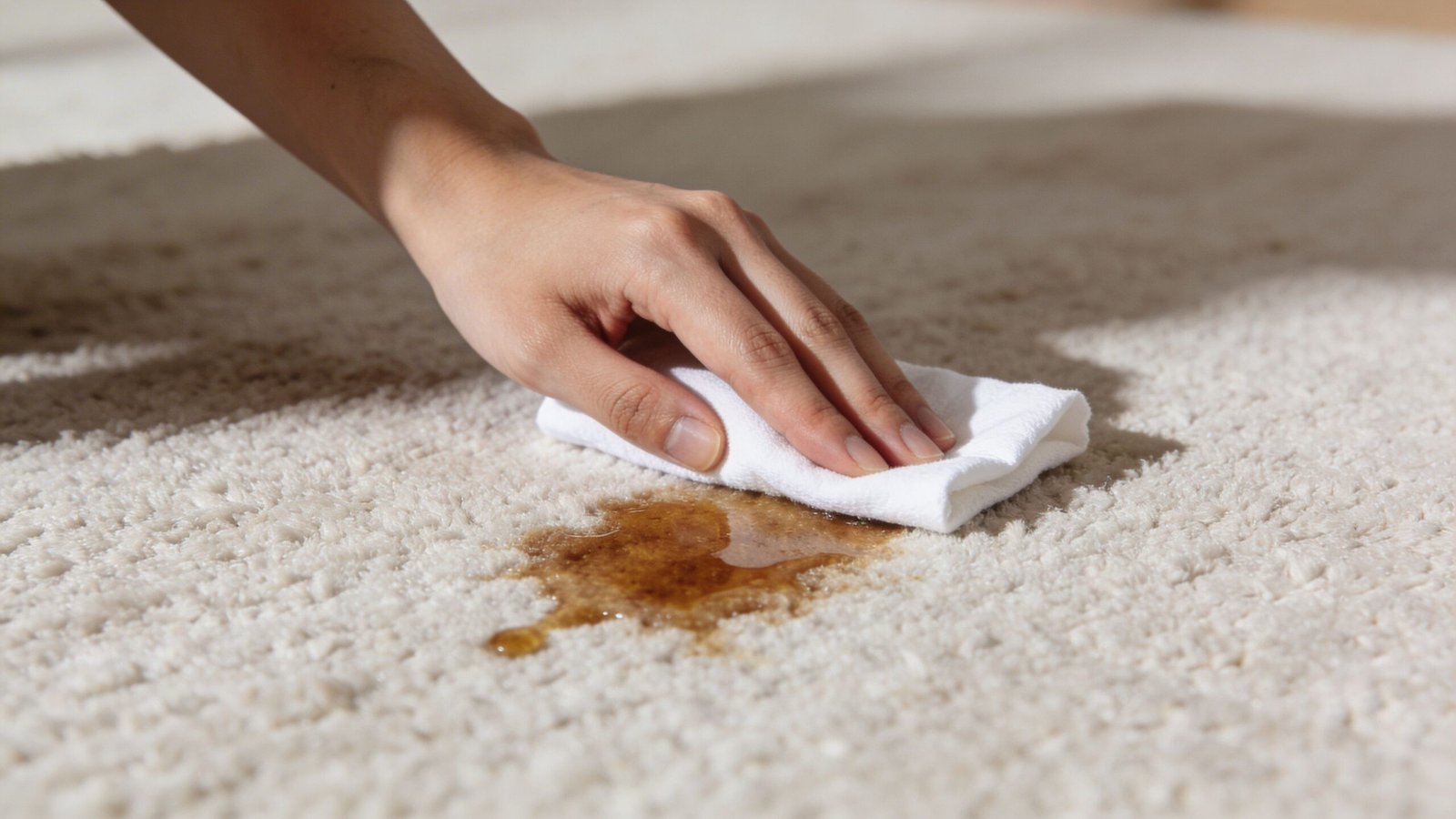
Blot. Don’t scrub.
Press the cloth into the stain. Lift. Move to a clean section of the cloth. Press again. Keep working from the outside edge toward the center so you don’t spread the stain wider.
Scrubbing feels productive because it creates movement. On carpet, that movement usually frays the fibers and pushes soil or dye deeper into the pile.
Practical rule: If your motion looks like you’re trying to polish the carpet, stop. Use pressure and absorption instead.
The first-aid sequence
Use this exact order for almost any fresh spill:
- Lift solids first: If there’s food, mud, or thick residue, scoop it gently.
- Blot up free liquid: Don’t add cleaner yet.
- Apply a small amount of cold water: Lightly mist or dampen the area.
- Blot again: You’re diluting what remains and pulling it upward.
- Repeat until transfer slows: Then decide on a stain-specific treatment.
What people get wrong in the first minute
A lot of failed DIY jobs come from one of these mistakes:
- Using too much water: That can push contamination into the backing.
- Using hot water immediately: Some stains react badly to heat.
- Rubbing with a brush: This distorts the carpet texture.
- Using random products together: Mixing cleaners can make residue worse and harder to rinse.
A fresh spill gives you a narrow window where a simple response works well. The goal isn’t to “clean the carpet” in the first minute. The goal is to keep the spill from becoming a set stain.
Identifying and Treating Common Household Carpet Stains
Once the immediate panic is under control, the next step is diagnosis.
A stain tells you what type of soil you’re dealing with. Water-based stains need one approach. Oily stains need another. Organic contamination, especially pet accidents, needs removal that addresses both the visible spot and what’s causing the odor.
This visual is a good quick reference before you start.
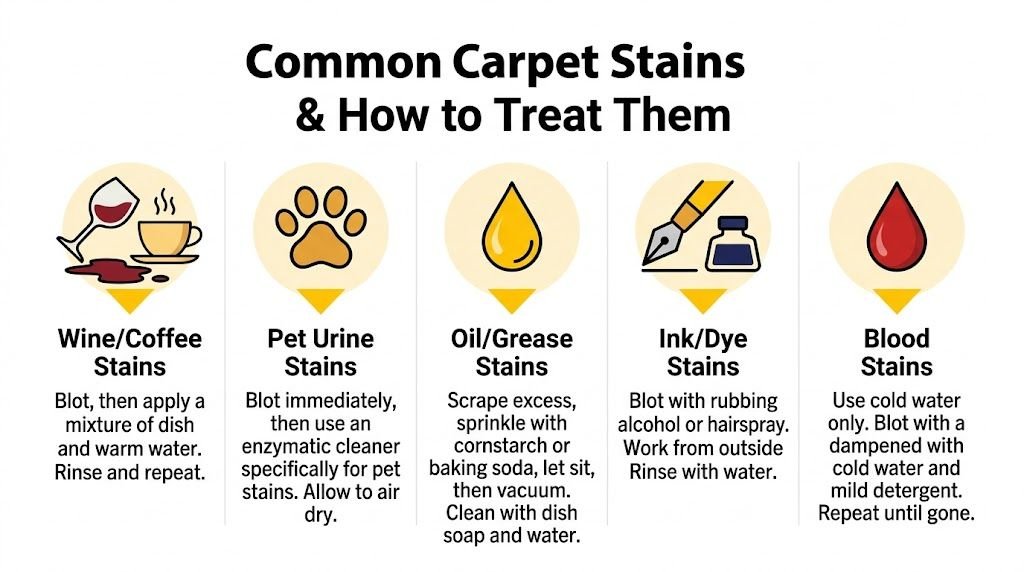
Wine and coffee stains
These stains often leave brown, red, or rust-toned discoloration. They spread fast and can settle into the tips of the fibers first, then deeper if walked on.
For a fresh spill:
- Blot immediately: Remove as much liquid as possible.
- Mix mild dish soap with water: Use a small amount on a white cloth.
- Work from the outer edge inward: This keeps the stain from expanding.
- Rinse lightly with clean water: Then blot dry again.
Why this works: dish soap acts as a surfactant. It helps release residue clinging to fiber surfaces.
If the stain has dried, lightly re-dampen it first so you’re not trying to remove a crusted deposit dry. Don’t soak it. You want control, not saturation.
If coffee had cream or sugar in it, the visible stain and the sticky residue aren’t the same problem. One affects color. The other attracts soil later if you don’t rinse well.
For homeowners who want another practical outside reference, this guide on how to remove stubborn stains from your carpet gives a useful homeowner-friendly overview of common spot types.
Later in the process, if residue remains, this video can help you think through general cleanup technique and drying:
Pet urine stains and odor
Pet urine is one of the most misunderstood carpet problems because the visible stain is often the least important part.
Fresh urine can often be improved with rapid blotting and careful rinsing. Older urine usually needs an enzymatic cleaner because ordinary soap may clean the surface while leaving odor-causing material behind.
A workable approach looks like this:
| Step | What to do | Why it matters |
|---|---|---|
| Blot | Use white towels and pressure | Removes free liquid before it sinks deeper |
| Cool rinse | Apply a small amount of cool water, then blot again | Dilutes remaining urine near the surface |
| Enzyme treatment | Follow the label exactly | Targets organic residue that basic cleaners may miss |
| Drying | Air movement and repeated towel blotting | Reduces the chance of smell returning |
Use cool or room-temperature water. Avoid heat.
If the odor persists after surface cleaning, the contamination may already be in the pad. As a result, many homeowners repeatedly clean the same spot. If you’re dealing with recurring smell, this page on eliminate urine odor is worth reading because odor control often requires more than spot removal.
Oil and grease stains
Grease behaves differently from coffee or juice because water alone doesn’t dissolve it well.
You’ll often see this from cooking oil, lotion, cosmetics, shoe polish, or food drippings near a sofa or dining area. The carpet may look darker or feel tacky.
Start dry, not wet.
- Lift any excess with a spoon or dull scraper
- Apply baking soda to the area
- Let it sit long enough to absorb surface oil
- Vacuum thoroughly
- Follow with a small amount of dish soap solution
- Blot and rinse lightly
Dish soap works here because it’s designed to break up oils. The trap is using too much. If soap residue stays in the carpet, it attracts more soil and turns a stain into a dirt magnet.
Ink and dye transfer
Ink is risky because it can spread fast with the wrong solvent or too much liquid.
You may see this from pens, markers, printer ink, cosmetics, or dye transfer from clothing. The right move is controlled blotting with a small amount of the appropriate spot treatment, not flooding the area.
For many homeowners, the safe sequence is:
- Test first in a hidden area
- Use a white cloth with a very small amount of cleaning agent
- Blot, don’t wipe across the stain
- Rotate to a clean section of cloth constantly
- Rinse lightly once transfer stops
The “outside in” rule matters a lot here. Ink likes to feather outward.
A spreading ink stain is often the result of too much liquid, not too little cleaning power.
If the carpet is wool, patterned, or a specialty fiber, stop early rather than experimenting. Dyes can migrate, and once they do, home correction gets difficult.
Blood stains
Blood needs a cooler approach than many other stains.
Never start with hot water. Protein-based contamination can set when heat is introduced, making removal harder.
Use this method:
- Blot with cold water
- Apply a mild detergent solution sparingly
- Blot repeatedly with a clean white cloth
- Rinse lightly with cold water
- Dry with towels and airflow
The key here is patience. Short cycles work better than aggressive rubbing.
The decision point that matters most
By this stage, most homeowners can tell whether the stain is improving. That matters more than whether it disappears instantly.
A DIY attempt is usually still in a reasonable zone when:
- The stain is getting lighter with each cycle
- The carpet isn’t staying wet
- There’s no strong odor left behind
- The affected area is limited to the visible spot
It’s time to stop DIY and reassess when:
- The spot comes back after drying
- The carpet pad feels wet underfoot
- There’s mustiness or sour odor
- The stain has spread beyond the original spill area
- The carpet is delicate, old, or expensive enough that testing is risky
That line matters in Los Angeles homes because “stain” and “moisture event” aren’t always separate categories. A spill near a sliding door might be simple. A recurring dark area near an exterior wall may be showing you a hidden leak.
Essential Tools and Cleaners for Your Stain Removal Kit
Prepared homeowners clean better because they don’t improvise with the wrong tools.
A good carpet stain kit isn’t complicated. It just needs items that give you control. That means measured moisture, clean transfer, and safe testing before you commit to a product across a visible area.
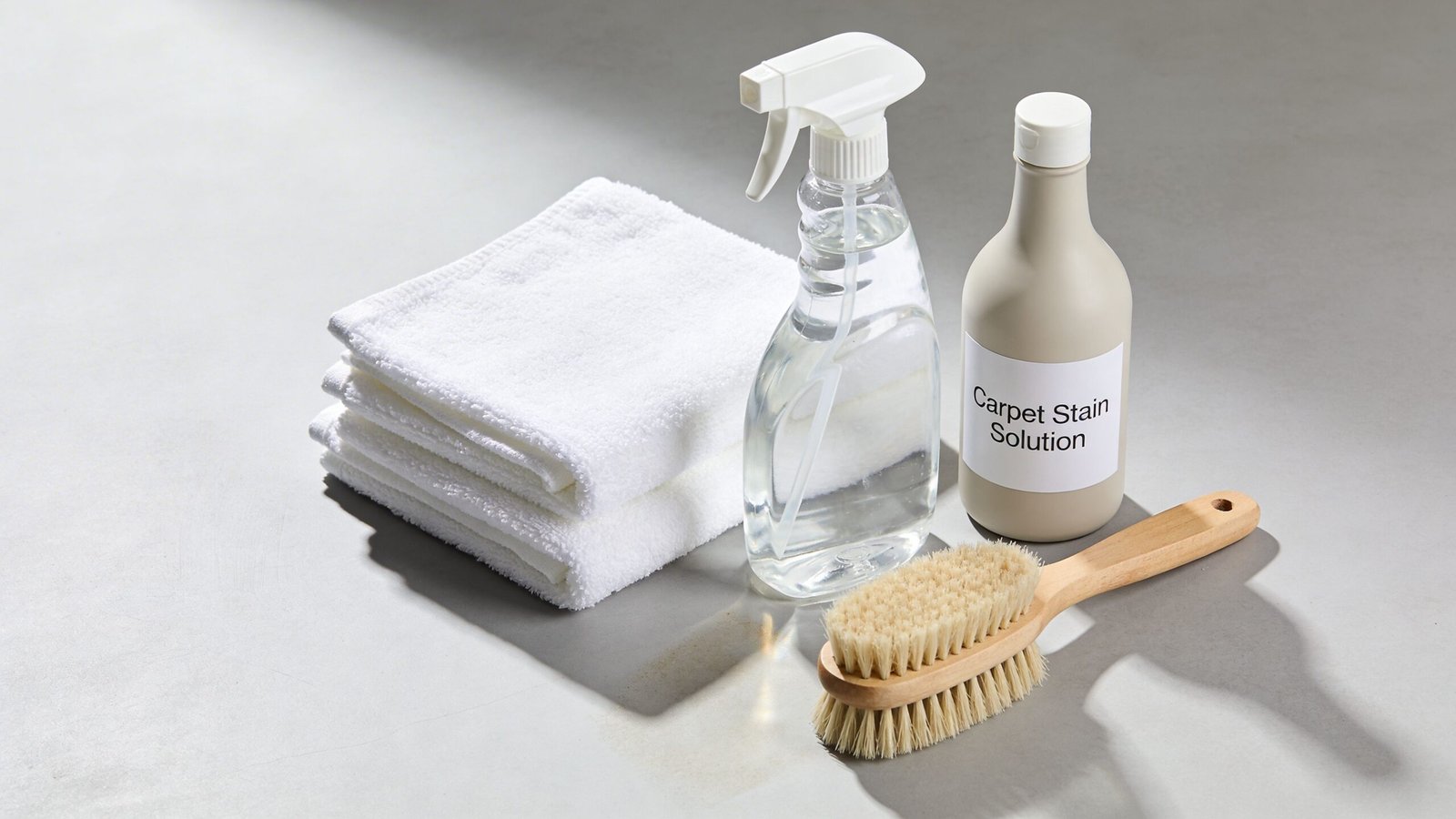
Build the kit before you need it
Keep these together in one bin or cabinet:
- White microfiber towels: Better than colored shop rags or old bath towels.
- Spray bottle: Lets you mist instead of pour.
- Mild clear dish soap: Useful for many food and drink spots.
- White vinegar: Handy for some household stain situations.
- Baking soda: Good for absorbing oily residue and some odor.
- Enzymatic pet cleaner: Best kept on hand if you have pets.
- Wet/dry vacuum: Useful when liquid volume is more than a towel can manage.
- Dull scraper or spoon: For solids and sticky residue.
- Disposable gloves: Especially for bodily fluid cleanup.
What to look for in store-bought cleaners
Read the label before you buy.
A useful cleaner usually tells you what stain category it targets. A risky cleaner promises to remove everything from everything. That broad approach often leads to over-application and residue.
Choose products based on the problem:
| Cleaner type | Best for | Main caution |
|---|---|---|
| Mild detergent | Food and drink residue | Can attract soil if not rinsed |
| Enzymatic cleaner | Pet accidents and organic matter | Needs dwell time to work |
| Spot remover for oils | Grease and oily transfer | Always test colorfastness first |
| Neutral rinse | Finishing after spot treatment | Don’t over-wet the carpet |
Always test colorfastness
Use a hidden area first. A closet corner is better than the middle of the living room.
Apply a small amount. Blot with a white cloth. If color transfers, if the fibers lighten, or if the texture changes, stop there.
Moisture control matters even when you think the stain is small. If you’re unsure whether the carpet or pad is still damp after cleaning, understanding how to read moisture meter readings helps you avoid guessing.
The right tool kit doesn’t make stain removal effortless. It keeps you from making the stain bigger, wetter, or harder to correct.
Carpet Stain Prevention Tips for Los Angeles Homes
The easiest carpet stain to remove is the one that never reaches the fibers.
In Los Angeles, prevention matters for a few local reasons. Fine outdoor dust gets tracked in constantly. Patio doors stay open. People move in and out with shoes on. Pets come in from dry yards, damp grass, or the occasional muddy patch after rain. By the time a visible stain appears, the carpet has often already been carrying a lot of grit and residue.
According to industry studies, 80% of all carpet dirt and potential stains originate from foot traffic, and entrance matting can capture up to 80% of that tracked-in soil within the first 12 feet of an entrance (industry matting and foot traffic facts).

Habits that make a visible difference
- Use real entry mats: Not decorative mats that slide around. You want mats that hold soil.
- Create a no-shoes routine: That cuts down on oils, grit, and street residue.
- Protect feeding zones: Under pet bowls, a washable barrier helps. This guide to choosing a pet waterproof mat is a practical reference if spills around bowls are a recurring issue.
- Cover repeat-traffic lanes: Hallways, family room walk paths, and bed perimeters wear first.
- Respond to moisture fast: A small leak near carpet can become a staining and microbial issue if it stays damp.
Why prevention beats spot treatment
Soil is abrasive. Every footstep grinds it lower into the carpet. That makes later stains harder to remove because the carpet wasn’t clean to begin with.
The homes that keep carpet looking good longest usually do a few boring things well. They trap debris at the door. They isolate pet messes. They don’t let damp carpet sit overnight after an unnoticed spill or AC issue. If you’ve had any kind of water event, this guide on how to prevent mold after water damage becomes part of carpet care too, not just structural care.
Carpet maintenance starts at the threshold, not at the stain.
When a Stain Signals a Deeper Problem for Restoration Pros
Some stains don’t fail because you used the wrong cleaner. They fail because the visible spot is only the top layer of the problem.
This happens a lot after leaks, pet accidents, appliance overflows, and repeated wetting in the same area. The carpet surface may look better after cleaning, then the discoloration returns as the carpet dries. That return is often wicking. Moisture and residue remain below, then move back up into the face fibers.
Red flags that change the job
A normal DIY stain usually improves and stays improved.
A deeper issue tends to show itself in one of these ways:
- The stain disappears wet, then reappears dry
- The spot feels crunchy or tacky after cleaning
- There’s a sour, musty, or urine smell that keeps returning
- The carpet feels cooler or damper than the surrounding area
- The affected area keeps widening over time
When that happens, surface treatment won’t solve it. You have to address what’s in the backing and pad.
Professional hot water extraction removes over 95% of embedded dirt and allergens, and IICRC standards call for pH-balanced solutions to protect fibers. That same guidance also matters because 80% of stain residue can lodge in the carpet backing and padding, which is why surface-only cleaning often misses the actual source (professional HWE and residue in backing and padding).
Where DIY gets risky
Homeowners usually run into trouble in three situations.
First, they over-wet the area and push the problem deeper.
Second, they use the wrong temperature. A critical mistake is using hot water on protein stains like pet urine, which can permanently set them, as noted in the same professional HWE guidance above.
Third, they keep treating the visible area without checking for hidden moisture. In Los Angeles, a recurring carpet stain near an exterior wall or under a window can point to intrusion from outside, not just a household spill. In a condo, it may be coming from a neighboring unit or a line inside a shared wall.
What restoration technicians do differently
A restoration technician doesn’t stop at “the spot looks better.”
The process is built around the source:
| Symptom | What it may mean | Professional response |
|---|---|---|
| Reappearing stain | Residue below the surface | Extraction and subsurface assessment |
| Musty odor | Ongoing moisture or microbial growth | Moisture mapping and drying |
| Persistent urine smell | Pad or subfloor contamination | Targeted decontamination or material removal |
| Large darkened area | Leak or intrusion | Source investigation and restoration plan |
If you’re seeing those signs, that’s the point to bring in an IICRC-certified restoration professional who can assess beyond the face fibers. Stains are cosmetic until they’re not. Once moisture gets into the system below, the question changes from “How do I clean this?” to “What’s still wet, and what has that moisture affected?”
Frequently Asked Questions About Carpet Stain Removal
Some of the most important carpet-cleaning questions come after the first cleanup attempt.
FAQ on Carpet Stain Removal
| Question | Answer |
|---|---|
| Can I use a rental carpet machine on a tough stain? | Sometimes, but rental equipment often helps more with broad surface cleaning than with precise spot correction. The bigger risk is over-wetting a small area and leaving moisture below the carpet. |
| Why does a stain come back after it looked gone? | That usually points to residue still sitting in the backing or pad. As the carpet dries, the remaining material can wick upward and show again on the surface. |
| How do I know if the carpet pad is wet too? | A damp or cool feeling underfoot, a stain that grows as it dries, or recurring odor all suggest moisture below the face fibers. Surface appearance alone doesn’t tell the whole story. |
| Will DIY cleaning void my carpet warranty? | It can if you use the wrong chemistry, too much moisture, or a method the manufacturer doesn’t recommend. If the carpet is newer or high-end, check the care guidance before using strong spotters or extraction equipment. |
| What’s the safest first cleaner to try? | For many everyday spills, controlled blotting with water and a small amount of mild dish soap is a reasonable first step. It’s still important to identify the stain type before escalating to stronger products. |
| When should I stop trying and call a pro? | Stop when the stain keeps returning, odor remains, the carpet stays damp, or the spot is tied to a leak or water intrusion instead of a simple spill. |
A lot of carpet mistakes come from treating every stain like it’s just surface dirt. It isn’t. Some spots are easy. Some are chemistry problems. Some are moisture problems wearing a stain as a disguise.
If your cleanup improved the appearance but not the smell, if the spot came back after drying, or if the carpet feels damp beyond the visible area, that’s your signal to move past DIY.
If a carpet stain may be tied to hidden moisture, pet contamination, or water damage, Onsite Pro Restoration can help assess what’s happening below the surface in Los Angeles and surrounding areas. Their IICRC-certified team handles emergency water extraction, structural drying, odor removal, and restoration work when a “stain” turns out to be something bigger.