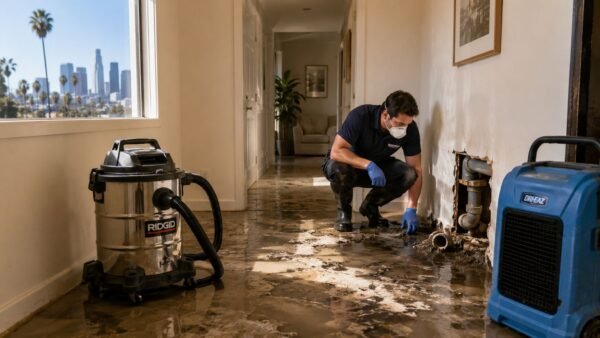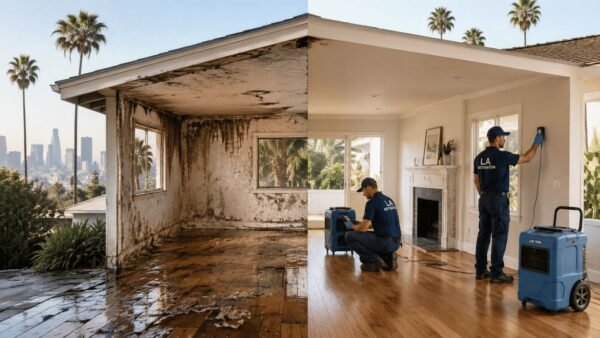

Los Angeles smoke damage cleanup is a documented, multi-step restoration process, not a cosmetic wipe-down, and homes usually need professional soot removal, deodorization, and HVAC treatment when soot is visible, when smoke odor persists past 48 hours, or when HVAC systems were running during the event. California's January 2025 fire response also showed how big this work can get, with crews removing more than 2.5 million tons of debris in nine months, 2,667 permits issued, and an average of 199 calendar days from permit application to permit issuance (state debris cleanup dashboard and recovery update).
That's why a smoke-damaged house in Sherman Oaks, Burbank, Glendale, or a canyon-adjacent hillside property near Los Angeles doesn't behave like a normal housekeeping project. The question isn't whether the smell is annoying, it's whether soot, ash, and HVAC contamination have turned the home into a restoration job that needs documentation, containment, and clearance.
What Counts as Smoke Damage in a Los Angeles Home
Smoke damage starts as a triage decision, not a cleaning task. If the property has visible soot on horizontal surfaces, a smoke odor that lingers beyond 48 hours, or an HVAC system that ran while smoke was present, the job usually moves from homeowner stabilization into professional cleanup. That's especially true in Los Angeles, where canyon winds, wildfire ash, and tightly packed multi-unit buildings can spread contamination farther than people expect.
The practical cutoff between stabilization and remediation
Light smoke odor without visible soot or ash can sometimes be stabilized with ventilation and filtration, if conditions outdoors are safe enough for fresh air. FEMA recommends that sequence for light smoke and soot damage, starting with aeration and ventilation, then a new MERV 11+ HVAC filter and constant fan mode, followed by odor absorption with activated charcoal (FEMA homeowner smoke damage guide). FEMA also warns against opening the home if heavy outdoor smoke or particulates are still present, which matters in active wildfire conditions around Los Angeles.
Once soot is visible, or the HVAC has recirculated contamination, the job changes. Older LA homes from the 1940s to 1960s often have mixed duct materials, patchwork remodels, and porous finishes that hold odor, so “wipe and air out” usually falls short. Multi-unit buildings raise the stakes even more because shared mechanical systems can move smoke residue from one unit into another.
Practical rule: if you can smell smoke but can also see residue, assume the issue is no longer just odor. It's a contamination problem.
The difference matters because the next decisions are not cosmetic. You'll have to decide whether to call a contractor, what scope to authorize, how to document for insurance, and how to keep the property safe while waiting for service. If you want a closer look at what soot does to surfaces, see our guide on soot from smoke. For residents trying to reduce airborne particles while they wait, smoke filters like EcoQuest Purifiers' smoke air purifier options can be part of a temporary containment plan, but they don't replace source removal.
First 24 Hours After Smoke Damage
The first hour after smoke exposure is about three things, safety, proof, and HVAC control. Don't start with scrubbing. Start with photographs, a quick hazard check, and a decision on whether the system stays off until someone inspects the property.
If the damage came from a fire, board-up or access control may also matter before anyone starts cleanup. For a damaged opening, a fast temporary closure from our board-up service can help protect the site while the restoration plan is being set.
What to do before you touch anything
Los Angeles County Public Health says to photograph smoke and ash damage before cleanup so the images can be used in the insurance record. That same guidance warns not to turn on the HVAC system until the bulk of soot and ash has been cleaned up, because running it too early can spread particulate through the property and re-contaminate surfaces. County guidance also favors damp cleaning over dry sweeping and says to avoid leaf blowers because they disperse ash and soot back into the air (Los Angeles County wildfire FAQ).
For homeowners doing only light stabilization, PPE matters. Los Angeles County recommends an N95 or P100 respirator, goggles, heavy-duty gloves, long sleeves and pants, and sturdy closed-toe boots for fire-affected areas. If the residue is light and the outdoor air is safe, wet down debris before moving it and use damp methods rather than dry sweeping (LA County property cleanup guidance).
A simple save-or-toss rule helps while you wait for a crew:
- Save for inspection: electronics, documents, appliance serial photos, receipts, and anything with visible soot.
- Toss only when obvious: food, porous items soaked in smoke odor, and materials that can't be cleaned without leaving residue.
- Hold in place: furniture, rugs, and contents if there's any chance the adjuster needs to see the original condition.
Leave windows closed if outside smoke is active. FEMA's advice on ventilation assumes the outdoor air is usable, and that's not always true in Los Angeles during a wildfire event.
Later, once the scene is documented and stable, you can decide whether the job needs emergency tarping, indoor containment, or a formal smoke remediation estimate. For properties exposed to fire entry points or broken glazing, a smoke damage cleanup los angeles response often starts with containment before any deodorization begins.
After that initial stabilization, the next call is usually to a contractor, not a cleaner.
What a Professional Smoke Damage Cleanup Actually Looks Like
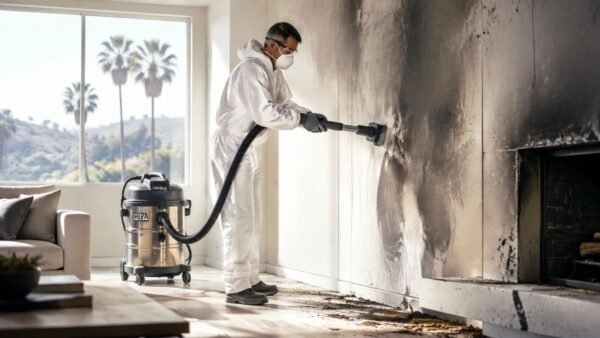
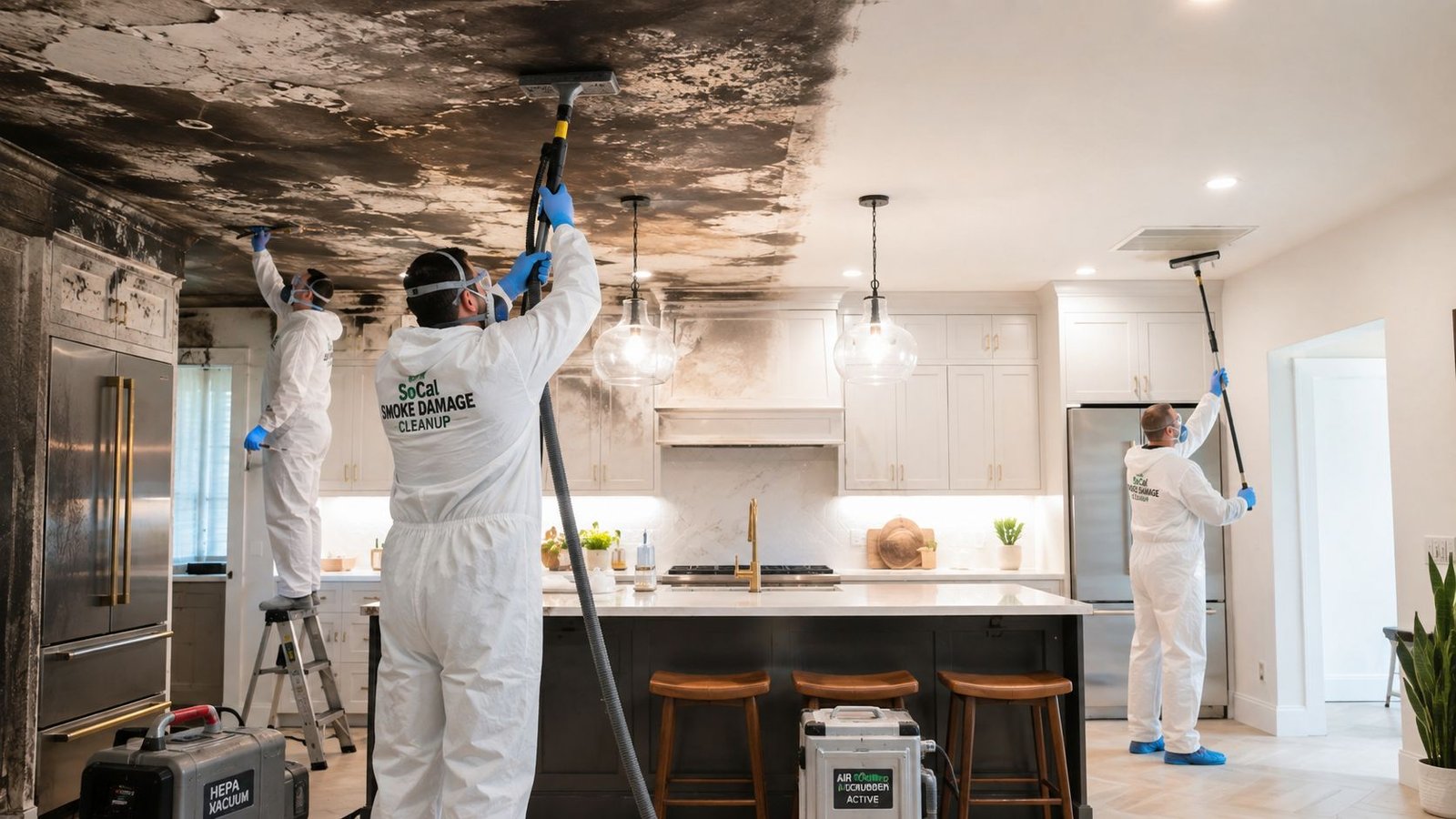
A legitimate smoke cleanup job in Los Angeles usually starts with a dry pass, not a wet wipe. That order matters because wet cleaning too early can drive soot deeper into drywall, trim, and other porous finishes. A restoration crew that knows smoke work will usually bring HEPA vacuums, dry chemical sponges, containment plastics, and equipment for negative air rather than just mops and fragrance.
The sequence on a real job
A proper crew begins by isolating the affected area and setting up negative air with HEPA exhaust so loosened particulate doesn't migrate into the rest of the house. Then comes dry soot removal, which typically means HEPA-filtered vacuuming and dry chemical sponges before any wet cleaning begins. After that, technicians clean the structure, contents, and contact surfaces, then move into HVAC decontamination and odor treatment.
That workflow lines up with the restoration standard most adjusters expect to hear about, IICRC S500, and California's fire-cleanup safety rules. Cal/OSHA requires HEPA-filtered vacuums for dust, ash, soot, and similar debris, plus NIOSH-approved respiratory protection, a written respiratory program, medical evaluations, annual fit testing, and proper maintenance procedures for workers entering burned areas (Cal/OSHA fire cleanup respiratory protection). For more hazardous atmospheres, the rule calls for a NIOSH-certified SCBA with at least a 30-minute service life or a supplied-air respirator with an auxiliary self-contained air supply.
What separates restoration from janitorial work is containment and verification. If nobody is controlling airflow or documenting the result, the job is probably not being done to remediation standards.
Where deodorization and clearance fit
Smoke odor treatment usually comes after source removal, not before. Thermal fogging or hydroxyl treatment can help once soot and residue are out of the materials that hold odor, and HVAC components need decontamination so the system doesn't keep recirculating contamination. Final sign-off often includes air sampling and surface wipe checks to verify that the property is ready for re-occupancy.
If you're pricing that work, compare it with smoke restoration costs in the GTA only as a loose reference point for process complexity. Los Angeles jobs often differ because of housing age, labor costs, and local approval issues. For odor-specific concerns, our how to remove smoke smell from house page covers how that finish stage connects to the rest of the scope.
One thing I see on LA jobs all the time, the owner thinks the smell is the problem, but the hidden HVAC contamination is what keeps the odor coming back. If the system was on during the event, that part of the scope usually can't be skipped.
Smoke Damage Cleanup Costs in Los Angeles
Smoke cleanup pricing in Los Angeles depends on severity, access, and how far contamination traveled. A light soot job might only need surface cleaning and filter replacement, while a heavy post-fire project can expand into contents work, HVAC decontamination, selective demolition, and deodorization. The main cost drivers are always the same, how many rooms are affected, whether drywall or insulation needs removal, whether the HVAC ran during the event, and whether contents can be cleaned on site or must be packed out.
Cost bands that actually help you compare bids
Angi's Los Angeles cost data for fire and smoke-related work is useful because it shows how local labor and scope push pricing upward, especially when the job is more than a simple wipe-down (Angi cost guide for Los Angeles fire damage cleanup). That's not a line-item estimate for every home, but it's a reminder that a phone quote rarely captures the full scope.
| Damage Severity | Typical LA Range | Main Cost Drivers |
|---|---|---|
| Light smoke and soot | Smaller, targeted scope | Surface soot, limited odor, filter replacement, minimal containment |
| Moderate smoke damage | Mid-range restoration scope | Multiple rooms, deodorization, contents cleaning, HVAC treatment |
| Heavy post-fire restoration | Highest scope and coordination | Demolition, insulation removal, pack-out, air sealing, clearance testing |
How adjusters read the estimate
A written estimate matters most when the claim is likely to turn into a scope dispute. If soot reached the HVAC, if ceilings or cabinets are affected, or if the odor keeps returning after cleaning, an itemized estimate beats a quick phone quote every time. Adjusters usually want to see line items that separate containment, dry soot cleaning, deodorization, and any demolition from the rebuild work.
You can compare that structure with our fire damage restoration cost page, because smoke jobs often get approved as a subset of fire loss rather than as a standalone cleaning expense. In older Los Angeles homes, especially in Glendale, North Hollywood, and Sherman Oaks, hidden labor can push the job beyond what the first walk-through suggests.
Insurance and Documentation for Smoke Claims in LA
Insurance fights on smoke claims usually start with missing proof, not missing damage. The cleanest claims file has photos, video, notes on the source and timing of the event, and a written scope that shows what got cleaned, what got removed, and what still needs attention. Los Angeles County Public Health specifically tells residents to document smoke damage before cleanup, because insurers often want the original condition preserved in the claim record (LA County wildfire insurance and smoke damage guidance).
What adjusters actually want first
The first packet should include:
- Photos and video before cleaning.
- A scope with room-by-room notes.
- Any soot, odor, or HVAC observations.
- Receipts for emergency mitigation.
- Proof that you didn't spread contamination with early cleanup.
The 2025 fire claims volume explains why this matters. The California Department of Insurance estimated more than 40,000 claims were filed after the January 2025 fires, and more than 13,000 involved standing homes with smoke damage. That kind of claim load slows response and makes clean documentation more valuable than a persuasive phone call (California Department of Insurance task force report).
The same report also notes that industry reporting found FAIR Plan had received more than 5,000 claims tied to the Eaton and Palisades fires, with more than half described as partial losses including smoke damage, and by early May it had paid $2.7 billion in claims tied to the blazes. UCLA researchers found outdoor benzene levels during the fires at a median of 0.38 parts per billion, dropping to 0.06 parts per billion at the end of sampling, which shows how smoke recovery often includes both visible cleanup and air-quality recovery.
Who has authority to authorize the work
A California law signed after the 2025 fire disasters clarifies that landlords, not tenants, are responsible for removing disaster-related hazards in rental housing, including smoke, smoke residue, smoke odor, ash, asbestos, mold, and water damage (LAist coverage of the landlord-tenant fire cleanup law). That matters in Los Angeles because it decides who can approve the contractor and who's responsible for the bill.
If the claim is likely to need back-and-forth with the carrier, our insurance claim documentation page shows the kind of record that holds up better than a casual estimate. Manual claims handling is still common, and platforms that track the cost of manual claims processing make the same point, detailed files reduce friction because someone still has to read, compare, and approve the scope.
Choosing an IICRC-Certified Smoke Damage Contractor
The fastest way to screen a smoke cleanup contractor in Los Angeles is to ask four questions. Do they hold a current IICRC firm certification, are they licensed with the California State License Board, do they follow Cal/OSHA respiratory protection rules, and do they carry general liability plus pollution or environmental coverage? If any of those answers are vague, keep looking.
What each credential buys you
An IICRC-certified firm signals that the contractor knows smoke work as a restoration process, not just as cleaning. A valid CSLB license gives you a way to verify the business authority, and it matters more when the job may cross into demolition or reconstruction. OSHA-compliant respiratory protection matters because fire cleanup is regulated work, not standard janitorial labor.
Insurance coverage is the last filter because smoke jobs often involve disputed scope, hidden contamination, and contents handling. If a contractor can't show coverage that fits the job, the homeowner ends up carrying more risk than necessary.
Red flags that should stop the conversation
- Door-to-door pressure after an event. That's a bad sign, especially after neighborhood-scale fire or smoke losses.
- Full payment upfront. Legitimate restoration work usually doesn't need that arrangement before the job is defined.
- No written scope tied to smoke remediation standards. If the estimate doesn't describe containment, dry soot removal, deodorization, and HVAC treatment, it's incomplete.
A good smoke estimate reads like a restoration plan, not a paint bid. You should be able to see where the contamination starts, where it spreads, and how the crew plans to verify that it's gone.
For homeowners comparing bids in Burbank, Studio City, Encino, or Van Nuys, the question is whether the contractor can explain missing line items. A cheap quote that leaves out HVAC cleaning, content treatment, or clearance testing usually costs more later than the bid you rejected first.
Your Los Angeles Smoke Damage Action Plan
If you're dealing with smoke damage in Los Angeles, use this short checklist. Triage signals, visible soot, lingering odor past 48 hours, or HVAC exposure. First-hour steps, photograph everything, keep the HVAC off, and don't spread ash with dry sweeping. Documentation, save photos, receipts, and a written scope before any major cleanup.
A few terms help when you talk to an adjuster or contractor. MERV 13 is the stronger HVAC filter range often used after smoke exposure. HEPA means high-efficiency particulate filtration. IICRC S500 is the restoration reference point for fire and smoke work. Negative air is the containment setup that keeps contaminated air moving out of the work zone instead of through the house.
If you need smoke damage cleanup in Los Angeles, call 818-336-1800 for a free inspection and ask for a fire-damage restoration assessment. Onsite Pro Restoration serves North Hollywood, Burbank, Glendale, Sherman Oaks, and nearby neighborhoods, and emergency calls in that area usually get a response window of about an hour.
Onsite Pro Restoration handles smoke cleanup as part of fire damage restoration in Los Angeles, including soot removal, odor treatment, HVAC decontamination, and claim-ready documentation. If your home or rental still smells like smoke, or the HVAC ran during the event, visit Onsite Pro Restoration to request a local assessment and get the cleanup moving today.