
Professional pet odor removal service cost usually falls between $100 and $700, with an average job around $350 to $400. Severe cases can reach $2,000 or more, especially when odor has spread beyond the surface into padding, subfloor, or multiple rooms.
If you're reading this because you've cleaned the same spot three times and the smell keeps coming back, you're dealing with the part most homeowners don't see. Pet odor isn't just a housekeeping problem. In Los Angeles homes, especially older properties in Glendale, Sherman Oaks, and parts of Burbank, odors often settle into porous materials that standard cleaning can't reach. That's where costs start to separate between a simple deodorizing visit and true remediation.
A lot of homeowners want one number. The honest answer is that pet odor removal service cost depends less on time and more on how far contamination has traveled. Surface odor is one problem. Urine in carpet pad, wood seams, baseboards, or subfloor is a different job entirely. If you're trying to eliminate pet smells from hardwood floors, that's a good example of where material type changes the approach and the budget fast.
If the smell keeps returning after sprays, shampooing, or baking soda, you're usually past DIY territory and into professional odor removal service territory.
Your Guide to Professional Pet Odor Removal
You walk into the house after work, and the odor hits before you reach the hallway. You already cleaned the spot, used an enzyme spray, and shampooed the carpet. In a lot of Los Angeles homes, that usually means the odor source is still below the surface, inside pad, subfloor seams, baseboards, or wood transitions.
Professional pet odor work starts with one question. Are you dealing with a surface cleaning issue, or contamination that has soaked into building materials? That difference matters more than homeowners expect, especially in LA where older homes, remodel layers, warm interiors, and high property values make partial fixes expensive.
A cheap surface treatment can hide the smell for a week and still leave the source in place. Then the odor comes back during humid weather, after the AC runs, or the moment a tenant or buyer steps inside. I see that mistake often. Homeowners spend money two or three times on products and carpet cleaning, then still need full remediation because urine salts stayed in the floor system.
What homeowners usually get wrong
The carpet is often the first place you smell the problem, but not always the main place it lives.
Practical rule: If odor gets stronger on humid days, near one wall, or after the house has been closed up, contamination has usually spread past the visible spot.
That is why a real inspection matters. A qualified professional odor removal service checks where the odor started, how far it traveled, and which materials are holding it. Carpet, pad, tack strip, drywall edges, and wood all respond differently. If you're trying to eliminate pet smells from hardwood floors, the approach changes fast because wood can absorb odor into joints and finish gaps that basic cleaning will not reach.
For homeowners in Los Angeles, this is not just about comfort. It is about protecting rental income, resale value, and recent renovation work. A partial DIY fix can look cheaper at first, but if odor is still present during a showing, inspection, or move-out walk-through, the final cost is usually higher.
Breaking Down Pet Odor Removal Service Cost
Homeowners usually want a straight answer. What will this cost if the smell is limited to one room, and what happens to the price if it has been sitting for months?
A practical starting point is to budget by scope.
Sample Pet Odor Removal Service Costs by Scope
| Service Scope | Typical National Cost Range |
|---|---|
| 1 room | $100 to $300 |
| 2 rooms | $200 to $500 |
| 3 to 4 rooms | $400 to $800 |
| Whole house | $600 to $2,000 |
Those ranges are useful for rough planning, but they are only baseline numbers. They do not show the difference between a light odor treatment and a remediation job where urine has already moved below the visible surface.
That distinction matters in Los Angeles more than many national cost guides admit. In a lower-value market, a failed spot treatment is frustrating. In LA, it can affect a rental turnover, delay a listing, trigger buyer objections, or force credits during escrow. I have seen owners spend a few hundred dollars trying to save money, then pay far more after the odor resurfaces during a showing or final walk-through.
Two homes with the same room count can price very differently for that reason. One may need targeted treatment in a single area. The other may need removal of pad, sealing of the subfloor, and repeat deodorization because the contamination has been building for years.
For budgeting, use these ranges as a screening tool:
- Lower end: recent, isolated odor that has not soaked significantly into flooring materials
- Middle range: repeated accidents in one or two areas, usually with inspection, treatment, and stronger odor control methods
- Upper range: multi-room contamination, long-term pet marking, or work that involves material removal and subfloor treatment
The cost question is not just how many rooms smell. It is how much of the building has absorbed the source.
That is also why partial DIY work often costs more in the long run. A rented carpet machine or store-bought enzyme can reduce odor near the surface while pushing moisture and residue deeper into pad, seams, or subfloor edges. Once that happens, the job usually gets larger, not smaller.
If you want added context on how service scope changes pricing across related work, this cleaning services cost guide gives a useful comparison point.
Key Factors That Determine Your Final Price
The final invoice usually comes down to one issue. How far did the contamination travel before anyone found it or treated it correctly?
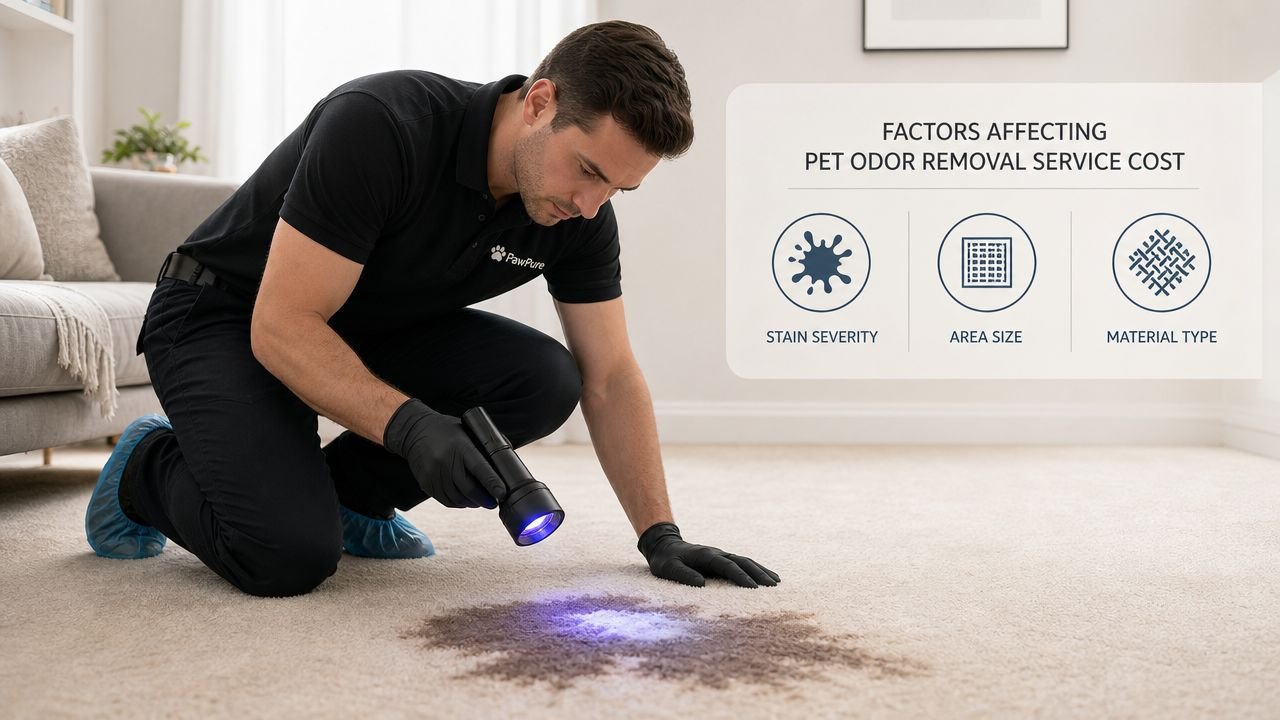
Surface odor vs absorbed contamination
Professional pet odor removal is typically priced by treatment scope rather than labor hours. While light cleaning can be $125 per room, once urine reaches the subfloor, remediation costs rise because crews may need extraction, enzyme treatment, and flooring removal, pushing the average job to $500 to $800 or more, according to Fixr's pet odor removal service cost guide.
That's the cost driver homeowners miss most. Odor-causing residue doesn't stay put. It follows gravity, capillary action, flooring seams, tack-strip edges, and absorbent materials.
In practical terms, these are the questions that change price fast:
- How old is the odor: Fresh contamination is easier to localize than years of repeated marking.
- What material was affected: Carpet, pad, hardwood, laminate, grout lines, and concrete all hold odor differently.
- Is the source isolated or spread out: One corner is simpler than multiple rooms and hallways.
- Has someone already tried DIY treatment: Some products dilute the surface while pushing contamination wider.
Material type changes the job
In Sherman Oaks and Glendale, older homes often have wood subfloors and transitions where odor can migrate under walls or beneath flooring edges. In some newer units, laminate and engineered flooring can trap odor below the visible wear layer, which means the top looks clean while the smell keeps coming back.
A low quote often means someone is pricing the visible stain, not the hidden source.
This is also why inspection matters. UV lights help identify organic staining patterns. Moisture meters help determine whether a recent or ongoing issue exists. Removal decisions shouldn't come from guesswork or from whether a scented spray made the room smell better for an hour.
Severity isn't just about smell strength
A faint smell can still signal widespread contamination if the area has been repeatedly cleaned. On the other hand, a strong smell can sometimes be localized.
What matters is where the odor reappears. If it comes back after cleaning, after humidity rises, or after the room stays closed, the source likely remains in place. In restoration work, that pattern tells you the material is still off-gassing or reactivating.
For homeowners comparing companies, credentials matter here. A contractor who understands contamination mapping, material behavior, and proper deodorization standards is less likely to miss the true source. This is one reason IICRC certification matters in restoration work, especially when the goal is permanent odor removal rather than a cosmetic pass.
What Is Included in a Professional Deodorization Service
A real deodorization service should look more like diagnostic work plus targeted remediation than basic carpet cleaning.
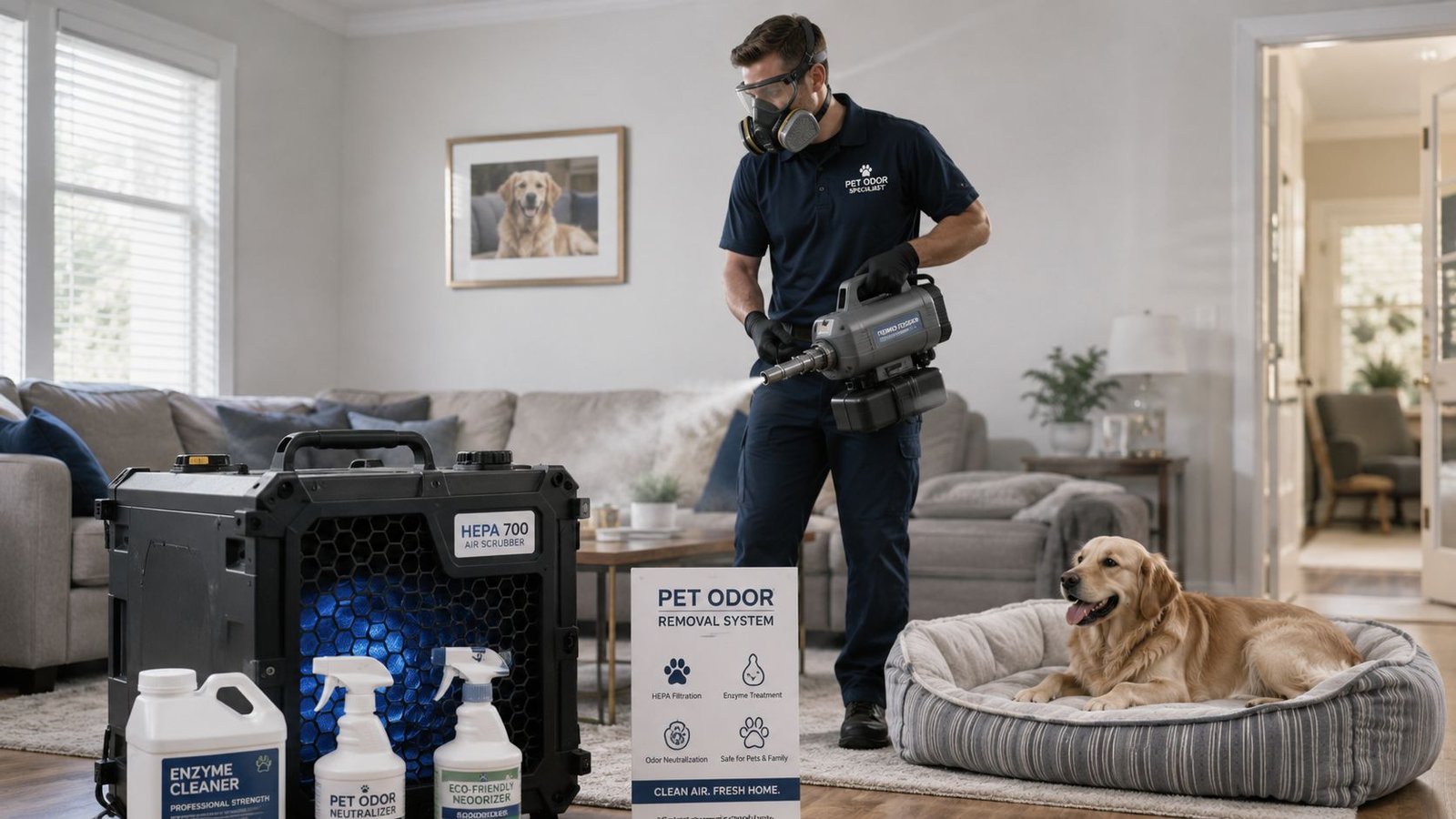
What professionals actually do
A proper service call usually includes some combination of inspection, source identification, cleaning, neutralization, and air treatment. The exact mix depends on what the technician finds.
In our experience, cleaning the carpet surface is a temporary fix. True remediation requires identifying every affected area with UV lights and moisture meters so the crew treats the source, not just the symptom. That may mean working on carpet and pad, but it can also include baseboards, subfloor, concrete, upholstery, or nearby wall cavities.
Common tools and methods include:
- UV inspection tools: These help map affected areas that aren't obvious in normal light.
- Enzymatic or source-specific treatment: These products target organic contamination instead of just covering odor.
- Extraction and deep cleaning: Useful when residue remains in fibers, pad, or porous surfaces.
- Air treatment equipment: Depending on conditions, crews may use air scrubbers, ozone generators, hydroxyl machines, or thermal fogging equipment.
One local option for this kind of work is carpet cleaning for pet odors, which focuses on odor removal rather than routine appearance cleaning.
What doesn't count as true odor removal
A lot of homeowners pay for deodorization and receive fragrance.
That's not the same thing.
Store-bought sprays, scented shampoos, and basic hot water extraction can reduce what you smell short term. They don't necessarily remove the source. If urine salts remain in padding or subfloor, odor usually returns. In enclosed spaces, it often returns stronger.
This walkthrough shows the kind of equipment and process many homeowners expect when they hire a specialist:
For indoor air concerns, it's also smart to review general odor and air quality guidance from the EPA's indoor air resources.
DIY Odor Removal vs Hiring a Professional
DIY has a place. It just has a narrow one.
If the accident is fresh, isolated, and hasn't soaked into deeper materials, a homeowner may be able to improve the area with prompt cleanup and the right product. That's where basic pet owner hygiene and prevention habits matter most. This guide shares essential tips for pet owners that can help reduce repeat odor problems before they turn into restoration work.
When DIY still makes sense
DIY is most reasonable when all of these are true:
- The odor is recent: You found it quickly.
- The affected area is small: It hasn't spread through multiple rooms.
- The material is accessible: You're not dealing with hidden pad, subfloor, or wall base.
- The smell doesn't return: After treatment and drying, the room stays neutral.
If that's your situation, professional remediation may be more than you need.
Where DIY becomes expensive
The cost difference between cleaning and true remediation is wide. While some sources quote pet odor removal from $125, remediation-focused data shows costs from $1,985 to $6,583 for non-invasive work and $3,644 to $12,711 for invasive jobs, according to HowMuch.net's pet odor remediation cost guide.
That spread matters because failed DIY doesn't freeze the problem in place. It often allows it to keep spreading.
Here's how homeowners accidentally increase the eventual bill:
- They clean the visible spot only. The surface looks better, but the pad or subfloor still holds contamination.
- They use the wrong product. Some cleaners mask odor or leave residue that complicates later treatment.
- They wait too long. Repeated humidity cycles reactivate odor and expand the affected area.
- They rely on nose tests alone. A room can smell fine for a day and then fail once doors and windows stay closed.
The cheapest approach is the one that actually ends the problem.
In Los Angeles, this isn't only about comfort. It's also about preserving lease value, avoiding tenant complaints, protecting staging results, and reducing the chance that a buyer notices odor before they notice anything else in the property. In a high-value market, partial DIY is often a bigger gamble than the initial savings suggest.
For homeowners dealing with recurring urine odor, this deeper look at enzyme cleaner for urine helps explain why some products help and why others fail when contamination has already spread.
The Restoration Process What to Expect When You Call
When homeowners are stressed, uncertainty usually feels almost as bad as the smell. A clear process helps.
Step one starts with the phone call
The first conversation should focus on where the odor is, how long it's been present, what materials are affected, and whether anyone has already treated the area. If the smell followed water damage, prior leaks, or tenant turnover, that context matters because odor problems sometimes overlap with broader restoration issues.
In neighborhoods from Burbank to Beverly Hills, crews also need to account for practical access issues such as multi-unit layouts, parking, occupied spaces, and time-sensitive real estate schedules.
The on-site visit should produce answers
A proper inspection usually includes visual review, odor tracing, UV inspection where appropriate, and material-by-material assessment. If the issue appears deeper than surface level, the technician should explain why and identify what parts of the structure may need treatment or removal.
A transparent quote should separate likely cleaning from likely remediation. Homeowners deserve to know whether the plan aims to reduce odor or eliminate it at the source.
The work should be documented
A professional process usually follows this sequence:
- Inspection and mapping: Identify affected rooms and materials.
- Work plan approval: Confirm the scope before treatment begins.
- Targeted remediation: Clean, extract, neutralize, and treat the actual source areas.
- Final walkthrough: Review what was treated and what conditions were found.
Ask for documentation if the odor issue could affect an insurance file, a landlord dispute, or a home sale.
Photos, moisture readings, and work notes can help if the odor issue overlaps with a covered property-damage claim or becomes part of turnover documentation for a rental. Good records don't remove odor by themselves, but they do reduce confusion and delays when multiple parties are involved.
For sanitation and contamination concerns that go beyond odor alone, the CDC cleaning and disinfection guidance is a useful public-health reference.
FAQ About Pet Odor Removal Costs in Los Angeles
How much does pet odor removal service cost in Los Angeles
Los Angeles pricing swings wider than many national guides suggest. A condo with light surface odor is one job. A house with urine that has soaked through carpet, pad, baseboards, or subfloor is a different scope and a different bill.
The biggest cost drivers here are labor rates, parking and access in dense neighborhoods, multi-unit rules, and the value of getting the odor fully resolved before a tenant turnover or sale. In LA, partial treatment can cost more in the end if the smell comes back during an open house, a final walkthrough, or a new lease-up.
Why do some companies quote much less than others
Low quotes usually reflect a smaller scope.
One company may be pricing a basic carpet cleaning or deodorizer application. Another may be pricing source removal, sub-surface treatment, pad replacement, or sealed subfloor work. Those are not equivalent services, and they should not cost the same.
Ask one direct question: does the price cover odor reduction, or does it address the source of contamination? That answer usually explains the gap.
What does a specialty pet odor treatment usually include
For a mild to moderate case, specialty treatment often includes carpet or upholstery cleaning, targeted urine treatment in affected areas, stain work where possible, and an odor treatment such as hydroxyl or ozone if the property can be safely set up for it. Severe cases may also require pad removal, subfloor sealing, trim removal, or replacement of materials that cannot be cleaned back to an acceptable condition.
That is why the final price can move fast once contamination has reached porous building materials.
Is carpet cleaning enough to remove pet urine odor
Only in limited cases.
If the urine stayed near the carpet face fibers and was treated quickly, cleaning may solve it. If it reached the pad or subfloor, standard carpet cleaning usually gives temporary improvement, then the odor returns as humidity rises or the room stays closed up. I see this often in Los Angeles rentals where a unit smells fine during a quick showing, then fails after move-in.
Is professional remediation worth it before selling or renting a home
In many LA properties, yes.
Odor changes how people judge cleanliness and condition within seconds. Buyers start wondering what else was covered up. Renters assume the unit was not maintained. A cheaper partial fix can protect this month's budget and still hurt your sale price, delay occupancy, or trigger deposit disputes later.
If pet odor keeps returning, the smartest next spend is an inspection that determines whether the problem is in the carpet system, the subfloor, drywall, or another porous material. Onsite Pro Restoration serves Los Angeles, CA and nearby areas including Sherman Oaks, Burbank, and Glendale. Call 818-336-1800 for a free inspection and a clear plan for odor removal that matches the existing condition of the property.