
Thermal imaging is a non-destructive technology that uses an infrared camera to see and measure temperature differences on surfaces, creating a visual map of heat patterns. Restoration professionals use it to quickly find hidden moisture from leaks, locate insulation gaps, and assess fire damage without tearing open walls.
If you're staring at a faint ceiling stain, smelling something musty near a bathroom wall, or wondering whether smoke damage spread farther than you can see, thermal imaging helps answer the next question fast. In Los Angeles homes, that matters because damage often hides in wall cavities, under slab-on-grade floors, around aging plumbing, and in attics that heat up hard during warm weather.
A good thermal scan doesn't replace hands-on testing. It gives your restoration technician a smart starting point. Instead of opening three walls to find one wet pipe, we can narrow the search, verify suspicious areas, and pair the camera with moisture meters and a full inspection.
What Is Thermal Imaging and Why Is It Used in Restoration
What is thermal imaging? It's a method of detecting surface temperature differences with an infrared camera, then displaying those differences as a visible image called a thermogram. In restoration work, that matters because wet materials, overheated electrical components, and fire-affected assemblies often create thermal patterns you can't see with the naked eye.
For a Los Angeles homeowner, the value is practical. You don't want a contractor cutting into drywall based on guesswork. You want someone to identify where moisture likely traveled, where drying is needed, and whether the visible stain is the whole problem or just the edge of it.
A common call starts with a small symptom. A water spot appears under an upstairs bathroom. The paint looks dry. The floor still feels normal. But the odor says something else is going on. Thermal imaging helps us scan the surrounding ceiling, wall intersections, and nearby floor areas to see whether the temperature pattern suggests hidden moisture spread.
Practical rule: Thermal imaging is a locating tool, not a guessing shortcut. It helps reduce unnecessary demolition when a trained technician confirms the findings with other instruments.
This is why thermal imaging shows up so often in water damage restoration, mold investigations, and post-fire inspections. It helps define the affected area faster, which often means faster containment, better documentation, and less disruption inside the home.
If you want a plain-language overview of how thermal vision works, that resource gives a useful background before you get into restoration-specific details. For homeowners dealing with active leaks or drying concerns, it also helps to understand the water damage restoration process so you know where thermal imaging fits in the larger response.
How an Infrared Camera Sees the Unseen
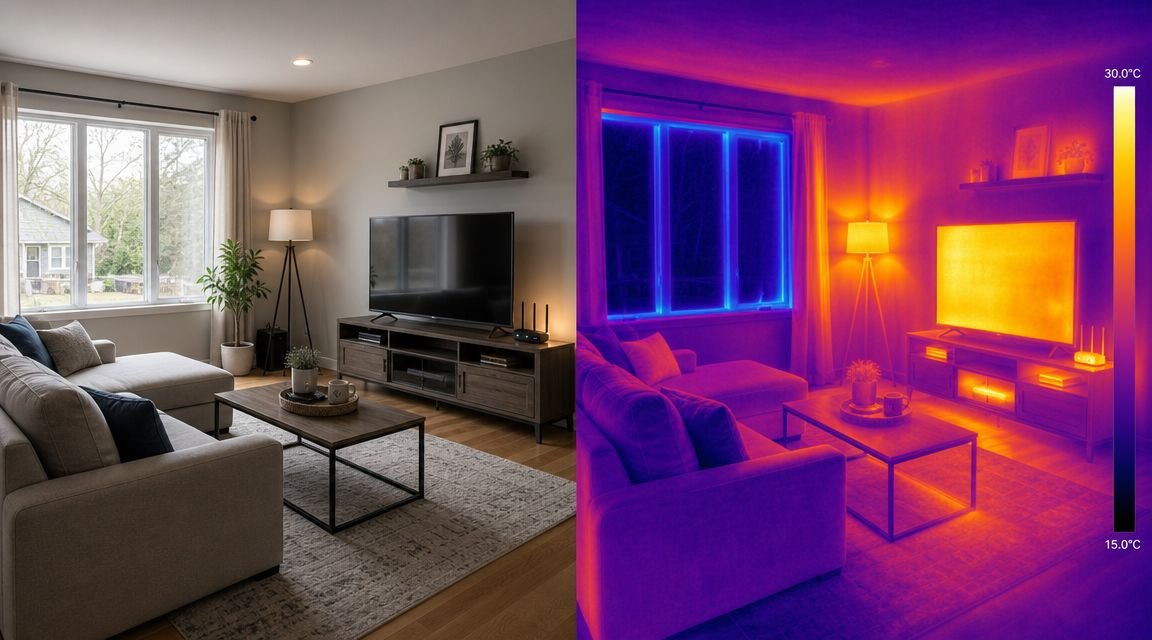
A regular camera captures visible light. An infrared camera captures heat differences. That's the simplest way to understand it.
Everything above absolute zero emits infrared energy, and thermal imaging turns that invisible energy into a visible thermogram, which is why the technology became such an important practical tool for inspection work, energy surveys, firefighting, and maintenance, as described in this thermography overview. What the camera shows isn't "inside" the wall. It shows how the wall surface is behaving thermally.
The science behind the image
If one part of a wall is cooler or warmer than the material around it, the camera highlights that contrast. In restoration, that contrast can point to moisture evaporating from drywall, missing insulation in a ceiling cavity, or a hot electrical issue after a fire event.
That doesn't mean every cool spot is a leak. Air movement, shadows, HVAC ducts, reflective surfaces, and building materials can all change the pattern. Reading the image correctly takes context.
Thermal imaging itself goes back a long way. It traces to 1800, when William Herschel discovered infrared radiation by placing a thermometer just beyond the red end of the visible spectrum. The technology developed further by the 1970s with solid-state thermal imaging arrays, which helped make it more accessible beyond military use, according to Armasight's thermal imaging history.
What matters more than the colors
Homeowners often focus on the color palette on the screen. The bigger issue is whether the camera has enough detail and sensitivity to show a meaningful pattern. The image is only useful if the technician can separate a real moisture signature from a harmless temperature variation.
In practice, I pay more attention to pattern shape, edge definition, and whether the suspect area matches known moisture paths. Then I confirm with a meter. If you want to understand how those follow-up readings work, here's a homeowner-friendly guide on how to read moisture meter readings.
For readers who want a broader view of how trained inspectors use infrared outside restoration, these industrial inspection resources give good examples of structured thermal analysis in the field.
Practical Uses in Los Angeles Property Restoration
Los Angeles buildings create their own inspection challenges. We see older plumbing in established neighborhoods, slab-on-grade construction that can hide water travel, additions with mixed materials, and heat-heavy attics that complicate surface readings. Thermal imaging helps, but only when it's used with local building knowledge.
Water damage detection
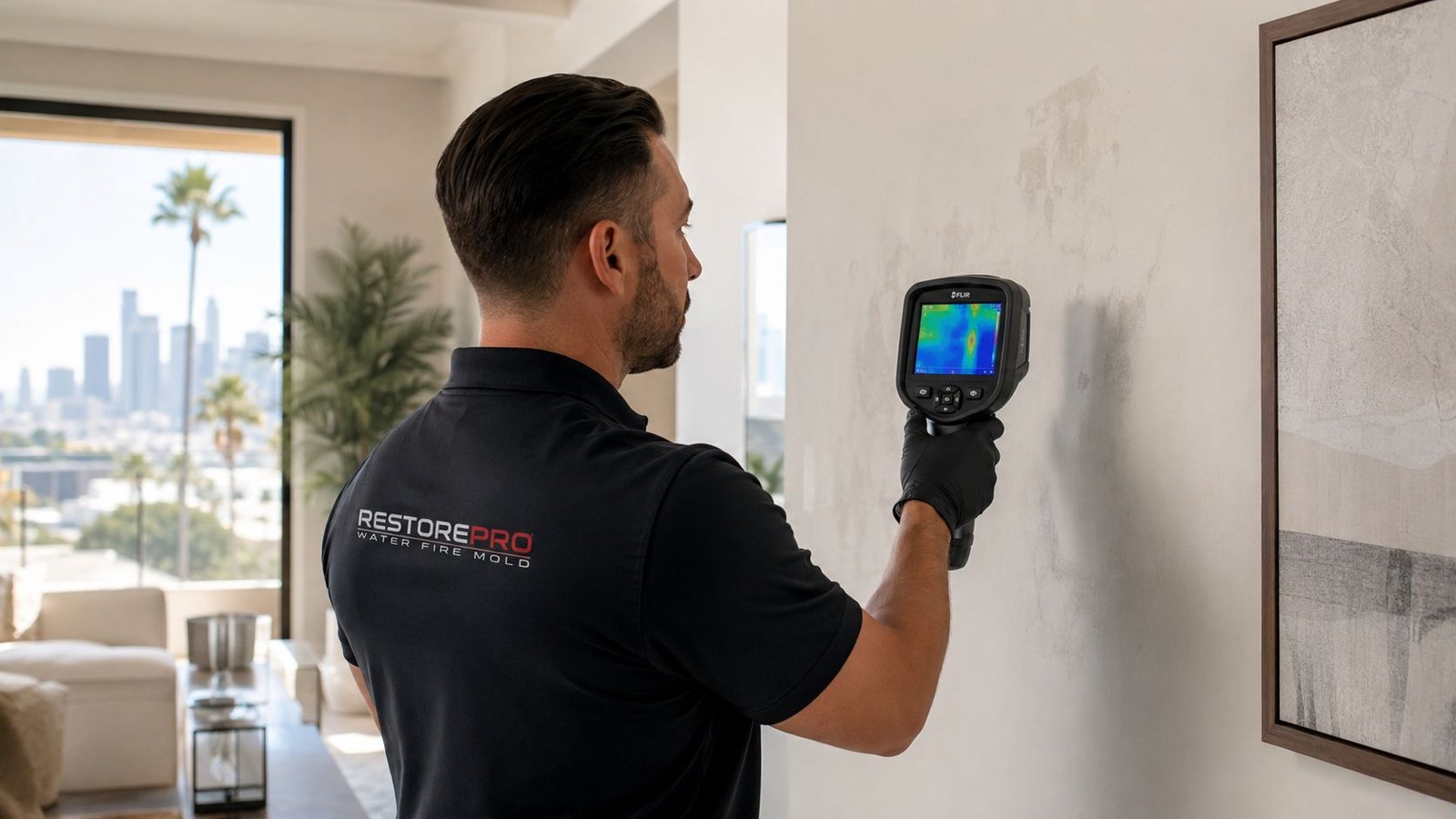
In Sherman Oaks, Burbank, and Glendale, one of the most common uses is tracing hidden moisture after a plumbing leak. A homeowner may only notice warped baseboards or a slight odor near a bedroom wall. The thermal camera often helps outline where moisture likely migrated behind drywall or under flooring.
Slab leak concerns are another major reason homeowners ask about thermal inspection. On slab-on-grade homes, the water may surface far from the actual break. The camera doesn't "see through" concrete, but it can reveal temperature anomalies on finished flooring and adjacent walls that help narrow the search area before invasive testing.
In our experience treating water damage in LA homes, the biggest win is speed. A thermal scan can quickly show whether the problem appears isolated or whether water likely traveled farther into a closet wall, cabinet toe-kick, or hallway transition.
For homeowners comparing services, thermal imaging for water leaks explains how this tool is used during leak investigations in occupied properties.
Hidden mold clues
Thermal imaging does not detect mold directly. It detects the temperature patterns that can suggest moisture conditions mold may be feeding on.
That matters in Los Angeles apartments and homes where bathrooms, laundry rooms, and poorly ventilated corners stay damp. In a Burbank unit, for example, a tenant may report a recurring musty smell under a window or near an exterior-facing closet. The camera may show a cooler pattern extending along drywall seams or below the sill, which tells the inspector where to meter and whether the moisture source may be ongoing.
Moisture is the clue. Mold is the consequence. A thermal camera helps locate the first problem so you don't spend weeks chasing the second.
Property managers also use thermal imaging when a resident reports intermittent leaks or after-hours maintenance issues that are hard to verify by the time a vendor arrives. Teams coordinating tenant communication often rely on tools like Eden's property management solutions to keep reports organized, but the field diagnosis still comes down to evidence on site.
Here's a short look at thermal leak detection in action:
Fire and smoke damage assessment
After a kitchen fire or localized electrical event, visible damage rarely tells the whole story. Cabinets may look intact from the outside while heat affected the wall behind them. Ceiling areas may carry smoke farther than the room's soot pattern suggests.
Thermal imaging helps evaluate abnormal heat signatures, check surrounding assemblies, and identify areas that need closer inspection during fire damage restoration. In hillside and foothill communities around Glendale, wildfire exposure can also leave homeowners with questions about heat impact, smoke spread, and whether hidden areas of the structure need more attention.
One practical use after fire suppression is checking for suspicious hot spots or unusual thermal behavior in adjacent building materials. Another is mapping areas where wet firefighting efforts introduced moisture that now needs drying to prevent secondary damage.
Onsite Pro Restoration uses thermal imaging alongside moisture meters during inspections, which is the right approach for restoration work because the camera guides the investigation and the meter verifies material conditions.
Benefits and Limitations of Thermal Technology
Thermal imaging is fast, non-invasive, and very good at showing patterns across a broad area. It can help a technician move from suspicion to targeted testing without opening every wall in sight.
But it isn't magic, and in this area, homeowners often get bad information.
What it does well
A trained technician can use thermal imaging to scan ceilings, walls, floors, and cabinetry for irregular thermal patterns that may suggest hidden moisture, heat damage, or missing insulation. It's especially useful when the visible symptom is small but the affected area may be larger.
It also creates clear visual documentation. That helps when you need to explain findings to a tenant, property manager, or insurance adjuster.
Where it falls short
Thermal imaging works best under the right conditions. The U.S. Department of Energy notes that the most accurate thermographic images usually require at least a 20°F indoor-outdoor temperature difference, and sometimes that differential needs to be maintained for up to four hours before a scan, which is why setup and timing matter so much in real inspections, especially in milder conditions common in Southern California. See the DOE guidance on thermographic inspections.
That means a rushed scan in the wrong conditions can produce weak or misleading images. It also means thermal imaging can't directly identify mold species, tell you moisture content by itself, or confirm that every dark area on a screen is damage.
Field note: The camera finds anomalies. The technician decides whether those anomalies matter.
Thermal Imaging Capabilities at a Glance
| What Thermal Imaging Can Do | What Thermal Imaging Cannot Do |
|---|---|
| Show surface temperature differences across walls, ceilings, and floors | See straight through walls or concrete |
| Help locate suspicious areas for moisture testing | Confirm mold by itself |
| Support non-destructive leak investigations | Replace moisture meters or invasive verification when needed |
| Document broad heat patterns after fire or smoke events | Deliver reliable results in poor scan conditions |
| Help reduce unnecessary demolition | Interpret itself without training |
For homeowners, the takeaway is simple. Thermal imaging is powerful when it's part of a complete inspection. Used alone, it's easy to overread or underread the problem.
What to Expect During a Thermal Inspection
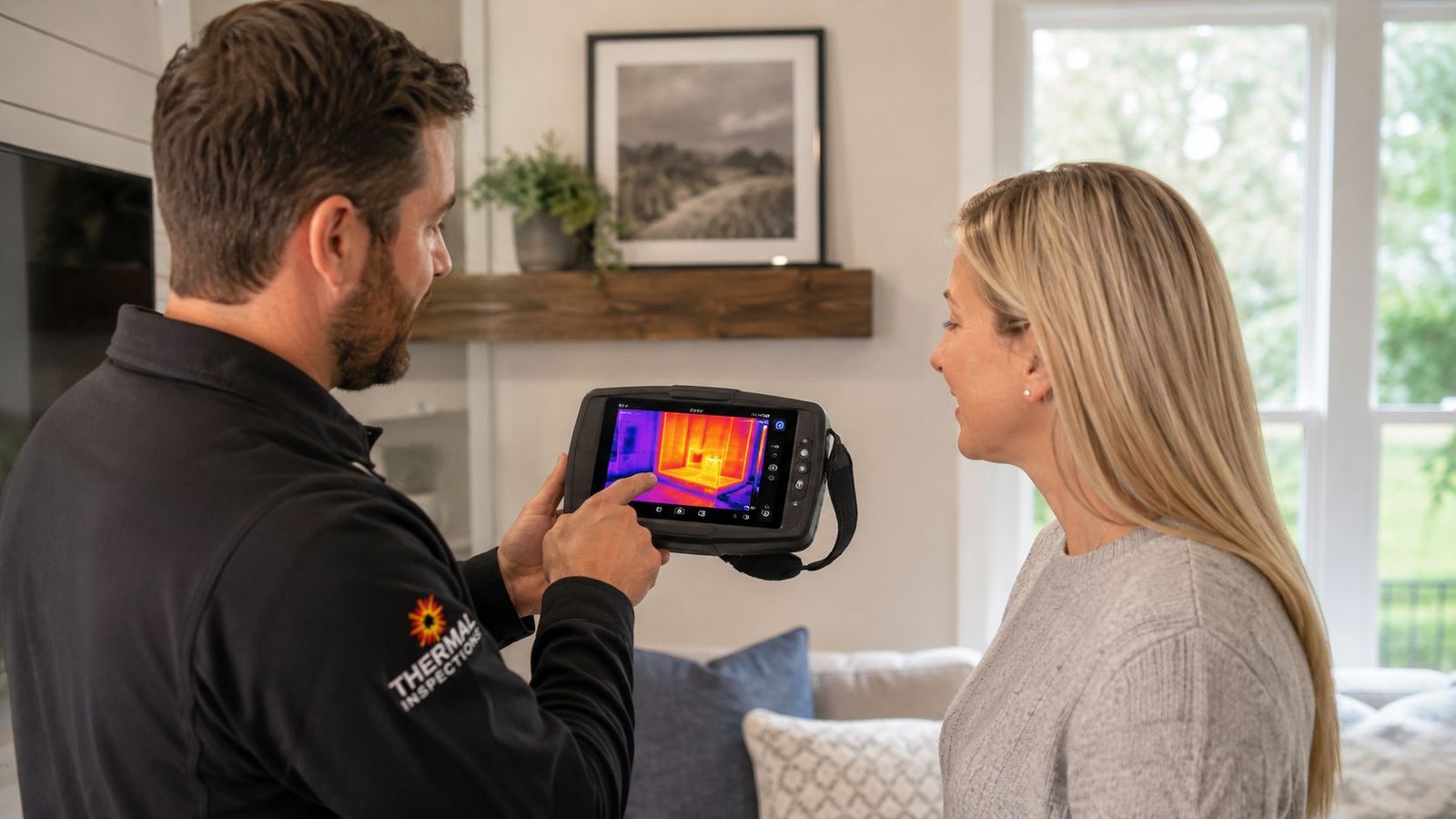
A professional thermal inspection should feel methodical, not mysterious. The technician isn't just waving a camera around. They're building a case for where damage is likely present and where it isn't.
The visit from your side of the door
First, the technician asks what you've noticed. A stain after rain. A spike in odor after running the shower. A hot wall after a small electrical event. That history matters because thermal patterns make more sense when tied to a timeline and location.
Next comes a visual inspection of the suspect areas and nearby rooms. If conditions aren't ideal, the technician may recommend adjusting indoor temperature or closing windows to improve the scan. In Los Angeles, where outdoor conditions can be mild, that setup step can make a real difference.
The scan and the confirmation
The camera is then used to scan surfaces systematically. Good operators don't chase colors. They compare rooms, look for pattern continuity, and check where moisture would realistically travel.
Image quality matters here. Professional-grade cameras with at least 320 x 240 resolution provide the detail needed to spot subtle thermal gradients from hidden moisture, while lower-resolution systems may miss small issues or distort their apparent size, as explained in this guide to thermal imaging camera specifications.
After the scan, the technician should confirm suspicious areas with moisture readings and explain the findings in plain language. If mold is a concern, this is also where a homeowner may benefit from a broader planning resource like your Los Angeles mold inspection checklist, especially when deciding what to test, document, and disclose.
A solid inspection usually ends with photos, notes, and a clear recommendation. Monitor it. Open it. Dry it. Test it. Or move to mitigation now.
Your Next Steps for Property Restoration in Los Angeles
Thermal imaging is one of the most useful diagnostic tools in restoration because it helps narrow the search without unnecessary demolition. But the main value comes from the person interpreting the image, verifying it with moisture testing, and tying it to the building's actual damage path.
If you've got a leak behind a wall, musty odors in a Sherman Oaks home, suspected mold in a Burbank rental, or smoke concerns after a fire near Glendale, don't rely on a surface-level guess. Start with a proper inspection and a clear restoration plan. If you're still sorting out where emergency response ends and drying begins, this overview of what is water mitigation helps clarify the process.
Frequently Asked Questions About Thermal Imaging
Can thermal imaging find a slab leak in Los Angeles homes
It can help identify suspicious temperature patterns on floors and nearby walls, which is useful in slab-on-grade homes common in parts of Los Angeles. It doesn't confirm the exact pipe break by itself, but it can narrow the area that needs follow-up testing.
Does thermal imaging detect mold
No. It detects temperature differences that may suggest hidden moisture. Since mold needs moisture, the camera helps locate conditions that may support growth, but mold confirmation requires inspection and, when appropriate, testing.
Is thermal imaging enough by itself for water damage
No. A proper inspection pairs the infrared camera with moisture meters, visual assessment, and building knowledge. The camera shows you where to look. The meter helps confirm what the material is doing.
Will my insurance company accept thermal images
Thermal images can support documentation, especially when they're part of a professional inspection report with moisture readings, photos, and a written scope. Coverage decisions depend on your policy and cause of loss, not just the presence of a thermal image.
Are phone-based thermal attachments good enough
They can be useful for casual observation, but they often lack the image quality and consistency needed for restoration decisions. For hidden moisture, subtle pattern differences matter. That's where professional equipment and interpretation make a big difference.
Can thermal imaging help after wildfire or smoke exposure
Yes. It can help inspect heat-affected areas, identify suspicious thermal anomalies, and support a wider fire damage assessment. In Los Angeles County, that can be useful after both interior fires and wildfire-related events.
When should I schedule a thermal inspection
Schedule one when you notice a new stain, persistent musty odor, unexplained wall discoloration, recent plumbing leak, or signs of lingering moisture after cleanup. Early inspection usually means a smaller repair area and fewer surprises.
If you suspect hidden water, mold, or fire damage, contact Onsite Pro Restoration for a professional inspection in Los Angeles, CA. We serve homeowners and property managers across North Hollywood, Glendale, Burbank, Sherman Oaks, and nearby communities. Call 818-336-1800 for help now.