
When a pipe bursts or a flood hits your Los Angeles home, the next 60 minutes matter more than any single decision you’ll make during the entire cleanup. Here’s the exact sequence to follow — and the mistakes that turn a manageable situation into a $20,000 restoration bill.
Minute 0–5: Stop the Water
Everything else is secondary until the water source is off. Find the main water shutoff valve — typically located at the water meter near the street, in the garage, or near the water heater. Turn it clockwise to close it.
For apartment residents: call your building manager immediately, as the shutoff is often in a utility room or basement only they can access. Know this number before an emergency happens.
If the flooding comes from a storm or external source (not a plumbing failure), get to high ground and focus on not entering areas where water may have contacted electrical outlets, panels, or appliances.
Minute 5–15: Address Electrical Hazards
Water and electricity are the most dangerous combination in a flood scenario. Before entering a flooded room:
- Turn off the circuit breaker for any rooms with standing water — do this from a dry location
- Do not touch any electrical outlets, switches, or appliances that may have been submerged
- If the main panel is in the flooded area, don’t enter — call an electrician first
- Unplug any electronics in adjacent rooms that are still dry but at risk
This step is non-negotiable. People are killed every year by energized water in flooded homes.
Minute 15–25: Document Everything
Before moving anything, before cleaning up, before lifting a single item — photograph and video the damage. This documentation is your insurance claim.
- Shoot wide-angle photos of every affected room showing the extent of water
- Get close-up photos of damaged materials: soaked drywall, buckled flooring, saturated furniture
- Video walkthrough with verbal narration describing what you see and the apparent source
- Note the time and take a photo of the clock — timestamps establish timeline for the adjuster
- Photograph the water source (burst pipe, overflow point) before anything is repaired
Many LA homeowners skip this step out of urgency to start cleanup. Don’t. A restoration company can verify the damage afterward, but you cannot recreate the initial scene once cleanup has begun.
Minute 25–40: Call Your Insurance Company
File the claim immediately — most policies require “prompt notice” of damage. Have ready:
- Your policy number
- Date and approximate time the damage occurred
- Cause of loss (burst pipe, appliance failure, roof leak)
- A rough description of affected areas
Ask specifically: does my policy cover this type of loss? Is emergency water extraction covered? Do I need to use a preferred vendor, or can I choose my own restoration company?
California homeowners should know: standard policies cover “sudden and accidental” events like burst pipes. Flooding from external sources (storm surge, rising groundwater) requires separate flood insurance through the NFIP.
Minute 40–60: Call a Certified Water Extraction Company
This is where speed pays dividends. Mold can begin colonizing wet materials within 24–48 hours. The faster water is extracted and structural drying begins, the less damage you end up with — and the lower your total restoration cost.
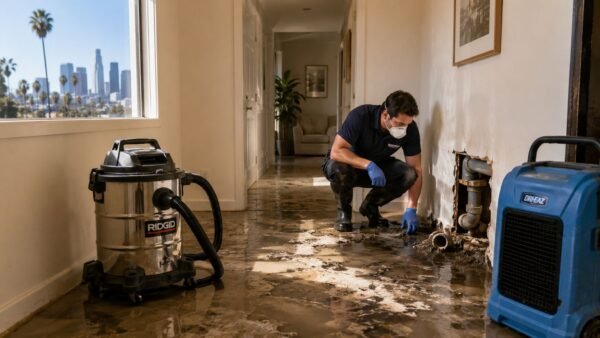
Professional emergency water extraction services do things a shop vac simply cannot:
- Truck-mounted extractors remove water from carpet padding, drywall cavities, and subfloors
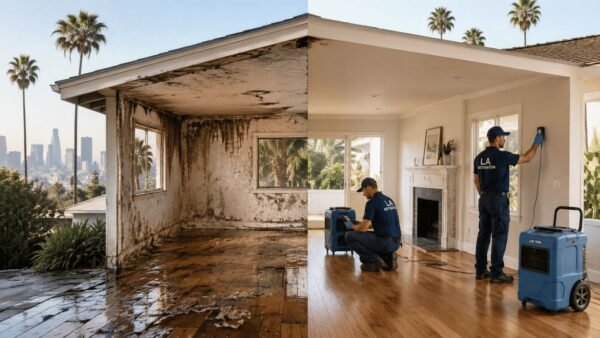
- Thermal imaging cameras locate hidden moisture behind walls and under flooring
- Moisture meters establish a data baseline that your insurance adjuster needs
- HEPA air scrubbers address airborne contaminants, especially in sewage-involved floods
IICRC-certified crews follow ANSI/IICRC S500 standards for water damage restoration — the same standards your insurance company expects. Using a certified team protects your claim.
What NOT to Do in the First Hour
As important as the action items are, several common mistakes escalate damage significantly:
- Don’t use a standard vacuum or shop vac for deep extraction — it can’t reach moisture inside materials
- Don’t turn on ceiling fans or HVAC — this spreads contaminated air if the flooding involves gray or black water
- Don’t use a space heater to dry things out — it raises humidity and accelerates mold growth
- Don’t throw away damaged items before documentation — your adjuster needs to see them
- Don’t begin any repairs before your adjuster approves — emergency mitigation (extraction, drying) is fine, but permanent repairs should wait
The 24-Hour Window: Why It Matters More Than Cost
Every hour of delay after a water event increases the total restoration cost. Wet drywall that could have been dried in place must be cut out and replaced. Hardwood floors that could have been salvaged cup and buckle beyond repair. Carpet padding that could have been dried becomes a mold substrate.
A study of insurance claims data consistently shows that claims where emergency extraction began within 4 hours have significantly lower average claim values than those where homeowners waited 24+ hours — often 40–60% lower in total restoration costs.
If you’re in Los Angeles and facing a water emergency, Onsite Pro Restoration’s IICRC-certified team responds within 90 minutes, 24/7. Call (818) 336-1800.
Quick Reference Checklist
- Shut off main water valve
- Cut power to affected circuits from a dry location
- Document with photos and video before touching anything
- Call your insurance company to file the claim
- Call a certified water extraction company immediately
- Move valuables out of affected areas if safe to do so
- Do NOT run HVAC, fans, or heaters in affected areas
- Keep all damaged materials until the adjuster has documented them
Learn more about emergency water extraction services in Los Angeles →