
After a fire, that lingering smell is usually the first thing people notice. While it's certainly unpleasant, professional smoke damage repair is about tackling a much deeper, more dangerous problem. The real threat comes from the invisible, corrosive particles of smoke and soot that blanket every surface in your Los Angeles home, causing slow but steady damage long after the fire is out.
This isn't just a cleaning job. It’s a hazardous material situation that needs immediate, expert attention. If you're facing the aftermath of a fire, don't wait for the damage to get worse.
Get a Free Smoke Damage Assessment
Why Smoke Damage Is More Than Just a Bad Smell
When a fire burns through your home, it’s not just consuming wood. It’s burning plastics, textiles, chemicals, and everything else in its path. The smoke it creates isn't some harmless vapor; it's a toxic cocktail of microscopic solids, liquids, and gases.
Thinking of these particles as simple dust is a huge mistake.
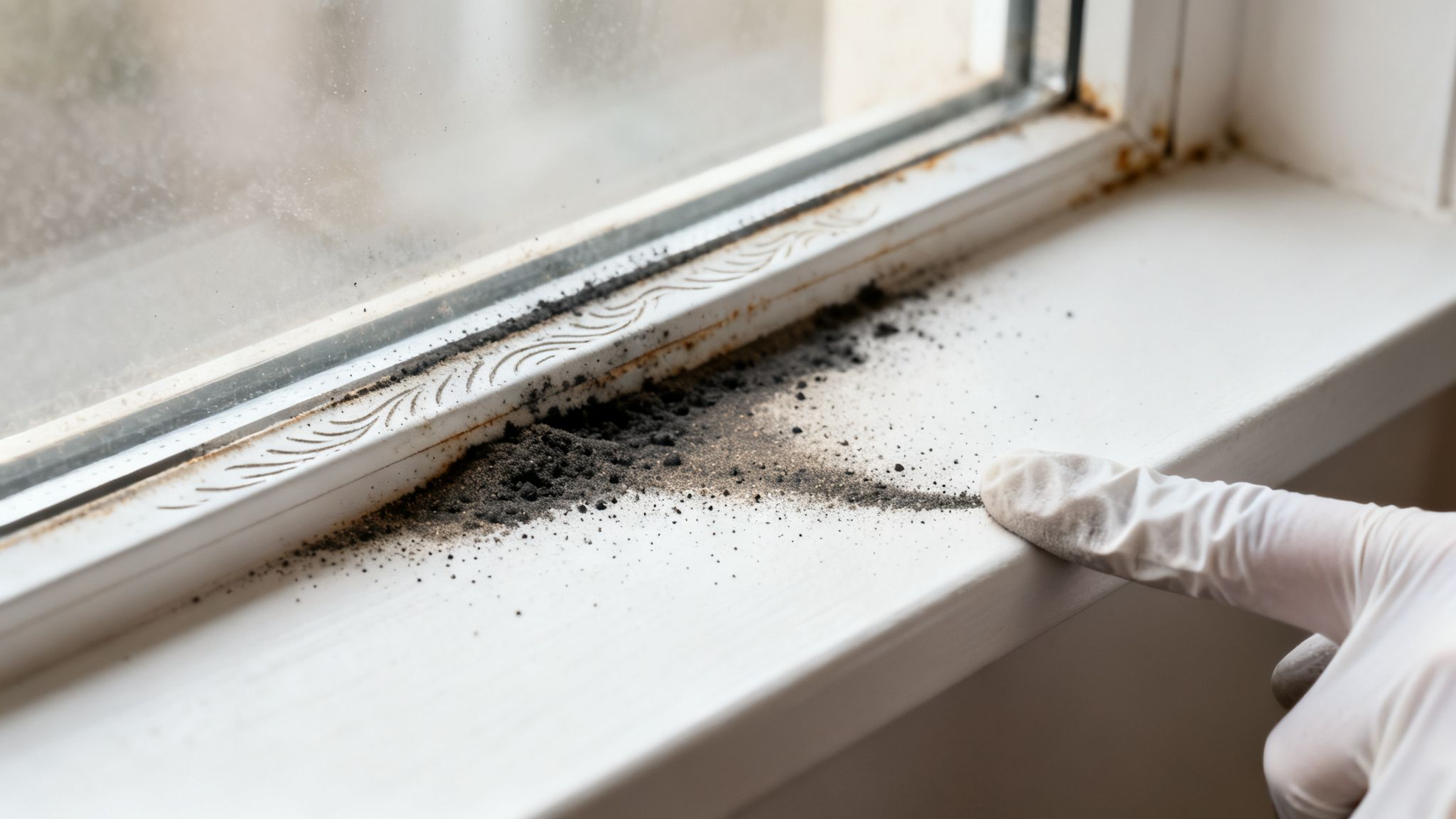
A better way to think about smoke and soot is like a fine, toxic sand. This "sand" is often highly acidic and corrosive, and it gets into absolutely everything—from the inside of your HVAC system to the delicate circuits in your electronics.
The Corrosive Nature of Soot
Let's say a small kitchen fire breaks out in a Studio City apartment. The flames might stay contained to the stove, but the smoke will travel everywhere. Once it settles, those acidic particles begin a quiet, destructive process:
- Etching Surfaces: Within just minutes or hours, soot can permanently etch glass, mirrors, and metal fixtures.
- Discoloring Materials: It seeps into porous surfaces like drywall, wood, and upholstery, causing a permanent yellowing stain that you can't just paint over.
- Damaging Electronics: Soot is conductive and acidic. It can short-circuit televisions, computers, and other appliances, causing them to fail days or even weeks after the fire.
This is exactly why seeing smoke damage as just a bad smell is a critical error. The odor is just a symptom of a much larger contamination that's actively threatening your property and your family’s health. We have a detailed guide on how to eliminate fire smoke odor, but the physical cleanup has to be the first step.
A Hazardous Material Situation
The particles left behind aren't just dirty—they're often toxic. They’re loaded with carcinogens and irritants that pose serious health risks if you breathe them in or touch them. Simply wiping surfaces with household cleaners won’t cut it. In fact, that usually makes things worse by smearing the greasy, oily soot deeper into the materials.
The crucial shift in perspective is understanding that you are not dealing with dirt, but with a hazardous chemical residue. This residue requires specialized cleaning agents, equipment, and personal protective gear to handle safely and effectively.
Beyond the visible soot, smoke leaves behind stubborn odors that can soak into surfaces and linger forever. It’s why understanding the science of how to get rid of home odors for good is so important. Ultimately, proper smoke damage repair is about neutralizing these hidden threats to protect your home and your health.
The Hidden Health Risks of Lingering Smoke Particles
Long after the fire trucks leave, an invisible threat can linger in your home. The soot and smoke residue coating your walls, furniture, and air ducts aren't just messy—they’re a toxic cocktail that can become airborne again and again, creating serious health risks for your family, kids, and pets. This is the part of smoke damage repair that goes way beyond just cleaning up stains.
Imagine a family in Glendale with nagging coughs and itchy eyes weeks after a small fire in a neighbor's unit. They might chalk it up to allergies, but the real culprit could easily be microscopic soot particles cycling through their HVAC system, poisoning the air every time the heat or AC kicks on.
Why Painting Over Stains Is a Dangerous Mistake
One of the worst DIY mistakes we see is when homeowners just paint over smoke-stained walls. It’s a tempting shortcut, but it only hides the discoloration—it does nothing to fix the actual problem. In fact, it makes everything worse.
Painting over soot essentially seals toxic particles into your home's structure. These trapped contaminants can continue to release harmful gases and odors for years, slowly degrading your indoor air quality and creating a long-term health hazard.
This approach completely misses the point. Real restoration isn't about covering things up; it's about meticulously and professionally removing the hazardous materials so your home is truly safe again.
The Invisible Contaminants in Smoke Residue
Soot isn't just burnt dust. It's a complex mix of chemicals and carcinogens from all the synthetic and natural materials that burned in the fire. When you breathe in these ultra-fine particles, they can travel deep into your lungs and cause a whole host of health issues.
Common problems we see linked to smoke particle exposure include:
- Respiratory Problems: A cough that won't quit, shortness of breath, bronchitis, and making asthma symptoms much worse.
- Eye and Skin Irritation: That constant red, itchy, or burning feeling from contact with airborne particles.
- Long-Term Health Risks: Extended exposure to the carcinogens found in soot can increase the risk of much more serious health conditions down the road.
This isn't a small problem. In recent years, U.S. residential fires have led to over 2,600 civilian deaths and 11,000 injuries, with billions spent on cleaning up the smoky aftermath. Soot is also acidic, meaning it requires specialized cleaning techniques to stop it from causing permanent damage and posing a constant health threat.
To get a true picture of what’s in your air, professional expert air quality tests for a safer home are a critical step in any thorough smoke damage cleanup. This is why hiring an IICRC-certified professional isn't just a good idea—it’s essential for protecting your family’s health. We use advanced gear like HEPA vacuums and specialized cleaning agents to get rid of contaminants at their source. If airborne particles are a big concern, you might want to learn more about how an air scrubber rental plays a key role in the process.
The Professional Smoke Damage Repair Process Explained
When you're staring at the aftermath of a fire, the road to recovery can feel impossibly long and confusing. A professional smoke damage repair job isn't just about wiping things down; it's a systematic, multi-phase operation designed to bring your property back to life, safely and completely.
Knowing the steps involved can take a lot of the mystery out of the process. It gives you a clear roadmap and shows you exactly what a certified team does to restore your home to its pre-fire condition.
Step 1: Initial Inspection and Damage Scoping
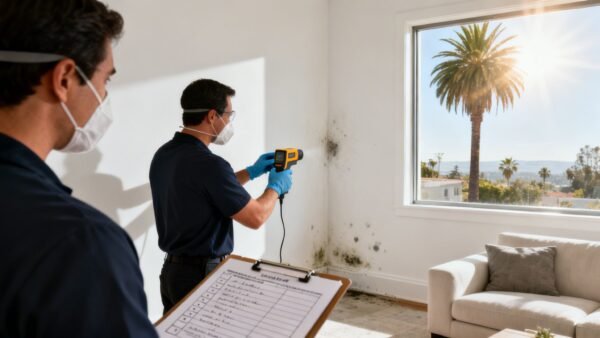
The moment our technicians arrive at your Los Angeles property, the first order of business is a thorough assessment. This isn’t a quick walk-through. It’s a meticulous inspection to map out the full extent of the smoke and soot contamination.
We use specialized tools to see how far the smoke has traveled, figure out which materials can be saved, and identify what needs to be removed. This initial deep dive is crucial for creating a solid action plan and giving your insurance company the detailed documentation they need.
Step 2: Securing Your Property and Preventing Further Damage
A fire often leaves a property exposed and vulnerable. Windows can be shattered, doors compromised, and roofs damaged. The immediate next step is to lock the site down and protect it from any further harm.
This usually involves:
- Board-Ups: Covering broken windows and any open entry points to keep the property secure.
- Roof Tarping: Laying down heavy-duty tarps over damaged roof sections to stop rain from getting in—a critical step, even here in the San Fernando Valley.
This emergency work prevents secondary issues, like water damage or vandalism, while we get ready for the main restoration.
To give you an idea of what a full-scale restoration project involves, here's a look at the typical workflow from start to finish.
Smoke Damage Repair Workflow
| Phase | Key Actions | Primary Goal |
|---|---|---|
| Emergency Mitigation | Site inspection, board-up, roof tarping, water extraction (if needed). | Secure the property and prevent further damage. |
| Soot & Smoke Removal | Use HEPA vacuums, dry-ice blasting, and specialized cleaning agents. | Remove all soot and smoke residue from surfaces. |
| Deep Cleaning | Sanitize all salvageable structures, contents, and HVAC systems. | Ensure the environment is hygienically safe. |
| Deodorization | Employ thermal fogging, ozone, or hydroxyl generators. | Eliminate smoke odors at the molecular level. |
| Repairs & Reconstruction | Replace drywall, flooring, paint, cabinetry; perform structural repairs. | Restore the property to its pre-loss condition. |
Each phase builds on the last, ensuring no stone is left unturned in making your home safe and clean again.
Step 3: Advanced Soot and Smoke Removal
This is where the real cleanup begins. Soot isn't just dust; it's a greasy, acidic film that sticks to everything, and your average household cleaner won't touch it. Our IICRC-certified technicians use specific techniques and equipment designed for the type of soot and the surfaces in your home.
As this infographic shows, the danger from soot goes far beyond cosmetic stains.
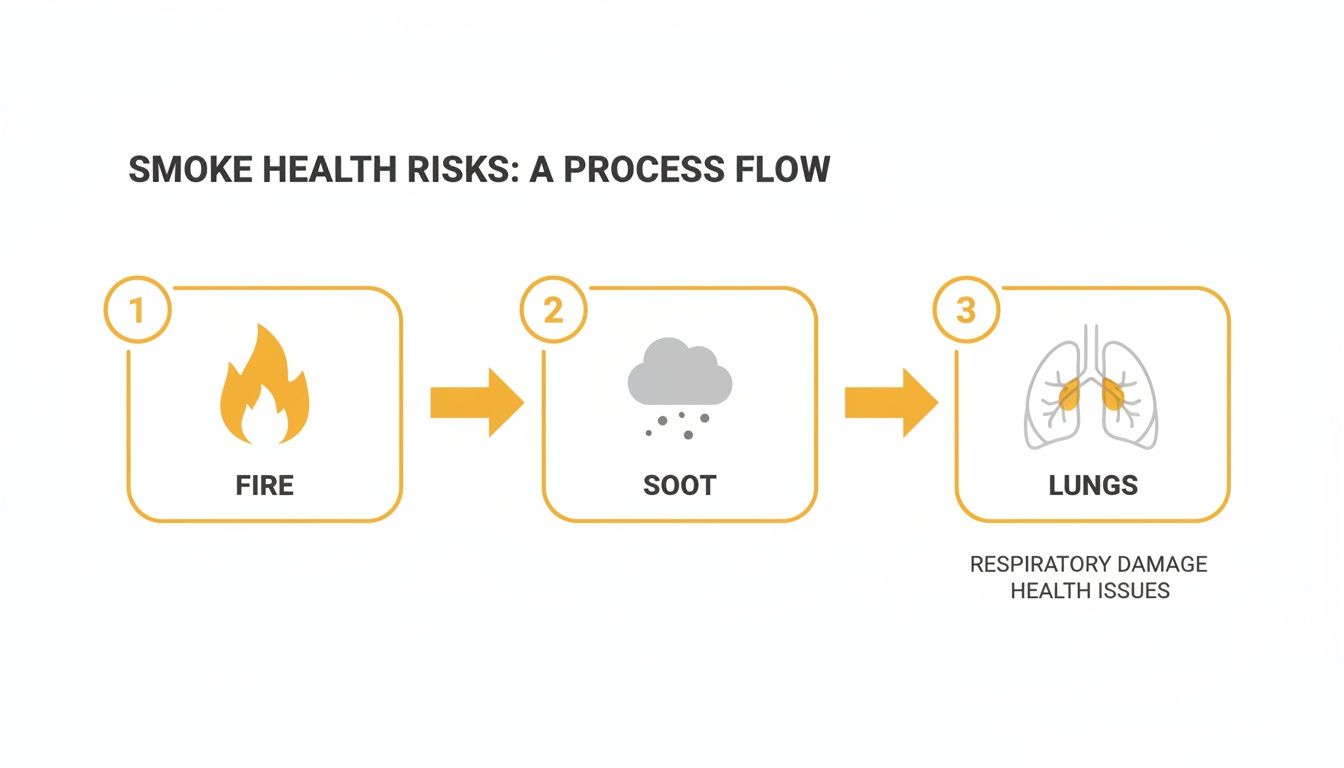
It’s a direct line from the fire to serious respiratory health risks if the soot isn’t removed completely. We use methods like dry-ice blasting for delicate electronics and powerful HEPA-filtered vacuums that capture even microscopic particles. The objective is total removal, especially from hidden areas like wall cavities and attics.
Step 4: Deep Cleaning and Sanitizing Surfaces
With the heavy soot gone, every single surface that remains—from countertops and floors to your personal belongings—gets a deep cleaning and sanitization treatment. This is especially important for porous materials like wood and drywall, which can act like sponges for smoke and odors.
We use professional-grade, EPA-approved cleaning agents formulated to break down stubborn soot residue and neutralize contaminants without harming your property. This step ensures your home isn't just visibly clean but also genuinely safe for you and your family to live in again.
The goal here isn't just to clean, but to truly restore. It’s about bringing items back to their pre-fire condition whenever possible and making sure every surface is free from harmful residues that could pose a long-term health risk.
Step 5: Professional Deodorization
That lingering smoke smell is notoriously stubborn. Why? Because the odor-causing particles are microscopic and wedge themselves deep inside porous materials. Spraying air freshener is like putting a band-aid on a broken leg—it just masks the problem for a little while.
To kill the odor at its source, we use advanced technology:
- Thermal Fogging: A heated solvent creates a fine fog that mimics the behavior of smoke, penetrating materials to neutralize odor particles on contact.
- Ozone Treatment: Ozone generators release a gas that chemically alters smoke molecules, completely eliminating the smell.
- Hydroxyl Generators: These safe, powerful machines use UV light to break down odor compounds in the air and on surfaces.
Step 6: Full Restoration and Reconstruction
The final step in the smoke damage repair process is putting everything back together. Once the cleaning and deodorizing are done, any materials that were too damaged to save need to be repaired or replaced.
This reconstruction work can be as simple as painting and laying new carpet or as complex as rebuilding walls and installing new kitchen cabinets. Our team handles every aspect of the build-back, creating a seamless transition from a damaged house back to the safe, comfortable home you remember.
You can learn more about this phase and our other capabilities by checking out our complete fire damage restoration service.
Why DIY Smoke Cleanup Attempts Often Go Wrong
After a fire, that gut instinct to grab a sponge and start scrubbing is powerful. It feels productive, like you're taking back control. But when it comes to smoke damage repair, that well-intentioned effort can backfire, turning a manageable problem into a permanent one.
The truth is, smoke and soot aren't like regular dust or grime. They’re an oily, acidic, and aggressive mess that requires a specific strategy to defeat. A failed DIY attempt doesn't just eat up a weekend—it can cause irreversible damage, create ongoing health hazards, and even put your insurance claim at risk.
The Wrong Tools for a Hazardous Job
One of the first mistakes we see is homeowners reaching for standard household cleaners. All-purpose sprays and soapy water just aren't built for this fight. They can't break down the greasy, acidic film that soot leaves behind.
Instead of lifting the residue, these cleaners tend to smear it around. This action grinds the microscopic soot particles even deeper into porous materials like drywall, wood, and upholstery. Once they're pushed in that deep, the stains become almost impossible to get out, locking in discoloration and odors for good.
Ignoring What You Cannot See
A successful smoke damage cleanup goes far beyond what’s visible on the surface. Smoke particles are microscopic invaders, experts at finding their way into places you’d never think to look.
The biggest mistake in a DIY cleanup is underestimating the enemy. Smoke doesn't just sit on walls; it penetrates deep into wall cavities, insulation, and the entire HVAC system. If you only clean the surface, you leave the source of the problem festering out of sight.
Professionals use specialized equipment like thermal foggers and ozone generators to track down and neutralize odors that have seeped into the very bones of your home. A store-bought air freshener just puts a temporary mask on the smell, which is why that frustrating smoky odor always seems to return weeks or even months later.
A Costly and Growing Problem
Getting the cleanup wrong the first time almost always leads to a much bigger bill down the road. The global fire damage restoration market is a multi-billion dollar industry for a reason—this work is incredibly complex. With over 1.3 million fires reported in the U.S. in 2023 causing a staggering $18 billion in property damage, the scale of the problem is immense.
Ultimately, improper cleanup can lead to a cascade of issues:
- Permanent Stains and Discoloration: Surfaces that could have been saved are now ruined beyond repair.
- Lingering Odors: That persistent smoke smell comes back, impacting your daily life.
- Ongoing Health Risks: Toxic particles are left behind in the air you breathe and on the surfaces you touch.
- A Denied Insurance Claim: Insurers may refuse to cover damage that was made worse by incorrect cleaning methods.
Calling a certified professional from the start isn’t just another expense. It’s a crucial investment in protecting your property's value and your family's health.
Navigating Your Smoke Damage Insurance Claim in Los Angeles
Dealing with the aftermath of a fire is stressful enough without having to untangle an insurance claim. But let’s be frank: successfully navigating this process is the most critical part of your financial and emotional recovery. A well-documented claim is what stands between you and the fair settlement you need for a complete smoke damage repair.
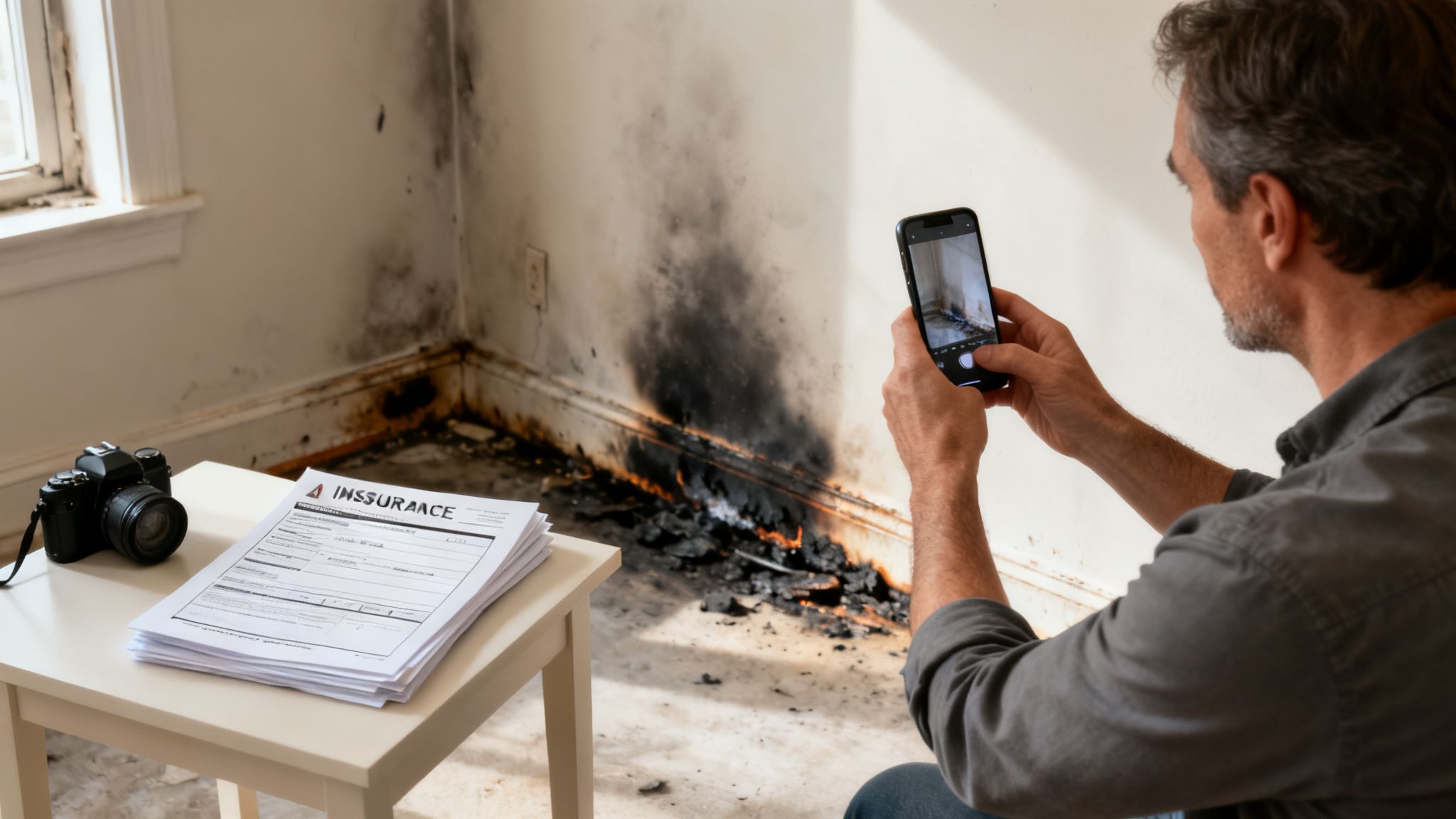
This can feel like a monumental task, especially if you’re a Los Angeles homeowner facing this for the first time. The good news? With a clear strategy and the right team in your corner, you can get through this effectively.
The Power of Meticulous Documentation
From the moment it’s safe to step back on your property, your number one job becomes documentation. Insurance companies run on proof, not promises. The more concrete evidence you can provide, the smoother your claim will go.
Start by taking hundreds of photos and videos. Don't just get a wide shot of a sooty room; get up close. Show the film on the TV screen, the soot inside the kitchen cabinets, the discoloration on the ceiling corners. This visual proof is your single most powerful tool.
Next, start a running list of every single damaged item. Be painfully specific.
- Item Description: Not just "a TV." Write "Samsung 55-inch 4K Smart TV, Model QN55Q80A."
- Details: Note its approximate age, what you paid for it, and dig up any receipts you can find (even digital ones).
- Cross-Reference: Match each item on your list to a corresponding photo or video clip.
This isn't overkill—it's what's necessary. This level of detail removes all guesswork and helps the adjuster accurately calculate your losses.
Why a Professional Damage Report is Non-Negotiable
Your personal photos and lists are absolutely essential, but they're only half the story. To get your claim approved without pushback, you need a professional assessment from a certified restoration company. This report is the cornerstone of any serious smoke damage repair claim.
A company like Onsite Pro Restoration delivers a report that sees what the naked eye can’t. We use specialized gear to test air quality, measure the depth of soot penetration into hidden wall cavities, and assess contamination inside your HVAC system.
A professional damage report translates the physical damage into the specific, technical language that insurance carriers require. It outlines the exact cleaning protocols, deodorization methods, and necessary repairs, creating a clear, evidence-backed scope of work that justifies every dollar of the claim.
This document becomes the playbook for negotiating a fair settlement, making sure hidden damage doesn't get ignored, only to pop up months later.
Working Directly with Your Insurance Adjuster
Here’s one of the biggest benefits of hiring an experienced restoration company: we work directly with your insurance adjuster. Our team speaks their language fluently. We understand the claims process, know exactly what documentation they need, and how to format our reports so they sync with their systems.
This collaboration takes the pressure off you entirely. Instead of you trying to play translator between contractors and claims agents, we handle the technical questions, provide any additional evidence they need, and push for approvals. This doesn’t just speed up your claim; it dramatically lowers your stress.
You can focus on your family while we manage the complex logistics of the smoke damage repair claim. By handling the nitty-gritty communication, we ensure nothing falls through the cracks and clear the path for a successful restoration.
How to Choose the Right Contractor in Los Angeles
After a fire, picking the right partner for your smoke damage repair is one of the most critical decisions you'll make. The Los Angeles market is crowded, and frankly, not all restoration companies are created equal. Making a smart choice here is the key to getting your property restored correctly and making sure your insurance claim goes through without a hitch.
Your job is to find a reliable, qualified pro who understands the science behind soot removal, deodorization, and reconstruction. Be wary of contractors using high-pressure sales tactics or giving you vague, ballpark estimates. A true partner will be transparent, patient, and completely focused on one thing: getting your life back to normal.
Essential Credentials and Qualifications
Before you even think about signing a contract, you need to verify a company's credentials. This isn't just about how long they've been in business; it's about proven competence and being held accountable.
Here are the absolute non-negotiables:
- IICRC Certification: The Institute of Inspection, Cleaning and Restoration Certification (IICRC) is the gold standard in our industry. If a company isn't IICRC-certified, it means their technicians haven't been trained on the latest, most effective methods for smoke damage repair. It's a major red flag.
- Proper Licensing and Insurance: Your contractor must be licensed by the California State License Board (CSLB) and carry both general liability and workers' compensation insurance. This isn't just paperwork—it protects you from being on the hook for any accidents that happen on your property.
- 24/7 Emergency Availability: Fires don't stick to a 9-to-5 schedule, and neither should your restoration company. A reputable team will be ready to roll around the clock to secure your property and start the mitigation process immediately.
A Proven Track Record with Insurance Companies
A contractor's technical skill is only half the battle. Their ability to work with insurance carriers is just as important. An experienced company gets how the claims process works and knows exactly what kind of detailed documentation an adjuster needs to approve your claim without endless back-and-forth. They should be able to speak directly with your adjuster, saving you a massive headache.
The demand for skilled restoration services has never been higher, especially in fire-prone areas from Glendale to Sherman Oaks. With climate-amplified wildfires, the global disaster restoration market is forecasted to hit a staggering $55.5 billion by 2030. In a U.S. market with over 35,000 businesses, the companies that thrive are the ones with strong insurer networks and rock-solid IICRC certifications. These are the teams best positioned to deliver fast, effective results when you need them most. You can read more about these industry trends to understand the bigger picture.
FAQ: Common Questions About Smoke Damage Repair
When you're dealing with the aftermath of a fire, questions come thick and fast. To give you some clarity, we've answered the most common concerns we hear from Los Angeles homeowners about smoke damage repair.
Q: How long does smoke damage repair usually take?
A: There’s no single answer—it all comes down to the scale of the damage. A small kitchen fire that was put out quickly in a Santa Monica apartment might only take a few days to clean up. However, a larger fire that compromised the structure of a home in the Valley could take several weeks or even months. A professional assessment is the only way to get an accurate timeline.
Q: Is it safe to stay in my house after a small fire?
A: We strongly advise against it until a professional gives the all-clear. Even a minor fire releases an incredible amount of toxic particles into the air and onto every surface, posing serious health risks. An IICRC-certified technician must perform air quality tests and a contamination assessment before you and your family re-enter the property.
Q: Can the smoke smell really be removed permanently?
A: Absolutely, but it requires professional technology. That lingering odor comes from microscopic soot particles embedded deep into porous materials like drywall, wood, and furniture. To eliminate the odor for good, we use advanced tools like thermal foggers and ozone generators that attack and neutralize the smoke molecules at their source, rather than just masking the smell.
Q: Does homeowners insurance cover smoke damage?
A: Yes, in most cases. A standard homeowners policy will almost always cover damage from both the fire and the resulting smoke. However, every policy has specific limits and exclusions, so you’ll want to review your documents. Filing your claim immediately and providing thorough documentation is key to a smooth process.
When you need fast, reliable, and professional smoke damage repair in Los Angeles, Onsite Pro Restoration is here to help 24/7. Call us now for a free assessment and let our certified team restore your property and your peace of mind.