
The best way to remove smoke smell from a house isn't a single trick—it's a comprehensive strategy. It starts with immediate ventilation, moves to deep cleaning every single surface, and often finishes with advanced, professional deodorization.
For a faint smell from a minor kitchen mishap, some DIY tricks with vinegar and baking soda might cut it. But for the stubborn, persistent odors left by a house fire in the San Fernando Valley or years of smoking, you have to bring in the heavy hitters. We're talking professional-grade tactics using HEPA air scrubbers and specialized cleaning agents to get rid of it for good.
Get a Free Smoke Damage Assessment Today
Understanding How Smoke Lingers in Your Home
Before you can really tackle a smoke odor, you have to understand what you’re up against. That stubborn smell isn't just floating in the air. It’s a physical residue made of microscopic particles and volatile organic compounds (VOCs) that are incredibly invasive and clingy.
Whether it’s the aftermath of a wildfire sweeping through the Santa Monica Mountains or a small kitchen fire in a Sherman Oaks apartment, those particles embed themselves deep into any porous surface they can touch. Just opening a window or spraying an air freshener won't even scratch the surface of the real problem.
The Science of Stubborn Smoke Odor
Smoke residue is often sticky and acidic. This allows it to form a tight bond with materials all over your home, which is why the smell seems to vanish and then reappear, especially on humid days when moisture in the air "reactivates" those odor-causing compounds.
Think about all the places these particles love to hide:
- Porous Surfaces: Drywall, paint, wood, and even ceiling tiles will soak up smoke like a sponge.
- Soft Fabrics: Carpets, upholstery, drapes, and clothes are notorious for trapping odor molecules deep in their fibers.
- HVAC Systems: Your home's ventilation system can become a superhighway for contamination, circulating smoky air long after the fire is out.
- Hidden Nooks: Smoke gets everywhere. We're talking inside cabinets, closets, light fixtures, and behind your appliances.
The key takeaway is that smoke odor isn't a single problem but a widespread contamination. A successful removal strategy must address every affected surface, not just the air.
Why a Systematic Approach is Crucial
You absolutely need a systematic plan for smoke odor, moving from immediate, simple actions to more intensive, long-term solutions. You can’t just paint over a smoke-stained wall and hope the smell disappears; that residue will bleed right through the new paint in no time.
Likewise, cleaning the carpets but ignoring the drapes and walls will just lead to re-contamination. A truly effective approach combines two critical stages: cleaning to remove the physical soot particles, and deodorizing to neutralize the odor molecules left behind. This is the only way to ensure the smell is gone for good.
To help you get started, here's a quick breakdown of the actions you can take right away versus the more involved solutions needed for complete smoke odor removal.
Immediate Actions vs. Long-Term Solutions for Smoke Odor
| Action Type | Examples | Effectiveness | Best For |
|---|---|---|---|
| Immediate Actions | Opening windows, using fans, placing bowls of vinegar or baking soda. | Low-Medium. Helps reduce airborne odors temporarily. | Minor smoke incidents, reducing initial smell while planning next steps. |
| Deep Cleaning | Washing walls, ceilings, and hard surfaces with specialized cleaners. | High. Removes the physical source of the odor (soot/residue). | The essential second step after initial ventilation for any level of smoke damage. |
| Soft Goods Cleaning | Professional laundering of drapes/clothing, steam cleaning carpets/upholstery. | High. Removes deeply embedded particles from porous fabrics. | Necessary for any home with significant soft furnishings. |
| Professional Deodorization | HEPA air scrubbers, ozone generators, thermal fogging. | Very High. Neutralizes microscopic particles and odors in the air and deep within materials. | Severe, persistent odors from house fires or long-term smoking. |
This table shows that while immediate steps are helpful, they are just the beginning. True, lasting smoke odor removal requires a thorough, multi-layered approach that addresses every corner of your home.
Immediate Actions to Take After Smoke Damage
When you’re standing in the aftermath of a fire or even a serious kitchen mishap, that lingering smoke smell feels like it’s everywhere. It is. And what you do in the first few hours is absolutely critical. Acting fast—and smart—can be the difference between a quick cleanup and a drawn-out, expensive restoration nightmare.
Your very first move, assuming the property is safe to enter, is to get fresh air moving. Throw open every single window and door you can. You want to create a strong cross-breeze. Grab any box fans or floor fans you have and point them outward through a window or doorway. The goal here isn't to just stir up the smoky air, but to actively push it outside.
Securing Your Home and Preventing Further Spread
Before you even think about wiping anything down, shut off your HVAC system at the thermostat. I can’t stress this enough. If you leave the heat or AC running, you're essentially pumping soot, ash, and those nasty smoke particles into every corner of your house through the ductwork. It’s a huge mistake that turns a localized problem into a whole-house contamination.
With the HVAC off, your next job is to get rid of the source. Carefully bag and remove any charred or burnt items that are beyond saving. You’ll want to wear protective gear for this—at a minimum, an N95 mask and a good pair of gloves. Soot isn’t just messy; it’s loaded with chemicals you don’t want on your skin or in your lungs.
Sometimes, you'll need to clear out undamaged belongings just to make room to work or protect them from getting contaminated during cleanup. If you find yourself in that boat, looking into efficient ways to store household goods can be a lifesaver.
This infographic gives you a great visual of what we're up against. Smoke particles don’t just float around; they invade everything they touch.
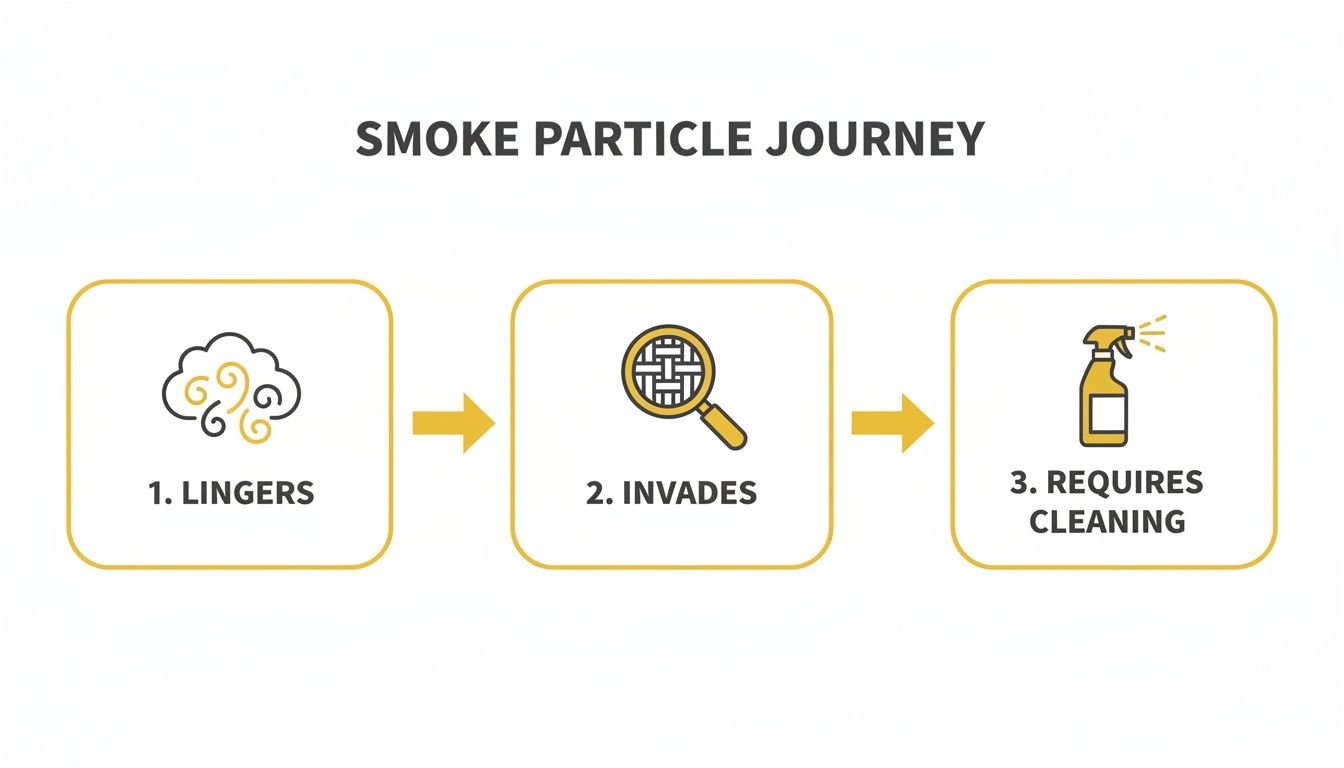
It shows exactly why just opening a window for a few days won’t cut it. Those particles get deep into porous materials and stick, which is why a systematic cleaning is so essential.
Your Initial Cleanup Checklist
A methodical start makes all the difference. One key rule: don't touch soot-covered surfaces with your bare hands. The natural oils on your skin will mix with the soot, creating a grimy stain that can be nearly impossible to remove later.
Here’s where to focus your energy first:
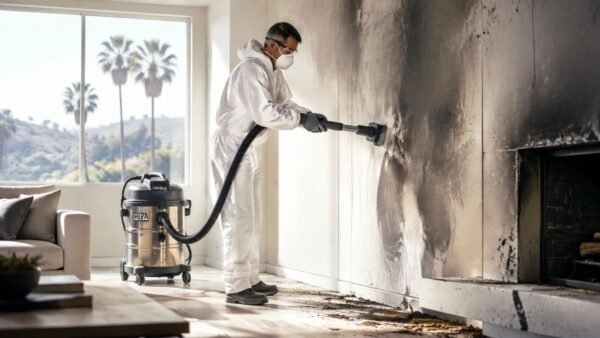
- Dry Soot Removal First: Before any wet cleaning, grab a shop vacuum with a HEPA filter. Gently vacuum up the loose soot from carpets, drapes, and furniture. Crucially, do not use the brush attachment. Pushing down with a brush will just grind the soot deeper into the fibers, making it worse.
- Wipe, Don't Rub: For walls, ceilings, and other hard surfaces, your best friend is a dry cleaning sponge (often called a chemical sponge). These are designed to lift soot off surfaces without smearing it around. Wet cleaning at this stage often just creates a muddy mess.
- Protect What's Clean: As you work from the top down, soot will inevitably fall. Cover clean furniture, carpets, and flooring with old sheets or drop cloths to prevent cross-contamination.
Pro Tip: Stay away from your typical household cleaners for now. Products like Windex or multi-surface sprays can have a chemical reaction with soot that sets the stain permanently.
Clearing the air itself is also a powerful first step. The EPA actually did some research showing that a DIY air cleaner—just a standard box fan with a MERV 13 filter taped to the back—can significantly reduce airborne smoke particles. Their study found it improved particle removal by 123%, which is a huge win for very little cost.
These first few steps are your best defense. They’re tough work, both physically and emotionally, especially right after a fire. Knowing what to do after a a house fire can help you feel more in control during a chaotic time and set you up for a much smoother recovery.
A Room-by-Room Guide to Deep Cleaning Surfaces
Once you've aired the place out and tackled the loose soot, it's time to roll up your sleeves for the deep clean. This is the grunt work, where you physically remove the sticky, acidic smoke residue that’s clinging to every surface. It’s the absolute core of finding the best way to remove smoke smell from house.
A methodical approach is everything here. If you clean randomly, you'll just end up re-contaminating areas you've already finished.
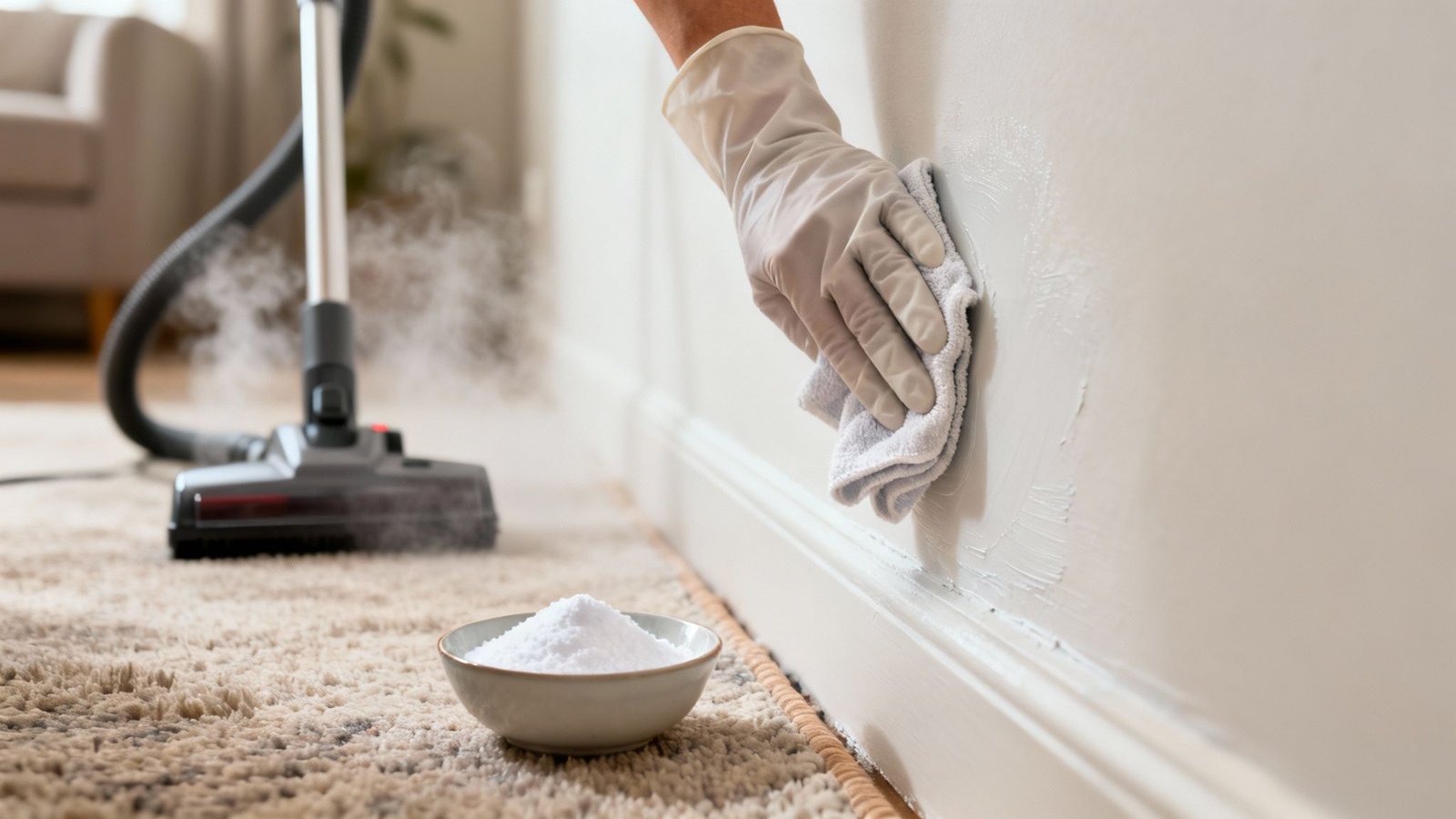
Tackling Hard Surfaces: Walls, Ceilings, and Floors
Always, always start high and work your way down. Begin with the ceiling, then move to the walls, and finish with the floors. This simple rule prevents dirty cleaning solution from dripping all over your freshly cleaned surfaces.
Walls and ceilings usually take the biggest hit. A solution of warm water and a degreasing cleaner like trisodium phosphate (TSP) is incredibly effective, but it's potent stuff—make sure you're wearing gloves and eye protection. For a gentler option that still cuts through the grime, a simple mix of one part white vinegar to one part warm water does a surprisingly good job of breaking down soot.
Here's a pro technique: use two buckets. One holds your cleaning solution, and the other holds clean rinse water. Wash a small, manageable section, then rinse your sponge in the second bucket before dipping it back into the cleaner. This stops you from just smearing dirty soot around.
For hard flooring like tile, vinyl, or wood, a thorough mopping with your cleaning solution is next. Don't forget the baseboards and corners, because that's exactly where soot loves to hide.
Reviving Soft Surfaces: Carpets, Upholstery, and Drapes
Porous materials are basically magnets for smoke odor. Carpets, sofas, and curtains trap those nasty smoke particles deep inside their fibers, making them a stubborn source of the smell. Just spraying them with Febreze is a waste of time; it does nothing to solve the root problem.
Pro Tip: Before you go wild with any liquid cleaner on your couch or carpet, test it on a small, hidden spot first. The last thing you want is to create a giant discolored patch.
Start by sprinkling a thick layer of baking soda over all your carpets and upholstered furniture. Let it sit for at least a few hours—or even overnight if the smell is really bad. Baking soda is a fantastic natural deodorizer and will pull a lot of the surface odor out. Then, vacuum it all up meticulously.
For a deeper clean, nothing beats a steam cleaner. The hot water and cleaning solution penetrate deep into the fibers to force out the soot and odor molecules. You can rent one from a local hardware store or hire a professional service for the best results.
Anything washable, like drapes or cushion covers, should go into the laundry. Add a cup of white vinegar to the rinse cycle for an extra deodorizing kick.
Cleaning the Often-Overlooked Areas
Smoke is sneaky. It gets into places you wouldn't even think to look. To truly kill the odor, you have to be just as thorough.
- Inside Cabinets and Drawers: Don't skip these. Empty everything out and wipe down every single interior surface. Leave the doors and drawers open afterward to air out completely.
- Light Fixtures: Soot coats light bulbs and fixtures, releasing a puff of smoke smell every time they heat up. Let them cool down, then carefully remove and wash any glass shades. Gently wipe down the bulbs and the fixture itself.
- HVAC Vents and Grilles: Pull off all the vent covers and wash them in warm, soapy water. While they're off, use a vacuum extension to clean as far back into the ductwork as you can reach.
Even with these steps, smoke residue can get deep inside your home's ventilation system. For a truly complete cleaning, it’s worth looking into professional duct cleaning services to clear out what you can't see.
Advanced Odor Neutralization Techniques
So, you’ve scrubbed every surface and washed every fabric in the house, but there's still a stubborn, lingering smoke smell. It happens. This is where we shift from cleaning to active odor neutralization. These methods don’t just cover up the smell—they get in there and break down the odor-causing molecules for good. This is truly the best way to remove smoke smell from house when it has seeped deep into the materials.
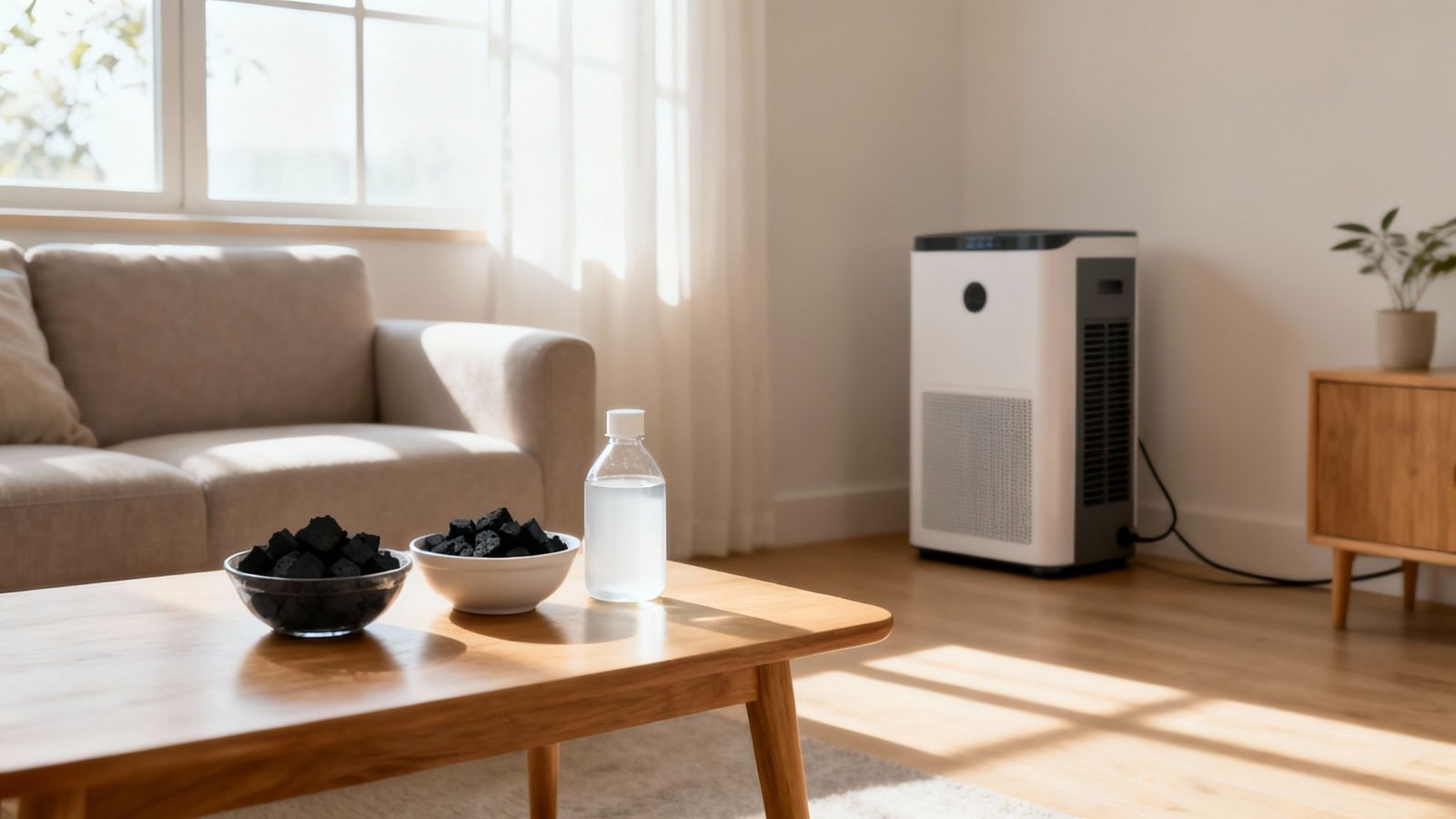
Natural Odor Absorbers for Lingering Smells
Before you bring in the heavy-duty equipment, a few simple, natural materials can make a surprisingly big difference. I recommend these for milder odors or as a great support player in a larger deodorization project.
- Activated Charcoal: This isn't your backyard barbecue charcoal. Activated charcoal is incredibly porous, giving it a massive surface area that literally traps odor molecules floating in the air. Just place a few bowls of it around the rooms that need work.
- White Vinegar: Setting out bowls of white vinegar is another classic trick. The acetic acid in vinegar helps neutralize those airborne smoke compounds. Don't worry, the vinegar smell itself will disappear once it dries.
- Baking Soda: You probably used it on your carpets, and you can do the same for the air. Pop open a few boxes or pour some into bowls and place them in smaller spaces like closets and cabinets to absorb those last traces of odor.
These methods are the "slow and steady wins the race" type. They won't fix a major smoke issue overnight, but they are effective, safe, and cheap additions to your toolkit.
HEPA Air Scrubbers and Carbon Filters
When you need a more immediate and powerful impact on your home's air quality, it's time to step up to professional-grade air purifiers. An air scrubber is a portable filtration beast that sucks in huge volumes of air, pushes it through a series of filters, and pumps out clean, fresh air.
The magic against smoke lies in its two-stage filtration system:
- HEPA Filter: This is your particle grabber. It traps 99.97% of airborne particles down to 0.3 microns—that includes the microscopic soot and ash that carry the smoke smell.
- Activated Carbon Filter: This is the game-changer. While the HEPA filter snags the physical bits, the carbon filter adsorbs the gassy odors and volatile organic compounds (VOCs) that a HEPA filter can’t touch.
Running an air scrubber 24/7 for a few days can make a world of difference. It's a standard first move in any professional deodorization job for a reason.
Professional-Grade Neutralization Technology
Sometimes, the smoke odor penetrates so deeply into structural materials—drywall, wood studs, subflooring—that even the best cleaning and air filtration can't reach it. This is where certified technicians like us bring out the advanced tech to destroy odors at the molecular level.
Important Safety Note: The following methods are extremely effective but can be hazardous. They should only be performed by trained and certified restoration professionals in an unoccupied and sealed property.
Thermal Fogging
A thermal fogger is a device that heats a special solvent-based deodorizer, turning it into a dense fog made of microscopic particles. This fog behaves just like the original smoke did, penetrating deep into cracks, crevices, and porous materials to neutralize odor molecules on contact. It goes where the smoke went.
Vaporization
Vaporization technology has become a real cornerstone of our industry. These systems use plant-based essential oils to create microscopic particles that actively neutralize odors, not just mask them.
Ozone and Hydroxyl Treatments
These are two of the most powerful tools in our arsenal for complete odor elimination:
- Ozone Generation: An ozone (O₃) generator creates an extra, unstable oxygen molecule. This molecule aggressively reacts with and oxidizes smoke odor molecules, permanently destroying them. But here's the catch: ozone is harmful to people, pets, and even plants. The property must be completely empty during treatment and for a period afterward until it's fully ventilated.
- Hydroxyl Generation: A safer, though slower, alternative is a hydroxyl generator. It uses UV light to create hydroxyl radicals (·OH), which are the same molecules that naturally clean the earth's atmosphere. This process is safe for occupied areas, but it takes significantly longer to get the same knockout results as an ozone treatment.
When to Call a Professional Restoration Company
It’s one thing to be a determined DIYer, but it’s another to know when you’re out of your depth. Knowing that line is critical when you’re dealing with smoke damage. While scrubbing surfaces and opening windows are great first steps, some types of smoke damage are just too stubborn—and hazardous—for a homeowner to tackle alone.
Recognizing the red flags early can save you a ton of time, money, and frustration. Not to mention, it protects your health.
If you’ve deep-cleaned every inch of your home and that stale, smoky smell comes roaring back on the first humid day, that’s a huge sign. It means the smoke particles aren’t just sitting on the surface; they’ve worked their way deep into drywall, insulation, and even the wood framing of your house. No amount of surface cleaning will ever reach that.
Key Signs You Need Expert Help
So, when is it time to put down the sponge and pick up the phone? Certain situations almost always demand a professional response. The type of smoke, how far the damage spread, and how stubborn the odor is are your biggest clues.
- Smoke from Synthetic Materials: A fire that burned plastics, synthetic fabrics, or foam creates a nasty, oily soot that’s both toxic and incredibly difficult to clean. This isn't something you can just wipe away; it requires specialized chemical agents and professional techniques.
- Widespread Soot Coverage: If you see soot on the walls and ceilings in more than one room, you can bet it’s also lurking inside your HVAC system, behind your walls, and in other hidden spaces you can’t see.
- Persistent Odor After Cleaning: You’ve aired the place out, scrubbed everything down, and deployed every odor absorber you can find, but the smell just won’t quit. This tells you the problem is at a molecular level, and you need advanced equipment like ozone or hydroxyl generators to fix it.
- HVAC System Contamination: If there's any chance the smoke got sucked into your ventilation system, don't even try to fix it yourself. Only a professional cleaning will stop it from pumping contaminated air right back into every room of your home.
The Value of an IICRC Certified Technician
Hiring a pro isn’t just about getting an extra pair of hands. It's about bringing in expertise and technology that you simply can’t find at the local hardware store. An IICRC (Institute of Inspection, Cleaning and Restoration Certification) certified technician brings a scientific approach to smoke and odor removal.
Professionals don’t just mask the odor—they eliminate it at the source. They use a combination of advanced cleaning agents and specialized equipment like thermal foggers, which replicate the smoke's path to neutralize odor molecules wherever they have settled.
These technicians are trained in critical safety protocols, so they know exactly how to handle hazardous materials and operate powerful deodorization equipment without putting your family at risk. This expertise is what truly defines the best way to remove smoke smell from house when you're facing serious damage.
Navigating the Insurance Claims Process
One of the biggest, and often overlooked, benefits of hiring a company like Onsite Pro Restoration is the help you get with your insurance claim. Let’s face it, the claims process can be a nightmare. A professional restoration company becomes your advocate.
They provide the detailed documentation your insurance adjuster needs to see—moisture readings, photos, and itemized reports explaining the damage and the steps required to fix it. This is exactly the kind of evidence that gets a claim approved quickly and fairly. By working directly with your insurer, they take that stress off your shoulders and make sure you get the full coverage you’re entitled to.
For a comprehensive look at how the pros handle these complex situations from start to finish, you can learn more about our fire damage restoration service. This level of intervention ensures every last trace of smoke and soot is gone for good, restoring your home to a condition that’s safe, clean, and finally smells like home again.
Frequently Asked Questions About Smoke Odor Removal
Even when you have a solid plan, questions are going to pop up. Getting rid of smoke smell isn't always straightforward, and knowing the specifics helps you make the right call for your home. Here are a few answers to the questions we hear most often from homeowners trying to figure out the best way to clear the air for good.
How long does it take to get rid of smoke smell in a house?
The timeline depends entirely on the severity and source of the smoke. A minor kitchen incident might clear up in a day or two with good ventilation. However, for severe odors from a house fire or long-term smoking, a professional remediation process can take anywhere from several days to a few weeks. Key factors include what materials burned (synthetics are worse), the size of the affected area, and how porous the damaged surfaces are. With professional equipment, most severe odor issues can be resolved in 3 to 5 days.
Will painting over smoke-stained walls eliminate the odor?
No, simply painting over smoke stains is a common mistake. Smoke residue is oily and acidic, and it will eventually "bleed" through the new paint, causing the stain and odor to return, especially in humid conditions. The proper method is to first thoroughly clean the walls with a degreasing agent like TSP, then apply a specialized stain-blocking, shellac-based primer. Only after the primer is fully cured should you apply the final coats of paint.
Is ozone treatment for smoke odor removal safe?
Ozone treatment is highly effective but must be performed with extreme caution by certified professionals. Ozone is a powerful oxidizing agent that can be harmful to people, pets, and plants at the concentrations needed for deodorization. Professionals ensure the property is completely vacant and sealed off during treatment, and then thoroughly ventilated afterward until ozone levels return to a safe, breathable state. It is not a DIY method.
Does homeowners insurance cover professional smoke odor removal?
In most cases, yes. If the smoke damage is the result of a covered peril in your policy, such as a house fire or even heavy smoke from a nearby wildfire, your insurance should cover the cost of professional remediation. It's crucial to document the damage and contact your insurance provider immediately. A professional restoration company can provide detailed documentation and work directly with your insurer, using industry-standard software like Xactimate to streamline the claims process.
When the DIY solutions just aren't cutting it and that smoky smell won't quit, you need a professional-grade solution. Onsite Pro Restoration uses IICRC-certified techniques and advanced equipment to permanently eliminate smoke odor from your Los Angeles home. Don't let stubborn smoke smell compromise your property's safety and comfort.