
That moment your foot squelches on a soaked carpet is pure panic. Whether it's a burst pipe under the kitchen sink in your Silver Lake condo or a window that gave way during a rare LA downpour, the feeling is the same. Learning how to dry wet carpet fast isn't about one trick—it's a rapid sequence of moves: immediately stop the water source, extract as much as possible with a wet/dry vac, and then unleash powerful airflow with fans and a dehumidifier.
You have a critical window of 24-48 hours. Act fast, and you can prevent mold from taking hold and stop permanent damage in its tracks. If the damage seems overwhelming, don't hesitate.
Your First Moves When You Find a Soaked Carpet
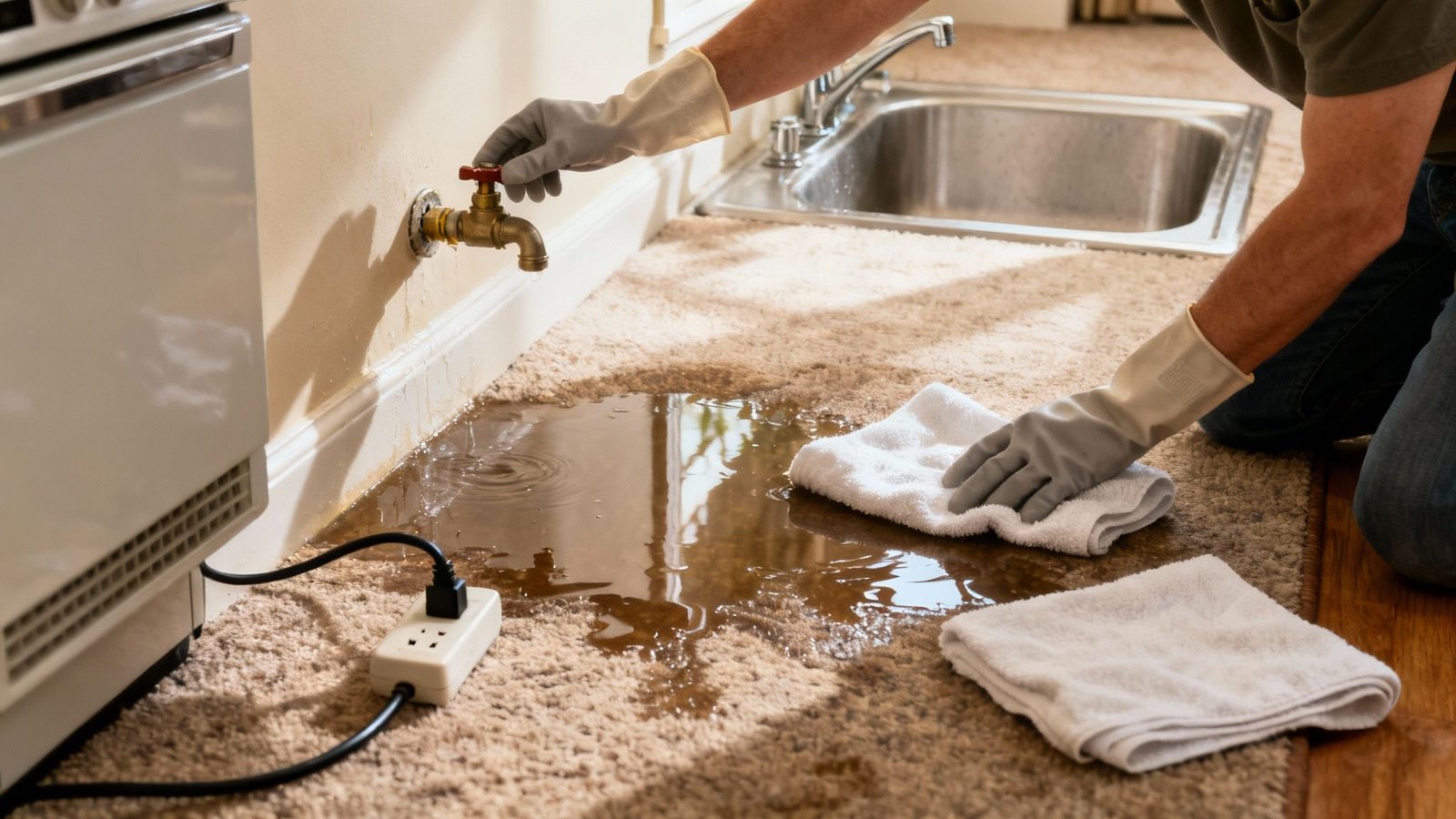
The first 30 minutes after you find the water are everything. The choices you make right now will dictate the extent of the damage, head off safety hazards, and set you up for a successful drying process. Before you even think about fans or vacuums, you need to assess the situation and make the area safe.
Find and Stop the Water Source
First things first: stop the flow. This could be as simple as turning off a sink faucet, but if you see water coming from a wall or ceiling, it’s time to shut off your home’s main water valve. Don't hesitate. Every second that water runs adds to the mess and the cost.
Assess Electrical Hazards
Water and electricity are a deadly mix. Before you wade into a wet room, you absolutely must check for electrical dangers.
- Kill the power. Go straight to your circuit breaker box and shut off the power to the entire affected area.
- Unplug everything. Cautiously unplug any lamps, electronics, or power strips that are in or near the water.
- Assume outlets are live. Be aware of any submerged outlets or cords you can't see under the carpet.
If you have any doubt, see sparks, or hear buzzing, stay out and call an electrician immediately. Your safety is worth more than any carpet.
Key Takeaway: Never step into standing water without first ensuring the power to that area is completely shut off. This simple action prevents the risk of severe electrical shock.
Identify the Water Contamination Level
Not all water is created equal. The source of the water determines whether you can tackle this yourself or if you need to call in the pros for emergency water extraction right away. Getting this wrong is a major risk to your health.
Water Contamination Levels and Recommended Actions
This quick reference table will help you identify what you're dealing with and make a safe decision on how to proceed.
| Water Category | Common Sources | Potential Risks | Recommended First Action |
|---|---|---|---|
| Category 1 | Broken water supply lines, overflowing sinks or tubs (no soap/waste) | Minimal health risk if addressed quickly. | Safe for DIY cleanup if you act within 24 hours. |
| Category 2 | Dishwasher or washing machine overflows, toilet overflows (urine only) | Significant contamination with bacteria and microorganisms. | Professional help recommended. Use PPE (gloves, mask) if handling. |
| Category 3 | Sewer backups, toilet overflows (with feces), water from rivers or streams | Grossly contaminated with pathogens, viruses, and toxins. Highly hazardous. | Do not touch. Call a certified professional restoration company. |
Understanding these categories is non-negotiable. Category 3 water, often called "black water," requires specialized equipment and safety protocols that go far beyond any DIY effort.
While we're focused on carpet here, these initial steps—safety, source, and assessment—are universal for any type of flooring. The same principles apply when you're addressing hardwood floor water damage. This quick evaluation is your roadmap for everything that comes next.
Extracting Water: Your Most Critical Step
Once you've shut off the water and made sure the area is safe, your number one job is to get as much standing water out as you possibly can. This is the most important part of drying a wet carpet fast.
Just dabbing the surface with a few towels won't do the trick, especially when water has soaked deep into the carpet fibers and, more importantly, the padding underneath. In this situation, your best friend is a wet/dry vacuum, which most people know as a shop vac.
This machine is built to suck up liquids and has way more power than your typical household vacuum. If you don't own one, renting one from a local hardware store is a small investment that pays off big time in preventing mold, rot, and other long-term headaches.
Mastering the Wet/Dry Vacuum
Using a wet/dry vac right isn't about rushing through it; it's all about technique. You want to move like you're mowing a lawn—slow, deliberate, with overlapping passes.
- Get It Set Up Correctly: First, make sure the vacuum is in its liquid mode. This usually means taking out the standard dry filter. If you don't, you'll ruin the filter and kill your suction power.
- Work Methodically: Start in one corner of the wet area. Pull the vacuum nozzle slowly and steadily toward you. Once you finish a pass, overlap it by about 50% on the next one.
- Apply Some Pressure: Use the right floor attachment and push down on it firmly as you pull. This helps squeeze water out of the carpet and padding, making it easier for the vacuum to suck it up.
You'll be surprised how quickly the collection tank fills up. A full tank murders your suction, so don't wait for it to overflow. Keep emptying it and making passes until you can't hear or see much water being pulled up anymore.
Tackling Smaller Spills and Damp Spots
For a smaller, more contained mess—like if you tipped over a bucket of water—you can start with a manual approach before grabbing the big machinery. We call this the 'towel-press' method.
Pro Tip: Whatever you do, don't rub a wet carpet. Rubbing can untwist and fray the fibers, causing permanent texture damage. The rule is always blot and press.
Lay a thick, dry, white towel over the wet spot. You need a white one to make sure no dye transfers to your carpet. Next, either walk all over the towel or put something heavy with a flat bottom on it. This steady, downward pressure forces the water up out of the carpet and into the towel.
Keep swapping out the wet towel for a dry one and repeat the process. You'll know you're done when the fresh towels are only picking up a little bit of dampness. This technique works wonders for minor spills and gets the area ready for the final drying steps.
Pulling out the bulk water is just the first phase of a bigger strategy. To get a better sense of how professionals tackle this critical first step, you can learn more about the principles behind structural drying for homeowners. This insight helps you understand why getting the water out thoroughly is the bedrock of preventing mold and making sure your home is truly dry.
Setting Up Fans and Dehumidifiers for Rapid Drying
Getting the bulk of the water out with a wet-vac is a huge first step, but it’s only half the battle. The real secret to drying a wet carpet fast is what comes next: creating an aggressive drying environment with high-powered fans and a quality dehumidifier. This is where you attack the hidden moisture your vacuum couldn't reach—the dampness trapped deep in the carpet fibers, the padding, and even the subfloor below.
Don't make the common mistake of pointing a single box fan at the wet spot and hoping for the best. That's a recipe for a soggy, smelly mess. To do this right, you need a strategic setup that creates a powerful vortex of airflow.
The initial extraction process, whether by hand or with a shop vac, sets the stage for this critical drying phase.
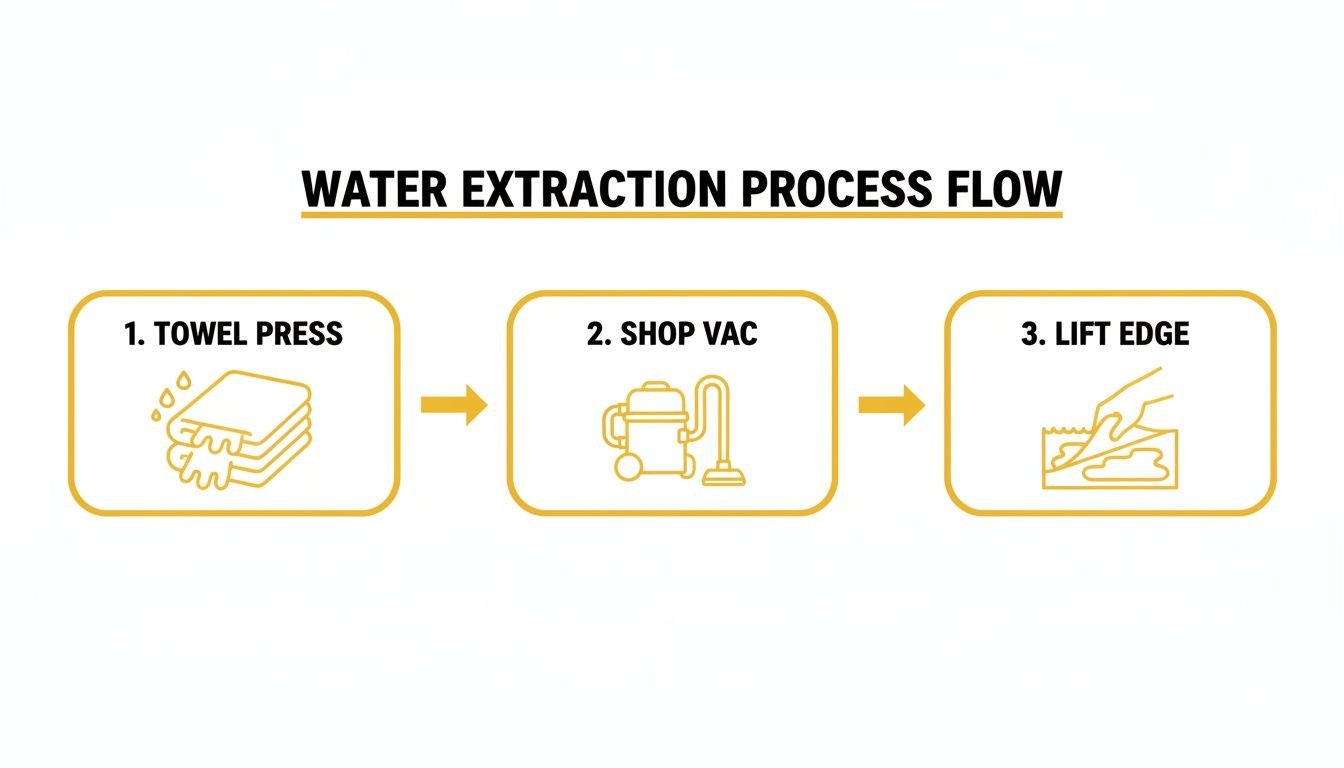
By getting the standing water out first, you give your fans and dehumidifier a massive head start, making the entire process faster and far more effective.
Creating a Vortex of Airflow
Your mission is to get dry air moving across every single square inch of the wet surface. High-velocity fans, often called air movers in the restoration industry, are built for this job. If you only have standard box fans, grab as many as you can find.
Here’s how to set them up like a pro:
- Position for Power: Place your fans along the edges of the room. You want to aim them across the surface of the carpet, not directly down at it.
- Angle for Lift: Tilt the fans at about a 45-degree angle toward the floor. This creates a low, powerful current of air that literally lifts moisture up and away from the carpet fibers.
- Create Circulation: With multiple fans, position them to create a circular airflow, a mini-whirlwind inside the room. This constant movement ensures humid, stagnant air has nowhere to hide.
To really supercharge the process, find a corner of the carpet you can gently lift. Prop it up with a block of wood or a few stacked books. This simple trick allows your fans to blow dry air directly onto the padding and subfloor, tackling the moisture that causes the most long-term problems.
The Essential Role of a Dehumidifier
As your fans work their magic, they're pulling all that trapped moisture out of the carpet and putting it into the air. If you don't capture that moisture, it’s just going to settle right back down into your carpet, drywall, and furniture. This is where a good dehumidifier becomes your most valuable player.
Key Insight: A dehumidifier does more than just dry the air—it creates a "moisture vacuum." By aggressively pulling water vapor out of the environment, it forces the carpet to release its remaining dampness much faster, dramatically cutting down your drying time.
Place the dehumidifier in the center of the affected area. Then, close all the windows and doors to create a contained drying chamber. Your goal is to get the room's relative humidity below 50%. You can track this with an inexpensive hygrometer from any hardware store.
Just be prepared to empty the dehumidifier's collection tank often, especially in the first few hours when it will be working overtime. For larger areas like a flooded basement, you might need a more powerful solution. For a deeper dive into how these machines work with your home's entire system, check out this guide to understanding dehumidifiers for HVAC systems.
This one-two punch of professional-grade air movers and dehumidifiers is exactly how restoration companies get such incredible results. A proper commercial drying setup can slash a typical wet carpet drying time from 72+ hours down to just 24-48 hours. Speed is everything, as it's the single best way to prevent secondary damage like mold.
How to Confirm Your Carpet Is Truly Dry
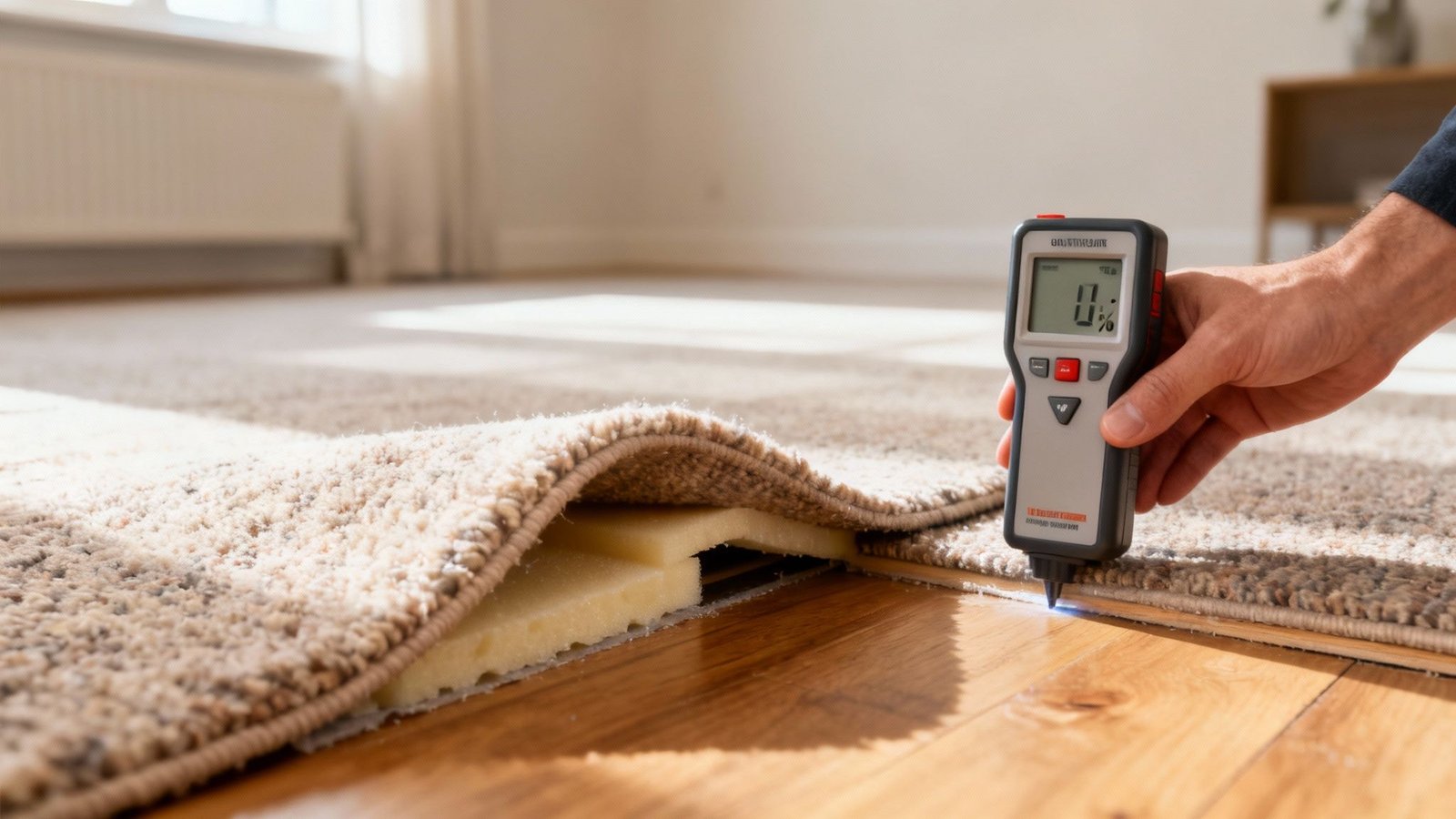
After you've had fans and a dehumidifier running for what feels like an eternity, the top of your carpet might finally feel dry to the touch. Don't be fooled. This is a classic false positive.
The real threat is the moisture you can't feel—the water that’s still trapped deep in the carpet padding and the subfloor beneath it. This hidden dampness is exactly what mold is waiting for. In the often humid conditions of Los Angeles coastal areas like Santa Monica or Venice, mold can get a foothold in just 24-48 hours. Guessing isn't good enough.
The Physical Inspection Test
Your first step is a hands-on check that goes deeper than the surface fibers. Head to a corner of the room that got the worst of it, usually along a wall. Grab a pair of pliers, get a firm grip on the very edge of the carpet, and gently pull it back.
Now you can see what’s really going on with the padding and subfloor. Here’s what to look for:
- Feel the Padding: Take a dry paper towel and press it firmly into the carpet pad. Does it wick up any moisture? Does the pad feel cool or spongy? If so, it’s still wet.
- Look for Discoloration: Carefully inspect both the pad and the subfloor. Any dark spots, water stains, or changes in color are dead giveaways that moisture is still present.
- The Smell Test: Get your nose close to the exposed padding and take a whiff. A musty, earthy, or sour smell is a major red flag. That’s the smell of mildew or the very beginning of a mold problem.
Crucial Insight: Dry carpet padding should feel completely neutral and look uniform in color. Anything else means your drying equipment isn't done with its job yet.
Using a Moisture Meter for Certainty
If you want to be absolutely sure, nothing beats a moisture meter. It’s the same tool we professionals rely on to guarantee a job is finished, and they're surprisingly affordable at most hardware stores. A meter takes all the guesswork out of the equation.
To use it correctly, you first need a "dry standard." Go to a completely different, unaffected room and take a moisture reading from that carpet and subfloor. That number is your goal.
Now, go back to the area you've been drying. Take readings in several different spots, especially where the water was deepest. You're not done until the readings in the affected area match the dry standard you just established. Only then can you be confident the carpet is truly dry. This step is non-negotiable if you suspect mold is already an issue; professional Los Angeles mold testing can give you a definitive answer about your home's air quality and any hidden contamination.
Don't even think about putting your furniture back or turning off the fans until both your hands-on check and the moisture meter give you the all-clear.
Knowing When to Call a Water Damage Professional
One of the most important parts of learning how to dry wet carpet fast is knowing when not to. You have to recognize your own limits. While your shop vac and fans might be perfect for a small, clean water spill, some situations are just too big, too complex, or too dangerous to handle on your own.
Hesitating to make that call can turn a manageable issue into a massive, expensive disaster. A small leak from a refrigerator supply line you catch right away is one thing. A toilet that overflows with raw sewage in your Sherman Oaks home is a completely different emergency. The second that "black water" (Category 3) from a sewer backup hits your carpet, it's a biohazard. That's a job for the pros, period.
When DIY Methods Are Not Enough
Certain scenarios immediately take a wet carpet problem out of the DIY realm. If you see any of these signs, your first call should be to a certified restoration company, not the hardware store.
- Contaminated Water Source: Any water from a sewer line, a toilet bowl with feces, or overland flooding is considered grossly contaminated. Trying to clean this yourself exposes you and your family to dangerous pathogens.
- The Water Has Spread Significantly: Has the water soaked an entire room or moved into multiple areas? Professionals have the heavy-duty equipment needed to handle large-scale extraction and drying far more efficiently than any homeowner can.
- Moisture is Wicking Up the Drywall: If you see a wet line creeping up from your baseboards, it’s a red flag. This means the water has already saturated the subfloor and is now affecting the very structure of your home.
- Your Carpet is Still Wet After 48 Hours: This is the absolute deadline. After two days, the risk of serious, irreversible mold growth in the carpet padding and subfloor skyrockets. Don't wait.
The Professional Equipment Advantage
So, what really separates a professional response from your best efforts? It all comes down to specialized technology designed for speed, power, and precision.
A professional restoration team doesn't just dry what's visible on the surface. They use advanced tools to find and eliminate every last pocket of hidden moisture. This is the only way to prevent long-term structural damage and mold.
Pros show up with gear you just can't rent. They use thermal imaging cameras to literally see where moisture is hiding behind walls and under floorboards—places you’d never find otherwise. Instead of a shop vac, they roll out powerful, truck-mounted extractors that have incredible suction, pulling far more water out of both the carpet and the pad beneath it.
This industrial-grade equipment guarantees a faster, more complete drying process. To see the full scope of what's involved, you can learn more by hiring a certified restoration pro. Their expertise and tools ensure the job is done right the first time, protecting your property and your health.
Frequently Asked Questions About Drying Wet Carpet
When you're staring at a soaked carpet, a million questions can run through your mind. Even with a game plan, it's natural to have concerns. Here are some straight answers to the questions we hear most often from homeowners, designed to help you make the right call and sidestep costly mistakes.
Can I use a heater to dry my carpet faster?
I know it’s tempting, but this is one shortcut you absolutely want to avoid. While it’s true that heat speeds up evaporation, it also creates a warm, steamy environment—basically, a perfect incubator for mold and bacteria to thrive, especially if you don't have powerful ventilation. Worse yet, placing a space heater near damp materials is a serious fire hazard. Your best bet is to stick with high-velocity fans and a dehumidifier. This combination focuses on the two things that matter most: aggressive air circulation and pulling moisture directly out of the air. It's safer and far more effective.
How long can a carpet stay wet before it's ruined?
The clock starts ticking the moment the water hits. You're in a race against a critical 24 to 48-hour window. Once you pass the 48-hour mark, the risk of permanent mold and mildew growth goes through the roof. At that point, harmful bacteria have multiplied, and you're no longer just dealing with water. If your carpet and the pad underneath are still damp after two full days of your best drying efforts, it’s time to bring in a professional. This isn't just about saving the carpet; it's about preventing rot and structural damage to your subfloor and avoiding a much bigger, more expensive mold remediation project later.
Does homeowners insurance cover professional carpet drying?
In many cases, yes, but it all comes down to the source of the water. Insurance is designed to cover "sudden and accidental" events. Think of a burst pipe, a washing machine hose that fails, or a dishwasher that overflows. Standard policies almost never cover damage from long-term, slow leaks (like a drip under the sink you didn't fix) or regional flooding from a storm. That requires separate flood insurance. The moment you discover water, document everything with photos and call your agent. A professional restoration company can provide the detailed documentation your insurer will need to process the claim.
What if my carpet smells musty after it dries?
That musty, earthy smell is a major red flag. Don't ignore it. It’s the classic sign that mold or mildew has already taken hold somewhere you can't see—most likely in the carpet padding or the subfloor beneath. At this point, the problem is beyond a simple surface issue. You need to contact a certified restoration professional for an inspection right away. They have specialized tools, like moisture meters and thermal cameras, to find the source and confirm if mold is present. Waiting only gives the problem time to spread, turning a manageable issue into a complex and costly repair.
If you're facing water damage that feels overwhelming or you're seeing any of the warning signs we've discussed, don't wait. The expert team at Onsite Pro Restoration is on call 24/7 to provide a free assessment and bring in the professional-grade equipment needed to dry your property fast. Protect your home and your peace of mind by calling us for immediate help at https://onsitepro.org.