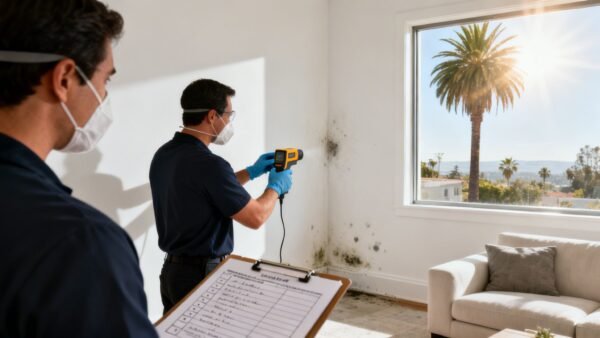

When you discover a burst pipe flooding your kitchen or the smoky aftermath of a small fire, your world tilts into chaos. It's stressful, overwhelming, and the first steps you take will define the success of your entire home insurance claim process. Before you do anything else, remember two priorities: ensure everyone is safe, then stop the damage from getting worse.
Insurers call this "mitigation," and it's a critical duty under your policy. These initial actions are vital for your family's well-being and for proving to your insurance company that you acted responsibly to minimize the loss.
What To Do Immediately After Property Damage
Whether you’ve walked into a flooded Sherman Oaks condo or are staring at a soot-stained wall in Glendale, it's easy to feel paralyzed. But before you even think about calling your insurance agent, there are a few things you absolutely must do. Taking charge of the situation right now is the single most important first step in the home insurance claim process.
Your main goal is to stop the source of the problem, but only if it's safe. This isn't about tackling major repairs; it's about damage control.
Secure the Property and Ensure Safety
For a water disaster, that means finding your main water valve and shutting it off. If you see sparks or standing water near outlets, head to your electrical panel and kill the power to that area. After a fire, once the fire department gives the all-clear, you’ll want to board up any broken windows or doors to keep the property secure.
Next, if some rooms are still dry and safe, start moving your valuables. Get the furniture, electronics, and family heirlooms out of the wet zone and into a safe spot. This simple act can prevent a ton of secondary damage and shrink the overall size of your loss.
Key Takeaway: Your insurance policy expects you to take reasonable steps to prevent more damage. If you let the water keep running for hours, it could seriously complicate your claim.
Document the Initial Scene
Stop. Before you move or clean up a single thing, pull out your smartphone.
Take videos of every affected room, getting wide shots that show the full scope of the disaster. Then, get in close with photos of the details—the warped floorboards, the soot creeping up the walls, the ruined appliance that started it all. This initial visual proof is gold for your home insurance claim.
You don't need a perfect inventory list just yet, but you do need a clear "before" picture of the scene before any professional cleanup starts. If you're dealing with a leak or flood, getting a handle on emergency water cleanup best practices can be a lifesaver.

As you can see, securing the site and documenting everything comes before you get on the phone to start the official claim process.
Make the Right First Call
Your gut reaction might be to call your insurance company. But think about it—what’s the most urgent need? It's getting the water out or the hole in your roof covered.
A 24/7 restoration company like Onsite Pro Restoration should be your first call. We can get a crew out for emergency water extraction, board-ups, and structural drying. Getting that drying process started immediately is absolutely crucial for preventing mold from taking hold, a common complication in coastal areas like Santa Monica.
Once the immediate emergency is under control, then it’s time to call your insurance agent to officially open the claim. For a deep dive into mastering the home insurance claim process and making sure you're treated fairly, it's worth checking out more detailed guides.
How To Document Everything For Your Insurance Claim
When it comes to your home insurance claim process, the strength of your case boils down to one simple thing: proof. An adjuster’s job is to verify your loss, and your job is to give them undeniable evidence. Vague descriptions and missing details are a recipe for delays and lowball offers. On the other hand, solid, thorough documentation builds a powerful case that gets you paid faster and fairly.
Think of yourself as a detective building a case file. Every photo, video, and receipt is a critical piece of evidence. You need to start gathering it immediately, even as our restoration crew is heading your way.
Create a Detailed Visual Record
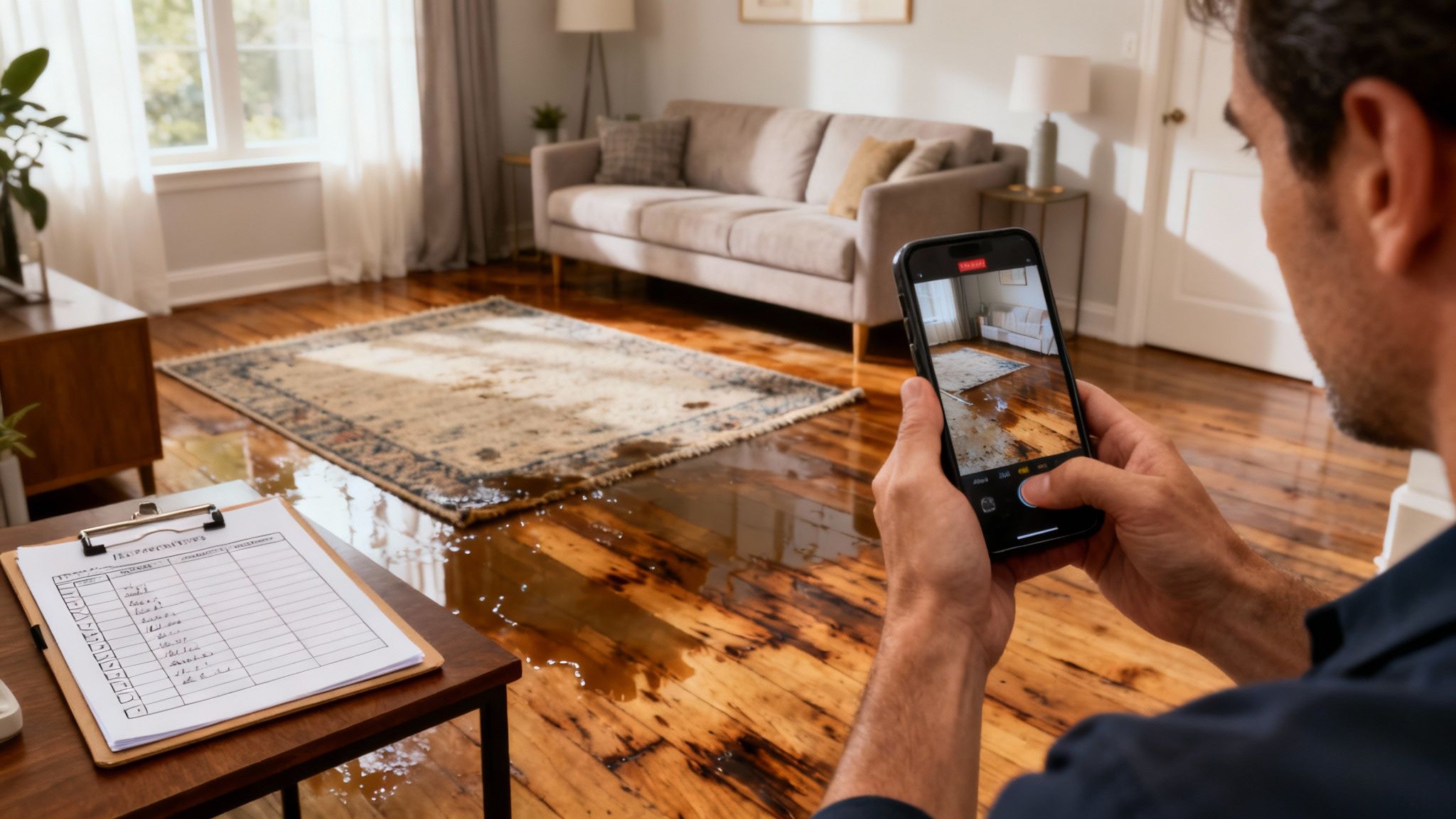
Right now, your smartphone is your best friend. Before a single thing is moved, touched, or cleaned, you need to capture the entire scene from every conceivable angle. The goal is to tell the complete story of the damage through images and video.
- Wide-Angle Shots: Kick things off with a video walkthrough of every affected room. Speak out loud as you record, noting the date, time, and what you’re seeing. This gives the adjuster an immediate sense of the overall scope.
- Medium Shots: Now, get still photos of entire walls, sections of flooring, and large pieces of furniture. These shots connect the dots and show how the damage flows from one area to the next.
- Close-Up Shots: Here's where the money is. Zoom in on the details that prove the severity of the loss. Get a shot of the high-water mark on the drywall, the soot staining the inside of a kitchen cabinet, or the individual hardwood planks that are starting to buckle. If it’s water damage, understanding how to read moisture meter readings can help you document the unseen saturation that our professional meters will later confirm.
Don't edit yourself. Take more photos and videos than you think you could possibly need. You can't go back in time to capture a detail you missed, so over-documenting is always the right move.
Build Your Home Inventory List
With the visual evidence secured, it's time to create an inventory of every single personal item that was damaged or destroyed. I won't lie—this is often the most tedious part of the process, but it directly impacts the "personal property" or "contents" portion of your settlement.
Go room by room, and be methodical. List everything that needs to be either repaired or completely replaced.
Pro Tip: Don’t just list "toaster." Be specific. An adjuster needs to know if it was a $300 Breville Smart Oven or a basic two-slice model from Target. That difference in value is significant, and you're entitled to it.
For every single item, try to nail down these key details:
- Item Description: Be as specific as you can—brand, model name, and even the serial number if it's accessible.
- Age of Item: Give your best estimate of how old it was.
- Original Cost: Dig up what you can. Old receipts, credit card statements, or even order confirmation emails are perfect for proving what you paid.
- Estimated Replacement Cost: A quick search on Amazon or a retailer's website will tell you what a new, comparable item costs today.
A Real-World West Hollywood Scenario
Let's make this real. Imagine a dishwasher supply line lets go in your West Hollywood condo. Water gushes out for hours, flooding the kitchen and seeping into the living room hardwood.
- Weak Documentation: The homeowner calls their insurer and says, "My kitchen and living room are flooded. The floor is toast and some of my stuff got wet." This forces the adjuster to fill in a lot of blanks and make assumptions, which rarely works in your favor.
- Strong Documentation: The homeowner provides a video walkthrough showing the standing water before our crew arrives. They include close-up photos of their warped custom cabinetry and the exact model number of the ruined dishwasher. They also provide a list of damaged electronics in the living room, complete with links to current retail prices on BestBuy.com.
The second claim isn't just a report; it’s an open-and-shut case. It gives the adjuster everything they need to quickly and accurately assess the loss. This leads to a faster, fuller settlement every single time. The effort you put in at this stage pays off directly in a smoother, more successful outcome.
Why The Los Angeles Claims Environment Is Tougher Today
If you've heard stories from friends or family about how filing a home insurance claim feels like pulling teeth these days, you aren't imagining things. The entire landscape has shifted. The modern home insurance claim process is a far more rigorous, scrutinized experience for homeowners in Los Angeles and pretty much everywhere else.
This isn't just insurers being difficult for the sake of it. It's a direct response to a perfect storm of economic and environmental pressures hammering the industry.
For Los Angeles homeowners, getting a handle on this new reality is the first step to a successful claim. It’s not about getting discouraged—it's about being prepared. When you understand why the adjuster is asking for such detailed proof or why things seem to be taking longer, you can get ahead of the hurdles and build a stronger case from day one.
The Surge in Climate-Driven Events
One of the biggest drivers is the sheer volume and severity of weather-related disasters. We’ve seen it all here: unprecedented atmospheric rivers causing floods in the San Fernando Valley and the constant, terrifying threat of wildfires in our canyons. Insurers are now facing a level of risk that used to be a once-in-a-generation event.
This isn’t just a local problem; it's a national trend with staggering financial consequences. A recent industry report from LexisNexis found that catastrophe claims now make up nearly two-thirds of all losses. In a single recent year, the cost of roof claims alone skyrocketed to nearly $31 billion—that’s a 30% jump in just two years. That kind of financial pressure changes everything.
Because insurers are paying out more in claims than ever before, their underwriting standards have tightened dramatically. They now look at every claim with a finer-toothed comb, demanding clear, comprehensive evidence that the damage was caused by a covered peril.
Soaring Construction and Labor Costs
The other shoe to drop has been the skyrocketing cost of actually rebuilding a home. Everything from lumber and drywall to copper wiring and skilled labor has seen major price inflation. A roof replacement in Beverly Hills that might have cost $20,000 five years ago could easily run $30,000 or more today.
This has a direct and immediate impact on your claim:
- Higher Scrutiny on Estimates: Your adjuster will comb through every single line item in a contractor’s estimate, making sure the costs are justified and line up with their idea of current market rates.
- Pressure on Scope of Work: They're more likely to push back, arguing for repairing materials that a professional restoration contractor knows should be replaced to guarantee a proper fix.
- Increased Use of "Preferred Vendors": Many insurance companies will try to steer you toward their own network of contractors. These vendors have agreed to work at pre-negotiated (and often lower) rates, which may or may not be in your best interest.
The claims environment has undeniably evolved over the last decade. What was once a more straightforward process has become more complex, demanding greater diligence from homeowners.
Key Shifts In The Home Insurance Claim Process
| Claim Aspect | Past Environment (5-10 Years Ago) | Current Environment |
|---|---|---|
| Documentation | Photos and a basic estimate were often sufficient. | High-res photos, videos, detailed moisture logs, and itemized scopes are standard. |
| Adjuster Scrutiny | Focused on confirming the cause and basic scope of damage. | Meticulously reviews every line item, questions material choices, and demands proof for every cost. |
| Timelines | Claims were often settled more quickly with less back-and-forth. | Longer review periods, multiple inspections, and requests for more information are common. |
| Policy Language | Broader coverage with fewer specific exclusions. | Tighter policy language with more exclusions for things like slow leaks or deferred maintenance. |
| Burden of Proof | Shared between homeowner and adjuster. | Rests almost entirely on the homeowner to prove the loss is covered and document its full extent. |
Understanding these shifts is key. You're no longer just reporting damage; you're building a comprehensive case file to justify every dollar of your claim.
Stricter Policy Language and Exclusions
To manage their own risk, insurers have also gotten much more specific with their policy language. Exclusions for slow leaks, certain types of mold growth, or damage they can trace back to deferred maintenance are more common and enforced more strictly than ever.
You really need to dig into your homeowners insurance policy declarations to understand the fine print.
At the end of the day, the burden of proof is squarely on your shoulders. It’s up to you, the homeowner, to show not only how bad the damage is but also that its cause is explicitly covered by your policy. In today's environment, an ambiguous claim is an easily denied claim. The key to getting through this is to be diligent, organized, and proactive from the moment disaster strikes.
Working With Your Adjuster And Restoration Company
Once you’ve filed your home insurance claim, you’re no longer going through this alone. Two key players now enter the picture: the insurance adjuster and your restoration company. I've seen countless claims succeed or fail based on how well these two work together. Understanding their roles is the secret to a smooth recovery.
The adjuster works for the insurance company. Their job is to investigate what happened, confirm your policy covers the loss, and calculate the repair cost based on their company's guidelines.
On the other hand, a professional restoration company like Onsite Pro Restoration works for you. We’re your boots on the ground, here to assess the full scope of the damage and perform the work needed to get your home back to the way it was. The dynamic between the adjuster and your contractor is where the rubber meets the road.

Preparing For The Adjuster's Inspection
The adjuster's visit is a critical moment. This is your chance to present a clear, organized case for your claim. When you're prepared, it not only makes their job easier but also shows you're a diligent homeowner who takes this seriously.
Have all your documentation—photos, videos, inventory list—ready in one place. Walk them through the property yourself. Point out the obvious damage, but don't forget the subtle things you've noticed, like that faint musty smell behind a wall or a small buckle in the hardwood floor. Those details matter.
This meeting is also your time to ask questions and set expectations. Don't be shy.
- "After this inspection, what's the very next step?"
- "What's a realistic timeline for me to see a preliminary report?"
- "Is there any other paperwork you need from me right now?"
- "How do you prefer to coordinate with my restoration contractor?"
Starting off with this kind of proactive communication sets a professional tone for the entire claim.
Crucial Tip: Never, ever throw away damaged materials before the adjuster has seen them. If our team needs to tear out ruined drywall or carpet to prevent further damage, we document it with photos and often keep a physical sample for the adjuster to inspect. Getting rid of the evidence can cause huge problems and disputes down the line.
How Your Restoration Company Acts As Your Advocate
While you handle the direct communication, your restoration company is building the technical foundation of your claim. An experienced team does a lot more than just the physical repairs; we build the evidence-based case that justifies the work and costs involved. We essentially translate the real-world damage into the language of insurance.
This is where hiring the right company really pays off. We provide the detailed, industry-standard documentation that adjusters need to approve a claim without a fight.
Here’s what that looks like in practice:
- Detailed Line-Item Estimates: We use Xactimate, the same software most major insurance carriers use. This creates a transparent, itemized estimate that breaks down every single cost—labor, materials, equipment. There's no guesswork.
- Moisture Maps and Psychrometric Readings: For water damage, we don’t just say something is "wet." We prove it. Moisture maps pinpoint exactly where water has spread, and our daily drying logs show that our equipment is effectively bringing your home back to a safe, dry standard.
- Photo Reports: We take our own detailed photos throughout the entire process, from start to finish. This creates a complete visual timeline that supplements the photos you took initially.
This level of thorough documentation cuts through the back-and-forth that can stall a claim for weeks. The adjuster gets the verifiable data they need, and you get the confidence that the job will be done right. Our role as a professional restoration contractor is to bridge that gap between your loss and what your insurer needs to see.
By working collaboratively and professionally with the adjuster—and backing everything up with undeniable proof—we make sure the approved scope of work is accurate and your property is restored correctly.
Understanding Your Settlement and Rising Deductibles
After all the inspections, documentation, and back-and-forth, the settlement offer arrives. This is the moment the numbers get real. But this document isn't always easy to decipher, and understanding what you're looking at is critical to getting a fair payout for your home insurance claim process.
There are two terms you absolutely have to know: Actual Cash Value (ACV) and Replacement Cost Value (RCV). They might sound alike, but the difference between them can easily mean thousands of dollars out of your own pocket.

Actual Cash Value vs Replacement Cost Value
Most insurance policies start by paying you the Actual Cash Value for your damaged property. The easiest way to think of ACV is as the "garage sale" price—it’s the value of your five-year-old hardwood floors today, not what it costs to install brand-new ones. Insurers figure this out by taking the replacement cost and then subtracting depreciation for age and wear.
Replacement Cost Value, however, is the full amount needed to replace what was damaged with a new, similar item at today's prices. If your policy includes RCV coverage, you'll usually get an upfront check for the ACV. The rest of the money—the depreciation—is paid out after you’ve finished the repairs and sent in the final invoices to prove it. This two-payment system is incredibly common.
Key Insight: Don't be shocked if the first check from your insurer seems low. If you have an RCV policy, that initial payment is likely just the ACV. The rest of the funds, called "recoverable depreciation," will be released once you show the work is done and paid for.
The Challenge of Rising Deductibles
Another huge number on your settlement is your deductible. This is the portion you have to pay out-of-pocket before your insurance kicks in. And if you feel like your deductible is way higher than it used to be, you’re probably right.
Insurers are hiking up deductibles across the board to manage their own risk from severe weather and increasing claims. This isn't just a feeling; a recent report shows a staggering 24.5% increase in the average deductible in just one year, which is a huge jump from the 15% increase seen the year before. These higher deductibles are hitting homeowners especially hard in places like Southern California, where weather-related events are a major driver of losses. You can dig into the specifics in this 2025 home insurance report.
Reviewing and Responding to Your Settlement Offer
When that offer finally lands in your inbox, don't just sign off on it. Take a deep breath and review every single line item with your restoration contractor. We live and breathe this stuff, so we can help you spot any gaps between what the adjuster approved and what’s actually needed to restore your home correctly.
If the offer is too low, you have every right to contest it. This is where all your detailed photos, notes, and our professional estimate become your most powerful tools. A polite but firm appeal, backed up by solid evidence, often leads to a revised and much fairer offer. For more practical advice, check out our insurance claim tips for water damage.
In today's tougher claims climate, it’s also smart to know your rights. If you’re hitting a wall with major delays or an offer that feels completely unreasonable, it might be time to seek legal guidance for insurance claim disputes. Knowing when to bring in an expert can make all the difference in getting the outcome you deserve.
Common Questions About The Los Angeles Claim Process
Navigating a home insurance claim can feel like learning a new language, especially when you're already stressed about the state of your home. Homeowners across Los Angeles and our neighboring communities tend to run into the same hurdles and ask the same urgent questions.
Getting clear, straightforward answers is the first step toward getting your life back on track. Here, we'll walk through some of the most common questions we get from clients every day, covering everything from timelines to contractor choices and what to do when a settlement offer feels off.
Q: How long does a home insurance claim take in California?
A: The timeline depends on the complexity of the damage. By law, insurers must acknowledge your claim within 15 calendar days and accept or deny it within 40 days of receiving your proof of loss. A simple pipe break in a single room might resolve within this timeframe. However, a major fire or multi-floor water damage claim in a place like North Hollywood could take several months to fully investigate, negotiate, and complete.
Q: Can my insurance company force me to use their contractor?
A: Absolutely not. In California, you have the right to choose your own restoration contractor. While your insurer may provide a list of "preferred vendors," you are not obligated to use them. Hiring an independent, IICRC-certified company ensures that your best interests are the top priority, not the insurer's bottom line.
Q: What should I do if my insurance company's offer is too low?
A: A low offer is often a starting point, not the final word. First, ask the adjuster for a detailed breakdown of their estimate to see where the numbers differ. Then, work with your restoration contractor to submit a formal, written appeal. This appeal should include a line-by-line comparison, photos, and professional documentation to justify the need for a revised, more accurate settlement.
Q: Should I hire a public adjuster for my claim?
A: For most standard claims, a reputable restoration company can advocate effectively for you. However, a public adjuster can be a valuable asset for catastrophic losses (like a total home fire), complex claims with difficult coverage issues, or if you suspect your insurer is acting in bad faith by causing extreme delays or issuing an unreasonable denial.
Q: Does my policy cover mold damage?
A: It depends. Most standard Los Angeles homeowner policies have very limited mold coverage, often capping it at a low amount (e.g., $5,000) or excluding it entirely unless it's the direct result of a covered, sudden event like a burst pipe. Mold from a slow leak in a Sherman Oaks flat-roof home, for example, may not be covered. Always review your specific policy language.
Q: What is recoverable depreciation?
A: This is the difference between the Replacement Cost Value (RCV) and the Actual Cash Value (ACV) of your damaged property. Your insurer will typically pay the ACV (the depreciated value) upfront. Once you complete the repairs and provide receipts, they release the "recoverable depreciation" amount, ensuring you are paid the full cost to replace the items with new materials.
When disaster strikes, you need a team that understands both the technical side of restoration and the complexities of the insurance world. Onsite Pro Restoration is your advocate, providing the expert documentation and skilled craftsmanship needed to restore your home and your peace of mind.