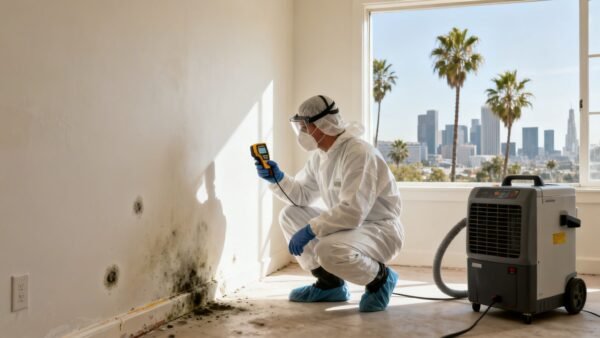

Walking into your home to find it flooded is a jarring, stressful moment. But your actions in the first 24 hours are critical and will set the stage for your entire recovery. The priorities are simple: ensure everyone is safe, stop the source of the water, document the mess for your insurance claim, and call a flood damage repair professional immediately. Acting quickly with a clear head can drastically reduce the long-term impact and costs.
If your Los Angeles property has been affected by a flood, don't wait. Call Onsite Pro Restoration now at (818) 336‑1800 for a free, no-obligation assessment.
What to Do in the First 24 Hours After a Flood
The second you see water pooling where it shouldn’t be, the clock starts ticking. A methodical response is your best defense against long-term problems like structural rot and mold, which can begin growing on damp surfaces in as little as 24-48 hours. How you handle this first day determines everything.
Prioritize Safety Above All Else
Before you worry about saving belongings, stop and assess the immediate dangers. Water and electricity are a lethal combination.
If you can safely access your breaker box without walking through water, shut off the power to all affected areas. If there's any doubt, leave it alone and wait for a professional. Your safety is not worth the risk.
Similarly, if you smell gas or suspect a leak, evacuate everyone immediately and call the utility company from a safe distance. Do not touch any electronics or do anything that could create a spark. Also, watch for sagging ceilings or bulging floors—the weight of water can compromise your home's structural integrity faster than you might think.
Stop the Water Source
Once you've confirmed the area is safe, your next job is to stop more water from coming in. If the flood is from an internal source like a burst pipe or a failed appliance, you must shut off your home's main water supply. Our guide on where to find the main water shut-off can help you locate it quickly.
If the water is from an external source like heavy rain, you can’t stop it, but you can perform damage control. Use sandbags to divert water away from doorways and other entry points. Knowing what to do when a pipe bursts is critical; for more on that, check out these expert tips for immediate actions when pipes burst.
Key Takeaway: Never underestimate the danger. Shutting off electricity and water at the source are non-negotiable first steps. Your personal safety is far more valuable than any possession.
Document the Damage Extensively
Before you move a single item, pull out your smartphone and start recording. This step is absolutely critical for your insurance claim. Take extensive photos and videos of everything.
- Go wide first: Capture shots of each affected room to show the full scope of the flooding. Be sure to document the water lines on walls and furniture.
- Then zoom in: Get close-up photos of specific damaged items—soaked rugs in a Sherman Oaks living room, warped hardwood floors in a Beverly Hills home, soggy drywall, and ruined electronics.
- Narrate your videos: As you record, state the date, time, and describe the damage in detail. This adds powerful, real-time context for your insurance adjuster.
This initial evidence is your proof. Without it, you enter the claims process at a serious disadvantage. Keep every receipt for immediate expenses, such as a hotel stay or emergency supplies. The more thorough you are now, the smoother your flood damage repair claim will be later.
Immediate Flood Response Checklist
This table breaks down the most critical actions you need to take within the first hour of discovering water damage. Follow these priorities to ensure safety and protect your property.
| Priority Action | Why It's Critical | Pro Tip for LA Residents |
|---|---|---|
| Turn Off Electricity | Prevents electrocution risk from water contacting live circuits. | If your panel is in a flooded garage or basement, do not enter. Call an electrician or your restoration pro first. |
| Stop the Water Source | Mitigates further damage by stopping the flow of water into your home. | Know where your main water shut-off is before an emergency. It’s often near the street or on an exterior wall. |
| Call a Restoration Pro | Professionals have the equipment and expertise to begin drying immediately, preventing mold. | LA's humidity can accelerate mold growth. A 24/7 company like Onsite Pro can be there within 60-90 minutes. |
| Document Everything | Provides undeniable proof for your insurance claim, ensuring a fair settlement. | Use your phone to take a narrated video walkthrough before moving or touching anything. |
Following these steps methodically will put you in the best possible position for a successful and swift recovery process.
A Look Inside the Professional Flood Damage Repair Process
Once the immediate danger is under control and our team arrives, the real work begins. Proper flood damage repair isn't just about mopping; it's a technical, multi-stage process that follows strict industry standards to get your home genuinely dry, safe, and restored. Knowing what to expect can make a chaotic situation feel much more manageable.
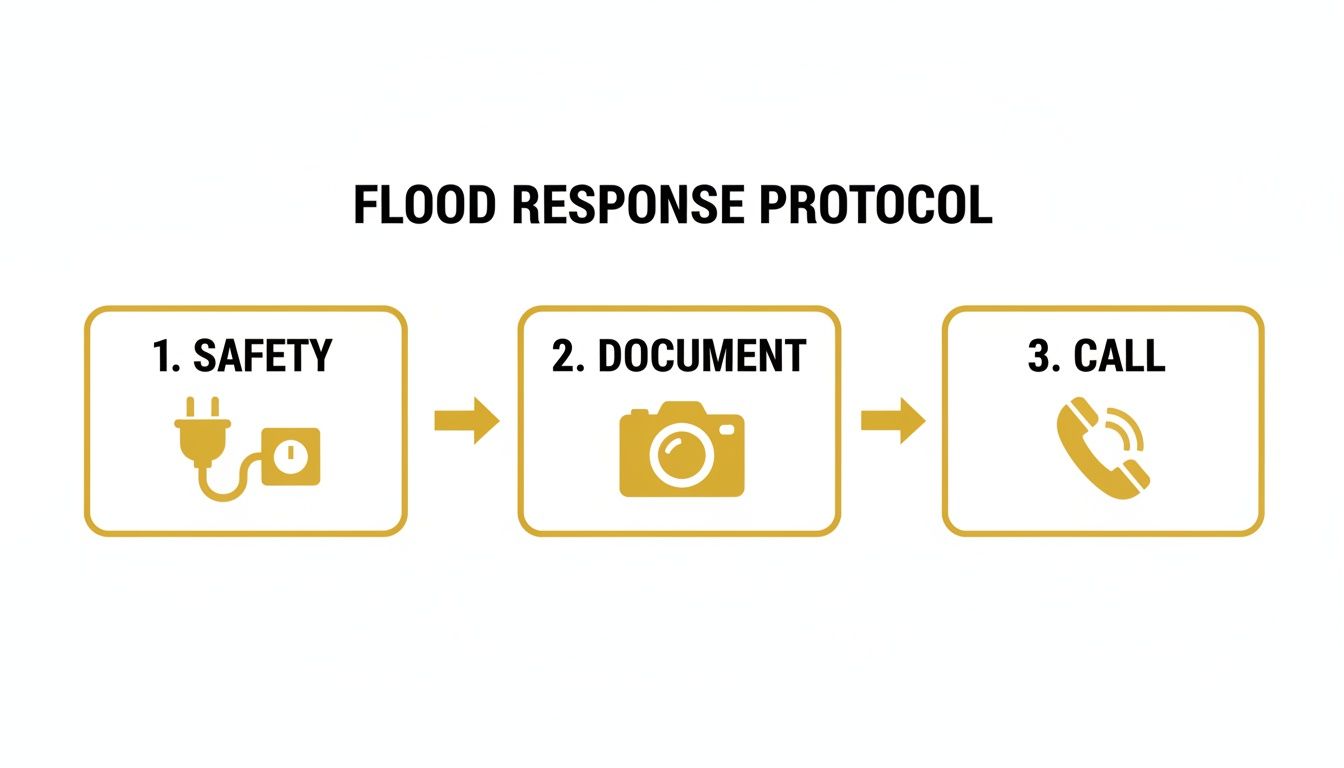
This flowchart highlights the three things you must do right away: ensure the power is off, take pictures for your insurance claim, and call in the pros without delay.
Initial Assessment and Water Classification
The first thing a certified technician does on-site is a thorough inspection. This isn't just a quick look around. We use specialized tools like moisture meters and thermal imaging cameras to see exactly where the water has gone. Water is sneaky—it can wick up inside drywall or seep under floorboards far from where the initial flood occurred.
During this assessment, we classify the water into one of three categories, which dictates the entire restoration plan:
- Category 1 (Clean Water): From a sanitary source, like a burst water supply line. It's harmless initially but can degrade quickly.
- Category 2 (Gray Water): This water is already contaminated. Think of an overflowing washing machine or a leaking dishwasher.
- Category 3 (Black Water): This is grossly contaminated and poses serious health risks. Sewage backups and any water from natural flooding fall into this category.
Determining the water category is non-negotiable. It dictates the safety protocols, cleaning methods, and the level of sanitization required.
Water Extraction and Structural Drying
With a plan in place, we begin removing the water. For significant flooding, this means bringing in high-powered, truck-mounted pumps that can extract hundreds or even thousands of gallons of standing water quickly. The goal is to remove the bulk liquid before it has more time to soak into porous materials like wood and drywall.
You can learn more about this critical first stage of mitigation in our guide to emergency water extraction services.
Expert Insight: Removing the standing water you can see is only about 10% of the job. The real challenge is pulling out all the hidden moisture trapped inside building materials.
Next is structural drying. This is where the science comes into play. Our technicians strategically place industrial-grade equipment to create an ideal drying environment.
- Air Movers: These are not average fans. They are positioned to create a vortex of airflow across wet surfaces, dramatically speeding up evaporation.
- Dehumidifiers: As air movers pull moisture out of walls and floors, commercial dehumidifiers capture that moisture from the air, preventing it from settling elsewhere.
This equipment typically runs for several days. Throughout the process, our team returns daily to take moisture readings, ensuring every part of the structure returns to its normal "dry standard."
Cleaning, Sanitizing, and Full Restoration
Once we verify that the structure is completely dry, the final phase begins. Any unsalvageable materials are removed. Everything remaining is deep-cleaned and sanitized. For Category 3 water, this includes applying EPA-registered antimicrobial treatments to kill any lingering bacteria and prevent mold growth.
The flood damage repair journey concludes with the full home restoration needed to return your property to its pre-loss condition. This might include replacing drywall, installing new flooring, painting, and repairing structural components.
In the end, our goal is to make it look like the flood never even happened, leaving you with a home that's clean, safe, and whole again.
Navigating Your Los Angeles Water Damage Insurance Claim
After a flood, dealing with your insurance company can feel as overwhelming as the water damage itself. The paperwork, confusing jargon, and constant phone calls are the last thing you want to handle. But knowing how to approach the process can make all the difference in getting the settlement you deserve for a proper flood damage repair.

It all starts with understanding your coverage. Many Los Angeles homeowners are unpleasantly surprised to learn their standard policy doesn't cover every type of water damage. This one distinction can make or break your claim.
Understanding Your Policy's Coverage in Los Angeles
Most standard homeowner's policies are designed to cover "sudden and accidental" water damage—the kind that originates inside your home. Think of a washing machine hose that bursts in your North Hollywood laundry room or a pipe that suddenly fails under the kitchen sink in a Santa Monica condo.
However, these policies almost never cover water from an outside source, like flash floods from heavy rain or a nearby river overflowing. For that, you need a separate flood insurance policy, typically managed through the National Flood Insurance Program (NFIP). Figuring out which policy applies is the first and most critical step.
Document Everything Meticulously
Your insurance adjuster’s job is to verify the loss. Your job is to provide irrefutable proof. The photos and videos you took immediately after the flood are a great start, but the documentation shouldn't stop there.
Create a detailed inventory of every single item that was damaged.
- List the item: Be specific. Don't just write "TV"; write "Samsung 65-inch 4K Smart TV."
- Note its condition: Describe the damage clearly, such as "submerged in 6 inches of water, will not power on."
- Estimate its value: Find original receipts if possible. If not, look up the current replacement cost online.
- Include model and serial numbers: This is crucial for electronics and major appliances.
This detailed list, paired with your visual evidence, builds a powerful claim that leaves little room for argument. For a deeper dive, check out our guide on how to handle an insurance claim for water damage.
Pro Tip: When speaking to your insurance adjuster, stick to the facts. Describe what happened and what you can see. Avoid guessing about the cause or admitting fault—even innocent comments can be misinterpreted and used to limit your payout.
How a Los Angeles Restoration Company Can Be Your Advocate
You don't have to face the insurance company alone. A professional, IICRC-certified restoration company like Onsite Pro Restoration acts as your expert advocate. We speak the same language as adjusters and know exactly what documentation they need to approve your claim without delays.
We use industry-standard software to generate estimates that align with what insurance companies expect, helping to avoid disputes over repair costs. Our team provides them with detailed moisture logs, photo reports, and a clear scope of work that justifies every step of the flood damage repair.
By communicating directly with your adjuster, we field technical questions, provide timely updates, and push for approvals. This not only takes a huge weight off your shoulders but also speeds up the entire process. With the average insurance payout for water damage sitting at $13,954, professional documentation is key to ensuring you get a fair settlement.
Facing flood damage? Let our experts handle the insurance paperwork and restoration. Call Onsite Pro at (818) 336‑1800 for immediate help.
Understanding the True Cost of Flood Damage Repair in Los Angeles
After the initial shock of a flood, the first question on every Los Angeles homeowner's mind is: "How much is this going to cost?"
The answer is rarely simple. The final bill for flood damage repair is a detailed calculation based on the extent of the damage, the type of water involved, and how long materials have been saturated. A small leak from a supply line in an Encino home is one thing; a multi-room flood from a sewer backup in downtown LA is an entirely different financial and logistical challenge.
Key Factors That Drive Restoration Costs
The single biggest cost driver is the scope of the damage. We measure the total square footage affected—not just the visible water, but also areas where moisture has wicked into drywall or seeped under flooring.
Another critical factor is the category of water contamination. Each category requires a different level of cleaning and sanitization, which directly impacts the price.
- Category 1 (Clean Water): From a burst pipe or overflowing sink. Restoration costs are lowest, typically $3 to $4 per square foot.
- Category 2 (Gray Water): From a dishwasher or washing machine. It has contaminants and needs more intensive cleaning, pushing costs to $4 to $6.50 per square foot.
- Category 3 (Black Water): Dangerously contaminated water from sewage or natural flooding. It demands extensive safety protocols and specialized cleaning, with costs often starting at $7 to $7.50 per square foot.
How long materials have been wet also plays a massive role. The longer water sits, the deeper it soaks into structural components, leading to swelling, warping, and the perfect environment for mold to take hold.
The High Price of Procrastination
Waiting to call for help is the most expensive mistake you can make. What starts as a simple water issue can quickly spiral into a much more complex—and costly—problem.
Delaying action allows secondary damage like mold growth and structural rot to set in. This doesn't just add to the bill; it can multiply your total flood damage repair expenses exponentially.
Within just 24-48 hours, mold spores can begin to colonize damp surfaces. A small water cleanup job suddenly becomes a full-blown mold remediation project, complete with containment, air scrubbing, and often, more demolition. This is why a fast response is so critical.
The scale of these events is staggering. From 1980 to 2024, the U.S. was hit by 403 separate billion-dollar weather and climate disasters, with total damages topping $3.1 trillion. These events often cause secondary flooding, which highlights the immense financial risk and why professional mitigation is key to controlling costs. You can discover more about these climate-related costs and their trends.
Getting A Clear and Honest Estimate
Because so many variables are in play, a professional assessment is the only way to get an accurate cost. A certified technician will use moisture meters and thermal cameras to map the full extent of the water intrusion, classify the contamination level, and create a detailed game plan.
This upfront estimate removes all the guesswork. It outlines every step, from water extraction and structural drying to material replacement and final sanitization. You can learn more about the factors that influence water damage cleanup costs in our detailed guide.
How to Prevent Future Water Damage in Your Los Angeles Home
After you’ve gone through a full restoration, the last thing you want is a repeat performance. Fortunately, preventing the next water disaster often comes down to proactive maintenance and a few smart, simple upgrades.
By turning these key habits into a routine, you can dramatically lower your risk and protect your biggest investment from another round of flood damage repair.
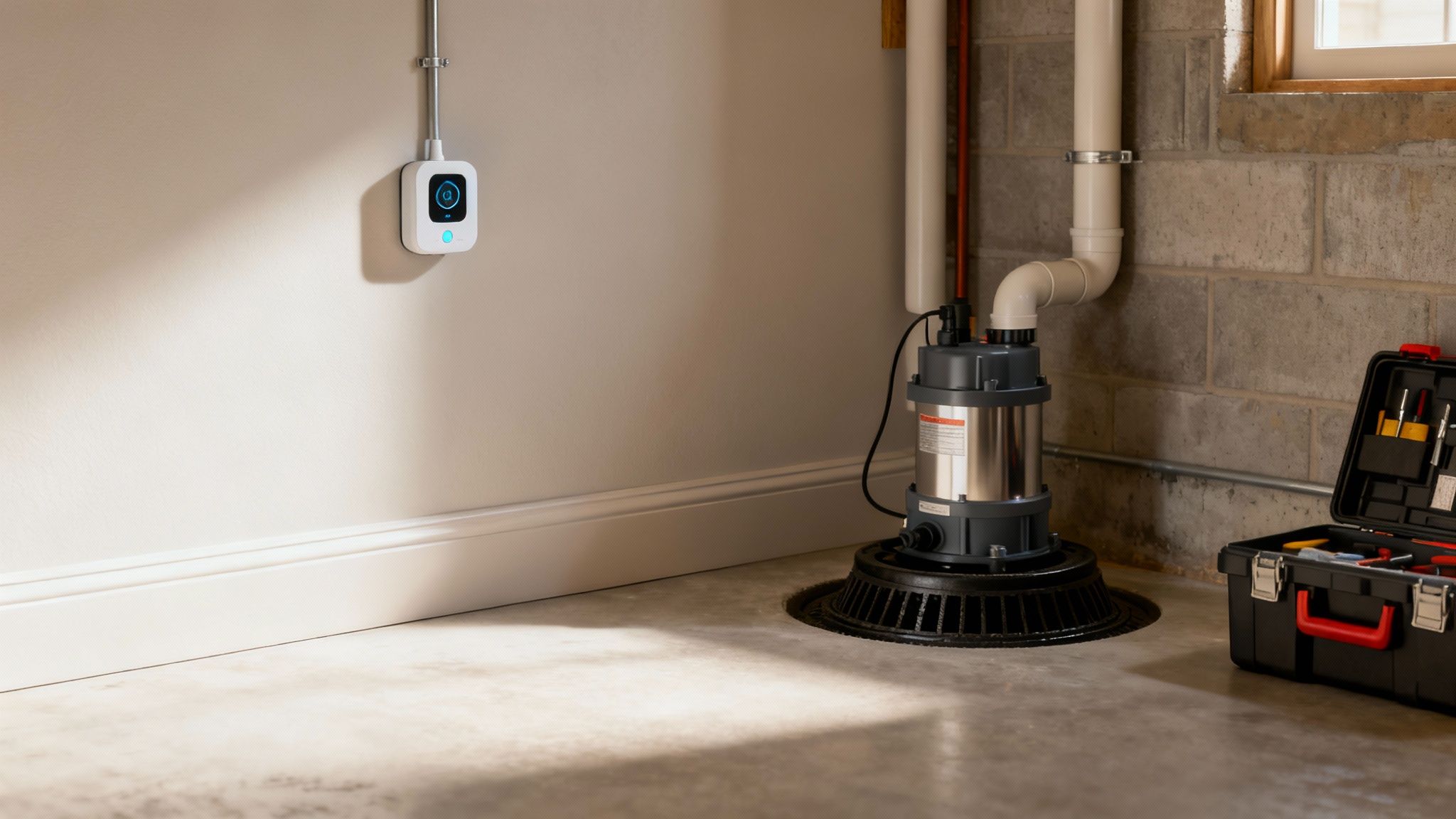
The goal is simple: catch small issues before they turn into catastrophic failures. A little diligence is your best defense.
Adopt Proactive Maintenance Habits
Regularly inspecting your home’s plumbing and exterior is the bedrock of water damage prevention. These aren't huge jobs—they're quick checks that can save you thousands.
Start with your appliances. The standard rubber supply hoses on your washing machine, dishwasher, and icemaker are ticking time bombs. Over time, they become brittle and are a top cause of major indoor flooding.
- Check Hoses Annually: Look for any signs of cracking, bulging, or brittleness. If a hose feels stiff or looks worn, replace it immediately.
- Upgrade to Braided Steel: Swap out those rubber hoses for braided stainless steel ones. They're far more durable and much less likely to burst.
Get in the habit of checking for slow drips under your sinks and behind toilets.
Key Takeaway: That tiny, persistent leak you've been ignoring is often a warning sign of a bigger problem. Fixing it early stops water from silently seeping into your subfloor and rotting your cabinetry.
Manage Water Outside Your Home
Controlling how water behaves around your property is just as critical as monitoring the pipes inside. You want to direct every drop of rainwater away from your foundation.
Your gutters are your first line of defense. When clogged with leaves and debris, water spills over and pools right against your foundation, where it can easily find its way into your basement or crawlspace. Clean them at least twice a year—once in the spring and again in the fall.
Landscaping also plays a huge role. The ground around your house should have a gentle slope, or "grade," that directs water away. If you see water pooling near your foundation after a storm, you may need to add soil to build up that grade. For more in-depth tips, learn how to prevent pipes from bursting during a cold snap.
Leverage Smart Home Technology
Modern tech offers fantastic new ways to protect your home. Smart water leak detectors are small, affordable sensors you can place in high-risk areas:
- Behind the washing machine
- Under the kitchen sink
- Next to your water heater
- In the basement near the sump pump
If a sensor detects moisture, it sends an alert straight to your phone, giving you a chance to shut off the water before major damage sets in.
For even more peace of mind, install an automatic water shut-off valve. This device connects to your main water line and can automatically close the valve the second a leak is detected, stopping a flood in its tracks. This technology can turn a potential flood damage repair crisis into a preventable inconvenience.
Why a Local, IICRC-Certified Los Angeles Team Is Your Best Bet
When your home is underwater, the sheer number of companies promising a quick fix can be overwhelming. But in a crisis, your choice of a flood damage repair team is one of the most important decisions you'll make.
This isn't a job for a handyman. You need specialized expertise, and that starts with two critical qualifications: a local Los Angeles presence and IICRC certification.
Choosing a team with these credentials isn't just about getting the job done—it's about getting it done right, safely, and in a way that protects your home's long-term health and value.
What IICRC Certification Actually Guarantees
The Institute of Inspection, Cleaning and Restoration Certification (IICRC) is the global standard-setter for our industry. It’s a rigorous training and certification program.
When a company is IICRC-certified, you're guaranteed:
- Adherence to the Highest Standards: Technicians are trained in the latest science of structural drying, water classification, and safety protocols.
- Advanced Technical Skill: They know how to use specialized equipment like thermal imaging cameras to find hidden water pockets that would otherwise lead to mold.
- A Commitment to Ethics: Certified firms are held to a strict code of professional conduct, ensuring transparent communication and fair practices.
This certification is your proof that the team understands the complex science behind a proper flood damage repair.
The Power of a One-Hour Local Response in Los Angeles
In water damage, every minute counts. The difference between a minor cleanup and a major mold remediation project can be measured in hours. This is where a local Los Angeles team like Onsite Pro Restoration brings an unbeatable advantage.
Our promise of a one-hour response time is a core part of effective mitigation. Whether you're dealing with a burst pipe in a Sherman Oaks condo or a flat-roof leak after a sudden downpour in Beverly Hills, getting a team on-site immediately is crucial.
Expert Insight: The longer water sits, the more it degrades materials. Drywall begins to swell, wood floors start to warp, and the risk of microbial growth increases exponentially. A fast, local response is your best defense against these escalating problems.
A local team also understands the specific challenges of our area, from the types of construction common in the San Fernando Valley to how coastal fog in Santa Monica can impact drying times.
With the increasing frequency of severe weather, this rapid response is more critical than ever. In the first half of 2025 alone, natural disasters, including severe floods, caused $131 billion in global losses. For homeowners in Los Angeles, these numbers highlight the financial urgency of expert flood damage repair. You can read more about the rising financial impact of natural disasters.
Core Services That Make the Difference
Choosing a certified, local company gives you access to a seamless, all-in-one solution. Look for a company that provides:
- 24/7 Emergency Response: Disasters don’t follow a 9-to-5 schedule.
- Free, On-Site Assessments: A professional should evaluate the damage and provide a clear plan of action at no charge.
- Direct Insurance Billing: A company that works directly with your insurance provider takes a massive burden off your shoulders, handling the paperwork and communication to get your claim approved swiftly.
Ultimately, hiring a local IICRC-certified team means bringing in a trusted partner with the training, technology, and local knowledge to navigate you through a difficult situation with confidence.
Frequently Asked Questions About Flood Damage Repair
Q: How long does the flood damage repair process take?
A: It depends entirely on the extent of the damage. A small, clean water leak contained to one area can often be dried in just 2-3 days. However, a major flood affecting multiple rooms, subflooring, and wall cavities can take several weeks, especially if significant reconstruction is needed. Our project manager will provide a more precise timeline after an on-site assessment.
Q: Can I clean up minor flood damage myself?
A: For anything more than a few square feet, we strongly advise against it. The visible water is rarely the whole picture; moisture seeps into drywall, under baseboards, and into the subfloor where consumer-grade equipment can't reach. Improper drying is the #1 cause of a simple water issue turning into a hazardous and expensive mold infestation.
Q: What is the difference between flood damage and water damage for insurance?
A: For insurance carriers, these are two entirely different events. Water Damage typically refers to water from an internal source, like a burst pipe or overflowing toilet, and is usually covered by a standard homeowner's policy. Flood Damage refers to water from an external source, like rising groundwater from heavy rains, and requires a separate flood insurance policy.
Q: Will I have to move out of my home during the restoration?
A: Not always. If the flood damage repair is limited to a single room or a small, contained area, you can usually stay in your home. We use containment barriers to separate the work zone and minimize disruption. However, for large-scale projects, significant demolition, or contamination from sewage (black water), it is often safer and more practical for your family to relocate temporarily.
When unexpected water damage hits your Los Angeles home, you need a team that's fast, reliable, and IICRC-certified. Onsite Pro Restoration guarantees a one-hour response time to handle everything from emergency water extraction to full reconstruction. Call us 24/7 at (818) 336‑1800 for a free, no-obligation assessment and let us help you get your home and life back to normal. https://onsitepro.org