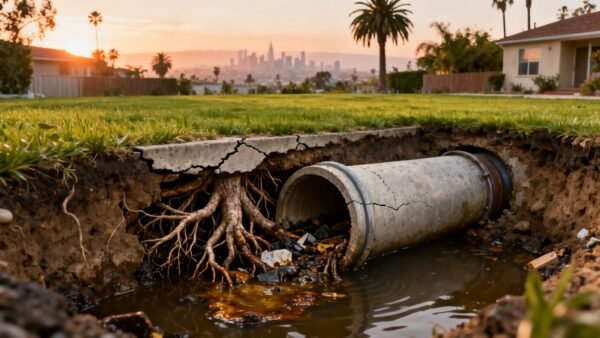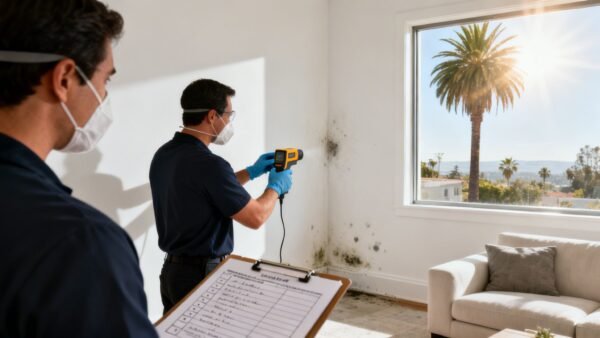

An emergency response plan template isn't just a document; it's your playbook for turning the chaos of a fire, flood, or biohazard event into a calm, controlled process. Think of it as a pre-written strategy that ensures you never miss a critical safety protocol, communication step, or piece of documentation your insurance company will demand. This is especially true for property owners in Los Angeles, where the risk of sudden damage is a part of life.
Whether it’s a burst pipe in a Downtown LA high-rise or a fire hazard in a Woodland Hills office, having a clear plan is the difference between a manageable incident and a financial disaster.
At Onsite Pro Restoration, we’ve seen firsthand how a solid plan saves property owners thousands in repair costs and lost revenue. Let’s get your plan built.
Why Your LA Property Needs an Emergency Response Plan Before Disaster Strikes
Imagine a water heater letting go in your Sherman Oaks apartment complex or a wildfire threatening your Calabasas home. Here in Los Angeles, we all know property emergencies aren't a matter of 'if,' but 'when.' Those first few minutes after a disaster are a blur of stress and confusion. Without a clear plan, costly mistakes are almost unavoidable.
I've seen it a hundred times: good people making bad decisions under pressure.
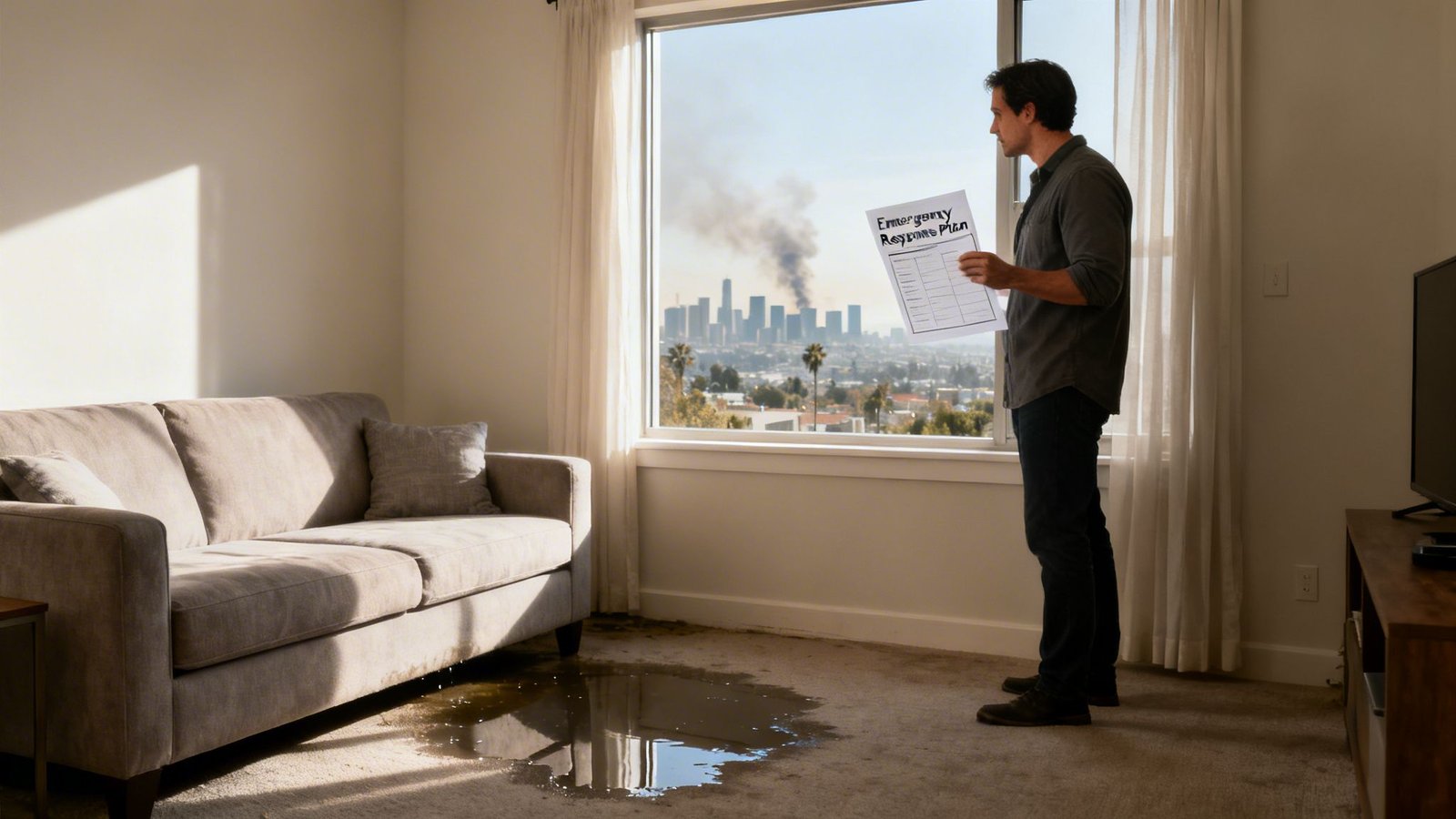
Having an emergency response plan shifts you from a state of panic to a position of control. It’s a personalized guide that tells you exactly what to do, who to call, and how to stop the damage from getting worse. This goes way beyond just having a fire extinguisher; it’s about having a complete recovery strategy ready to go.
A well-rehearsed emergency plan is the single most valuable asset you can have in a crisis. It's the best tool for minimizing damage, protecting people, and making the entire recovery process smoother.
The True Cost of Unpreparedness
Without a plan, small problems have a way of spiraling out of control. That slow leak you keep meaning to fix can lead to catastrophic structural damage and a serious mold infestation. The smoke residue from a minor kitchen fire can become permanently embedded in your walls and furnishings if not professionally handled within hours.
Often, this secondary damage is far more expensive to fix than the original problem.
For property managers and commercial owners, the stakes are even higher. Being caught unprepared leads to a cascade of problems:
- Skyrocketing Liability: If you don't have a documented safety and evacuation plan, you're exposing yourself to serious legal risk.
- Crushing Business Interruption: Every single hour your property isn't operational is an hour of lost revenue.
- Destroyed Tenant Relationships: A chaotic, poorly handled emergency destroys the trust you've built with tenants and can easily lead to vacancies.
- Nightmare Insurance Claims: Missing documentation and delayed action will complicate your claim, slow down payment, and could even lead to a denial. For a closer look at what insurance will and won't pay for, you can learn more about how homeowners insurance covers water damage in our guide.
From Chaos to Control
This guide provides a customizable emergency response plan template built specifically for Los Angeles properties. It isn't a generic checklist. It's a solid framework you can use to build a practical plan that accounts for the real risks we face in Southern California—from earthquakes and mudslides to flash floods and fires.
By putting in the work now, you're doing more than just creating a document. You're investing in peace of mind, protecting your asset's value, and ensuring the safety of everyone on your property.
Let's get your plan built.
Building the Core of Your Emergency Response Plan
An effective emergency plan isn't a generic document you download from the internet. It’s a living playbook tailored to your specific Los Angeles property. This is where you put pen to paper—or fingers to keyboard—and build the core guide that will dictate your actions when a crisis hits.
Whether you manage a commercial building in Glendale or own a home in West Hollywood, the fundamentals are the same. Let's walk through building the essential components that will actually make a difference when the clock is ticking.
First Moves: Securing the Property and People
When disaster strikes, your absolute first priority is the safety of anyone on the property. Forget about the damage for a moment; you need to secure the scene. That starts with knowing how to shut down your main utilities without a second thought.
You won’t have time to hunt for a valve when a pipe has burst or you smell gas. Your plan needs clear, simple instructions.
- Utility Shut-Off Maps: Sketch out simple diagrams showing the exact location of your main water, gas, and electrical shut-offs. Don't just mark the spot—add notes on how to turn them off (e.g., "Wrench needed for gas valve," "Flip main breaker at top of panel").
- Evacuation Routes: Map out at least two escape routes from every area. For an apartment building, this means a primary and secondary stairwell. For a home, it means different exits that lead to a pre-planned safe meeting spot, well away from the structure.
- Emergency Gear Locations: Note where you keep fire extinguishers, first-aid kits, and other safety gear. Make sure they’re easy to get to and that key people know how they work.
A great place to start is our guide on where to find your main water shut-off. Before finalizing any plan, it’s also smart to understand what you’re up against by conducting a thorough fire risk assessment. This process uncovers the specific vulnerabilities of your property.
Who to Call and When: Your Emergency Roster
In an emergency, fumbling for phone numbers is a costly waste of time. Your emergency response plan template needs a prioritized contact list that’s available both digitally and on paper.
Organize your list by urgency.
- Immediate Response (Life & Safety):
- 911: The first call for any fire, medical emergency, or immediate danger.
- Utility Companies: Essential for gas leaks or major electrical hazards.
- Property Stabilization (Damage Control):
- 24/7 Restoration Partner (Onsite Pro Restoration): After ensuring everyone is safe, this is your next call. Getting a professional team on-site quickly is the single best way to minimize secondary damage from water, fire, or mold.
- Official & Financial Contacts:
- Insurance Agent/Provider: To get the claims process started right away.
- Property Manager/Landlord: If applicable, to handle tenant communication and coordinate access.
- Key Contractors: Your go-to plumber, electrician, or roofer who you trust.
Pro Tip: Don't just list a name and number. Include after-hours contacts, your insurance policy number, and utility account details. The more information you have in one place, the faster you can get things moving.
Proof of Loss: Document Your Property Before Disaster Strikes
After an emergency, the success of your insurance claim depends almost entirely on the quality of your documentation. You need to prove your property's pre-loss condition to get a fair and fast settlement. This isn't something you do during the chaos; it’s a crucial prep step.
Take your smartphone and create a complete visual record. Go room by room and get:
- Wide-Angle Photos: Shoot each room from every corner to show the overall condition of walls, floors, and ceilings.
- Detailed Videos: Walk through and narrate what you're recording. Point out high-value items, recent renovations, and expensive finishes.
- Appliance & Electronics Inventory: Get close-up shots of the serial and model number tags on your major appliances and electronics.
Upload these files to a cloud service like Google Drive or Dropbox. That way, you can access them from anywhere, even if your phone and computer are toast. This simple task can be worth thousands of dollars when it's time to file your claim.
Essential Components of Your Emergency Response Plan
To make sure your plan is truly ready for action, it has to cover a few key areas. The table below breaks down the absolute must-haves for any property owner’s plan. Think of it as your final checklist.
| Component | What to Include | Why It's Critical |
|---|---|---|
| Safety & Evacuation | Utility shut-off maps, clear exit routes, assembly points, locations of safety equipment. | Protects human life, which is always the first priority in any disaster scenario. |
| Emergency Contacts | Prioritized list with names, 24/7 numbers, and account details for first responders, restoration partners, and insurance. | Enables rapid communication to stop damage and begin the recovery process without delay. |
| Property Documentation | Pre-loss photos and videos of every room, high-value items, and major systems. | Serves as irrefutable proof of your property's condition for a smoother insurance claim. |
| Communication Plan | Pre-written scripts for notifying tenants, employees, or family members. | Ensures clear, calm, and consistent communication, reducing panic and confusion. |
| Role Assignments | Clearly defined roles for key personnel (e.g., who calls 911, who manages tenant communication). | Eliminates confusion and ensures all critical tasks are handled swiftly and efficiently. |
Having a solid plan isn't just a good idea—it's becoming an expectation. The emergency response planning market in North America is expected to hit USD 6.7 billion in 2025 and grow to USD 14.3 billion by 2030. Even with that, 18% of workers globally say their company has no written plan at all. By creating this core plan, you're not just protecting your asset; you're joining the ranks of proactive owners who are ready for anything.
Customizing Your Plan for Specific LA Disasters
A generic plan is a decent starting point, but Los Angeles doesn't deal in generic disasters. A burst pipe in a downtown high-rise demands a completely different response than a flash flood threatening a coastal Santa Monica home. For your plan to work, it has to be built for the real-world threats your property actually faces.
Southern California's unique risks—from Santa Ana winds fueling wildfires to "atmospheric rivers" overwhelming our drainage systems—make a one-size-fits-all approach dangerous. A tailored plan is your single best defense.
At its core, every solid emergency plan follows the same fundamental flow: first, secure the scene for safety. Then, document everything. Finally, make the right calls to the right people.
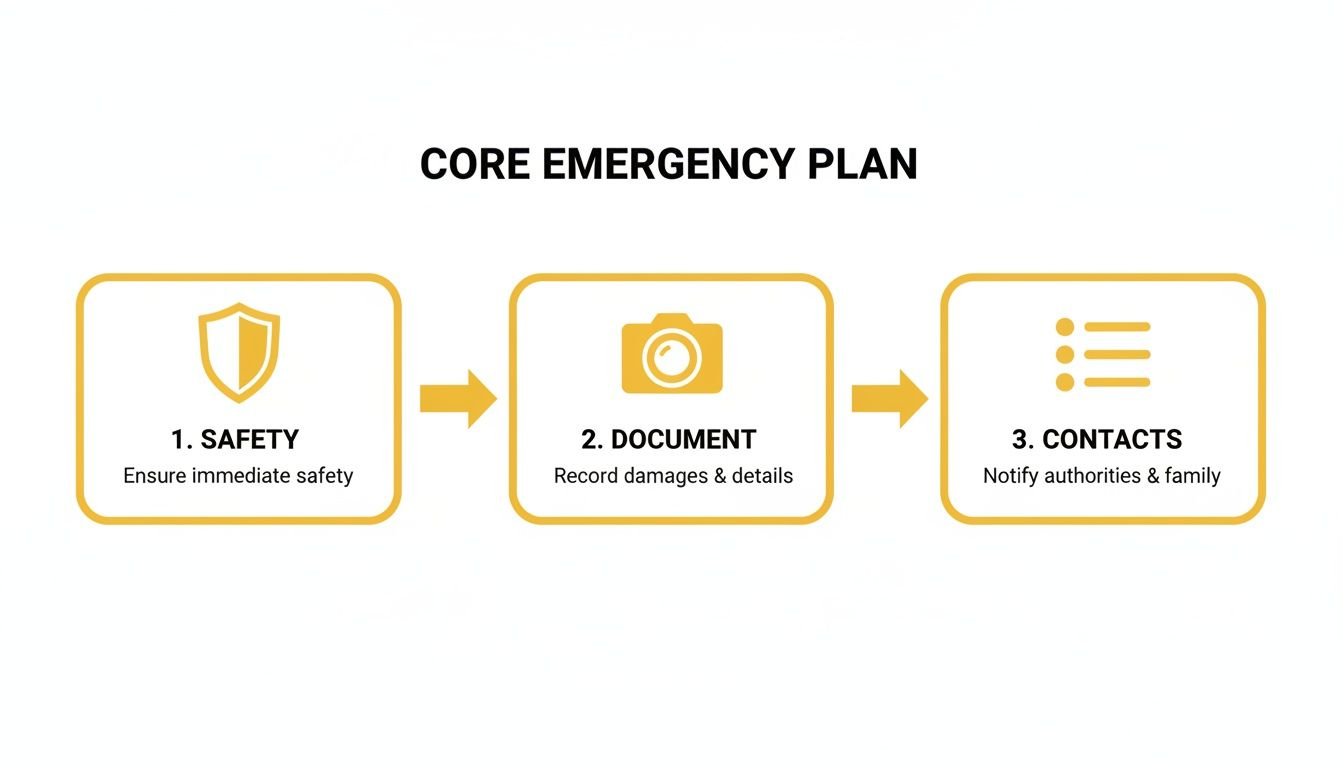
This simple sequence—Safety, Documentation, Contacts—is the backbone of your response, no matter what kind of disaster you're facing.
Water Damage Response Plans
In LA, water damage is a year-round threat that comes from inside your walls and from the sky. Your plan needs to have a clear protocol for both.
- Internal Plumbing Failures (Burst Pipes, Leaks): Speed is everything here. Your plan must include the exact location of the main water shut-off valve. The mission is to stop the water flow in minutes, before it soaks into drywall, flooring, and the subfloor beneath.
- External Flooding & Storms: This is all about preparation. For properties in low-lying areas, your plan should detail pre-storm prep: where to get and place sandbags, how to check sump pump function, and a reminder to clear storm drains. Knowing how to prepare for drought and storms is a fundamental part of managing any California property.
Regardless of the source, once everyone is safe, your very first call should be to a professional restoration company. Water creates the perfect environment for mold, which can start colonizing in as little as 24-48 hours.
Fire Damage Action Checklists
When the fire department rolls away, your job is just getting started. The acidic soot and corrosive smoke left behind can cause more permanent damage than the flames if you don't act immediately. Your plan needs a specific post-fire checklist.
Do not try to clean anything yourself. Wiping at soot-covered surfaces without the proper chemistry and techniques will smear and permanently set the stains, making professional restoration far more difficult and expensive.
Your immediate actions should be focused on two things: mitigation and documentation.
- Secure the Property: Board up broken windows and doors immediately. This prevents unauthorized entry and protects what's left of the interior from the elements.
- Limit Movement: Don't walk through the damaged areas unless you absolutely have to. Every footstep grinds soot deeper into carpets and flooring, making it harder to salvage.
- Document Everything: Before a single thing is moved, take extensive photos and videos for your insurance claim. Get shots from every angle, capturing all the damage.
- Call for Professional Help: Contact a certified fire damage restoration team. They have the training and specialized equipment to handle soot, smoke, and the water damage left by firefighting efforts. For a deeper dive, read our guide on what to do after a house fire.
Mold Discovery Protocols
Finding mold is always alarming, whether it's a small patch in a bathroom or a major colony uncovered during a remodel. How you react in the first few hours is critical to stopping its spread and protecting the health of everyone in the building.
The single biggest mistake we see property managers and homeowners make is trying to handle it themselves. Disturbing a mold colony without proper containment releases millions of spores into the air, which can quickly contaminate your entire HVAC system and spread the problem everywhere.
Your plan for dealing with mold should be short and direct:
- Isolate the Area: Shut all doors to the room. Turn off the HVAC system to stop spores from circulating through the vents.
- Do Not Touch It: Avoid trying to clean the mold with bleach or store-bought chemicals. This is rarely effective on porous surfaces and can actually aerosolize the spores, making the air quality worse.
- Contact a Certified Mold Inspector: Your only move is to call a professional for a proper assessment and air quality test. They can identify the type of mold and map out the right remediation strategy.
Customizing your emergency plan isn't about making it more complicated—it's about making it crystal clear. By thinking through these specific LA-centric disasters now, you create an actionable playbook that gives you and your team clear, effective instructions when the pressure is on.
Implementing Your Emergency Response Plan During a Crisis
When the worst happens at your property, chaos is the enemy. Panic spreads like wildfire, but a clear, calm voice can stop it in its tracks. This is the moment your emergency response plan becomes your most valuable asset, giving you the exact words and steps to take control when it matters most.
A good plan isn’t just a document; it’s a script. It maps out who to call, in what order, and what to say. It replaces frantic guesswork with confident action.
Your First Critical Calls
Once you’ve confirmed everyone is safe, the clock starts ticking on protecting your property. Your next moves can make or break your recovery.
Your contact list should be prioritized and ready to go:
- First Responders (911): This is non-negotiable. For any fire, major flood, or immediate threat to life or property, this is always your first call.
- A 24/7 Restoration Company (Onsite Pro Restoration): As soon as safety is secured, get the professionals moving. The difference between a call made now versus an hour from now can be thousands of dollars in secondary damage. Quick mitigation is everything.
- Your Insurance Provider: With mitigation underway, your third call is to your insurance agent. This officially opens the claim and gets the financial recovery process started.
Talking to Your Insurance Adjuster
How you report the loss matters. A lot. Emotional or vague descriptions like "the place is flooded!" create confusion and slow everything down. You need to be factual, precise, and project control from the very first call.
Instead of panicking, use a script straight from your plan.
"I am reporting a water loss event at [Property Address]. The source appears to be a burst supply line in the upstairs bathroom. Water has affected the bathroom, the downstairs living room ceiling, and the west wall. We have already contacted a certified restoration company to mitigate further damage."
This single statement tells the adjuster you're a responsible property owner who has the situation under control. It builds immediate credibility and helps fast-track your claim. For a deeper dive, check out our guide on essential insurance claim tips for water damage.
Notifying Tenants and Employees
For property managers and commercial owners, your next conversation is with your tenants or staff. Your communication here needs a careful balance of authority and empathy. You have to give clear directives without causing a panic.
This is where pre-written templates are a lifesaver. For a contained water leak that isn't a life-safety issue, your script might be:
Sample Tenant/Employee Notification:
"This is an important notice for all residents/staff at [Property Name]. We are currently managing a water leak affecting the [Location, e.g., 'east wing, third floor']. The water has been shut off, and a professional crew is on-site. We will provide another update within two hours. Please avoid the affected area until further notice."
This works because it's simple and effective. It tells them what happened, confirms action is being taken, and sets a clear expectation for the next update. No drama, just facts.
Having these scripts ready means you never have to invent the right words under pressure. Yet, it's shocking how many businesses are unprepared. A recent U.S. survey found that while 76% of employees believe their company has a written plan, a worrying 24% have nothing. Even worse, 28% of U.S. companies with a plan fail to test it, a dangerous gap that a rehearsed communication strategy closes. The importance of this planning is becoming a major focus, as shown in this market analysis from Grand View Research.
Testing and Maintaining Your Emergency Plan
Let’s be honest: creating an emergency plan and then shoving it in a drawer gives you a false sense of security that will evaporate the moment a real crisis hits. An untested plan is just paper. A tested and updated plan is your single best tool for turning chaos into control.
Preparedness isn't a one-and-done task; it's an ongoing process.

I’ve seen it happen too many times. A pipe bursts or an earthquake hits, and the property manager pulls out a plan only to find the emergency contacts are outdated, the designated evacuation route is blocked by new construction, or the person assigned to shut off the gas has no idea where the valve is.
Regular reviews are what make a plan work in the real world, not just on paper.
Create a Simple Review Schedule
The best maintenance schedule is one you’ll actually follow. Keep it simple. For any LA-area property owner or manager, this is a practical rhythm that works.
Semi-Annual Review (Every 6 Months): This is your quick-check for the details that change most often. Pull out your emergency contact list and verify every phone number and email. Double-check your insurance policy numbers and the contact info for your agent.
Annual Walkthrough (Once a Year): Grab your plan and physically walk the property. Are the utility shut-off valves still accessible and clearly marked? Are fire extinguishers and first-aid kits where they should be? Most importantly, are the evacuation routes completely clear of junk and obstructions?
This simple habit transforms your plan from a static document into a living tool that actually reflects the current state of your property.
The Dangers of "Set It and Forget It" Planning
The global market for emergency and disaster response is massive—climbing from USD 151 billion in 2026 to a projected USD 183.02 billion by 2031. It shows a huge global investment in being ready.
Yet, a shocking number of businesses fail on the follow-through. A recent analysis found that 28% of U.S. firms don't regularly test their plans, a much higher rate than the 19% seen globally. For anyone managing property in a high-risk area like Los Angeles, that statistic should be a massive red flag. You can explore the full market analysis from Mordor Intelligence to see the data for yourself.
An untested plan is worse than no plan at all. It provides a false sense of security that will evaporate the moment a real emergency occurs, leaving you more vulnerable than ever.
Ensure Your Team Knows Their Roles
The final piece of the puzzle is making sure everyone knows what to do. A brilliant plan is useless if your family or staff doesn't know it exists or what their specific job is during a crisis.
Here’s how to lock in team readiness:
- Centralize and Digitize: Keep a physical copy in a clearly marked, accessible location. Also, save a digital version in a cloud service like Google Drive or Dropbox so key people can access it from their phones.
- Assign Clear Roles: Don’t be vague. Who is responsible for calling the restoration company? Who handles communication with tenants or family members? Make sure each person knows their exact task.
- Hold a 30-Minute Annual Briefing: Once a year, get everyone together for a quick review. It’s not about memorizing the document; it’s about reinforcing roles and keeping safety top of mind.
By committing to this simple cycle of reviewing, walking the property, and briefing your team, you guarantee your emergency plan is a reliable asset ready to protect your property and the people inside it.
Your Top Questions About Emergency Planning Answered
Even with a detailed guide, a few questions always pop up. Over the years, I’ve heard the same crucial ones from LA property owners, managers, and business owners. Getting these details right is what separates a plan on paper from one that actually works when the pressure is on.
How Often Should I Update My Emergency Plan?
Your plan isn't a "set it and forget it" document. Think of it as a living part of your property management. A full review should happen at least once a year. But honestly, certain events mean you need to pull it out and update it right away.
Don't wait for your annual review if any of these happen:
- Major Renovations: Construction can completely change your evacuation routes, move utility shut-offs, or block access points. Your plan must reflect the new layout.
- New Commercial Tenants: A new business brings different operational risks, hazardous materials, or key personnel who need to be on your emergency contact list.
- You Switch Insurance Providers: A new policy means a new number, a new agent, and a totally different claims process. Outdated insurance info is a nightmare during a crisis.
- Key People Leave or Change Roles: If your designated safety manager or primary contact leaves, their responsibilities must be reassigned immediately.
An outdated plan with wrong numbers or old information is almost as useless as having no plan at all.
I Just Found Water Damage. What's the Very First Thing I Do?
Your first thought must be safety. Before you do anything else, secure the area.
If you see standing water anywhere near electrical outlets or appliances, your first move is to shut off the power at the main breaker box. But only if you can get to it safely without stepping in water. If you have any doubt, stay out of the area and call for professional help.
Next, find the source and stop the water. This usually means shutting off the main water valve to your property. Once you've controlled the immediate hazards, your very next call should be to a 24/7 restoration company. Time is critical here. Mold can start to grow in as little as 24-48 hours, turning a simple water issue into a major health hazard. You can learn more in our guide to emergency water cleanup.
Can't I Just Use a Generic Emergency Plan Template?
A generic template is a fantastic starting point, but it should never be your final plan. It gives you the skeleton, but you have to add the muscle and nerves to make it work.
A generic template is like an empty map. To make it useful, you have to draw in the specific roads, landmarks, and routes that apply to your journey. An effective emergency plan needs that same level of personalization.
A document you download online won’t know where your gas shut-off valve is hidden behind the bushes. It won't have the after-hours number for your specific insurance agent or account for the unique evacuation challenges of your building's second floor. Use a template for the structure, then fill it with the specific, customized details we’ve outlined in this guide.
Why Is Calling a Restoration Company So Urgent?
When it comes to property damage, time is your worst enemy. Every hour you wait, the damage gets worse and the repair bill gets higher. It’s that simple.
- For Water Damage: We’ve already mentioned it, but it bears repeating: mold growth starts within 24 to 48 hours. Beyond that, porous materials like drywall, wood, and insulation are still soaking up water, leading to swelling, warping, and irreversible structural rot.
- For Fire Damage: After a fire is out, the acidic soot and smoke residue that’s left behind immediately starts corroding surfaces. If it’s not cleaned professionally and quickly, it will cause permanent etching and staining on metal, glass, and even stone.
Getting a certified restoration team like Onsite Pro Restoration on-site immediately means you stop the clock on secondary damage. This single step will dramatically cut the total cost of repairs and provide the professional documentation your insurance carrier requires to process your claim smoothly.
Ready to get protected? The team at Onsite Pro Restoration is available 24/7 to help you recover from water, fire, or mold damage. Don't wait for a disaster to find a partner you trust. Visit us at https://onsitepro.org or call us now for immediate assistance.