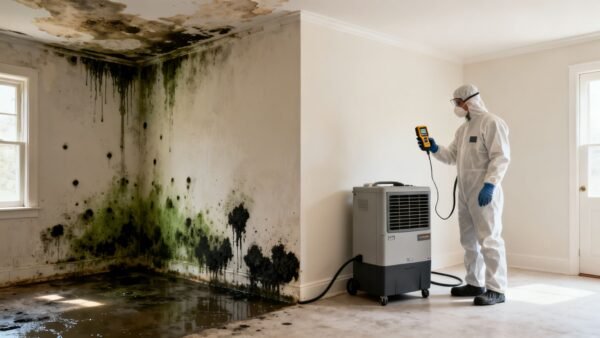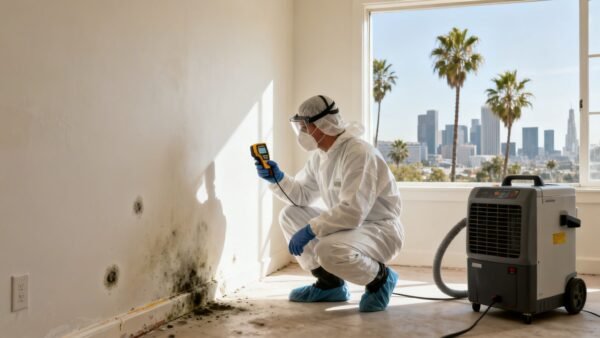

When we talk about commercial mold remediation in a business setting, we’re not just cleaning up a few spots. It's a professional, systematic process designed to find, contain, and completely remove mold from a business environment, all while fixing the moisture problem that started it. This goes way beyond what a standard cleaning crew can handle, ensuring the building is safe for everyone and protecting your Los Angeles business from shutdowns, liability, and serious structural damage.
Dealing with mold in a Los Angeles property requires a professional approach. If you suspect an issue, don't wait for it to get worse.
Why Mold Remediation Is a Business Imperative
Finding mold in your commercial property isn't just an annoyance—it's a genuine threat to your business. That musty smell in the office kitchen or a stained ceiling tile isn't just cosmetic; it’s often the tip of the iceberg, signaling a much larger problem hidden from view. A problem that can threaten employee health, bring operations to a grinding halt, and tarnish your company’s reputation.
Commercial spaces have their own set of challenges that you just don't see in a residential home.
Take HVAC systems, for example. In a large building, they can act like a superhighway for mold spores. A small, undetected leak in a backroom closet in a Sherman Oaks office can quickly contaminate every office on the floor. The sheer size of warehouses, retail stores, and office buildings also means there are countless places for moisture to hide, letting mold grow unchecked for weeks or even months.
The Financial and Reputational Stakes
Trying to ignore a mold problem is one of the worst financial decisions a property manager can make. The risks of doing nothing are huge and can hit your business from every angle, from your bottom line to how the public sees you.
- Operational Disruption: A major remediation job could mean shutting down entire sections of your building. For a busy retail store or office in downtown L.A., that means lost productivity and revenue, plain and simple.
- Legal Liability: If an employee or customer gets sick from mold exposure in your facility, you're looking at the possibility of expensive lawsuits and fines from regulators like OSHA.
- Decreased Property Value: A known history of mold makes a building incredibly difficult to sell or lease. It’s a red flag that can dramatically slash its market value.
We're seeing a growing awareness of these risks across the board. Businesses are finally realizing that being proactive about mold isn't just about compliance—it's a core part of risk management. That's why the demand for professional remediation is on the rise.
A Modern Approach to Property Management
It’s a mistake to think of commercial mold remediation as just another unexpected expense. A much smarter way to look at it is as a critical investment in keeping your business running smoothly. The numbers back this up: the global mold remediation market was valued at USD 1,234.6 million in 2023 and is only expected to keep growing.
Understanding the specific risks of mold in commercial buildings is the first step. Taking a professional, systematic approach doesn’t just fix the immediate contamination; it protects your building, your people, and your company's future.
The Initial Assessment and Containment Strategy
A professional commercial mold remediation job never starts by swinging a sledgehammer. It begins with a careful, methodical investigation to figure out exactly what you're dealing with. This initial assessment is everything—it's the blueprint for the entire project, ensuring the fix is both effective and efficient.
The process kicks off with a detailed visual inspection. A certified technician will walk the site, looking for the obvious signs like discoloration, musty odors, or visible fuzzy growth. But let's be honest, the most dangerous mold is often the mold you can't see. Colonies love to hide behind drywall, above ceiling tiles, and under flooring, especially after a slow, silent leak from a flat roof common in Los Angeles architecture.
Pinpointing the Moisture Source and Scope
To uncover these hidden problems, we bring in specialized tools like moisture meters and thermal imaging cameras. These gadgets are fantastic because they can detect elevated moisture inside building materials, pointing us straight to the water source that's feeding the mold. If you don't fix the source—whether it's a leaky pipe, bad roof flashing, or just out-of-control humidity—the mold will always come back. No exceptions.
Once we know where the water is coming from, the next job is to map out the extent of the contamination. This often involves professional air and surface sampling. A qualified inspector will collect samples to identify the exact type and concentration of mold spores in the air and on surfaces. To get a better idea of this process, you can check out our guide on professional mold inspection services near me. This data is what allows us to build a precise, targeted game plan for your building.
This infographic breaks down the biggest business risks that unchecked mold growth creates, hitting your health, operations, and reputation hard.
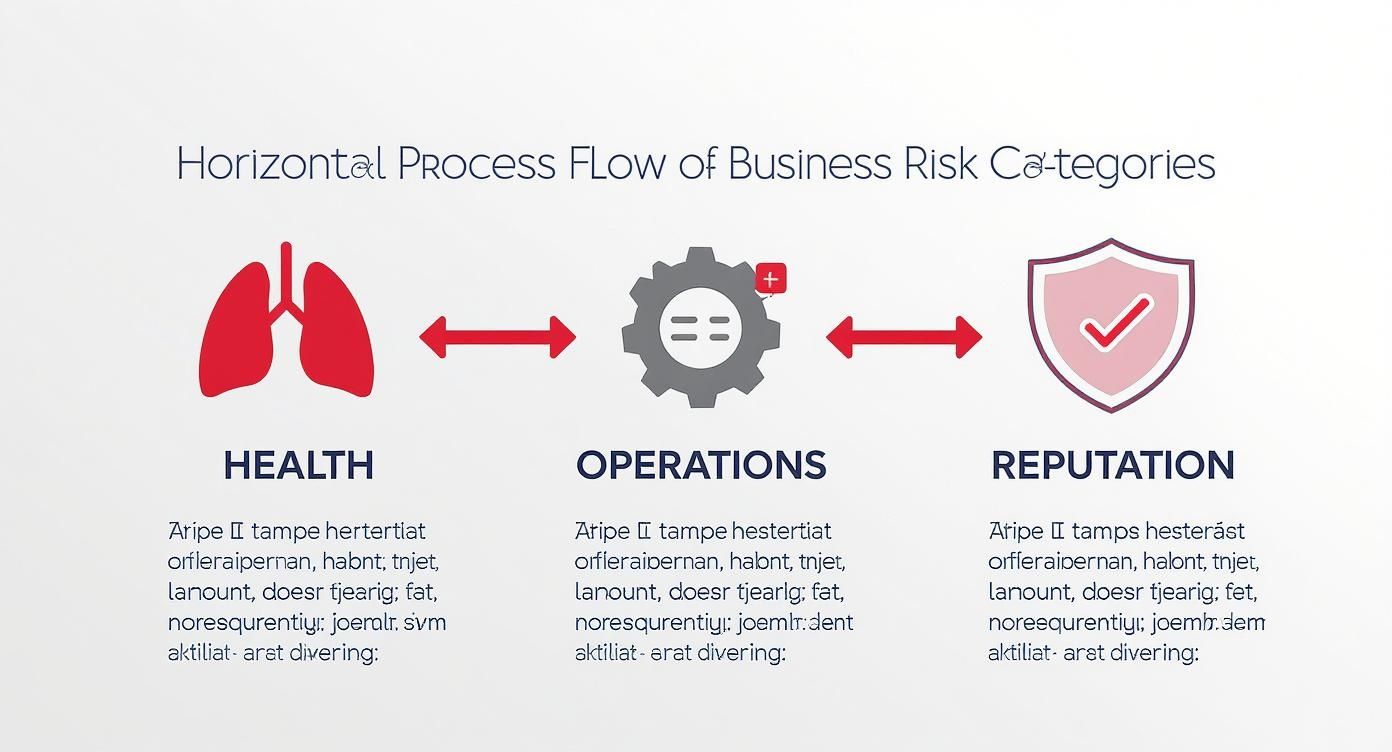
As you can see, the consequences of ignoring mold go way beyond just damaged drywall. They directly impact your employees' well-being and can seriously tarnish your brand's integrity.
Establishing a Secure Containment Zone
With a clear picture of the problem, we move to the most critical phase: containment. This is a non-negotiable step in any legitimate remediation project. The goal is to completely seal off the contaminated area from the rest of the building, preventing airborne spores from turning a small problem into a building-wide disaster.
Here’s how our technicians lock down the area:
- Setting up physical barriers: We use thick plastic sheeting to seal off doorways, HVAC vents, and any other openings.
- Creating negative air pressure: We set up powerful, HEPA-filtered air scrubbers to create a vacuum effect. This ensures that air only flows into the contained area, not out, effectively trapping any disturbed spores inside.
Think of it like a quarantine zone for your building. This controlled environment is what separates professional remediation from a simple wipe-down. It’s the single most important factor in protecting the clean areas of your property and making sure the problem doesn't get worse during cleanup.
For example, imagine a leak behind a wall in a multi-story office building. Proper containment keeps the mold spores from traveling through the HVAC system into every adjacent office. This single step can save a business tens of thousands of dollars in expanded cleanup costs and potential liability. Strategic isolation is the hallmark of a job done right.
The Process of Mold Removal and Cleanup
With the containment zone sealed off, it’s time to get our hands dirty. This is where the real work of commercial mold remediation starts, and it’s far more than a simple wipe-down. We’re talking about a systematic process of physically removing mold-infested materials and treating every surface to make sure those spores have nowhere to hide and no reason to come back.
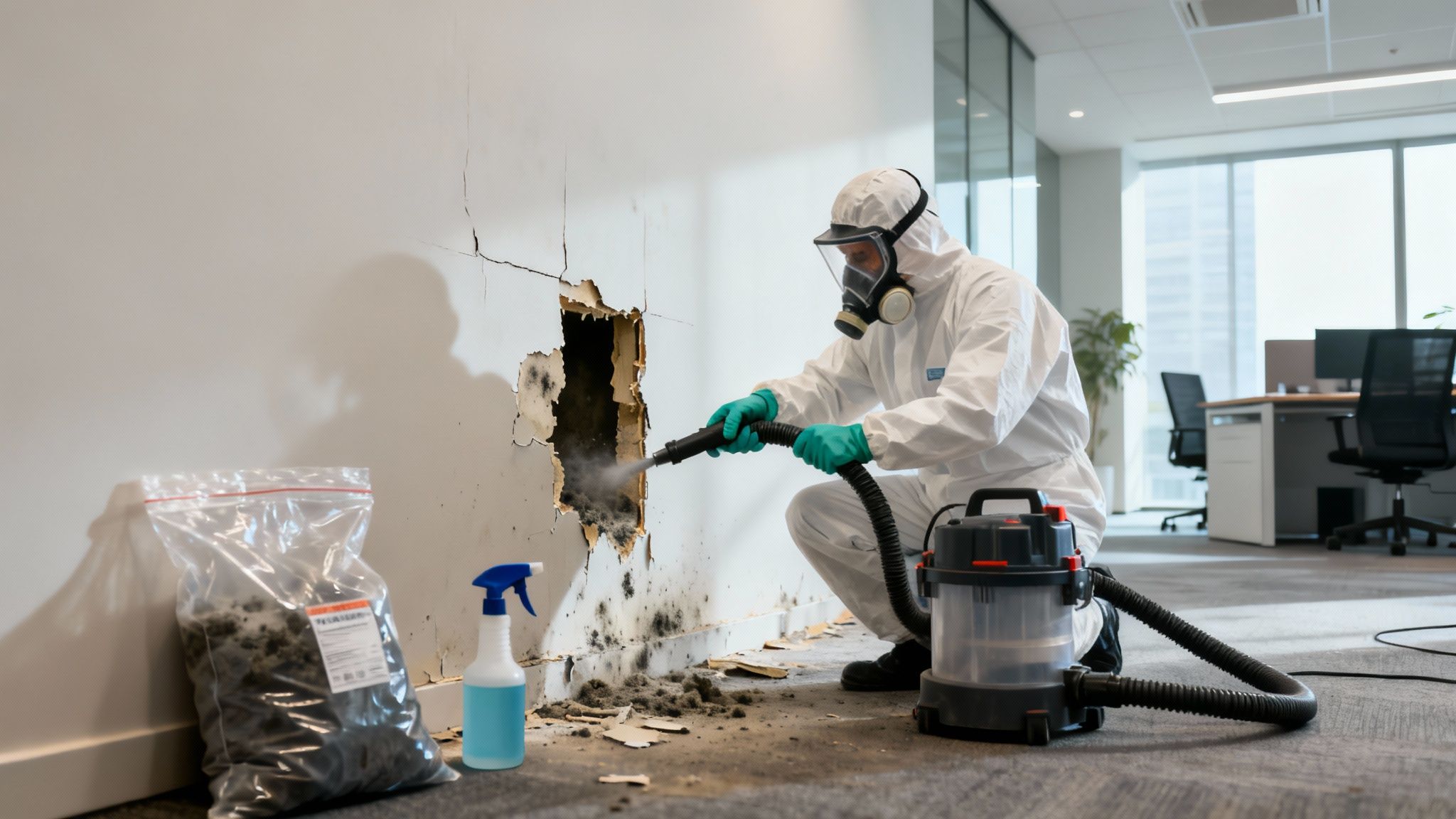
This is a critical distinction that many property managers miss. True remediation isn't about scrubbing a visible spot on the wall. It’s about tackling the entire contamination lifecycle, from the fuzzy colonies you can see to the microscopic spores floating in the air—something a standard cleaning crew just isn't equipped to handle.
Safely Removing Contaminated Materials
First things first, any porous materials that have become a breeding ground for mold have to go. Think drywall, soggy ceiling tiles, insulation, and carpet padding. Once mold gets deep into these materials, there’s no cleaning it effectively. The only safe solution is to remove them completely.
Our technicians, geared up in full Personal Protective Equipment (PPE), carefully cut out and bag these contaminated materials right inside the containment area. This isn't a demolition free-for-all; it’s a surgical strike to prevent any dust or debris from escaping and spreading the problem.
We’re essentially taking away the mold’s food source. By removing compromised drywall and insulation, we eliminate the environment where it thrives. This stops the problem at its root and paves the way for a thorough deep clean.
Air Filtration and Surface Disinfection
Once the compromised materials are out, our focus shifts to what’s left behind: the air and the remaining surfaces. We bring in high-efficiency particulate air (HEPA) vacuums to go over every inch of the contained space. These aren't your average shop vacs; they’re designed to capture particles as small as 0.3 microns, trapping invisible mold spores with incredible efficiency.
Next, we treat surfaces like wood framing, concrete, and metal fixtures with EPA-registered antimicrobial agents. These aren't just cleaners; they are professional-grade solutions that kill any lingering spores and inhibit future growth. This is a vital step in the mold removal process that ensures the area is genuinely sanitized.
Air ducts are another major concern. Beyond just dust, they can hide mold and mildew, which can re-contaminate a space in no time. Proper cleaning air ducts for mould or mildew is a specialized task that’s crucial for restoring healthy indoor air quality after remediation.
Commercial mold remediation plays a huge role in the wider USD 7.1 billion restoration industry in the U.S. With studies showing over 50% of U.S. homes have mold, commercial properties often face even bigger risks due to their size and complexity. For a property manager, professional remediation isn't just a repair—it's a critical step in managing risk and avoiding potential legal or insurance headaches.
Comparing Commercial Mold Remediation Techniques
To give you a clearer picture, here’s a look at the different methods we use and when they’re most effective. Choosing the right technique for the job is key to a successful outcome.
| Technique | Best For | Key Benefit | Considerations |
|---|---|---|---|
| HEPA Vacuuming | All surfaces, especially wood, concrete, and furnishings. | Captures microscopic airborne spores without releasing them back into the air. | Must be used in conjunction with other methods for deep-seated mold. |
| Antimicrobial Treatment | Non-porous surfaces like wood studs, concrete floors, and metal. | Kills remaining spores and prevents regrowth. | Requires proper application and ventilation; not a substitute for material removal. |
| Abrasive Blasting | Heavy contamination on dense materials like wood framing or masonry. | Aggressively removes mold from surfaces without chemicals. | Can create significant dust; requires robust containment and air filtration. |
| Material Removal | Porous materials like drywall, insulation, and ceiling tiles. | Permanently eliminates the mold source material. | Necessary for most significant mold problems; requires proper disposal. |
Each of these techniques has its place. A skilled remediation team knows how to combine them to create a comprehensive plan that doesn't just clean up the mold you see, but eliminates the entire problem for good.
Structural Drying and Post-Remediation Verification
Tearing out all the mold-affected materials is a huge step forward, but the job is far from over. The final, and arguably most critical, phases of any professional commercial mold remediation project are all about one thing: making absolutely sure the mold can't come back.
This is where aggressive structural drying and independent verification come into play. It's the only way to prove the space is truly safe.
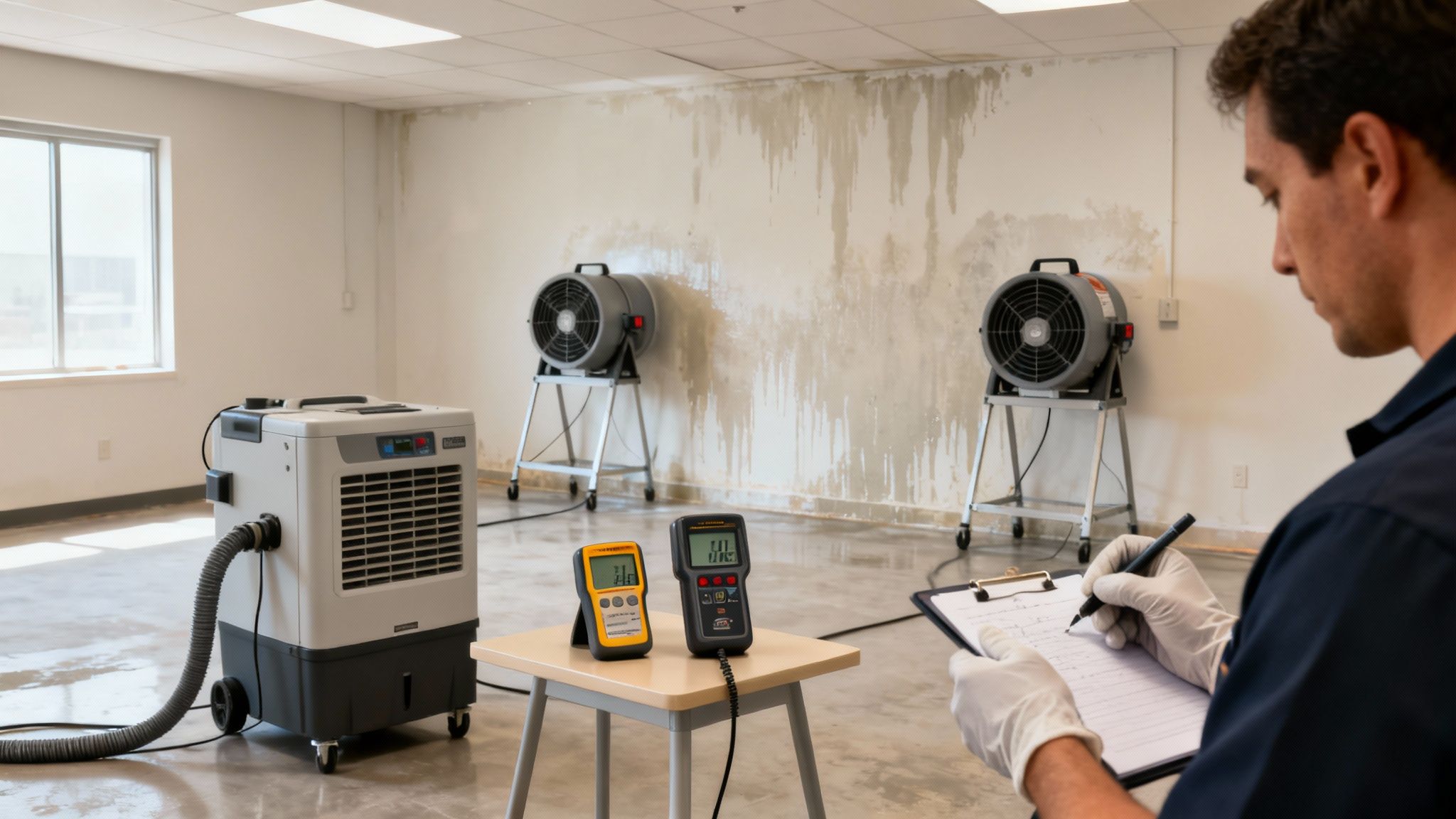
Simply letting an area "air dry" is never a real option in a commercial setting. Any lingering moisture hiding in wood studs, concrete, or subflooring is basically a welcome mat for a brand new mold colony. That’s why our technicians roll in with an entire arsenal of industrial-grade equipment designed to actively yank moisture out of both the building materials and the air itself.
The Science of Creating a Dry Standard
The drying process isn’t guesswork; it’s a methodical, science-backed procedure. We don't just feel a wall and call it dry. We use professional moisture meters to take precise readings, confirming that every material has returned to its normal, pre-damage moisture level.
You'll see a combination of heavy-duty equipment working in concert on-site:
- High-Volume Air Movers: These aren't your average fans. They blast high-speed airflow across wet surfaces to supercharge the rate of evaporation.
- Refrigerant Dehumidifiers: These workhorses pull in damp air, cool it down to condense the water out, and then push dry, warm air back into the room.
- Desiccant Dehumidifiers: For situations that demand extremely low humidity levels, these units use a special absorbing material to pull moisture from the air.
Together, this equipment creates an environment so dry that dormant mold spores simply can't activate. Getting the fundamentals right is everything, and you can dive deeper into the principles of structural drying for homeowners.
Post-Remediation Verification and Clearance Testing
So, how do you know for sure the job was done right?
The answer is post-remediation verification (PRV), also known as clearance testing. Think of it as the final exam for the entire project. Crucially, this testing should always be done by an independent third party, like a certified industrial hygienist, who has no stake in the remediation work itself.
Having an unbiased expert conduct clearance testing is your ultimate protection. It provides objective, scientific proof that the area has been returned to a normal fungal ecology—invaluable for liability, insurance, and simple peace of mind.
An industrial hygienist will perform a thorough visual inspection and take a new round of air and surface samples. Those samples go to a lab to ensure the mold spore counts inside the contained area are the same or even lower than the levels found outside or in other unaffected parts of your building.
Passing this test is the official green light to finally take down the containment barriers and start putting things back together. It’s the documented proof that the commercial mold remediation was a success and your property is safe for business again. For us, this step is completely non-negotiable.
Navigating Insurance and Preventing Future Outbreaks
Getting rid of the mold is a huge milestone, but the job isn't quite finished. The final steps—managing your insurance claim and making sure this never happens again—are just as critical for protecting your investment and keeping your business running smoothly.
Proper documentation is the absolute foundation of a successful insurance claim. From the moment you even suspect a problem, you need to start keeping meticulous records. Think of it as building a clear, evidence-backed story for your insurer, showing them exactly what happened, how you responded, and what it took to fix it.
Assembling Your Insurance Claim Documentation
A messy, disorganized claim is practically an invitation for delays or even denials. To make the process as painless as possible, you'll want to gather every single piece of information into one organized file. This isn't just about being tidy; it shows the insurance adjuster you've been diligent and makes it far easier for them to approve the work.
Here’s a quick checklist of the non-negotiable records you’ll need:
- Initial Inspection Report: This is the professional assessment from your remediation team that details the type of mold, how far it spread, and where the moisture came from.
- Time-Stamped Photos and Videos: Your most powerful evidence. Capture everything before, during, and after the cleanup. You can't have too many visuals.
- Contractor Communications: Save every email, text, work authorization, and any other written correspondence you have with the remediation company.
- Detailed Invoices: Get itemized bills for every single service, from the first air test to the final coat of paint.
- Clearance Certificate: This is the final report from the independent industrial hygienist that officially confirms your property is safe to occupy again.
Of course, knowing what's actually in your policy is half the battle. To get a better handle on what to expect, take a look at our detailed guide on insurance coverage for mold, where we break down common scenarios for commercial properties.
Building a Proactive Prevention Strategy
Once the remediation is done and you have the all-clear, your mindset has to shift from reactive cleanup to proactive prevention. The goal now is to make your building an environment where mold simply can't get a foothold. That takes a real commitment to ongoing maintenance.
A crucial first step is to detect a water leak long before it has a chance to feed a new mold colony. This means making regular property inspections a non-negotiable part of your routine.
A preventative maintenance plan isn't an expense; it's an insurance policy against future disruption. Simple, consistent actions are what protect your property from the significant costs and headaches of another large-scale remediation project.
Set up a recurring schedule to check all the usual suspects for moisture intrusion. Pay close attention to your HVAC system—make sure those drip pans are clear and the ductwork is clean. You'll also want to regularly inspect the roof, plumbing lines, and window seals, especially after heavy storms or big seasonal shifts.
This focus on prevention isn't just a good idea; it's where the entire industry is heading. With stricter indoor air quality regulations on the rise, more businesses are investing in better detection and remediation. This is a key reason the market for these services is projected to hit USD 1,500 million by 2025.
Ultimately, a truly successful commercial mold remediation project doesn't end when the last fan is turned off. It transitions into a smarter, more resilient property management strategy for the long haul.
Your Top Questions About Commercial Mold Remediation Answered
As a business owner or property manager, you're bound to have questions when facing a mold issue. Here are direct, experience-based answers to the most common concerns we hear in the field.
Can My Employees Stay in the Building During the Process?
For both safety and liability, the answer is almost always no. The affected area, and often the surrounding zones, must be completely vacated during commercial mold remediation. Our professional containment measures are incredibly effective, but the goal is zero risk.
Think of it this way: keeping the area clear protects your staff from any airborne contaminants and lets our team work efficiently without interruptions. That means we get the job done faster, safer, and more thoroughly, which gets you back to business sooner.
How Long Does Commercial Mold Remediation Typically Take?
The timeline really depends on the scope of the problem. A small, straightforward job in a single office might be wrapped up in just 1-3 days. We can get in, contain, remove, and clear it pretty quickly.
But if we're dealing with extensive contamination that has worked its way into the HVAC system or spread behind the walls of a large facility, the project could easily take a week or more. Any reputable remediation company will give you a detailed project scope with a realistic timeline right after the initial assessment.
Is This Covered by My Business Insurance Policy?
This is the million-dollar question, and the answer is: it depends entirely on your specific policy and what caused the moisture in the first place. Mold that results from a sudden, covered event—like a burst fire sprinkler line—is often included in a standard policy.
Key Takeaway: Mold from gradual issues is the big exclusion. Things like a slow pipe leak, persistent high humidity, or just putting off maintenance are almost always denied by commercial property insurance policies.
Your first move should be to pull out your policy and start documenting everything. The more detailed your records, the smoother the conversation with your insurer will be.
What Is the Difference Between Mold Removal and Mold Remediation?
You'll hear professionals use the term "remediation" for a very specific reason. "Removal" suggests we can eliminate every single mold spore from your building, which is biologically impossible—spores are a natural part of our environment.
Mold remediation is the correct, industry-standard process. It’s a comprehensive approach that ensures the problem is truly solved, not just painted over. It involves:
- Finding and fixing the source of the moisture.
- Containing the entire work area to stop spores from spreading.
- Safely removing all contaminated materials.
- Cleaning and disinfecting every remaining surface.
- Filtering the air to bring spore counts back down to normal, healthy levels.
This holistic method tackles the problem at its root, giving you a lasting solution.
When you need an IICRC-certified team to handle your commercial mold remediation with the precision and documentation your business deserves, trust Onsite Pro Restoration. We bring the expertise needed to get your doors back open, fast.