
When you discover water in your basement, your first moves are critical. They set the stage for safety, damage control, and a smooth insurance claim. Your immediate priorities for basement flood cleanup are simple: shut off the electricity to eliminate the risk of shock, and then stop the water at its source if you can. Once the immediate threats are handled, your next calls are to a 24/7 restoration pro and your insurance agent.
If your Los Angeles home has suffered a basement flood, don't wait for the problem to get worse. The experts at Onsite Pro Restoration are on call 24/7 to provide a free assessment and start the cleanup process right away. Call (818) 336‑1800 Now!
Your First Steps After Discovering A Flooded Basement
Finding standing water in your basement can send anyone into a panic. But what you do in the first 60 minutes can make all the difference. This is your game plan for stabilizing the situation, protecting your family, and preventing thousands in additional damage.
Picture this: a classic Los Angeles atmospheric river dumps inches of rain, and you head downstairs to find a mini-lake where your storage room used to be. It’s a nightmare scenario, and it’s shockingly common. In fact, an incredible 98% of basements in the U.S. will deal with water damage at some point. Here in Southern California, with our unique weather patterns, homes from North Hollywood to Beverly Hills are especially vulnerable.
Prioritize Safety Above All Else
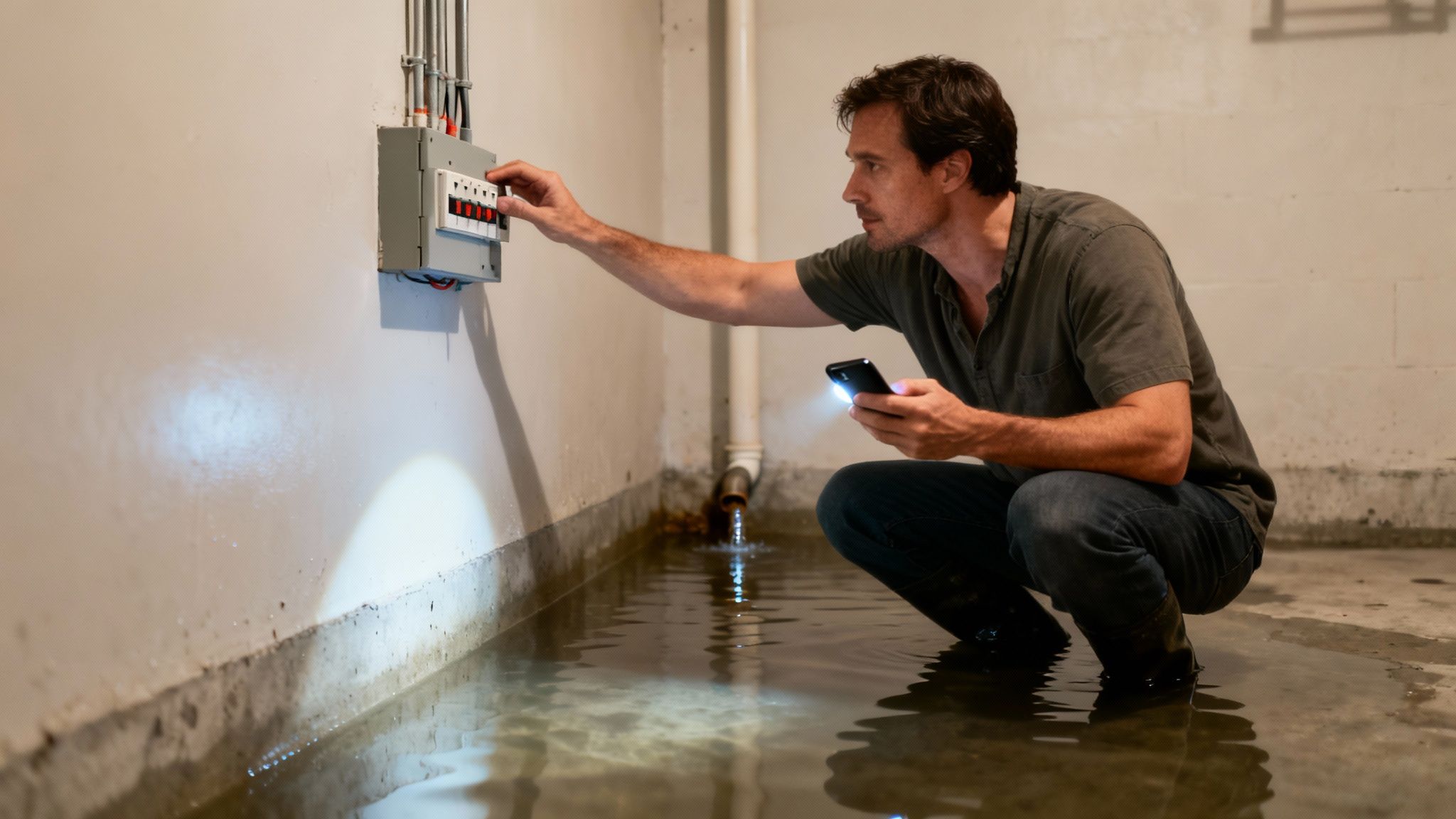
Before you even think about saving a single soaked cardboard box, you have to assess the danger. Standing water and electricity are a lethal combination.
Never, ever step into standing water unless you are 100% certain the power to that area has been shut off at the main circuit breaker. If there is any doubt in your mind, stay out. It's not worth the risk. Wait for a professional to arrive.
Identify The Source Of The Water
Once you've confirmed it's safe to enter, your next job is to play detective. Figuring out where the water is coming from will guide your next actions and heavily influence your insurance claim.
- Internal Sources: This is your plumbing. Look for things like burst pipes, a leaking water heater, or a washing machine that's decided to empty itself onto the floor. A sudden, massive flood is often caused by a burst supply line, which requires a fast response. If you think that's the issue, you'll need to know the basics of dealing with burst water pipes.
- External Sources: This is water getting in from the outside. Check for seepage through foundation cracks or around window wells. This is a common sight after heavy rains, particularly for homes in hillside communities like Sherman Oaks or Glendale where drainage can be a real challenge.
If you trace the flood back to a plumbing failure, your most powerful move is to shut off the main water valve to the house. This one action can stop a catastrophe in its tracks, buying you precious time until help arrives.
This flowchart breaks down the critical safety decisions you need to make in those first few moments.
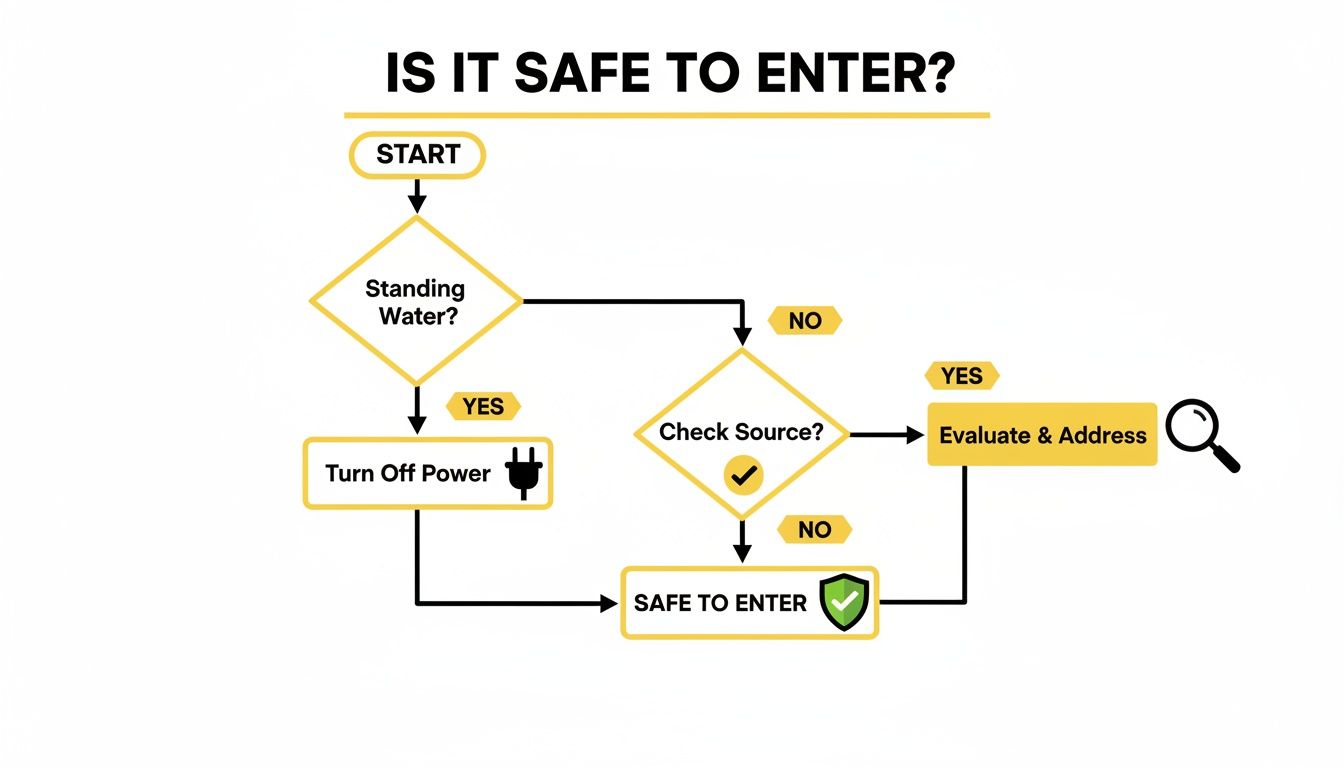
The bottom line is simple: safety first. Always assume the water is energized until you've personally shut off the power at the source.
To make things even clearer in a high-stress moment, here’s a quick-reference checklist.
Immediate Safety And Action Checklist
| Priority Action | Why It's Critical | Who To Call |
|---|---|---|
| Shut Off Electricity | Prevents life-threatening electrocution risk. This is non-negotiable if water is near outlets or appliances. | An electrician if you are unsure how to safely access your breaker box. |
| Stop the Water Source | If it's a burst pipe or appliance, turning off the main water valve stops further flooding and damage. | A 24/7 emergency plumber. |
| Call a Restoration Pro | Mold can start growing in 24-48 hours. Professionals have the gear to extract water and dry structures fast. | A 24/7 IICRC-certified water damage restoration company. |
| Notify Your Insurer | Opens your claim and gets the process started. They'll advise on documentation and coverage. | Your insurance agent or the carrier's 24-hour claims hotline. |
This table outlines the essential calls and actions that protect both your family and your property.
Make The First Essential Calls
Once you’ve addressed the immediate hazards, it’s time to get the cavalry on the way. The clock is ticking, because mold can begin to form in as little as 24-48 hours in damp conditions.
Your first call should be to a 24/7 emergency restoration company. These pros have the industrial-strength pumps, air movers, and dehumidifiers needed to tackle a basement flood cleanup properly. Your second call is to your insurance agent to get the claims process rolling. They'll tell you exactly what you need to do to document the damage for your claim.
How To Document Damage For A Stronger Insurance Claim
Once you’ve handled the immediate safety hazards, your next priority is documentation. This isn’t just about snapping a few photos; it’s about creating an undeniable, detailed record of your loss. A strong insurance claim is built on solid evidence, and the work you put in right now will directly affect your final payout.
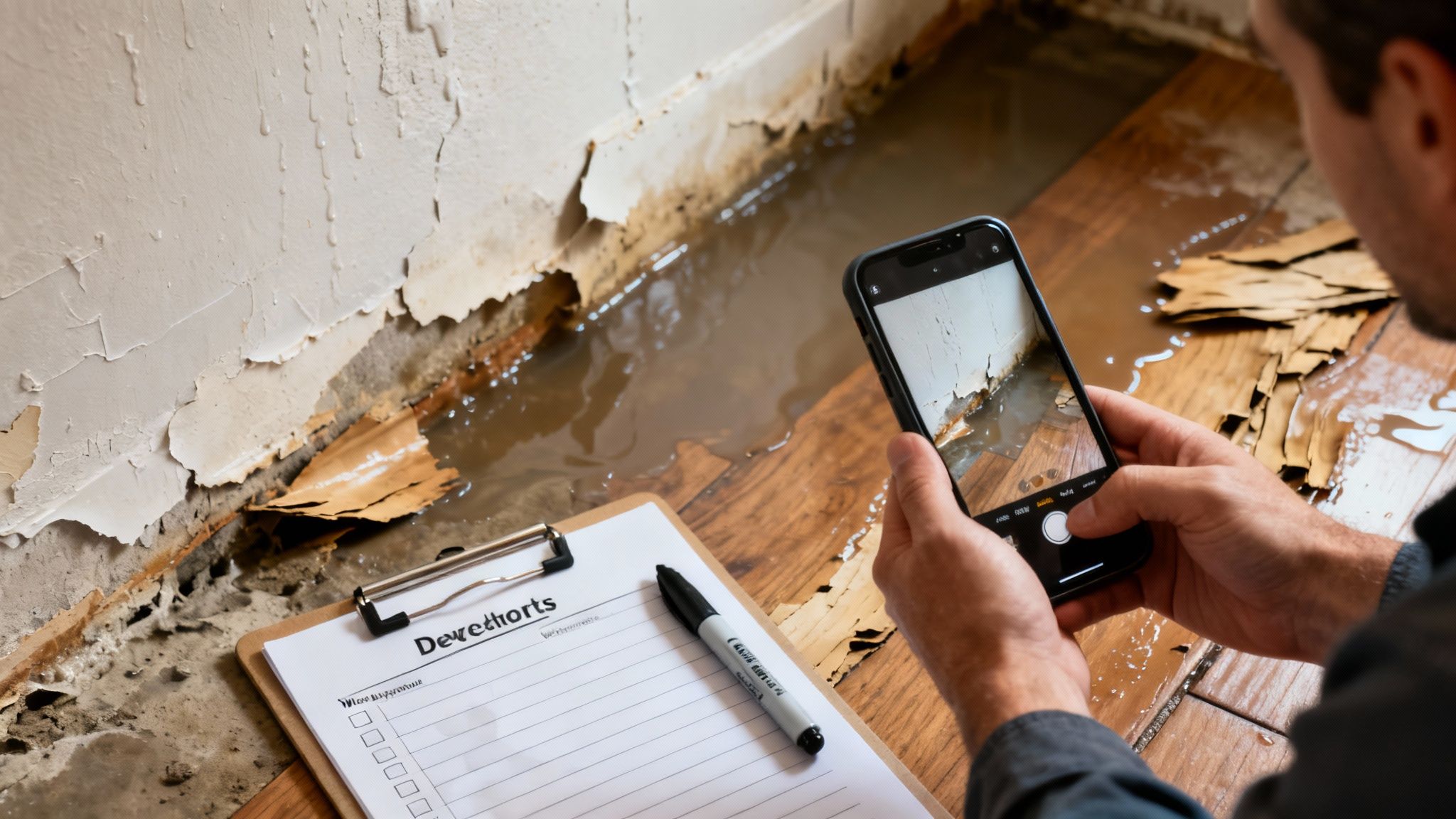
Start by taking photos and videos of everything before a single item gets moved or any cleanup begins. You'll want wide shots of the entire basement to show the full scope of the flood, then zoom in on the details.
Get close-ups of the high-water marks on the walls, the submerged furniture, and any damaged flooring. Video is especially powerful here. Do a slow walk-through of the space, narrating what you see as you record. For instance, say something like, "This is the north wall of the basement; the water is about six inches high here, and you can see it has soaked the drywall and baseboards."
Understanding Water Categories Is Critical
From an insurance perspective, not all water is created equal. Your insurer will need to know exactly what you’re dealing with, as the water is classified into three distinct categories. This classification is crucial for both your safety and your claim.
- Category 1 (Clean Water): This comes from a clean source, like a burst water supply line or an overflowing sink. While it isn't immediately hazardous, it can quickly degrade to Category 2 if it's left to sit and stagnate.
- Category 2 (Grey Water): This water is contaminated and can cause illness if you're exposed to it. Think of overflows from a washing machine or a toilet bowl containing urine but no feces.
- Category 3 (Black Water): This is the bad stuff—grossly contaminated and a serious health risk. It contains dangerous bacteria and pathogens from sources like sewage backups or rising river water that has mixed with ground contaminants.
Key Takeaway: If you even suspect you have Category 2 or 3 water, do not try to clean it up yourself. Professional restoration teams have the proper personal protective equipment (PPE) and specialized, EPA-approved cleaning agents to handle these biohazards safely.
Create A Detailed Inventory Of Damaged Items
Next up is creating a comprehensive list of every single item that was damaged or destroyed. I know it’s tedious, but this is an absolutely essential part of the basement flood cleanup and the insurance process. Go through the basement systematically, room by room, and be as specific as you can.
For each item, try to jot down:
- Item description (e.g., "7-foot grey sectional sofa from Living Spaces")
- Brand and model number, if you can find it
- Approximate age and what you originally paid for it
- A clear photo of the damaged item
Don't forget to list the structural materials that will need to be replaced, like drywall, insulation, carpeting, and baseboards. The more detail you provide, the less room there is for the adjuster to dispute your claim. The whole process of filing an insurance claim for water damage can feel overwhelming, but this kind of thorough documentation is your best weapon for a successful outcome.
Why Professional Documentation Matters
While your own photos and lists are vital, insurance adjusters put immense trust in the reports generated by IICRC-certified restoration companies. When a team like Onsite Pro Restoration shows up, we don't just start extracting water; we document everything with scientific precision.
We use professional tools like moisture meters and thermal imaging cameras to find hidden pockets of water behind walls and under floors—damage you simply can't see with the naked eye. Our reports include detailed moisture readings, atmospheric data, and a full scope of the work required to bring the property back to its pre-loss condition. This professional, third-party validation is often the key to maximizing your claim and ensuring all the necessary repairs are fully covered.
What Pros Do: The Water Extraction and Drying Process
When a certified restoration team shows up at your door, they’re not just bringing a shop vac and some house fans. They're rolling in with an arsenal of high-powered, specialized equipment designed for one job: getting water and moisture out of your home as fast and as thoroughly as possible. It’s a scientific process aimed at stopping long-term structural damage and mold in its tracks.
The first order of business is always tackling the standing water—the most immediate threat.
This initial step is what we call water extraction. For serious situations, like the Burbank homes we've seen after a major pipe burst, technicians will deploy truck-mounted extractors or powerful submersible pumps. These machines are beasts, capable of pulling out hundreds of gallons of water a minute. Getting that water out quickly is the foundation of any successful basement flood cleanup.
Mastering the Science of Structural Drying
Once the puddles are gone, the real work begins. Now we’re focused on structural drying, which is all about targeting the hidden moisture that porous materials like drywall, wood studs, and even concrete have soaked up. Just pointing a fan at a wet wall won’t cut it. Moisture trapped deep inside is a ticking time bomb for mold and rot, which can seriously compromise your home's integrity.
Professional technicians create a controlled drying environment using a specific combination of three key tools:
- Industrial-Grade Dehumidifiers: These aren't your standard home units. We use commercial LGR (Low-Grain Refrigerant) dehumidifiers that can pull dozens of gallons of water vapor from the air every single day. This makes the air incredibly "thirsty," forcing moisture to evaporate out of wet materials.
- High-Velocity Air Movers: You might know them as "snail fans." These powerful units are strategically placed to blast air across all affected surfaces. This constant, directed airflow speeds up evaporation, pulling moisture out of drywall, flooring, and framing so the dehumidifiers can grab it.
- Moisture Detection Tools: Technicians rely on specialized gear like moisture meters and thermal imaging cameras. These tools let us "see" behind walls and under floors, pinpointing exactly where moisture is hiding and tracking our drying progress with scientific precision.
This isn't guesswork; it's a calculated strategy to get your property back to normal. If you want to know more about those critical first moves, our guide on emergency water extraction covers the initial response techniques we use.
Real-World Scenarios From West Hollywood and Burbank
How and where we place this equipment is everything. In a recent West Hollywood condo basement we restored, water had seeped under the laminate flooring and wicked up the drywall. We set up a perimeter of air movers aimed right at the base of the walls and put a massive dehumidifier in the middle of the room. This created a circular airflow pattern that systematically pulled moisture from the entire area.
Expert Insight: The goal is to reach the "dry standard"—a measurement we take from an untouched, dry area of your home. Technicians continuously monitor moisture levels in the damaged spots until they match this baseline. That's how we know the structure is truly back to its pre-loss condition and safe from future mold growth.
Monitoring for a Complete Dry-Out
The drying process itself usually takes about 3 to 5 days. Throughout this time, our technicians will be at your property daily. They'll reposition equipment as needed and take detailed moisture readings from everything—concrete, wood, drywall—to document the progress. This meticulous monitoring ensures we don't leave any hidden pockets of moisture behind.
This commitment to total dehumidification is what separates a professional restoration from a simple cleanup. It’s our guarantee that when the equipment finally leaves, your basement isn't just dry on the surface. It’s dry all the way to its core, protecting your investment and your family’s health.
Don’t risk incomplete drying that leads to mold. For professional water extraction and structural drying in Los Angeles, call Onsite Pro Restoration at (818) 336‑1800.
Salvaging Belongings And Preventing Mold Growth
Once the water is gone, you’re not done. You're just moving into the next, and arguably more critical, phase of the cleanup. This is where you shift from emergency mode to a careful game of recovery and prevention—deciding what can be saved and stopping a secondary disaster: mold.
The first job, and often the toughest one emotionally, is to sort through everything that got wet. You have to be methodical here, drawing a clear line between what can be salvaged and what’s a lost cause. That line is almost always drawn between porous and non-porous materials.
Sorting Possessions: The Save Vs. Toss Pile
Making fast, smart calls on your belongings is essential. Anything that soaked up water is now a ticking time bomb for bacteria and mold, and it can stay a health risk long after it feels dry to the touch.
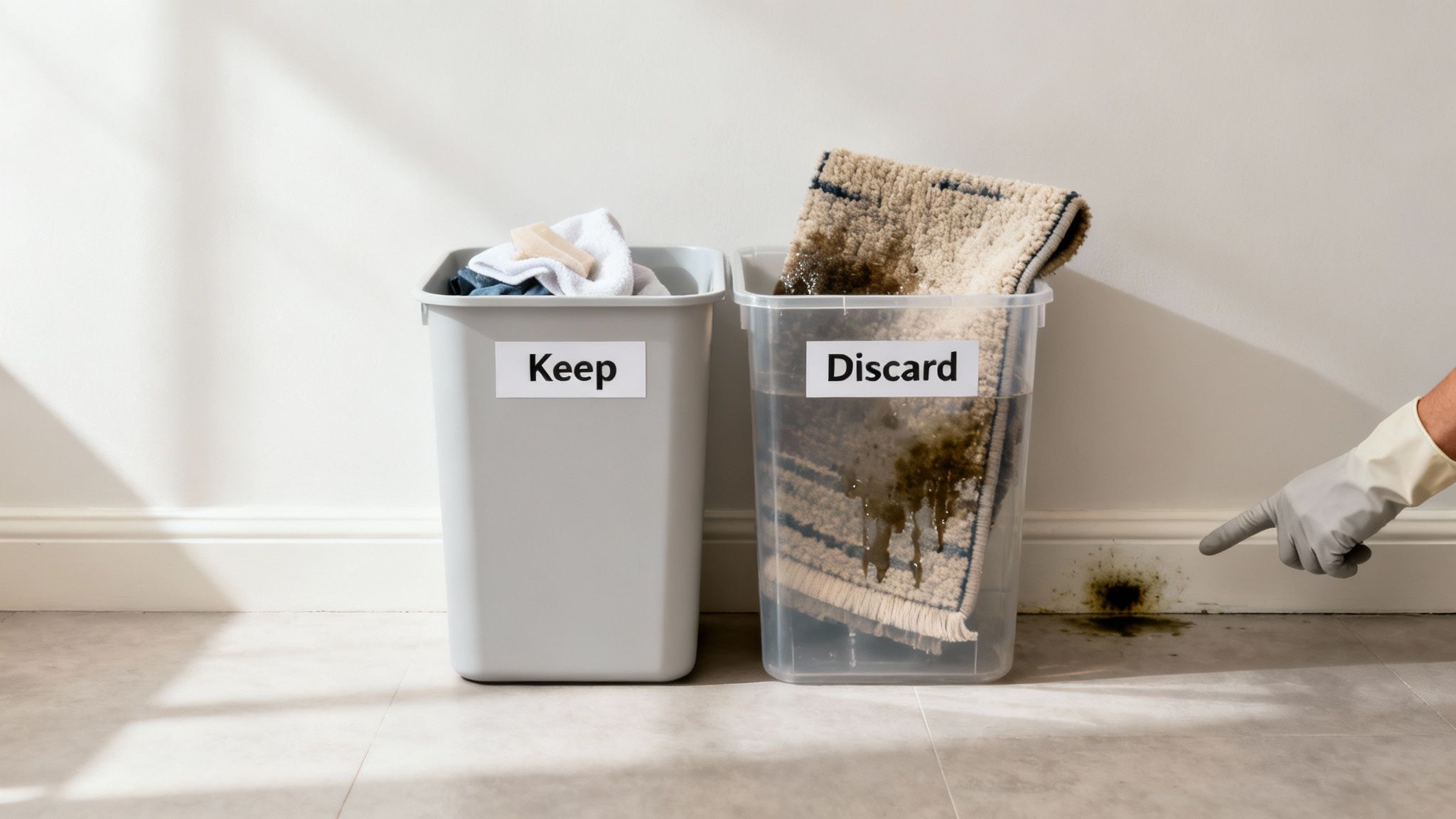
- Non-Porous Items (Likely Salvageable): These are the easy wins. We're talking about things that don't absorb water well, like hard plastics, glass, metal, and solid wood furniture. In most cases, these can be thoroughly cleaned, hit with an antimicrobial solution, and dried out completely.
- Porous Items (Often Unsalvageable): This is where the biggest losses usually happen. Think of items like carpet, carpet padding, upholstered furniture, mattresses, and especially particleboard furniture. They act like sponges. Once they’re saturated with contaminated floodwater, getting them fully sanitized is next to impossible.
For anything that's beyond saving, you need to know how to properly dispose of damaged furniture. Don't hang onto contaminated porous stuff; it's a gamble with your home's health that just isn't worth taking.
The Race Against Mold Growth
Here in Los Angeles, the clock starts ticking the second the water is gone. Mold spores are everywhere, all the time. A flooded basement just handed them the perfect recipe to explode: moisture, a food source (like the paper on drywall), and darkness.
Critical Timeline: Mold isn't patient. Colonies can take root and start spreading in as little as 24 to 48 hours after water exposure. That tiny window is exactly why professional, rapid drying isn't a luxury—it's a necessity to prevent a full-blown infestation.
Delaying the drying process is the single biggest mistake you can make. What starts as a simple water problem will quickly morph into a much more hazardous and expensive mold problem that requires a whole different level of remediation.
Professional Sanitization And Mold Prevention Techniques
A real basement flood cleanup is more than just drying things out. To make sure mold never gets a foothold, certified technicians use specific treatments to sanitize the area and make it an unfriendly environment for future growth.
This usually involves a few key steps:
- Applying EPA-Registered Antimicrobial Agents: After cleaning all the affected surfaces, pros will spray professional-grade antimicrobial solutions on the exposed wood framing, subflooring, and other structural parts. This doesn't just clean; it actively kills lingering mold spores and stops new ones from latching on.
- Thorough Dehumidification: As we've covered, industrial-strength dehumidifiers are non-negotiable. They run until the entire structure is back to its normal, pre-flood dry standard, robbing mold of the moisture it needs to live.
- Controlling Post-Cleanup Humidity: In our coastal climate, keeping humidity low is a long-term strategy. Technicians will often advise you to run a good residential dehumidifier in the basement to keep the relative humidity below 50%. An environment that dry is an environment where mold simply can't thrive.
Preventing mold after a flood is a science, not a guessing game. If you want a deeper look at the strategies involved, our guide on how to prevent mold after water damage breaks it down even further. Taking these steps is how you truly put a basement flood behind you for good.
Navigating Cleanup Costs And Choosing The Right Restoration Partner
Understanding the financial side of a basement flood is crucial. When you're dealing with the stress of water damage, the last thing you want is a surprise bill. The final cost for a professional basement flood cleanup isn't a single, fixed number; it’s a spectrum that depends on a few key variables.
How big is the flooded area? What kind of water are we dealing with? How much damage did it do? A minor leak from a clean water pipe in a small corner is a completely different ballgame than a full-basement sewage backup that has soaked through drywall and insulation.
Breaking Down The Costs Of Cleanup
When a pipe bursts or a sewer backs up in your Los Angeles home, the cleanup bill can escalate quickly. The national average might be around $4,000, but in reality, the range is huge—anywhere from $1,500 to $15,000, depending on how bad things are.
For instance, a Category 1 clean water flood might land between $1,500 and $3,500. But a Category 3 "black water" event from a raw sewage line? That requires specialized biohazard protocols and pushes costs into the $7,000 to $15,000 range easily. These figures cover the whole process, from extracting the water to drying the structure and sanitizing everything.
If you want to get a clearer picture of what your specific situation might involve, you can dive deeper into our breakdown of water damage cleanup costs.
Selecting The Right Restoration Partner Under Pressure
In the chaos right after a flood, trying to choose a restoration company can feel overwhelming. This is when predatory contractors often pop up, promising quick fixes at suspiciously low prices. Making the right choice isn't just about cost; it’s about competence, trust, and knowing the job will be done right the first time.
Key Insight: A rushed or incomplete cleanup almost always leads to a much bigger and more expensive problem down the line—mold. A certified professional doesn't just remove water; they eliminate the conditions that allow mold to grow, protecting your property's value and your family's health.
Look for a company that is IICRC-certified. The Institute of Inspection, Cleaning and Restoration Certification is the gold standard in our industry. It's proof that their technicians are trained in the latest, most effective restoration techniques.
How To Choose A Restoration Pro
When you're vetting potential companies, treat it like an interview. Your home is on the line. I've seen too many homeowners burned by unqualified crews, so I put together this table to help you ask the right questions and spot a true professional.
| Critical Factor | Why It Matters | Our Commitment |
|---|---|---|
| 24/7 Rapid Response | Water damage gets worse every hour. You need a team that answers at 2 AM and can be onsite in about 60 minutes to prevent secondary damage like mold. | We guarantee a 24/7/365 live answer and an average 60-minute response time across Los Angeles. We're there when you need us. |
| IICRC Certification | This proves technicians are trained to industry standards (the IICRC S500) for safe and effective water removal, drying, and mold prevention. | Our entire team is IICRC-certified in Water Damage Restoration (WRT) and Applied Structural Drying (ASD). We follow the book. |
| Insurance Claim Expertise | A pro who speaks "insurance" can document your loss properly (using software like Xactimate), which streamlines your claim and helps maximize your payout. | We have years of experience working directly with every major insurance carrier in California. We provide the exact documentation they need. |
| Professional-Grade Gear | A contractor with a shop vac isn't equipped for structural drying. Look for industrial LGR dehumidifiers, air movers, and moisture meters. | We deploy the latest in drying technology, including thermal imaging cameras to find hidden moisture and LGR dehumidifiers to dry structures fast. |
| Transparent Pricing | You should receive a detailed scope of work and clear pricing before work begins. No surprises. | We provide a detailed, itemized estimate upfront. We walk you through the entire process so you know exactly what to expect from start to finish. |
Choosing the right partner transforms a crisis into a managed process. It's the difference between a quick recovery and a lingering nightmare. It ensures your basement is not just dry, but truly restored to a safe, healthy, and pre-loss condition.
Answering Your Top Basement Flood Questions
Even after the drying equipment is gone and the immediate crisis feels over, you're bound to have some lingering questions about the basement flood cleanup process. I get it. Here are the straight-up answers to the most common concerns we hear from Los Angeles homeowners just like you.
Q: How long does basement flood cleanup usually take?
A: This is never a one-day job; it's a process with distinct phases, and the timeline really depends on how bad the flood was. Getting the standing water out—the extraction phase—can take anywhere from a few hours to a full day. The real time-consumer is the structural drying, which almost always takes 3 to 5 days using industrial-grade equipment. For a minor flood, the entire process might take a week. For an extensive flood requiring repairs, the timeline could extend to several weeks.
Q: Will my homeowners insurance cover a basement flood?
A: This is the big one, and the answer isn't a simple yes or no. Standard homeowners policies are designed to cover water damage that is sudden and accidental, originating from inside your home (e.g., burst pipes, appliance failure). What your standard policy almost certainly does not cover is flooding from external sources like heavy rain. For that, you need a separate flood insurance policy, usually from the National Flood Insurance Program (NFIP).
Q: Can I clean up a flooded basement myself?
A: The urge to just jump in and handle a basement flood cleanup yourself is understandable, but it’s rarely a good idea. A DIY approach might work for a tiny, clean water spill (Category 1). However, if the water covers more than a small room, has soaked into drywall, or is contaminated (Category 2 or 3), you need a professional. Incomplete drying is the #1 cause of post-flood mold growth, which creates a much bigger problem.
Q: What is the difference between water mitigation and water restoration?
A: People use these terms interchangeably, but they are two different phases. Water mitigation is the emergency response to stop the damage from getting worse. It includes water extraction, removing soaked materials, and structural drying. Water restoration is the rebuilding phase. It includes all the repair work, like installing new drywall and flooring, painting, and putting your property back to its pre-loss condition. Mitigation stops the damage; restoration makes it whole again.
If your Los Angeles home has suffered a basement flood, don't wait for the problem to get worse. The experts at Onsite Pro Restoration are on call 24/7 to provide a free assessment and start the cleanup process right away.