
When you discover a leak in your Los Angeles home, your first worry is probably the warped floorboards or the spreading ceiling stain. But the real danger is often the one you can’t see. Effective mold and water damage remediation treats these two issues as one cohesive problem. Why? Because wherever you have persistent moisture, mold is practically a guarantee. It only takes 24 to 48 hours for mold spores—which are always floating in the air—to find a damp surface, take root, and start spreading. This guide explains why acting fast is crucial for protecting your property and health.
Facing a water or mold emergency? Don't wait for the damage to spread. Call (818) 336-1800 now or get a free inspection today.
The Hidden Dangers: Why Mold and Water Damage Are Linked
Every homeowner's nightmare starts small. It could be a slow drip from a pipe under the sink, a dishwasher that decided not to drain, or a damp spot on the ceiling after a heavy Los Angeles rain.
While the initial water is a problem, it’s the moisture left behind that kicks off a much bigger disaster. Think of that lingering dampness as fuel and the dormant mold spores in your home as the spark. Once those two connect, the problem can spread silently and rapidly behind your walls and under your floors.
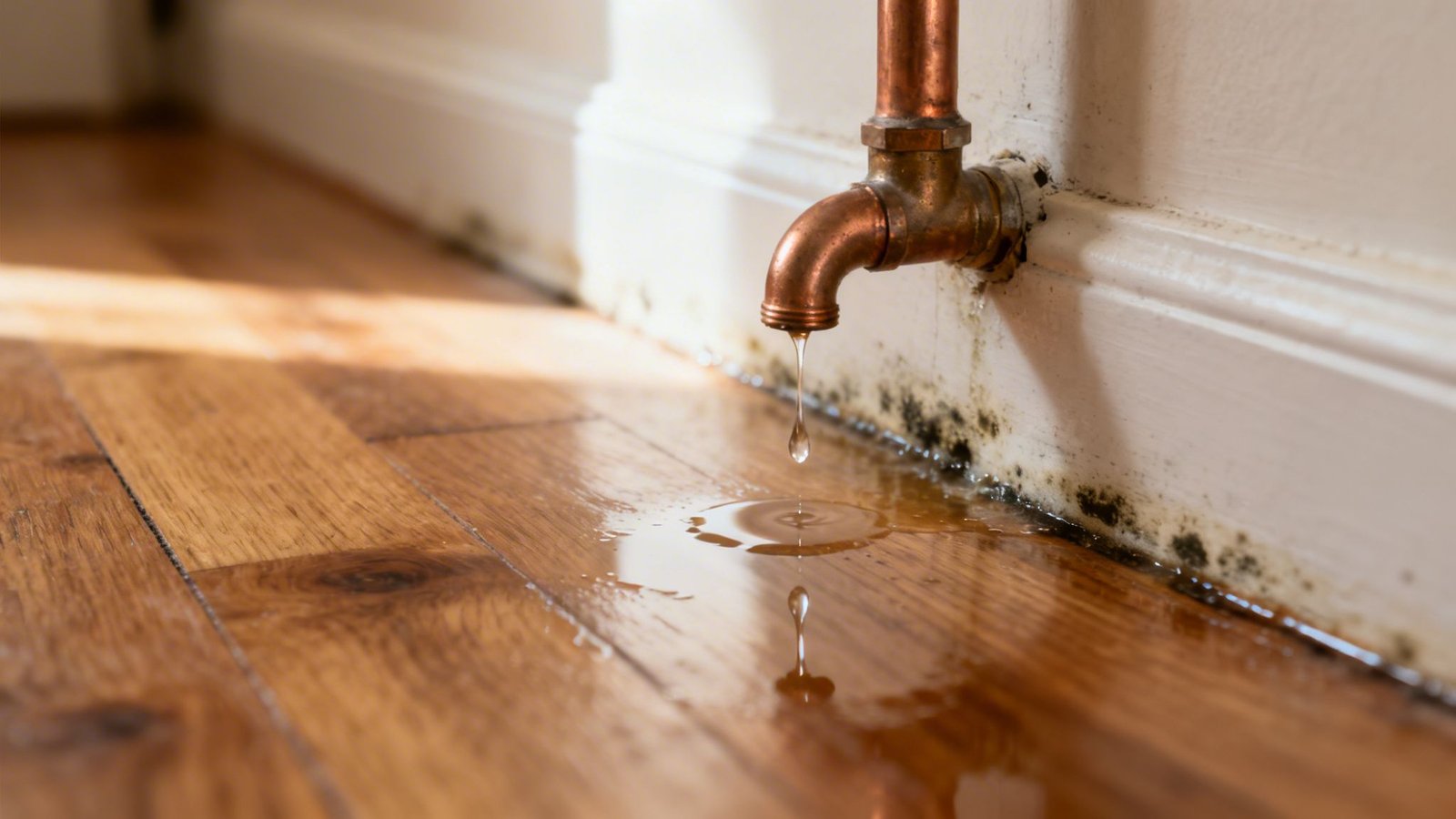
The numbers don't lie. Water damage is a widespread crisis, impacting an estimated 14,000 people across the U.S. every day. With the average insurance claim for these events topping $11,000, the financial hit is serious. The issue is especially common in basements, where an incredible 98% will see some kind of water intrusion in their lifetime.
Given that mold can explode across these damp surfaces in just 24 to 48 hours, a simple leak can quickly become a hazardous outbreak that demands professional help.
Why Rapid Response Is Non-Negotiable in Southern California
Here in Southern California, the risk is everywhere—from the aging plumbing in historic Sherman Oaks homes to the flat-roof vulnerabilities common in Burbank. The single most important factor in stopping a minor water issue from becoming a major mold catastrophe is speed.
If you delay, moisture seeps deeper into porous materials like drywall, wood framing, and insulation. This creates a hidden, perfect breeding ground for mold. That’s why the first step isn't just mopping up the puddle you can see; it's about total moisture control.
This initial process is called water mitigation, and its entire focus is on stopping the damage from getting worse. You can learn more about what is water mitigation in our detailed guide.
Key Takeaway: The relationship between water damage and mold is direct and time-sensitive. Controlling the moisture source immediately is the first and most critical step in protecting your property and health.
Understanding this connection empowers you to act fast. Professional mold and water damage remediation isn't just about patching a hole; it's a systematic process to return your home to a safe, healthy, and dry state. It involves a clear, multi-step plan:
- Identify and stop the water source.
- Extract all standing water.
- Thoroughly dry all affected structures and materials.
- Safely contain and remove all mold growth.
By tackling both problems together, you ensure the issue is truly solved, not just covered up. This foundational knowledge is crucial for making smart decisions the moment you find water where it doesn't belong.
Health Risks Linked to Mold Exposure
That musty smell in the basement or the small, dark patch near a bathroom vent isn’t just a cosmetic problem. It’s a warning sign. While the visible spot might seem minor, the real threat is what you can’t see: millions of microscopic spores released into your home’s air.
These airborne spores are the source of those nagging, allergy-like symptoms that never seem to clear up—the persistent cough, constant sneezing, itchy eyes, and runny nose. For anyone with asthma, mold exposure is even more serious, often triggering more frequent and severe attacks.
The Impact on Vulnerable Individuals
While anyone can be affected, some family members are at far greater risk. The young, the elderly, and anyone with a compromised immune system face a much more significant danger. This includes people undergoing chemotherapy, living with autoimmune disorders, or recovering from an organ transplant.
For these vulnerable groups, the problem goes way beyond allergies. Certain molds are pathogenic, meaning they can cause active infections. When inhaled by someone whose body can’t fight them off, these spores can lead to serious respiratory infections like bronchitis or pneumonia.
Mold in a home is never just an inconvenience—it's a direct threat to the health and well-being of the people living there. Postponing professional mold and water damage remediation means exposing your family to health risks that are entirely preventable.
This isn't a rare problem. An astonishing 47% of U.S. homes are estimated to have mold issues, contributing to an estimated $5.6 billion in annual health costs. When you add the asthma-related expenses made worse by mold, that figure jumps by another $16.8 billion. You can read the complete market research on mold remediation services to see the full financial scope.
How Hidden Mold Affects Your Entire Home
The most dangerous mold is the colony you can’t see. It can thrive for months or even years behind drywall, under warped floorboards, or in a damp crawl space. This is a huge issue here in Los Angeles, where conditions like the coastal "marine layer" in Santa Monica can drive up indoor humidity and create the perfect breeding ground for unseen growth.
A single patch of hidden mold can pump millions of spores directly into your HVAC system. Once inside the ductwork, those spores are efficiently circulated to every room in the house, contaminating the air you breathe everywhere. This is exactly why just wiping down a visible spot is never a real solution.
Ignoring the problem means accepting a lower quality of life and exposing your family to chronic sickness. The real cost of delay isn't just in the final repair bill—it's measured in your family's health.
The Professional Remediation Process Explained
When a professional team shows up to handle mold and water damage, they’re not just there to "clean up." They’re following a strict, science-based playbook designed to safely remove every trace of contamination and moisture. This isn’t guesswork. It’s a precise, multi-stage process that follows industry standards from organizations like the IICRC (Institute of Inspection, Cleaning and Restoration Certification).
Knowing these steps will give you the confidence that the job is being done right—protecting both your property and your family. Each stage is critical, building on the one before it to make sure nothing gets missed.
The infographic below breaks down the key phases you should expect from any certified remediation crew.
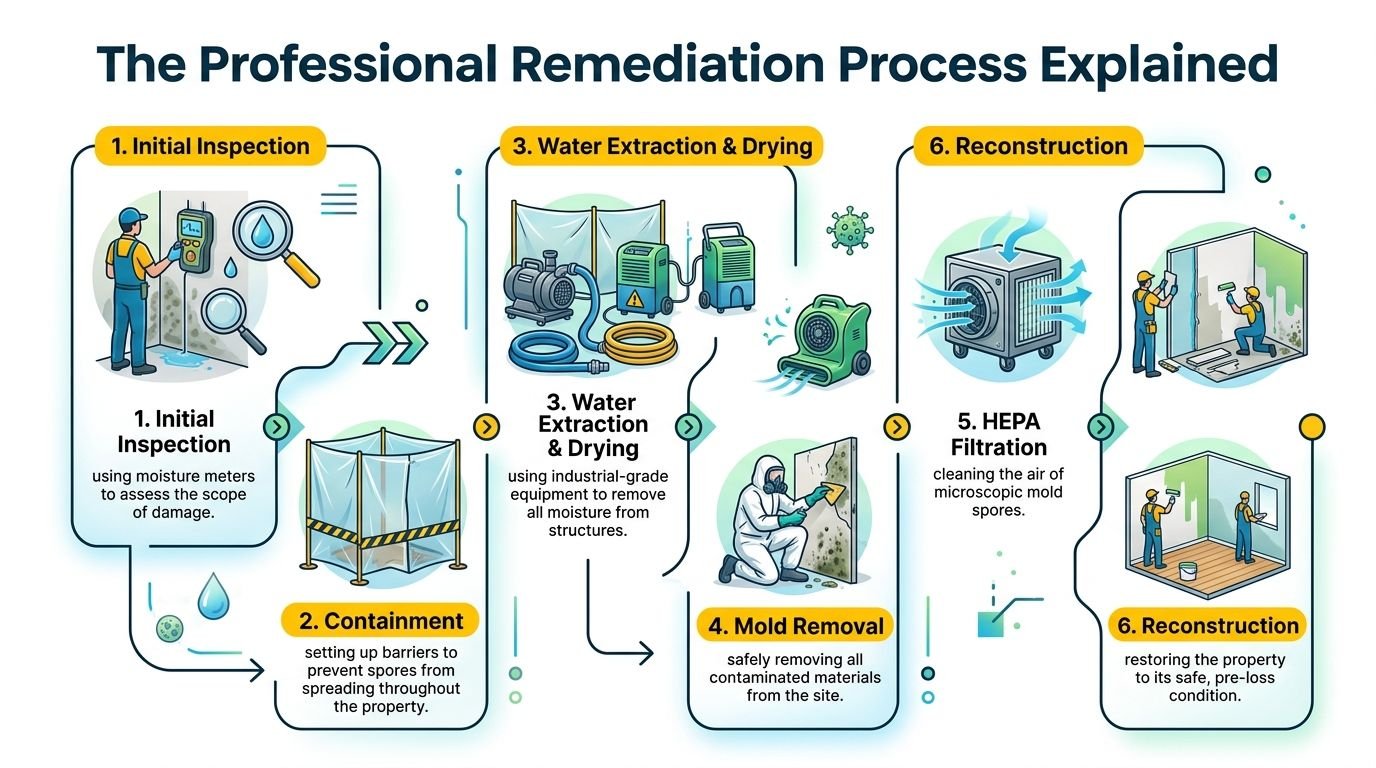
As you can see, it’s a methodical progression from assessment and containment all the way to final repairs, ensuring every part of the problem is addressed.
Stage 1: Containment And Air Filtration
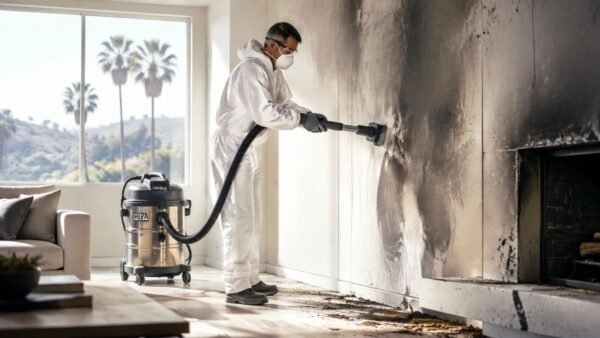
The absolute first move after assessing the damage is containment. Think of it like a surgical quarantine zone. Technicians use heavy-duty plastic sheeting to build a sealed-off chamber around the affected area, often using negative air pressure machines to ensure nothing escapes.
This is the most critical step for preventing cross-contamination. Without a proper barrier, the act of tearing out moldy drywall could send millions of spores airborne, turning a localized problem into a whole-house nightmare via your HVAC system.
At the same time, powerful air scrubbers armed with HEPA (High-Efficiency Particulate Air) filters are set up. These machines run 24/7 inside the containment zone, constantly scrubbing microscopic mold spores, dust, and other junk from the air. This cleans the air in the work area and stops contaminants from drifting into unaffected parts of your home.
Stage 2: Water Extraction And Structural Drying
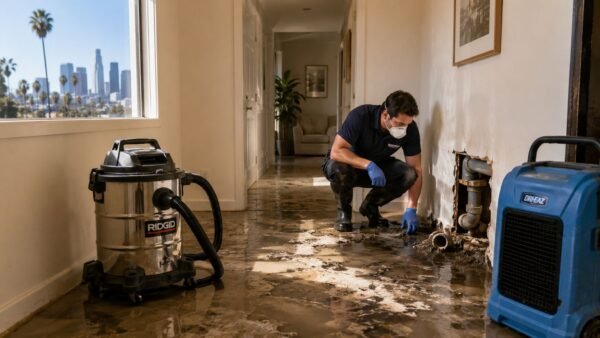
With the area sealed, the focus turns to getting everything dry. This is the "water damage" part of the equation. Technicians start by using powerful, truck-mounted vacuums and portable extractors to pull out any standing water from floors, carpets, and hidden cavities.
Once the bulk water is gone, the real science of structural drying begins. And no, a few box fans from the garage won't cut it.
Professional Insight: Porous materials like drywall, wood studs, and subflooring are like giant sponges. They can feel dry on the surface but still hold a ton of moisture deep inside. This hidden dampness is the #1 reason mold comes roaring back after a DIY cleanup attempt.
To pull that hidden moisture out, teams use a specific arsenal of equipment:
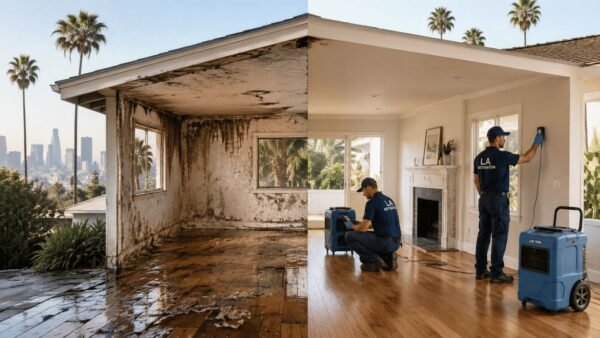
- High-velocity air movers are set up at precise angles to create a vortex of airflow, speeding up surface evaporation.
- Low-grain refrigerant (LGR) dehumidifiers are industrial-strength machines that aggressively pull water vapor out of the air and the materials themselves.
- Moisture meters and thermal imaging cameras are used every single day to track the drying progress and hunt down any stubborn wet spots.
The goal is to get the moisture content of every affected material back to a normal, dry standard—usually below 15%. Rushing this stage is a guaranteed recipe for failure, because any leftover moisture is an open invitation for mold to return.
Stage 3: Mold Removal And Disposal
Only after everything is verifiably dry does the actual mold removal start. And notice the word remove, not "kill." Spraying bleach on mold might turn it white, but it often leaves the allergenic and toxic spores behind. Proper remediation is about physical removal.
Any contaminated porous materials that can’t be saved—like drywall, insulation, and carpet padding—are carefully cut out, double-bagged in thick plastic sheeting, and hauled away according to local disposal rules.
For sturdier materials like wood framing or concrete, technicians get physical. They use techniques like wire brushing, sanding, or even media blasting (like dry ice blasting) to scour every trace of growth from the surface. After the mold is gone, they treat the clean surfaces with an EPA-registered antimicrobial agent to inhibit future growth. It's this level of detail that defines a professional mold remediation service and ensures the problem is solved for good.
The entire property restoration industry, now worth over $210 billion a year, is built on a simple principle stressed by the EPA: you must control the moisture source within 24-48 hours. Miss that window, and repair costs can skyrocket as secondary mold damage takes over.
Don’t let mold and water damage compromise your home’s safety. Schedule professional mold testing for $499 to get definitive answers and a clear path forward.
How to Navigate Water Damage Insurance Claims
When you find a burst pipe or a flooded kitchen, the last thing you want is a fight with your insurance company. Dealing with a claim can feel like a second job, but if you understand the playbook, you can get the coverage you need to get things back to normal.
The clock starts the second you spot the water. Your first call should be to a professional restoration team, and your second to your insurance agent to open the claim. The keyword here is mitigate—a term your adjuster will use over and over. You need to act fast to stop the damage from getting worse.
Mitigation just means taking emergency steps to prevent more harm. This includes extracting water, setting up industrial-grade drying equipment, and containing any potential mold. Insurers require you to take these "reasonable steps," and dragging your feet could put your entire claim at risk.
What Your Policy Typically Covers
Homeowner's insurance is built to handle sudden and accidental problems. For water damage, that usually means issues that pop up without any warning.
Here are a few classic examples that most policies cover:
- Burst Pipes or Hoses: A washing machine hose suddenly gives out, or a pipe freezes and cracks inside a wall.
- Appliance Malfunctions: A toilet overflows without warning, or the dishwasher decides to empty itself onto your kitchen floor.
- Roof Leaks from Storms: A storm knocks a tree onto your roof, letting rain pour in.
But policies are just as specific about what they don’t cover. Damage from gradual issues or poor maintenance is almost always denied. This means slow drips from old plumbing, a roof that’s been failing for years, or mold that grew because of constant high humidity are on you.
Crucial Insight: The source of the water is everything. Coverage for the resulting mold and water damage remediation almost always comes down to whether the initial event was "sudden and accidental." If the main cause isn't covered, the secondary damage (like mold) probably won't be either.
The Power of Detailed Documentation
Your best friend in any insurance claim is solid documentation. The more proof you have, the less friction you'll face. From the moment a professional restoration crew walks in, they should be documenting every single thing.
This evidence serves as undeniable proof of the loss and the work done to fix it. It must include:
- Photos and Videos: Clear visuals of all affected rooms, damaged belongings, and the source of the water.
- Moisture Readings: Hard data from moisture meters and thermal cameras that show exactly how far water has penetrated walls, floors, and ceilings.
- Professional Reports: A detailed scope of work from your contractor that spells out the damage and the plan to fix it.
- Inventory of Damaged Items: A list of every personal item that was ruined, including its age and what it would cost to replace.
This kind of detail leaves no room for an adjuster to guess or argue. It lets them see the full scope of the loss and greenlight the work quickly. Without it, you're signing up for delays and disputes. For a deeper dive, check out our guide on how to handle an insurance claim for water damage.
Knowing the lingo helps, too. For instance, Loss of Use or Additional Living Expenses (ALE) is the part of your policy that pays for you to live somewhere else if your home is uninhabitable during repairs. When you can speak the same language as your adjuster, you can make your case effectively and get the full benefits you're paying for.
Choosing the Right Mold Removal Company in Los Angeles
In a city like Los Angeles, a quick search for a mold company brings up a sea of options. The problem is, when you’re dealing with a water or mold emergency, you don't have time to sift through dozens of websites trying to figure out who’s a true professional and who’s just a handyman with a shop vac.
Making the wrong choice can mean recurring mold, hidden structural damage, and a much bigger headache down the road. You need a partner who is qualified, transparent, and knows LA-specific challenges—not someone who will just make the problem look like it's gone.
The Non-Negotiable Qualifications
Before you even talk price, any company you consider must clear a few fundamental hurdles. These aren't just suggestions; they're the baseline that separates a legitimate expert from an unqualified operator.
Your vetting process should start with these three items:
- IICRC Certification: The Institute of Inspection, Cleaning and Restoration Certification (IICRC) is the gold standard. If a company isn't certified, its technicians haven't been trained in the modern, science-backed protocols for mold and water damage remediation. It's a non-starter.
- Proper Licensing and Insurance: A legitimate contractor must be licensed to work in California. They also need to carry both general liability and workers' compensation insurance. This is crucial—it protects you from being held liable for accidents on your property.
- Proven Local Experience: Los Angeles isn't a one-size-fits-all city. A pro who understands the plumbing in older Glendale homes or the unique humidity issues of coastal Santa Monica is far better equipped to solve your specific problem. Look for recent reviews and case studies from your area.
A contractor who says they'll just "spray some bleach on it" is an immediate red flag. Bleach only whitens the surface of mold. It doesn't kill the underlying spores or fix the moisture source, which all but guarantees the problem will come right back.
Spotting Red Flags and Demanding Transparency
Once you have a shortlist of certified and insured companies, the focus shifts to their process. An honest contractor will never give you a final price over the phone without first performing a thorough on-site inspection.
Be wary of any company that:
- Offers a quote without using moisture meters or thermal imaging to map the full extent of the damage.
- Pressures you into signing a contract on the spot without explaining the full scope of work.
- Can't provide clear documentation or a detailed report of their findings.
A qualified team, on the other hand, will hand you a detailed, itemized scope of work before they start. This document should clearly outline the containment plan, the drying strategy, which materials need to be removed, and the final cleaning protocol. Clear pricing and a transparent plan are the hallmarks of a company that stands behind its work.
To help you evaluate and compare potential hires, use this quick checklist.
Contractor Vetting Checklist
| Qualification | Why It Matters | What to Look For |
|---|---|---|
| IICRC Certification | Confirms training in industry-standard, science-based methods. | Look for the IICRC logo on their site or ask for their certification number. |
| CA License & Insurance | Protects you from liability and ensures they operate legally. | Ask for their Contractor State License Board (CSLB) number and a certificate of insurance (COI). |
| Local Reviews & History | Proves they have experience with local homes, climate, and building codes. | Check for recent, detailed reviews on Google or Yelp from your part of LA. |
| On-Site Inspection | A quote without a physical inspection is just a guess and a major red flag. | They should use moisture meters and thermal cameras to find hidden moisture. |
| Detailed Scope of Work | A written plan ensures you know exactly what you’re paying for and what will be done. | Ask for an itemized estimate outlining containment, remediation, and verification steps. |
| Clear Documentation | Proper documentation is essential for your records and for any insurance claims. | They should provide moisture logs, photos, and a final clearance report. |
This checklist is your first line of defense. For an even deeper dive, explore our guide on finding the best mold removal contractors and the critical questions you should be asking them.
Ultimately, choosing the right company isn’t about finding the cheapest option—it’s about finding the best value and total peace of mind. Investing in a top-tier professional ensures the job is done right the first time, protecting your property's value and your family's health for years to come.
Proactive Home Maintenance to Prevent Future Damage
The best way to deal with mold and water damage is to make sure it never happens in the first place. Once your property is restored, the final—and most important—step is shifting from a reactive cleanup mode to a proactive prevention mindset.
A simple, consistent maintenance routine is your strongest defense against future leaks. It's what will save you thousands in potential repairs and protect your property’s long-term value. This isn't about massive projects; it's about paying attention to your home's most vulnerable points.
Your Essential Home Maintenance Checklist
Think of this as a regular health checkup for your house. By building these small checks into your seasonal routine, you can catch problems long before they turn into emergencies.
Inspect Plumbing and Appliances Regularly: At least twice a year, get a flashlight and look under every sink and around the base of every toilet. You're searching for any sign of moisture, discoloration, or slow drips. Don't forget to check the hoses on your washing machine, dishwasher, and refrigerator—these are notorious failure points that can bulge or crack over time.
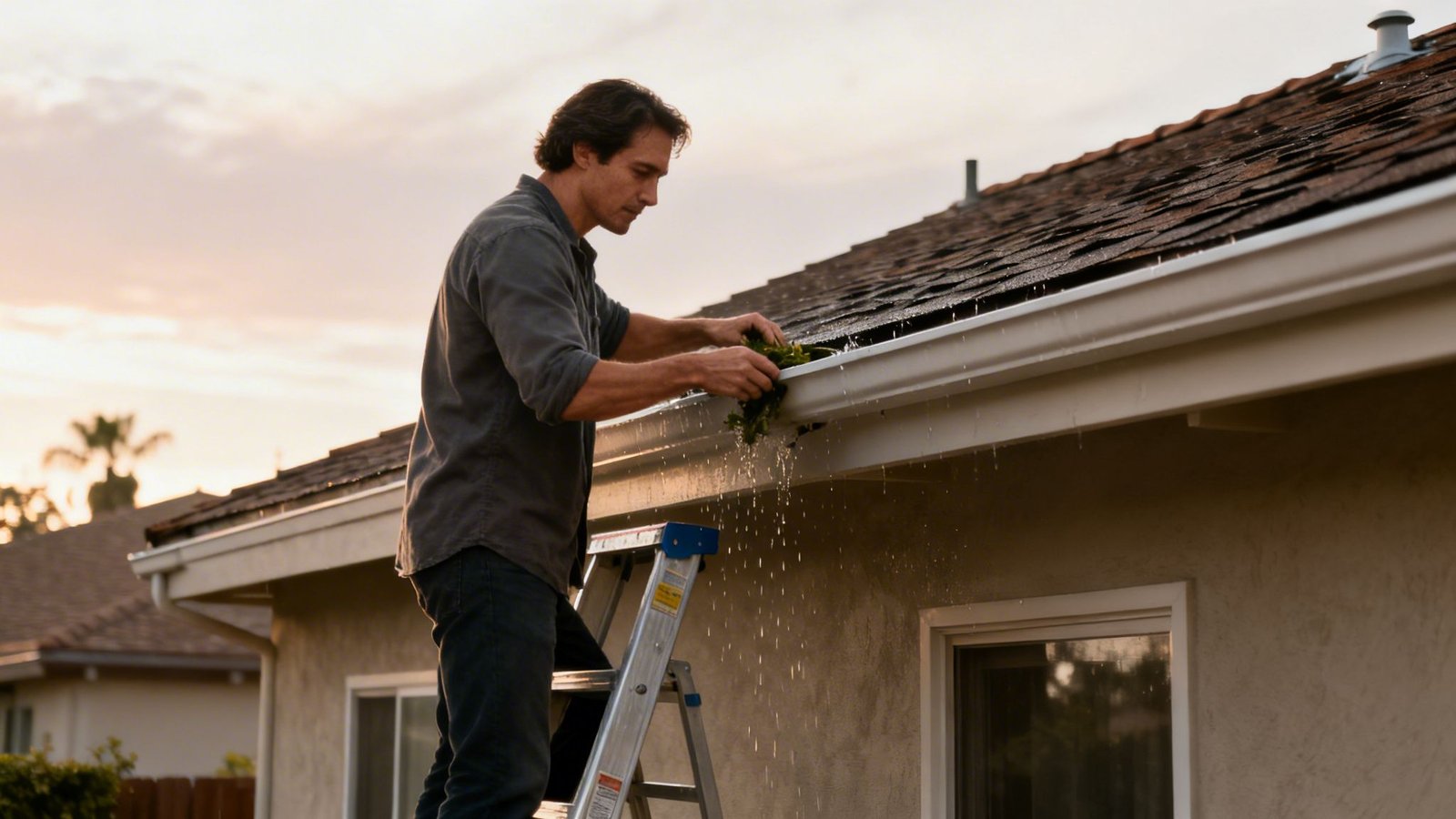
Maintain Roofs and Gutters: Clean your gutters every spring and fall, without fail. Clogged gutters are a primary cause of water damage, forcing rain to overflow and seep into your roofline, walls, and even your foundation. For Los Angeles properties with flat roofs, it's especially critical to inspect them after heavy rains to ensure water isn't pooling.
Ensure Proper Ventilation: Your kitchen and bathrooms are humidity hotspots. Make it a habit to run the exhaust fan during and for about 20 minutes after every shower or cooking session. If a fan sounds weak or unusually loud, it likely needs cleaning or replacement to do its job of venting moist air outside.
Monitor Indoor Humidity: Keeping indoor humidity between 30% and 50% is non-negotiable for preventing mold. This is especially true in coastal areas like Santa Monica where the marine layer drives up moisture levels. A simple, inexpensive hygrometer will help you track this, and a dehumidifier can be your best friend during damp seasons.
Recognizing Early Warning Signs
The key to prevention is vigilance. You have to train your eyes—and your nose—to spot the first subtle clues that unwanted moisture has found its way inside.
Catching a problem early transforms a potential disaster into a minor repair. A small, discolored spot on the ceiling or a faint musty odor is your home's way of asking for help.
Keep an eye out for these critical indicators:
- A persistent musty or earthy smell, especially in basements, closets, or under sinks.
- Paint that is bubbling, peeling, or cracking on walls or ceilings for no apparent reason.
- Dark or discolored spots appearing on drywall.
- Warped floorboards or baseboards that have started separating from the wall.
By making these habits part of your routine, you’re not just maintaining a building; you are actively managing the health of your home. This proactive approach is the ultimate way to ensure you never need emergency remediation services again.
FAQs: Answering Your Remediation Questions
Even after you’ve read up on the process, some questions always come up. Here are the straight answers to the most common things we hear from Los Angeles homeowners dealing with water and mold damage.
Q: What should I do if I find mold behind drywall?
A: Do not disturb the area, as this can release spores. Immediately isolate the room by closing doors and turning off the HVAC system. Contact a licensed restoration company to assess the risk, as mold often spreads far beyond the visible spots.
Q: Can I just use bleach to clean mold myself?
A: Absolutely not. This is a dangerous myth. Bleach may whiten the surface of mold on hard, non-porous surfaces, but it doesn't kill the underlying root structure on porous materials like drywall or wood. Scrubbing also releases millions of spores into the air, potentially turning a small problem into a whole-house contamination.
Q: How long does the remediation process take?
A: The timeline depends entirely on the scale of the problem. A minor leak contained to one small area (like under a sink) may take 1-3 days. A larger issue, like a burst pipe affecting multiple rooms, could take 5-7 days or more. The structural drying phase is often the longest but most crucial part.
Q: Will my homeowners insurance cover mold?
A: It depends on the source of the water. Most policies cover mold remediation if it's the result of a "covered peril"—a sudden, accidental event like a burst pipe. However, mold from gradual leaks, poor maintenance (like a roof you knew was failing), or high humidity is almost always excluded.
Q: What is the difference between mold remediation and mold removal?
A: While often used interchangeably, "removal" implies simply taking out the mold. Remediation is a more comprehensive, scientific process. It involves not only removing the mold but also containing the area, filtering the air, addressing the moisture source, and cleaning the structure to prevent future growth. True professionals perform remediation, not just removal.
If you're facing a water or mold emergency, don't wait. Onsite Pro Restoration provides 24/7 emergency services to contain the damage and begin the restoration process immediately. Get the professional help you need by visiting https://onsitepro.org or calling for a free, no-obligation assessment.