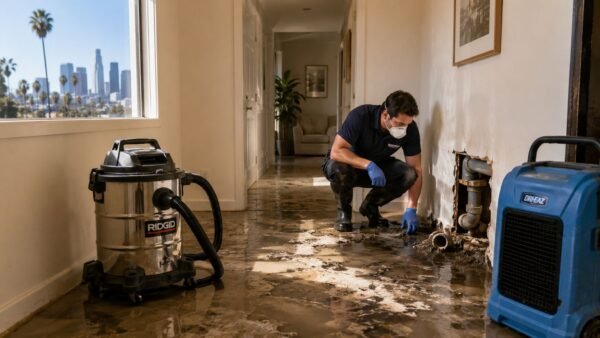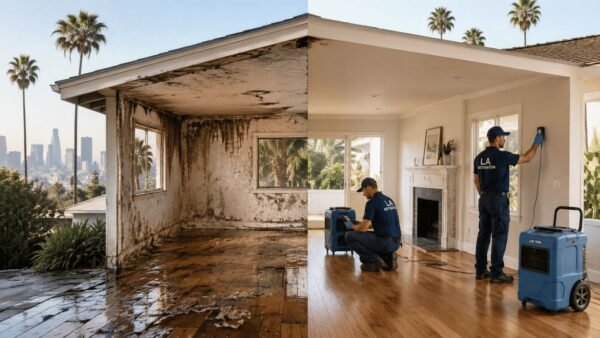

The short answer to whether your homeowners insurance covers mold is frustratingly simple: it all comes down to the cause. Mold remediation insurance coverage isn't some separate policy you buy. Instead, it's a very specific feature buried in your standard policy that only kicks in when the mold is a direct result of a "covered peril," like a pipe that suddenly bursts.
Think of it this way: your policy is designed to handle sudden, accidental emergencies, not problems that have been brewing for a while. If you've discovered mold after a water-related incident in your Los Angeles home, understanding this distinction is the first step toward a successful claim.
Get a Free Mold Inspection Today
Understanding When Your Policy Covers Mold

Most homeowners in Los Angeles are caught off guard when they learn their insurance won't just automatically pay to remove mold. The single most important factor is the source of the moisture that fed the mold in the first place. Insurers draw a very clear, firm line between sudden accidents and issues caused by neglect or gradual wear and tear.
Sudden and Accidental vs. Gradual Damage
Let's say a supply line under your kitchen sink suddenly ruptures, flooding the cabinets and floor. Because the event was immediate and unexpected, the water damage cleanup and any resulting mold growth are very likely to be covered. That's a classic "covered peril."
Now, picture a slow, pinhole leak from a pipe inside a bathroom wall. It drips silently for months, creating a hidden mold colony. That's considered gradual damage. An insurer sees this as a maintenance issue the homeowner should have caught, and they almost always deny these claims.
By the same token, mold from widespread flooding requires a separate flood insurance policy. It's a specific exclusion in every standard homeowners policy.
To make this crystal clear, here’s a quick breakdown of common scenarios and how an insurer typically views them.
Quick Guide to Mold Coverage Triggers
| Scenario | Typically Covered? | Reason |
|---|---|---|
| Pipe bursts behind a wall | Yes | A classic "sudden and accidental" event. |
| Washing machine hose fails | Yes | An unforeseen and immediate appliance failure. |
| Slow leak under a sink | No | Considered gradual damage due to poor maintenance. |
| Roof leak from a major storm | Yes | Caused by a named peril (wind, hail). |
| High humidity/poor ventilation | No | A long-term condition, not a sudden event. |
| Regional flood waters enter home | No | Requires a separate flood insurance policy. |
As you can see, the theme is clear: if the water event was sudden and a surprise, you have a strong case. If it was slow and preventable, you'll likely face a denial.
Coverage Limits and Endorsements
Even when mold is covered, it’s not an open-ended check. Most standard policies have very specific sub-limits for mold, often capping the payout at $5,000 to $10,000. That cap has to cover everything—testing, professional removal, and rebuilding the damaged area.
Given how expensive proper remediation can be, that limit can disappear in a flash. Some homeowners opt to buy a "mold endorsement," which is an add-on that increases this coverage limit. It's a smart move that provides a much better financial safety net.
Understanding these financial realities is crucial, especially since water damage is a leading cause of claims. In fact, in 2023, property damage—which includes the water-related incidents that lead to covered mold—accounted for a staggering 97.3% of all homeowners insurance payouts.
Navigating the fine print of your policy can be tough. For a much deeper look, check out our guide on insurance coverage for mold to see how we help clients manage these tricky claims every day.
Why Mold Claims Got So Complicated
Believe it or not, before the 1990s, mold was a non-issue for insurance companies. A little mildew from a leaky pipe was just part of the water damage cleanup, not a headline-grabbing disaster. It was handled quietly and without much fuss, usually rolled into the overall cost of repairs.
But a perfect storm was brewing. Public awareness and scientific research started connecting indoor mold exposure to serious health problems. Suddenly, what was once a simple nuisance became a major liability, and this silent risk started making a lot of noise.
The Shift from Nuisance to Liability
As homeowners and the media latched onto terms like "toxic mold," a wave of high-profile, high-cost lawsuits hit the courts. Claims for mold-related health issues and property damage led to massive, multi-million dollar verdicts against insurers and property owners. This legal pressure completely flipped the script for the entire industry.
Insurers, now staring down unpredictable and potentially gigantic payouts, realized they had a multi-billion-dollar problem on their hands. They had to get control of this risk—fast.
The insurance industry's response was swift and decisive. They moved to fundamentally restructure how their policies addressed mold, creating the complex and often restrictive landscape homeowners navigate today.
Building Walls Within the Policy
To shield themselves from this explosion in claims, insurers started building protective walls right inside their standard homeowners policies. This wasn't about getting rid of mold coverage entirely, but about strictly defining and limiting their exposure. This strategic shift involved three key changes that are now standard in most policies.
These changes were designed to turn an open-ended risk into a manageable, quantifiable one. Here’s what they did:
- Specific Mold Exclusions: First, they added clear language that flat-out excluded mold damage unless it was the direct result of a covered "sudden and accidental" water event. This immediately knocked out claims from slow leaks, high humidity, or general neglect.
- Low Coverage Caps: For mold that was covered, they slapped on sub-limits. These caps, often between $5,000 and $10,000, put a hard ceiling on what the insurer would pay for everything—testing, removal, and reconstruction combined.
- Optional Endorsements: Finally, they created optional add-ons, or endorsements, allowing homeowners to "buy back" a bit more mold remediation insurance coverage for a higher premium. This put the financial responsibility back on you to decide how much risk you’re willing to take.
This industry-wide pivot explains why today's policies are so tight. Before the 90s, mold claims were a rarity, but their frequency and cost have since skyrocketed. Insurers reacted aggressively by capping or excluding restoration costs, a trend that continues to impact property owners. You can read more about the industry's struggle with mold coverage on crcgroup.com.
Knowing this history is key. It explains why your policy is written the way it is and why a smart, strategic approach is non-negotiable when you file a claim.
Decoding Your Mold Remediation Insurance Coverage

When you discover mold, your homeowners insurance policy can suddenly feel like an impenetrable legal document. But buried in all that dense language are a few key phrases that act as gatekeepers, determining whether your claim sails through or gets shut down.
Getting a handle on these terms is your first step toward advocating for yourself. The entire world of mold remediation insurance coverage boils down to one thing: proving the mold is a direct result of a very specific kind of event. Insurers are precise, and this is where most homeowners get tripped up.
The Litmus Test: Covered Peril and "Sudden and Accidental"
The single most important phrase in your entire policy is "covered peril." It’s just insurance-speak for a specific cause of damage your policy agrees to pay for, like a fire, a break-in, or a heavy windstorm. When it comes to mold, the covered peril is almost always water damage.
But—and this is a big but—not all water damage is the same in their eyes. The policy adds another critical layer: the damage must be "sudden and accidental." This distinction is everything.
- Sudden and Accidental (Usually Covered): Think about the supply line to your dishwasher bursting while you're out, flooding the kitchen. It’s unexpected, it’s immediate, and it’s a textbook covered event. The cleanup and any resulting mold remediation would most likely be covered.
- Gradual and Preventable (Usually Excluded): Now, picture a slow, tiny drip from the P-trap under your bathroom sink that you don't notice for months. The cabinet rot and mold that follows are considered gradual damage. The insurance company will argue it was a maintenance issue you should have caught, and they’ll almost certainly deny the claim.
A good rule of thumb: If you can point to a specific moment the water damage started, you’ve got a strong case. If it developed over weeks or months, coverage is a long shot.
Understanding Key Policy Language
Beyond "sudden and accidental," a few other terms pop up constantly in mold claims. Knowing what they mean can save you from some major headaches when you're on the phone with an adjuster.
Ensuing Loss
This one is a powerful but tricky concept. An "ensuing loss" is damage that happens as a result of an initial event that was excluded. For example, your policy might exclude damage from a faulty sump pump, but it might still cover the mold damage that ensues from that failure. It's a complex part of insurance law, but it can sometimes open a door to coverage when the original cause is denied.
Gradual Damage Exclusion
This is the clause insurers lean on to deny claims from slow leaks, condensation, and high humidity. It’s a standard exclusion in virtually every policy and a big reason why proactive home maintenance is so important. To an insurer, a leaky roof in a Sherman Oaks home that went unpatched is a clear case of neglect, not an accident.
Coverage Limits and Sub-limits
Here’s a reality check: even if your claim is approved, the payout isn't a blank check. Your policy will have a "sub-limit" specifically for mold, which is the absolute maximum the insurer will pay for that part of the claim. Often, this is just $5,000 to $10,000.
It's crucial to realize this limit has to cover everything. It’s not just for tearing out the mold. It has to pay for:
- Professional Mold Testing: To figure out the type and extent of the problem.
- Remediation Work: This includes setting up containment, demolition, and the actual cleaning.
- Reconstruction: The cost to rebuild everything that was torn out, like drywall, flooring, and cabinets.
With professional remediation costs easily blowing past $10,000, that sub-limit gets eaten up fast, leaving you to cover the rest out-of-pocket. This is why understanding the fine print of your mold remediation insurance coverage is so critical long before you ever need it. To go deeper, you can explore the structure of a typical homeowners insurance policy in our related guide.
Common Exclusions in Mold Remediation Insurance Coverage
Knowing what your policy covers is a great start, but understanding what it doesn’t cover is how you truly protect yourself from a surprise claim denial. Most homeowners policies have specific walls built around them to keep certain types of mold damage out.
Think of your policy as a partnership. Your insurer agrees to cover sudden and accidental events, but they expect you, the homeowner, to handle routine upkeep. When mold grows because of an issue that falls under your responsibility, coverage is almost always off the table.
The Big Four Mold Exclusions
Most denied claims for mold remediation insurance coverage fall into one of four categories. These are the red flags adjusters look for because they signal a problem that wasn’t sudden or accidental.
1. Flood Damage
This is the most clear-cut exclusion of them all. Standard homeowners insurance policies do not cover damage from natural flooding. Rising water from heavy rains, overflowing rivers, or storm surges are specifically excluded. To get coverage for this, you have to purchase a separate flood insurance policy, usually through the National Flood Insurance Program (NFIP) or a private insurer.
2. Poor Maintenance or Neglect
This is a broad but critical category. It covers any issue that could have been prevented with reasonable care. For example, if you knew about a slow roof leak in your Sherman Oaks home for months but never got around to fixing it, any resulting mold is considered your responsibility. Other common examples include:
- Failing to repair leaky faucets or pipes promptly.
- Not replacing old, worn-out appliance hoses.
- Ignoring those growing water stains on ceilings or walls.
3. High Humidity and Condensation
Mold that grows because of poor ventilation or constant high humidity—a common issue in coastal areas like Santa Monica—is not covered. This includes mold in a bathroom without a proper exhaust fan or condensation that builds up on windows and isn't managed. Insurers see this as an atmospheric condition, not a specific, accidental event.
4. Construction Defects
If mold grows because of a flaw in your home’s construction, like improperly installed window flashing or a faulty foundation that lets moisture seep in, the claim will be denied. Your only recourse in this situation would be against the builder or contractor, not your insurance company.
Bridging the Gap with Mold Endorsements
So, what can you do if you're worried about these gaps? The best proactive step is to ask your insurance agent about a mold endorsement or "buy-back" coverage.
An endorsement is an optional add-on to your policy that increases the coverage limit for mold damage. While it won't override exclusions for neglect or flooding, it can significantly raise the standard $5,000-$10,000 cap to a more realistic amount like $25,000 or $50,000.
This extra protection can be an absolute financial lifesaver. Given that a serious remediation project can easily blow past the base limit, investing in an endorsement provides crucial peace of mind and a much stronger safety net for covered events.
It's also worth noting how different water-related issues are handled. For instance, while a burst pipe is covered, damage from a sewer backup often requires its own separate endorsement. You can learn more about sewer backup coverage in our detailed guide to ensure you're fully protected from all angles.
How To Document and File a Successful Mold Claim
When you find mold tied to a covered water event like a burst pipe, the clock starts ticking. The first 24 hours are absolutely critical, and how you act can make or break your mold remediation insurance coverage claim. A disorganized, poorly documented claim is an easy one for an insurer to deny. But a methodical, well-supported one? That's tough for any adjuster to dispute.
Think of it like building a legal case. Every photo, every note, and every report from a pro is a piece of evidence. The stronger your evidence, the better your chances of getting the full and fair settlement you deserve. The goal is simple: present your insurance company with an undeniable record of the damage and every step you took to handle it.
Your Immediate Action Plan
Before you even think about cleanup, your job is to stop the damage from getting worse and document everything exactly as you found it. If you rush in and start cleaning, you could accidentally destroy the very evidence you need to prove your claim.
Here’s exactly what to do the moment you discover mold from a covered water problem:
- Stop the Water Source Immediately: If a pipe burst or a washing machine hose failed, your first priority is to shut off the main water valve to your home. This prevents more water from feeding the problem and shows your insurer you took immediate action to mitigate the loss.
- Document Everything Visually: Before a single thing is moved, grab your phone and take tons of photos and videos. Get wide shots of the affected rooms, then zoom in for close-ups of the mold and water damage. A great tip is to record a video where you walk through the area, narrating what you see, when you found it, and what you think caused it.
- Notify Your Insurance Agent: Call your agent right away to report the loss. Don't put it off. Give them the basic facts and get a claim number. This officially starts the process and fulfills your duty to report the claim in a timely manner.
The Power of Professional Documentation
Your own photos are a great start, but the documentation from a certified restoration company is what truly validates your claim in the eyes of an adjuster. They rely on industry-standard reports, moisture readings, and detailed assessments from IICRC-certified professionals like us at Onsite Pro Restoration. This is not the time for a DIY approach.
An expert restoration team provides the proof your insurer needs to see:
- Moisture Mapping: We use specialized tools to map exactly how far water has spread inside your walls, floors, and ceilings—proving the damage goes far beyond what’s visible.
- Detailed Scope of Work: You’ll get a professional scope that outlines every necessary step for remediation, from containment and demolition to cleaning and reconstruction, all justified by industry standards.
- Third-Party Validation: Our professional assessment acts as objective, third-party validation of your claim's severity. This makes it much harder for an insurer to try and downplay the extent of the damage.
The infographic below shows some common reasons a claim gets denied, which is why proving a covered cause is so important.

This visual guide really drives home why linking mold to a sudden, accidental event is critical. Problems like gradual leaks, high humidity, or flooding are almost always excluded from standard policies.
To help you stay organized, we've put together a checklist of the essential documentation you'll need.
Mold Claim Documentation Checklist
| Step | Action Item | Why It's Critical |
|---|---|---|
| 1 | Photo/Video Evidence | Take detailed photos and videos of all damage before cleanup. Capture wide shots and close-ups. |
| 2 | Proof of Cause | Get a report from a plumber or roofer identifying the "sudden and accidental" water source. |
| 3 | Emergency Receipts | Save every receipt for immediate costs, like the plumber's fee or supplies to stop the leak. |
| 4 | Communication Log | Keep a written log of every call and email with your insurer: date, time, who you spoke with, and what was said. |
| 5 | Professional Reports | Work with a certified restoration company to get moisture maps, drying logs, and a professional scope of work. |
Following this checklist methodically will give your claim the structure and evidence it needs to succeed.
Building Your Case and Navigating Disputes
Keep a detailed log of every conversation you have with your insurance company, including the date, time, and the name of the person you spoke with. Save all receipts for any immediate expenses, like hiring a plumber to stop the leak. If the claims process gets rocky, this organized record will be your best friend.
The most successful claims are those where the homeowner acts as a project manager, meticulously documenting the loss and partnering with a professional restoration company to provide the technical evidence.
If your claim is unfairly delayed or flat-out denied, don’t give up. Understanding when to hire a lawyer for an insurance claim can be essential for getting the resolution you deserve. An attorney who specializes in insurance disputes can help you understand your rights and effectively challenge the insurer's decision.
And since mold almost always follows water, be sure to check out our guide on filing an insurance claim for water damage for more tips on navigating that side of the process.
The Financial Reality of Mold Remediation Costs
To understand why having the right mold remediation insurance coverage is non-negotiable, you first need to grasp what you're up against financially. Professional remediation is a world away from a simple DIY scrub-down. It's a complex, multi-stage process where costs can spiral in ways that catch most homeowners completely off guard.
The big-ticket items start with safety and containment. A certified team can't just start tearing things out. Their first job is to build containment barriers and set up negative air pressure systems. This isn't just for show—it's the only way to stop billions of microscopic spores from turning a localized problem into a whole-house disaster. That step alone requires specialized equipment and trained hands.
Breaking Down the Major Costs
From there, the expenses keep stacking up. The core of the work involves the methodical removal and safe disposal of every contaminated material—think drywall, insulation, carpet, and even wood framing. This isn't a sledgehammer-and-dumpster job; it's a careful deconstruction to prevent releasing more spores into the air.
Once the contaminated materials are gone, the entire contained zone has to be deep-cleaned and sanitized with HEPA vacuums and powerful antimicrobial agents. The final, critical step is post-remediation testing, where an independent inspector comes in to verify the area is truly clean and safe to rebuild. Every one of these steps has a price tag.
The real financial shock comes when you compare these costs to a standard insurance policy's mold cap. A typical $10,000 limit can be exhausted by a moderate-sized project before the reconstruction phase even begins, leaving you to cover the rest out-of-pocket.
This gap between the real-world cost and what insurance often covers is a huge issue. The global mold remediation market was valued at a staggering $2.4 billion in 2024, yet many policies still offer surprisingly low protection, often capping payouts somewhere between $10,000 and $50,000. When you see high-stakes litigation, like a $32 million verdict awarded over toxic mold from delayed repairs, you realize the immense financial risk of getting this wrong. You can discover more insights about the mold remediation insurance market at dataintelo.com.
This is why hiring a professional isn't just about health—it's a smart financial move. Cutting corners almost always leads to regrowth, failed property inspections, and even legal headaches. To get a better sense of potential expenses, check out our guide on what mold remediation costs. Acting quickly and correctly is the best way to protect both your property and your wallet.
FAQ: Mold Remediation Insurance Coverage
When it comes to mold, insurance can feel like a maze. Let’s clear up a few of the most common questions we get from homeowners here in Los Angeles.
What Should I Do If My Mold Claim Was Denied for a "Slow Leak"?
This is probably the single most common reason for a mold claim denial. Insurers love to point to "gradual damage" or "long-term seepage" as a reason to close the file. Don't take that as the final word. Your best first move is to bring in an independent, IICRC-certified restoration pro for a second opinion. We can perform a more thorough investigation, using moisture meters and thermal imaging to pinpoint the water's true origin and timeline. Sometimes, we uncover evidence that a "slow leak" was actually caused by a sudden failure that just wasn't obvious at first, which can give you solid ground for an appeal.
Does Homeowners Insurance Actually Cover Mold Testing?
It really depends on why you're testing. If the test is part of a claim for a covered water event—like after a pipe bursts and you need to confirm the extent of the mold—then yes, the cost is usually rolled into the remediation claim. It's considered part of the "scoping" process. But if you're just getting a test out of general concern, during a home sale, or without an active, covered water loss, you'll almost certainly be paying for it out of pocket. Insurance doesn't typically cover preventative or investigative costs.
What Is a Mold Endorsement, and Do I Really Need One?
Think of a mold endorsement (or "rider") as an optional upgrade for your policy. Standard policies often have a very low cap on mold damage, usually around $5,000 to $10,000. A mold endorsement lets you buy more coverage, raising that limit to something more realistic, like $25,000 or even $50,000. Is it worth it? In our experience, absolutely. A serious mold remediation job can easily blow past a $10,000 limit, especially if it involves tearing out walls or cabinets. The small annual cost of an endorsement provides a huge financial safety net. It’s a conversation worth having with your agent.
Am I Stuck Using My Insurer's "Preferred" Contractor?
No, you are not. You have the legal right to choose your own licensed and certified contractor. Insurers often have a list of "preferred vendors" they work with, but you are never obligated to use them. In fact, it's often better to select your own trusted, IICRC-certified company. An truly independent contractor works for you, not the insurance company. Their job is to advocate for a complete and proper remediation based on industry standards, not just what fits into the insurer's budget. Their loyalty is to you and the health of your home.
Navigating a mold damage claim is complicated, but you don’t have to figure it out alone. The team at Onsite Pro Restoration is on call 24/7 to give you an honest assessment, provide the documentation your insurer needs, and get your home back to a safe, healthy state.