
When your property is damaged, knowing what does property insurance cover is the most critical question. At its core, property insurance is your financial safety net for damage that is both sudden and accidental. Think of your policy less as a home maintenance plan and more as an emergency fund for unexpected disasters. This single principle is the key to understanding whether a catastrophe, like a burst pipe in your Burbank home or a house fire in Sherman Oaks, will be covered.
Understanding this distinction is the first step. Your policy is designed to handle unforeseen events, not gradual wear and tear. This guide breaks down what property insurance covers, what it excludes, and how to navigate the claims process to ensure a successful recovery.
Get a Free Damage Assessment Now
Your Policy's Foundation: What Property Insurance Covers First
When disaster strikes your Los Angeles home, the first question on your mind is always, "Am I covered?" The answer almost always comes back to that "sudden and accidental" rule. Your standard homeowner's insurance policy is built to be a financial safety net, protecting you from those unforeseen events that cause immediate, significant harm.
This means it's designed to respond to a specific list of disasters, which the insurance world calls perils. Getting a handle on these core perils is the first real step to understanding what your policy does for you.
Core Covered Perils
Most policies act as a shield against a standard set of dangers. While policies vary, you can almost always count on coverage for these heavy hitters:
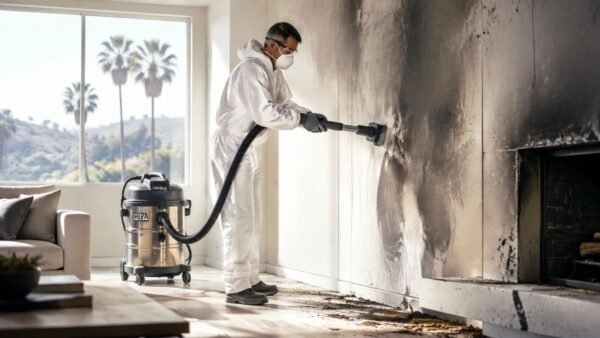
- Fire and Lightning: This is the cornerstone of property insurance. It covers damage not just from the flames themselves, but also from the resulting smoke, soot, and even the water damage caused by firefighters putting out the blaze.
- Windstorms and Hail: Damage from powerful winds tearing off roof shingles or hail battering your siding is typically covered. If a fierce Santa Ana wind gust sends a tree crashing onto your roof in Sherman Oaks, your policy is designed to step in.
- Explosions: This covers disasters like a natural gas leak triggering an explosion that compromises your home's structure.
- Theft and Vandalism: If your home is burglarized or intentionally damaged, your policy helps pay to replace stolen belongings and repair the property itself.
- Falling Objects: This applies when things like large tree branches or even debris from a neighbor's construction project fall and damage your home.
This foundational coverage also extends to protecting you legally. Your policy almost always includes detailed premises liability insurance coverage to defend you against claims if someone gets hurt on your property.
Key Takeaway: The single most important factor for a successful claim is proving the damage was not the result of neglect or pre-existing issues. An old, leaky faucet that slowly rots the cabinet underneath is a maintenance problem; a supply line that suddenly bursts and floods the kitchen is a covered emergency.
Knowing the difference is everything. You can get a much clearer picture by digging into what a typical homeowners insurance policy details. This knowledge empowers you to act fast and, more importantly, to call a professional restoration company immediately to document the "sudden and accidental" nature of the damage.
Quick Guide to Common Perils and Your Coverage
Navigating what is and isn't covered can feel confusing. This table breaks down some of the most common events homeowners face and what you can generally expect from your insurance.
| Type of Damage | Typically Covered by Standard Policy? | Common Exclusions or Special Requirements |
|---|---|---|
| Fire & Smoke | Yes | Arson by the homeowner is excluded. |
| Wind & Hail | Yes | Some coastal areas may have higher deductibles or specific exclusions for hurricanes. |
| Sudden Water Damage | Yes | Damage must be from an internal source (e.g., burst pipe, appliance malfunction). |
| Theft & Vandalism | Yes | Excludes theft by a resident of the household. |
| Flood | No | Requires a separate policy from the National Flood Insurance Program (NFIP) or a private insurer. |
| Earthquake | No | Requires a separate earthquake insurance policy or endorsement. |
| Sewer Backup | No | Typically requires a specific add-on (endorsement) to the main policy. |
| Gradual Wear & Tear | No | Considered a maintenance issue (e.g., old roof, slow leaks). |
| Mold | It's Complicated | Covered only if it's the direct result of a covered peril (like a burst pipe). |
Remember, this is a general guide. The language in your specific policy is what ultimately matters, so it always pays to review the fine print or talk to your agent.
Breaking Down Your Coverage: Dwelling, Belongings, and Living Expenses
Think of your property insurance policy less like a single, giant safety net and more like a well-stocked emergency kit. It’s a bundle of specific protections, each designed for a different job. Knowing what’s inside—often labeled with codes like "Coverage A" or "Coverage C"—is the key to understanding what help you’ll get when disaster strikes.
At its heart, your policy is built to cover three critical areas: the structure of your home itself, all the stuff you own inside it, and the extra costs you face when you can’t live there during repairs. Each piece plays a vital role in getting you back on your feet.
Coverage A: Dwelling Protection
This is the absolute foundation of your homeowner's insurance. Coverage A (Dwelling) is all about repairing or rebuilding the physical structure of your house. It covers the bones of your home.
This includes the big, essential stuff:
- The foundation, walls, and roof.
- Built-in systems like your plumbing, electrical wiring, and HVAC.
- Anything attached to the house, like a connected garage or a deck.
So, if a kitchen fire in your Burbank home scorches the walls, cabinets, and wiring, your Dwelling coverage is what pays for the professional restoration to put it all back together. It’s designed to return your home to the way it was before the loss.
Coverage C: Personal Property Protection
While Dwelling coverage handles the house, Coverage C (Personal Property) takes care of everything inside it. This is the part of your policy that helps you replace your belongings if they’re ruined by a covered event like a fire, theft, or a burst pipe.
This protection applies to a huge range of items, from your sofa and TV to your clothes and kitchen gadgets. One important heads-up: most policies have special, lower limits for high-value things like jewelry, art, or rare collectibles. You’ll likely need a separate add-on, or "rider," to get full protection for those.
The chart below does a great job of showing how policies separate the standard coverage from common exclusions.

As you can see, there's a clear line. Things like fire are almost always covered, while major events like floods are almost always excluded, requiring their own dedicated policies.
Coverage D: Loss of Use
This might be one of the most important—and most overlooked—parts of a policy. Coverage D (Loss of Use), sometimes called Additional Living Expenses (ALE), is your financial lifeline when a covered disaster makes your home unlivable.
It’s designed to pay for the reasonable increase in your day-to-day costs to maintain your normal standard of living.
Key Insight: Loss of Use isn't just for a hotel bill. It can cover restaurant meals when you don’t have a kitchen, laundry services if your machines are gone, and even fees to board your pets while you're displaced.
The sheer scale of property damage claims can be staggering. To give you an idea, in 2025, global insured losses from natural catastrophes shot past $100 billion in the first half of the year alone, with California wildfires being a major driver. The Insurance Information Institute also points out that around 93% of U.S. homeowners policies are HO-3 forms, which give you that strong "open peril" coverage on the dwelling itself. You can dig into these trends and their market impact by checking out the global market overview from Aon. Numbers like these really highlight how critical Loss of Use coverage becomes when a major event forces you out of your home.
Navigating Water Damage: Leaks, Bursts, and Exclusions
Water damage is, without a doubt, one of the most common—and most confusing—claims a property owner will ever file. When you find water pooling where it shouldn't be, the first question is always: what does property insurance cover? The answer almost always boils down to one critical distinction: was the cause sudden and accidental, or was it gradual and preventable?
This one factor is the pivot point between a straightforward claim and an immediate denial.

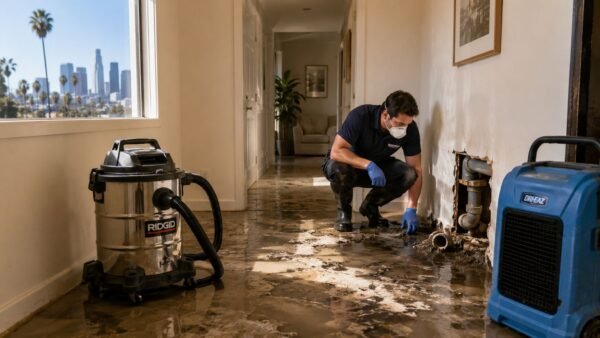
Let's paint a picture. Imagine a supply line to your dishwasher suddenly bursting, sending water gushing across your Beverly Hills kitchen. This is the textbook definition of a covered event. The damage was immediate, completely unexpected, and came from a system failure inside your home. In this case, your policy is designed to step in and cover the costs of water extraction, professional drying, and repairing the soaked floors, cabinets, and drywall.
Now, picture the opposite: a tiny, slow leak under a bathroom sink that goes unnoticed for months. That slow drip eventually leads to rotted wood, spreading mold, and crumbling drywall. An insurer looks at this and sees gradual damage that could have been prevented with routine maintenance. They consider it an upkeep issue, not an accident, and will almost always deny the claim.
The Critical Difference Between Water and Flood Damage
Here’s where many property owners get tripped up. In the insurance world, "water damage" and "flood damage" are two completely different things, and they are not interchangeable.
- Water Damage: Think of this as water originating inside your house. It’s the burst pipes, overflowing washing machines, and failed water heaters. Your standard property insurance policy is built to cover these kinds of internal, accidental mishaps.
- Flood Damage: This is water that comes from a natural source and enters your property from the outside. We're talking about overflowing rivers, storm surges, or heavy rains that saturate the ground and seep into your foundation. Your standard property insurance policy does not cover this.
Essential Fact: To be covered for flood damage, you need a completely separate policy, usually purchased through the National Flood Insurance Program (NFIP) or a private flood insurer. Without it, you are 100% on the hook for any damage caused by natural flooding.
The Sewer Backup Endorsement: A Must-Have Add-On
Just like flooding, damage from a sewer or drain backup is another major exclusion in a standard policy. If a city sewer line clogs and sends wastewater pouring back into your home, the staggering cleanup and repair costs fall squarely on you—unless you have a specific add-on. This is called an endorsement or a rider.
This "water backup" coverage is a relatively inexpensive but absolutely vital addition to your policy. Without it, you could be facing tens of thousands of dollars in restoration bills for something that was completely out of your control. Adding this endorsement is one of the smartest, most proactive moves a property owner can make. In fact, understanding if homeowners insurance covers water damage in all its forms is crucial.
The financial stakes here are incredibly high. With home insurance premiums in California jumping over 31% since 2019, it’s more critical than ever to know exactly what you’re paying for. Water claims now account for over 23% of all homeowner claims nationally, with the average incident costing a shocking $12,000. And considering that sewer issues impacted roughly one in every 50 insured homes annually before 2025, verifying you have a 'water backup' endorsement isn’t just smart—it’s essential.
Fire, Smoke, and Mold: What Property Insurance Covers in Complex Disasters
When disaster strikes, it rarely sticks to one type of damage. A fire isn’t just about what burns; it’s about the smoke that seeps into every corner. A leak isn't just a puddle; it’s a potential breeding ground for mold. Knowing what does property insurance cover in these messy, layered situations is the key to a full recovery.
Fire is the classic disaster, a core peril covered by just about every standard property insurance policy you'll find. But the coverage is much deeper than just rebuilding what the flames touched.

Unpacking Your Fire and Smoke Damage Coverage
When you file a claim after a fire, your policy is built to handle the entire mess. It accounts for not just the visible charring but all the secondary effects that make a space unlivable.
Your insurer should cover:
- Structural Repairs: This is the big one—rebuilding or fixing walls, roofs, floors, and any other part of the structure damaged by the fire.
- Smoke and Soot Cleanup: Smoke isn’t just a smell; its particles leave behind a grimy, acidic film on everything. Your policy should pay for pros to come in and get rid of it.
- Professional Deodorization: That lingering smoke odor won't go away with an open window. Getting it out requires special equipment like thermal foggers or ozone generators, which is a standard part of a fire restoration claim.
- Damage from Firefighting Efforts: The water and chemicals sprayed by the fire department can cause a ton of secondary damage. Because it happened as a direct result of a covered fire, your policy is on the hook for these repairs, too.
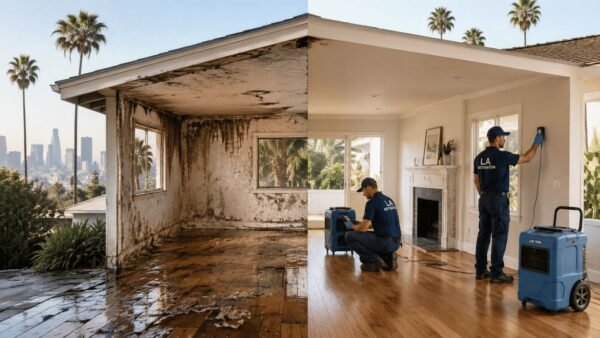
The whole point is to bring your property back to its pre-loss condition, which means tackling every single layer of damage the fire left behind. You can check out our guide on how homeowners insurance covers fire damage to dig deeper into the specifics.
Mold: The Conditional Coverage Problem
Here’s where things get tricky. Unlike fire, mold coverage isn't a given. It’s almost always conditional, meaning it all comes down to why the mold started growing in the first place.
Key Rule: Your property insurance will only cover mold remediation if the mold is a direct consequence of a covered peril.
Think of it this way: if a pipe bursts (a covered water event) and mold starts growing on the damp drywall before it can be properly dried out, the cost to remove that mold is usually covered. It's considered part of the original water damage claim.
But if mold appears because of a slow, dripping faucet you never fixed or from constant high humidity in your coastal Santa Monica home, your insurer will almost certainly deny the claim. They see that as a maintenance problem, not a sudden, accidental event.
This is why an immediate, professional response to any water intrusion is so important. If you wait, you’re not just letting mold spread—you could be giving your insurance company a reason to deny coverage for the cleanup.
The financial stakes here are huge. Across the U.S., mold-related claims cost a mind-boggling $3.5 billion every year. Because of this risk, most standard policies put a low cap on mold payouts, often just $10,000 to $50,000. This is why many property managers get specific mold endorsements. To have a shot at a successful claim, you need bulletproof documentation—inspections, testing, and proof of professional containment—to restore air quality and protect everyone involved.
A Step-by-Step Guide to Filing Your Property Damage Claim
Knowing what your insurance policy says is one thing. Knowing what to do when water is actively pouring through your ceiling is another thing entirely.
When disaster strikes, how you act in those first few hours can make or break your insurance claim. A fast, smart response can mean the difference between a smooth process and a frustrating denial. This guide will walk you through the exact steps to take, giving you a clear roadmap when you're stressed and overwhelmed.
Step 1: Secure the Property Immediately
First things first: safety and damage control. Before you do anything else, your top priority is to prevent the situation from getting any worse. In the insurance world, this is called mitigating your damages, and it’s a non-negotiable part of your duties under the policy.
What does this look like in the real world?
- A pipe bursts? If it's safe, find and shut off your home's main water valve. Fast.
- A storm shatters a window or rips a hole in the roof? Get it boarded up or covered with a tarp to keep the elements out.
- Water flooding the living room? Move your furniture, electronics, and valuables to a dry area.
If you don't take these common-sense steps, an insurance carrier could argue that any subsequent damage—like mold that grows a week later—was your fault, not part of the original event.
Step 2: Document Everything Relentlessly
Put on your detective hat. Before a single thing is moved, cleaned, or thrown away, your smartphone becomes your most important tool. Thorough documentation isn't just a good idea; it's your primary evidence.
Take more photos and videos than you think you need. Get wide shots to show the overall scope of the mess, then get close-ups of the ruined drywall, the warped flooring, and the soaked belongings.
Crucially, don't just document the damage. Try to document the source. Get a clear shot of the split washing machine hose or the cracked pipe under the sink. This visual proof is the foundation of your claim.
Step 3: Call a Certified Restoration Company
This is the step most people get wrong, but it’s arguably the most critical. Before you even dial your insurance agent, call a 24/7 professional restoration company like Onsite Pro Restoration.
Why? A certified pro does three things for you that an insurance company simply can't:
- Immediate Mitigation: They have the trucks and equipment to start extracting water and setting up drying equipment right away. This is what stops secondary damage like mold from ever getting a foothold.
- Expert Documentation: They don't just take pictures. They use professional tools like thermal imaging cameras and moisture meters to create a scientific, data-driven record of the damage that adjusters understand and respect.
- Advocacy on Your Behalf: They speak the same language as the insurance adjuster. They know how to document the loss properly and ensure nothing gets missed. Having a professional in your corner from minute one is a huge advantage.
To get the best possible outcome, it helps to master the home insurance claim process and understand your rights.
Step 4: Notify Your Insurance Carrier
With the property secure and a professional team on-site stopping the damage, now it’s time to officially open the claim. Call the claims hotline for your insurance provider, get your claim number, and get an adjuster assigned.
Give them a clear, factual account of what happened, sticking to what you documented.
Key Distinction: Remember, your restoration contractor works for you. Their goal is to restore your home to its pre-loss condition. The insurance adjuster works for the insurance company. Their job is to evaluate the loss based on the fine print in your policy.
A great restoration partner will communicate directly with the adjuster, handing over all the documentation and moisture readings needed to justify the work. This partnership is essential for getting things approved without delay. If you're dealing with a particularly tricky situation, it helps to read up on the specifics of the insurance claim process for water damage.
How a Restoration Pro Can Maximize Your Insurance Claim
Knowing what your insurance policy says is one thing. Actually getting the full value of your claim paid out is another game entirely. This is where a professional restoration company becomes your most powerful asset, transforming from a cleanup crew into a strategic partner in your recovery.
Hiring an IICRC-certified team isn't just about getting the work done; it’s a decision that directly influences the final dollar amount of your claim and how quickly your property gets back to normal.
Providing the Hard Evidence Insurers Need
Think of it from the insurance company's perspective: their job is to pay out exactly what the policy requires, based on documented, verifiable proof. A top-tier restoration team speaks their language by providing exactly that—indisputable evidence.
When our experts show up, we’re not just sucking up water or wiping away soot. We are meticulously building the case for your claim with scientific data.
This isn't just guesswork. It's a precise process:
- Moisture Mapping: We use thermal imaging cameras and sensitive moisture meters to create a detailed map of exactly where water has gone. This uncovers hidden moisture behind walls or under floorboards, proving the full scope of the water damage.
- Psychrometric Readings: This is the science of drying. By tracking temperature and humidity levels, we can provide hard data that justifies the specific type and amount of drying equipment needed to stop mold before it even starts.
- Photo and Video Logs: A picture is worth a thousand words, and a detailed visual log is priceless in a claim. We document everything, from the initial disaster to the final touches, leaving zero room for an adjuster to question the reality of the situation.
This level of professional documentation turns a vague statement like "it's really wet in here" into a data-driven report that an adjuster can't ignore. It gives them the concrete proof they need to approve the work without all the frustrating back-and-forth.
Your Expert Advocate in a Complex Process
Trying to manage a major fire, water, or mold claim on your own can feel like you’re in over your head. A restoration pro is your guide and advocate through the entire maze, making sure every "i" is dotted and every "t" is crossed.
Here’s the bottom line: A professional restoration company works for you, not the insurance company. Our job is to restore your property to its pre-loss condition based on industry standards, and all our documentation is designed to justify that work.
Your partner in restoration provides 24/7 emergency response to stop the damage from getting worse—which, by the way, is your duty as a policyholder. We also handle direct insurance billing, which takes the financial and administrative headache completely off your plate.
From a burst pipe in Burbank to a smoke-filled home in West Hollywood, we are the first call you should make. We protect your property’s value, deliver peace of mind, and ensure your knowledge of what property insurance covers actually leads to a successful recovery. You can learn more about how a certified restoration professional can streamline this entire journey for you.
FAQs: Answering Your Top Los Angeles Property Insurance Questions
Property insurance can feel like a maze, especially when you're dealing with the kind of curveballs Los Angeles weather and infrastructure can throw at you. Here are answers to the most common questions we hear from homeowners trying to make sense of their policies.
Q: Is a leaky roof in Los Angeles covered by insurance?
A: It depends entirely on the cause. If a sudden storm ripped shingles off your roof, leading to a leak, the resulting water damage inside your home is almost always covered. That’s a classic “covered peril.” However, if the leak is from a roof that’s just old, worn out, and hasn't been maintained, your claim will likely be denied. Insurers see that as a homeowner’s maintenance responsibility, not a sudden event.
Q: Will my rates go up if I file one water damage claim?
A: Filing a single claim won't automatically raise your rates, but it is a possibility. Insurance carriers assess risk, and while one claim might not move the needle much, filing several claims in a few years is a red flag. If the repair cost is only slightly more than your deductible, it may be smarter to pay out-of-pocket to protect your claims history and avoid a potential premium hike.
Q: What’s an insurance endorsement, and do I really need one?
A: An endorsement (or rider) is an affordable upgrade to your standard policy that plugs a specific coverage gap. For Los Angeles property owners, the sewer and water backup endorsement is essential. Without it, if a city sewer line backs up into your home, you are responsible for the entire messy and expensive cleanup. It's a small cost for critical protection.
Q: How does my deductible actually work on a claim?
A: Your deductible is your share of the repair cost. It's the amount you must pay before your insurance company's coverage kicks in. For example, if a kitchen fire causes $20,000 in covered damage and you have a $2,500 deductible, you pay the first $2,500, and your insurer covers the remaining $17,500. Choosing a higher deductible lowers your annual premium, but means you'll pay more upfront when filing a claim.
When disaster strikes, you need a team you can trust to get your life back on track—fast. For 24/7 emergency response and expert restoration services across Los Angeles, call the IICRC-certified professionals at Onsite Pro Restoration. We manage the entire process, from water removal to working with your insurance adjuster, so you can focus on what matters most.
Get a Free Damage Assessment Now