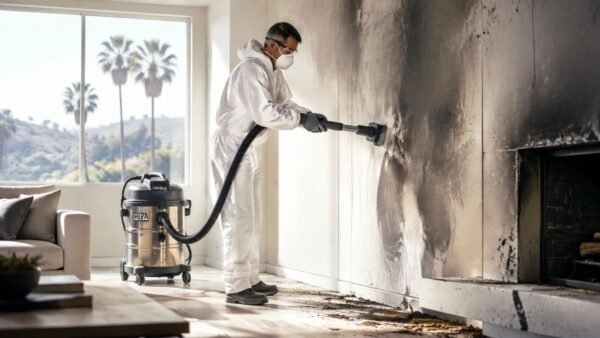

When disaster strikes your Los Angeles home, the first question on your mind is the most important one. So, does homeowners insurance cover fire damage?
The short answer is a reassuring yes. Standard homeowners insurance policies are built to cover accidental fire damage. In fact, fire is considered a foundational "covered peril" in almost every policy out there. Whether it's a kitchen fire in a Sherman Oaks condo or damage from a wildfire event in the hills, your policy is designed to be your financial backstop.
Does homeowners insurance cover fire damage? Yes, Your Policy Almost Certainly Covers It

Think of your homeowners policy as a financial safety net designed specifically for devastating events like a fire. Whether it was sparked by a lightning strike, a cooking mishap, or faulty wiring in an older home, your policy is structured to help you get back on your feet.
This is the core reason homeowners insurance exists in the first place. Fire is one of the most common and destructive risks a home can face. According to the Insurance Information Institute (III), about one in 430 insured homes in the U.S. files a property damage claim related to fire and lightning each year. You can explore more data on homeowners insurance claims to get a clearer picture of the risks.
The Three Pillars of Fire Protection
Your policy’s response to a fire isn't just one lump sum of cash. It’s a coordinated effort involving several types of coverage that work together. This support rests on three main pillars that form the backbone of your recovery.
Here’s a quick overview of how these coverages work together after a fire.
Standard Fire Damage Coverage At a Glance
| Coverage Type | What It Covers | Example in Los Angeles |
|---|---|---|
| Dwelling Coverage | The physical structure of your home, including walls, roof, and foundation. | Rebuilding a section of your house in the Valley that was burned or repairing smoke damage to the walls. |
| Personal Property | Belongings inside your home, like furniture, electronics, and clothing. | Replacing a couch, television, and wardrobe destroyed by the fire and smoke. |
| Additional Living Expenses (ALE) | Temporary housing and related costs if your home is unlivable. | Paying for a hotel or short-term rental in a nearby neighborhood, plus extra meal costs, while your home is repaired. |
These three components are designed to make you whole again after a devastating fire. In the sections that follow, we'll dive into the crucial details of how each coverage works, what your policy likely doesn't cover, and how to navigate the claims process for the best possible outcome.
Understanding Your Fire Damage Coverage in Detail
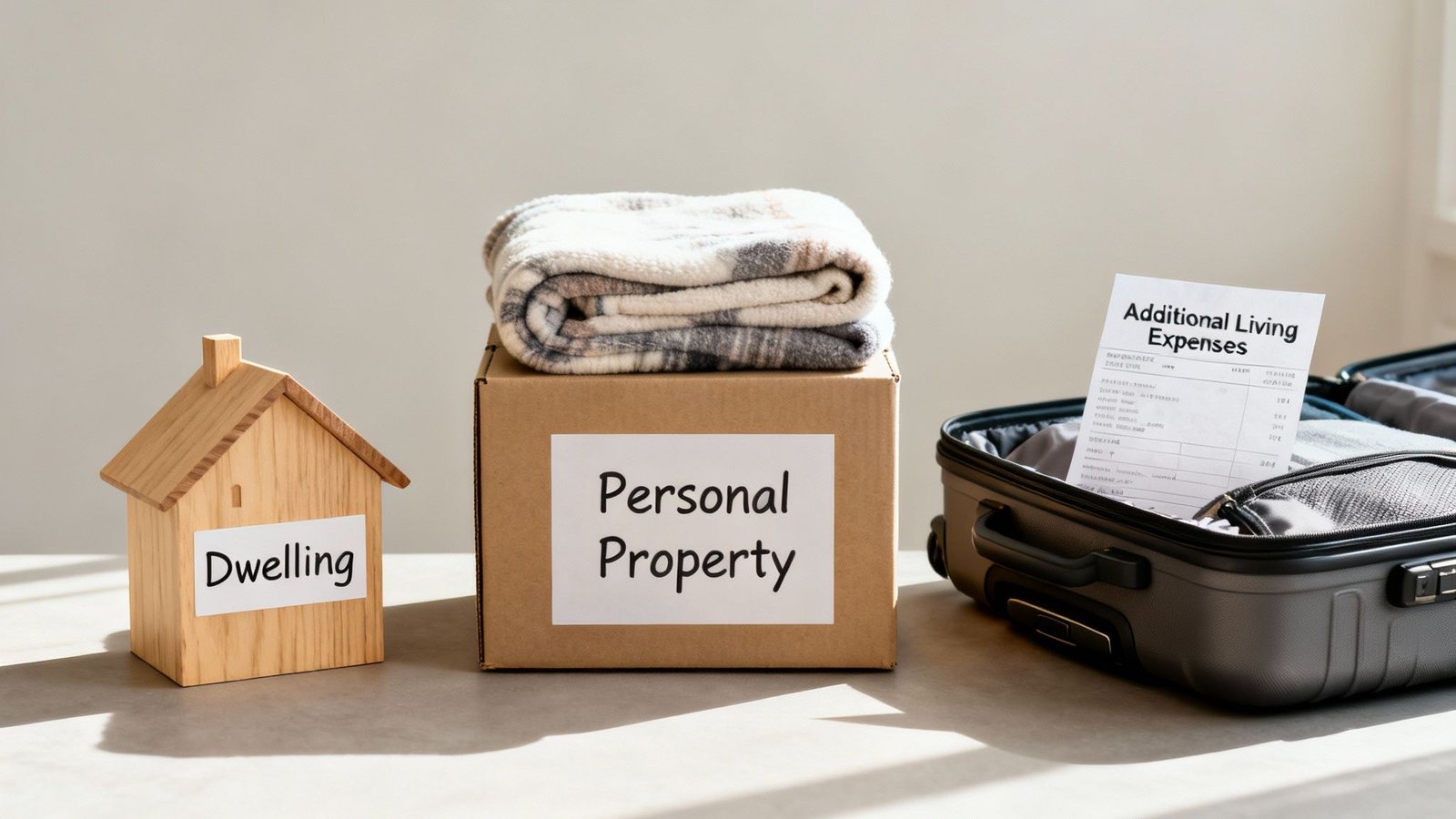
Knowing your policy covers fire damage is a good start, but understanding how it covers you is what makes all the difference when disaster strikes. A standard homeowners policy isn’t just one big pot of money; it's broken down into specific coverages, and each one has a very distinct job to do. Let's pull them apart to see how they work together to get you back on your feet.
Think of your policy as a team of specialists. Each specialist is responsible for a different part of the loss, ensuring everything from the roof over your head to the clothes on your back is accounted for.
Dwelling Coverage: The Foundation of Your Rebuild
This is the absolute core of your policy after a fire. Dwelling Coverage (Coverage A) is what pays to repair or rebuild the physical structure of your home. We're talking about the foundation, walls, roof, and all the built-in systems like your plumbing and electrical wiring.
Your dwelling coverage limit needs to be high enough to completely rebuild your home from scratch at today's costs—not what it was worth on the market. After a major event, the cost to rebuild a home in Los Angeles can skyrocket, often ending up much higher than what you originally paid for it.
Other Structures Coverage: Beyond Your Main House
Fires don’t always stay neatly contained within the four walls of your house. Other Structures Coverage (Coverage B) is there to protect the standalone structures on your property that aren't attached to the main home.
This coverage typically includes things like:
- Detached garages
- Sheds or workshops
- Fences
- Gazebos or pergolas
This bucket of money is usually set at 10% of your dwelling coverage limit, giving you a crucial financial buffer for other valuable parts of your property.
Personal Property Coverage: Replacing Your Belongings
While the house is the structure, your belongings are what make it a home. Personal Property Coverage (Coverage C) is designed specifically to help you replace all the items you lost or that were damaged in the fire. This covers everything from your couch and TV to your clothes and kitchenware.
Key Insight: Taking the time to create a detailed home inventory before a disaster ever happens is one of the most powerful things you can do for a smooth claims process. A simple list with photos and receipts can save you an incredible amount of stress and helps ensure you get every dollar you're entitled to.
Additional Living Expenses (ALE): Your Lifeline When Displaced
If a fire makes your home unlivable, where are you supposed to go? This is where Additional Living Expenses (ALE), or Coverage D, becomes your financial lifeline. It covers the extra costs you rack up while living somewhere else as your home is being repaired. To get a deeper look at how these pieces fit together, you can explore our detailed guide to the standard homeowners insurance policy.
ALE is designed to cover expenses above and beyond your normal household budget, such as:
- Hotel bills or the cost of a short-term rental
- Restaurant meals if you don't have access to a kitchen
- Laundry services
- Fees for boarding your pets
This coverage makes sure your life can continue with as little financial disruption as possible while your home is being put back together.
Navigating Common Exclusions and Policy Limits
While your homeowners policy is your first line of defense after a fire, it’s not a blank check. Every policy comes with a set of rules—known as exclusions and limits—that draw a clear line around what’s covered. Understanding these boundaries before a disaster can save you from a huge financial shock during an already painful time.
Think of it like a car warranty. The manufacturer will cover a faulty engine, but they won’t pay to fix damage you caused by neglecting oil changes or driving it into a wall. Insurance works the same way, with specific rules to protect against fraud and unmanageable risk.
Intentional Acts and Arson
This one is pretty straightforward. If you or someone else on your policy intentionally sets a fire, the claim will be denied flat out. Insurance companies bring in investigators to determine the cause of every fire. If they find evidence of arson, not only is there no payout, but criminal charges are almost guaranteed.
Insurance is designed to cover accidents and unforeseen events, not deliberate destruction.
Issues Arising from Vacancy and Neglect
Insurers get nervous when a home sits empty for too long. If your house has been vacant for an extended period—usually more than 30 or 60 days—your policy might not cover fire damage. Why? An unoccupied home is a magnet for vandals, and small issues like a frayed wire can turn into a catastrophe with no one around to notice.
Important Takeaway: If you know your home will be vacant for a while, call your insurance agent. You may need to add a special endorsement to keep your fire coverage active and avoid a claim denial that could cost you everything.
Simple neglect can also sink a claim. Let's say a fire starts because of a faulty electrical panel you knew about but never bothered to fix. The insurer could argue that your negligence caused the loss and refuse to pay. This principle also applies to secondary damage; for example, understanding if mold remediation is covered by insurance often comes down to whether the initial water damage was sudden and accidental or the result of a long-ignored leaky pipe.
Policy Sub-Limits for High-Value Items
Even when a fire is fully covered, your personal property protection isn't unlimited. Standard policies place specific dollar caps, called sub-limits, on certain categories of expensive items that are easily stolen or have a high concentration of value.
Here are a few common examples:
- Jewelry and Furs: Often capped at a total of $1,500 for all your items combined.
- Firearms: Coverage might be limited to around $2,500.
- Fine Art and Antiques: These almost always need a special appraisal and a separate policy rider.
If your jewelry collection or fine art is worth more than these standard limits, you absolutely need to purchase extra coverage. This is typically done through a "rider" or "floater" that insures these items for their full, appraised value.
How Your Fire Insurance Claim Payout Is Calculated
Knowing how the numbers work is the key to managing your financial recovery after a fire. Once your claim gets the green light, the payout isn't just some random figure. It’s a number crunched from the specific terms you agreed to when you bought your policy.
The first number you'll bump into is your deductible. Think of it as your share of the cost—the amount you have to pay out of pocket before the insurance company starts writing checks. If you have a $2,000 deductible and $80,000 in covered fire damage, you’ll handle the first $2,000, and your insurer will cover the remaining $78,000.
Replacement Cost vs. Actual Cash Value
Beyond the deductible, the single most important factor shaping your payout is whether your policy is based on Replacement Cost Value (RCV) or Actual Cash Value (ACV). This one detail can mean a difference of tens of thousands of dollars. The distinction is simple but has a huge impact.
Replacement Cost Value (RCV): This is the gold standard. It pays to replace your damaged property with brand-new items of similar kind and quality, with no deduction for age or wear and tear.
Actual Cash Value (ACV): This only pays what your property was worth the moment before the fire, which means it accounts for depreciation. In other words, you get paid for your used stuff, not new stuff.
Let's make this real. Imagine a fire destroys your five-year-old sofa. You paid $1,500 for it back then, but a comparable new one today costs $1,800.
With an ACV policy, the insurer might say that after five years of use, your sofa was only worth $500. That’s all you’d get. But with an RCV policy, you’d get the full $1,800 you need to head to the store and buy a new one. This same logic applies to everything—your roof, your TV, and even the framing of your house.
Below is a simple breakdown showing how these two coverage types play out financially for that same sofa.
Actual Cash Value vs Replacement Cost
| Factor | Actual Cash Value (ACV) | Replacement Cost (RCV) |
|---|---|---|
| Original Purchase Price | $1,500 | $1,500 |
| Current Replacement Price | $1,800 | $1,800 |
| Depreciation (5 years) | -$1,300 | $0 |
| Final Payout | $500 | $1,800 |
As you can see, the difference is stark. While ACV policies almost always have cheaper premiums, they leave a massive gap you have to fill yourself.
Crucial Takeaway: ACV policies might save you a little on premiums, but RCV coverage provides far better financial protection. The whole point of insurance is to make you whole again, and RCV is the most direct way to get there after a devastating fire.
The Growing Role of Insurance in Modern Disasters
Having a solid fire damage policy is more critical than ever, especially in California. In a recent year, global climate-related events racked up $162 billion in economic losses. The good news? Uninsured losses dropped to a record low of 38%, a huge improvement from the 21st-century average of 69%.
This shift was largely because U.S. insurance carriers absorbed over 90% of the $100 billion in insured losses worldwide. U.S. wildfires alone caused $53 billion in total damages, with $40 billion of that covered by insurance. This really highlights how robust coverage is the buffer between a disaster and total financial ruin.
Getting a handle on these financial mechanics is vital for setting realistic expectations as you move forward. To see how all this fits into the bigger picture, check out our guide on the typical insurance claim timeline.
A Step-By-Step Guide to Filing Your Fire Damage Claim
The minutes and hours after a fire are a blur of shock, stress, and confusion. It’s an overwhelming experience, but the actions you take right away are absolutely critical for a smooth insurance claim. Now that you know the answer to "does homeowners insurance cover fire damage?" is almost always yes, here's a clear roadmap to navigate the process.
Step 1: Contact Your Insurance Company Immediately
After making sure everyone is safe, your very next call should be to your insurance company. The sooner you report the fire, the faster an adjuster gets assigned to your case. This single phone call starts the clock on everything—from securing your property to getting you set up with additional living expenses if your home isn't safe to live in.
Step 2: Document Everything Before Touching Anything
I can't stress this enough: fight the urge to clean up or move things around. Before a single item is touched, you need to become a detective. Grab your smartphone and take exhaustive photos and videos of every single room that was affected, shooting from multiple angles.
Get up close and capture the details:
- Structural damage to walls, ceilings, floors, and windows.
- The layer of soot and smoke residue coating every surface.
- Ruined furniture, melted electronics, and other damaged personal items.
- The source of the fire, but only if it's clearly visible and safe to approach.
This visual record is your single most powerful piece of evidence. It’s undeniable proof of your loss that will be invaluable for the claims adjuster. A professional team can also help with this crucial first step; our guide on the fire damage restoration service process explains how experts document damage specifically for insurance claims.
Step 3: Create a Detailed Home Inventory
Next comes the tough part: making a list of everything that was damaged or destroyed. Try to go room by room and jot down every single item you can think of. For each one, include its brand, model number, approximate age, and what you originally paid for it, if you can recall. This detailed inventory is what the adjuster uses to calculate the payout for your personal belongings.
This visual shows the simplified flow from filing your claim to receiving a payout after your deductible is met.
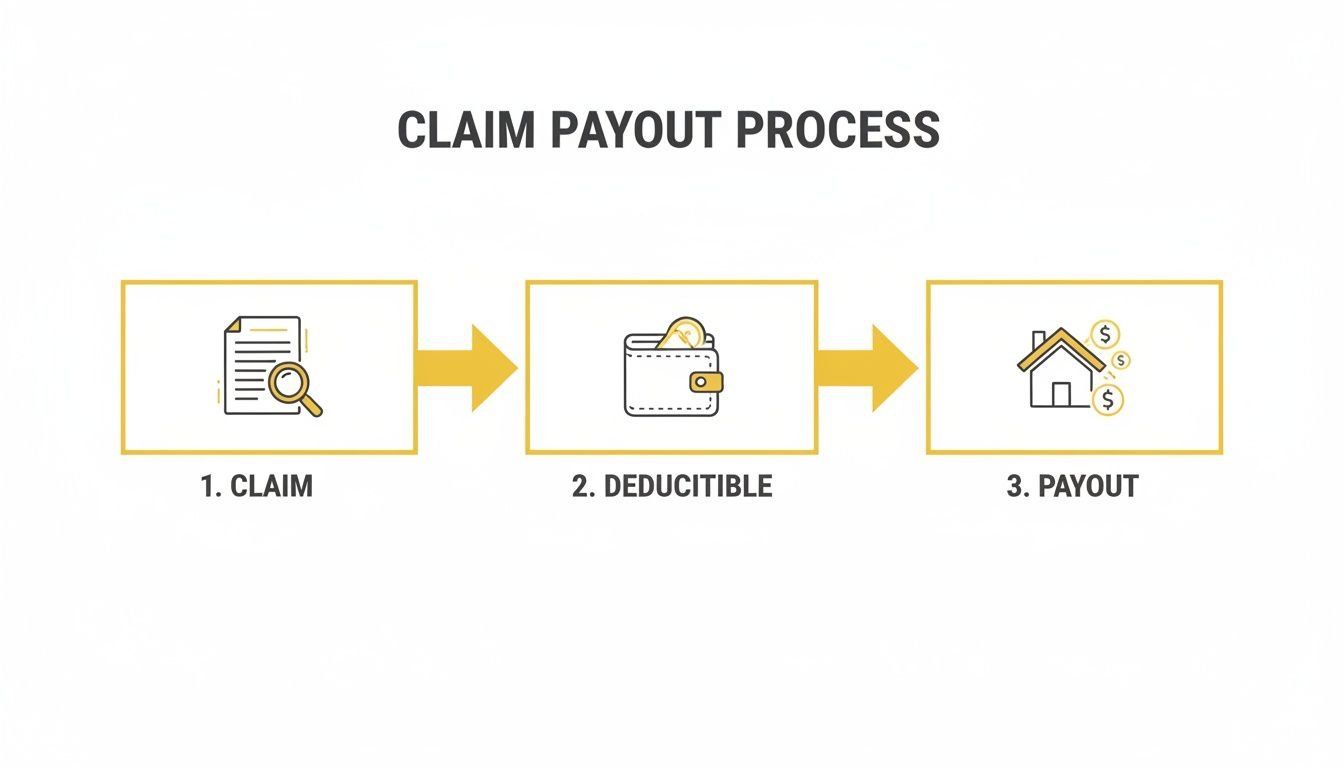
Understanding this sequence helps you anticipate the financial steps involved in your recovery.
Step 4: Meet with the Claims Adjuster
Your insurance company will send a claims adjuster to inspect the damage in person. Make sure you are there for this meeting. Use your photos and inventory list to walk them through the property, pointing out specific areas of loss. Be prepared to answer their questions honestly and provide all the documentation you’ve gathered.
Pro Tip: Start a dedicated folder or binder for everything related to your claim. Keep every receipt for temporary lodging, meals, clothing, and any emergency repairs you were authorized to make. Staying organized will be your best friend during this stressful time.
Once your fire damage claim is approved and it’s time to rebuild, make sure you know the crucial questions to ask a general contractor before signing any contracts. Following these steps helps you stay in control of the process and puts you in the best position for a fair and successful outcome.
Proactive Steps to Maximize Your Fire Coverage
The absolute best time to think about your fire insurance is long before you ever see a wisp of smoke. Shifting from a reactive to a proactive mindset is the single most powerful thing you can do to protect your home and your financial future. It’s all about taking small, deliberate actions today to make sure your safety net is strong enough to catch you after a disaster.
One of the most critical steps is to review your policy limits regularly, especially your dwelling coverage. After a major home renovation or in a fast-moving real estate market like Los Angeles, the cost to rebuild your home can easily climb past your coverage limit, leaving you with a massive gap to pay out-of-pocket.
Strengthen Your Claim Before It Happens
Creating a home inventory is a simple but incredibly powerful strategy. Just walk through your home with your smartphone, recording video and taking plenty of photos of everything you own. For bigger items like electronics and furniture, jot down the brand, model, and roughly when you bought it.
Store this digital inventory securely in the cloud. If the worst happens, this file becomes invaluable proof for your claims adjuster. It simplifies the entire process and helps ensure you’re fairly compensated for what you've lost. This small effort can save you an immense amount of stress and prevent frustrating delays.
Special Considerations for High-Risk Areas
The growing need for solid fire damage policies is clear when you look at the numbers. The fire insurance market, initially valued at USD 96.16 billion, is projected to skyrocket to USD 262.17 billion by 2034. North America holds a dominant 41% share of this market, largely due to regional risks like the wildfires common in Southern California.
For homeowners living in wildfire-prone zones, a standard policy often isn't enough. It's crucial to explore specialized policies or add endorsements that provide the protection you actually need.
To further reduce potential damage, consider incorporating durable and fire-resistant building materials, like fibre cement cladding, into your home's construction or next renovation. These proactive measures can significantly lower your risk. If you need expert advice on reinforcing your home or restoring it after an incident, our team of certified restoration pros can provide clear, actionable guidance.
FAQs About Homeowners Insurance and Fire Damage
Q: What should I do first after a house fire in Los Angeles?
A: Your first priority is safety. Once everyone is accounted for and you are in a safe location, your next call should be to your insurance company to start the claims process immediately. This gets an adjuster assigned to your case and activates your Additional Living Expenses (ALE) coverage if you're displaced.
Q: What happens if my neighbor's fire spreads to my house?
A: Your first and only call should be to your own insurance company. File a claim with them immediately. Your policy is designed to cover your damages, regardless of where the fire started. Your insurer will handle the repairs and payments for you directly. Later, they might pursue your neighbor's insurance company for reimbursement through a process called subrogation, but that happens behind the scenes and won't delay your repairs.
Q: Is smoke and soot damage covered, even from a small fire?
A: Yes, absolutely. Smoke and soot are considered direct results of a fire, so damage from them is covered under a standard homeowners policy. This includes the cost of professional fire and smoke damage cleaning and deodorization services to remove stubborn residue and lingering smells from your home and belongings, which is often a major expense.
Q: Will my insurance premium go up after a fire claim?
A: It is very likely, yes. After you file a significant claim for something like fire damage, your insurer will probably see your property as a higher risk. When your policy comes up for renewal, you can expect your premium to increase to reflect that. However, this increase is minimal compared to the cost of covering a major fire loss out-of-pocket.
Q: Are fires caused by lightning strikes covered?
A: Definitely. In most standard homeowners policies, fire and lightning are listed together as a covered peril. Any damage from a lightning strike is covered, up to your policy limits and after your deductible. This includes the fire itself, fried electrical systems or appliances, and any structural damage from the initial impact.
When fire and smoke damage strikes your Los Angeles home, you need a team that can respond immediately and manage the cleanup with expertise. Onsite Pro Restoration offers 24/7 emergency fire damage restoration services to get your property back to pre-loss condition quickly and professionally. Get a Free Assessment Now.